



vodojem Něchov Technical monument
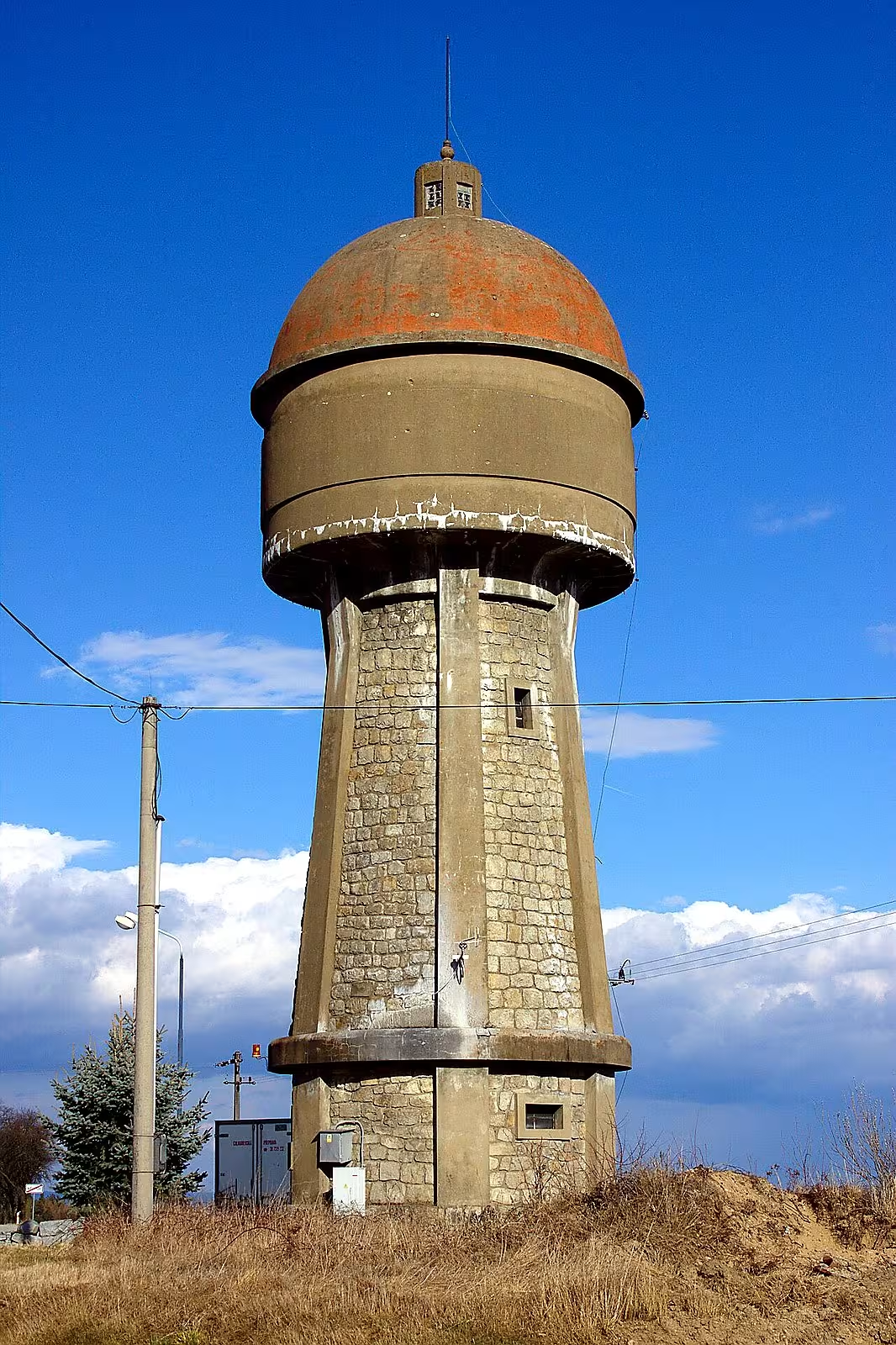
The water of Nechov is a tower of water in the eastern part of the village of Nekhov in the district of České Budějovice. The building was part of the besednik group water pipeline and was declared a cultural monument of the Czech Republic in 2012.
Besednik group water pipeline was established in the years 1924-1927. He used the spring on the slopes of Besednice Mountain and gravitatively brought water to the villages of Nekhov, Nebov, Besednice and Todna. Kress and Lanna Praha were involved in its construction; Total costs, including state subsidies, exceeded CZK 1.5 million. The construction of the water tower in Nechov was carried out by Lanna Praha in 1927 under the professional supervision of engineer Oldřich Leble. The design of water jams for this system was developed by engineer František Doskoš from Market Svins. The test operation started in August 1928 and the approval took place in May 1929.
Architecturally, it is a skeleton reinforced concrete structure on a 17-metre circular plan. The Skelet consists of six pillars operating from the outside as presses, which carry a cylindrical concrete reservoir with a diameter of 5 meters and a volume of 85 cubic metres. The tank is finished with a dome with lantern and luxury windows. The space between the pillars is lined with a treated stone. The lower part of the building is cylindrical and contains two windows and a metal entrance door. The upper part of the building ends with a simple concrete ledge followed by a cone segment with three windows (one of them was later covered). At the entrance there is a memorial plate and a mould with the inscription Lanna Praha 1927.
A major event occurred in the history of the building at the end of World War II, when it was damaged by bombardment in 1945. After the repairs were carried out, it was restarted in 1952.
This monument is an important example of the technical modernisation of infrastructure from the period between the two world wars. The unique skeleton design and historical significance make this water work an interesting target for interested in technical history.
Historical milestones
- 1927
- Construction of the water tower by Lanna Praha
- 1928
- Start of test operation
- 1929
- Collation
- 1945
- Bombing damage
- 1952
- Re-entry into service after repair
Architectural development
The construction is a skeleton reinforced concrete construction with six pillars. The space between the pillars is equipped with a treated stone. The upper part is finished with a concrete ledge and conical part with luxury windows.
Historical events
The construction of the water tower was completed in 1927. In 1945, the building was damaged by bombing. In 1952 it was restarted after repair.
Points of interest
- In 2012 the building was declared a cultural monument of the Czech Republic. - The construction of the water tower was carried out by Lanna Praha in 1927 under the professional supervision of engineer Oldřich Leble. - Architecturally, it is a skeleton reinforced concrete structure on a 17-metre circular plan. - At the end of World War II, the watercourse was damaged in 1945 by bombing. - The tank is finished with a dome with lantern and luxury windows.
Guide
Show guide text
This text was created by artificial intelligence and has not been editorially reviewed. It may contain inaccuracies.
Welcome to Peacock. You have just stopped at one of the most important technical structures in this area, and now that you have headphones in your ears, you can perceive it not only through your eyes, but through its deep history. You are standing right in front of a monumental tower, which, with its height of seventeen meters, sticks to the sky and in its circular form seems very harmonious, even though it is made of such a firm material. Feel the power emanating from this building. It is a work that is not just a simple technical object but a symbol of progress and the engineering courage of its time. Look up and watch how this high construction stands out against the sky. Its presence here is not random, it is evidence of an effort to modernise and secure the basic needs of the people.
Now let's go deeper into the past together to understand why this object is standing right here. The water in Nochov was not built as a separate building, but as a key and necessary element of the bohemian group water pipeline. Imagine the atmosphere of 1927, when major technical projects began to take place in this part of the country, which were meant to fundamentally change the lives of local people. It was this year that Lanna Praha started to build this water tower. The aim was to ensure a stable and reliable water supply to nearby municipalities, which was at that time one of the most important tasks for developing infrastructure and improving hygiene conditions. The construction started in 1928, when the test operation started to verify that the whole technique and pressure of water would function exactly as planned. It was only in 1929 that the construction was officially co-ordinated and fully started to serve its people.
Now pay attention to the architecture itself and to what you're seeing right now. If you look at the structure of this tower, you'll see something that was completely revolutionary at the time. It's a skeleton reinforced concrete structure on a circular plan. Feel the fascinating game between matter and space. Instead of being a closed, heavy khviiem, its skeleton form creates a more open and lighter impression, even though it is made of extremely solid reinforced concrete. This geometry, this circular shape, gives stability to the structure and also gives it aesthetic elegance. Feel the line of construction rising up and how this circular plan works with the surrounding space. It is a fascinating example of how new materials began to work in the first half of the 1920s and how engineering thought began to connect with modern architecture.
However, in order to fully understand the importance of this place, we need to look at the people behind this success. Behind this whole technical miracle were the great minds of the time. The architect František Doskok and engineer Oldřich Lebl designed architecture and technical solutions. It was the engineer Lebl who had expert supervision over the entire implementation, which was at that time absolutely essential to ensuring the quality of such demanding and precise work. These men were not just builders, they were visionaries, who had to calculate in every detail the strength of concrete and the stability of the entire 17-meter tower. Their names are now closely linked to this waterjet and their work is visible in every piece of this structure that has resisted the trials of time.
However, the history of this place has not always been about peaceful progress and technical perfection. If you look at the chronology of events, you'll see that this object has gone through some very difficult and dramatic times. After years of successful operation came 1945, which brought destruction to the whole country. Water was damaged as a result of the bombing. You can only imagine the uncertainty and concern about whether this symbol of modern engineering will ever be saved and whether it will only become a ruin. Fortunately, however, the resilience of this building and the efforts of people to save it have prevailed. After repairs and heavy repairs, the water line was successfully put into operation in 1952. This ability to survive the war and serve the community again gives this place special depth and weight.
It is interesting that this building was not only seen as an ordinary technical object for water supply. Its importance and architectural value were so high that in 2012 this building was officially declared a cultural monument of the Czech Republic. This is proof that even things that have been created with primary purpose as practical machines can acquire the status of artistic and historical jewels of our national heritage.
We hope that this view of the water in Pekhov has enriched you with new insights into the history of technical progress and that you have been able to imagine the people and events that have left their mark. Feel the beauty of this structure and its continuing strength. We thank you for your visit and wish you a pleasant rest of the tour around. Goodbye.
Tips for visitors
The best time to visit the water tower in Nochov is spring or autumn, when the weather is welcoming for a walk along the surrounding hills and vegetation on Besednik Mountain offers beautiful color contrasts. In summer it can be hot in the surroundings, therefore it is advisable to visit the memory early in the morning or late in the afternoon to make the light softer and the temperature more tolerable for field movement.
For a comfortable visit, wear fixed shoes suitable for uneven terrain, because access to both water and surrounding areas is not always reinforced. We recommend that you take with you enough drinking water, especially in the summer months, and a light snack if you plan to take a longer walk around Nechov and Nechov.
The water is ideal for photography thanks to its skeletal reinforced concrete structure, which is architectural interesting. The best light for shooting the tower is in the morning, when the sun lights up the structure from the side and creates interesting shadows. Try shooting from different angles, including a view from above from the surrounding heights, such as Besednik Mountain, where you can capture the water in the context of the landscape.
In the area, about 30 minutes by foot or by car, there are villages of Nekhov, Nebov, Besednice and Todna, which are suitable for short walks and exploring the local atmosphere. For families with children, the surroundings are suitable for running around and exploring nature, but it is important to ensure that children wear visible clothes and are supervised because the terrain can be difficult sometimes.
Frequently asked questions
Can the monument be visited?
This is a technical monument. Some are open as exhibitions, others are out of use or on private land. We have not verified whether this one is accessible.
What are the opening hours and admission?
We have not verified the opening hours or admission. Current information is published by the operator.
Where is the monument?
Location: Trhové Sviny, Jihočeský kraj. The map on this page shows the exact spot.
Why is the monument protected?
It is listed in the Central List of Cultural Monuments of the Czech Republic as a cultural monument (register no. 1533625186).
Businesses nearby
Do you run a restaurant, accommodation, shop, museum, rental, wellness or other visitor service near this monument? Show yourself directly to the people heading to it — this is how they will see you in the app and on the web:
Nearby
Besednická hora a obce Něchov, Nesměň, Besednice a Todně.
Accommodation nearby
Trips and activities nearby
Guided tours, tickets and activities nearby from GetYourGuide
Affiliate link: if you buy from the partner, we may receive a commission. The price for you does not change.
Search tours and activities →Seasonal recommendations
Spring: In the spring season vodojem Něchov is surrounded by flowering gardens and wonderful sunlight lighting, which gives the water part life. This time of year offers a peaceful atmosphere without overloaded crowds, allowing relaxed sightseeing tours. We recommend visiting in the early afternoon light when the sun lights up the landscape while avoiding hot noon. Due to temperature changes, it is advisable to carry light clothes for a cooler morning as well as umbrella, because spring weather can suddenly be irregular.
Summer: In the summer vodojem Něchov gains life when surrounded by green nature and sunlight. This time of year is ideal for outdoor activity, but it can also be the most visited season, which means potential crowds. We recommend arriving in the early afternoon light to avoid peak times and sunlight. Don't forget to wear sun protection, sunglasses and plenty of drinking water because summer temperatures can be very high.
Autumn: In autumn, vodojem Něchov offers a charming atmosphere with golden leaves and a quieter environment, which is ideal for relaxation in the local surroundings. This time of year has fewer visitors compared to the summer period, which allows a more intimate experience of the sights. Remember the warmer clothes and umbrella, because autumn weather can suddenly be cold or wet. A shorter day also requires planning the arrival due to the early setting of the sun.
Winter: During the winter period vodojem Něchov takes a completely different character, when it is covered with snow and illuminated by the light of ice flowers. This time of year can be quiet without too many crowds, which offers a unique atmosphere to visit. Due to the cold weather, it is important to dress warm and carry an umbrella or protective disguise, because winter day is shorter and the weather suddenly variable. We recommend visiting in the early afternoon light so that it is possible to fully explore the memory before setting the sun.
Visualizations and artistic views


The visualisations are generated by artificial intelligence and serve as inspiration.
Photos from the area
Real photos taken near the monument


Zdroj a licence jsou uvedeny u každého snímku.
Tips from visitors
No tips yet. Be the first!
Log in and add your tip.
Sources and literature
Photos: I would appreciate being notified if you use my work outside Wikimedia. More of my work can be found in my personal gall / CC BY-SA 4.0 — Wikimedia Commons. The author and licence also appear when you hover over the image.
Faktickým podkladem tohoto textu byl článek na Wikipedii, jehož autory jsou přispěvatelé Wikipedie. Článek je dostupný pod licencí CC BY-SA 4.0.
Location on the map




Příběhy a pověsti
Legendy, pověsti a příběhy spjaté s touto památkou
Fotografie návštěvníků
Zatím žádné fotografie. Buďte první, kdo přidá fotografii z návštěvy!
Log in a přidejte svou fotografii nebo hodnoťte.
Za ověřenou návštěvu v aplikaci získáte víc bodů — poznáme podle GPS, že jste na místě.
Reviews and comments