



Kostel Nanebevzetí Panny Marie (Trhové Sviny) Church
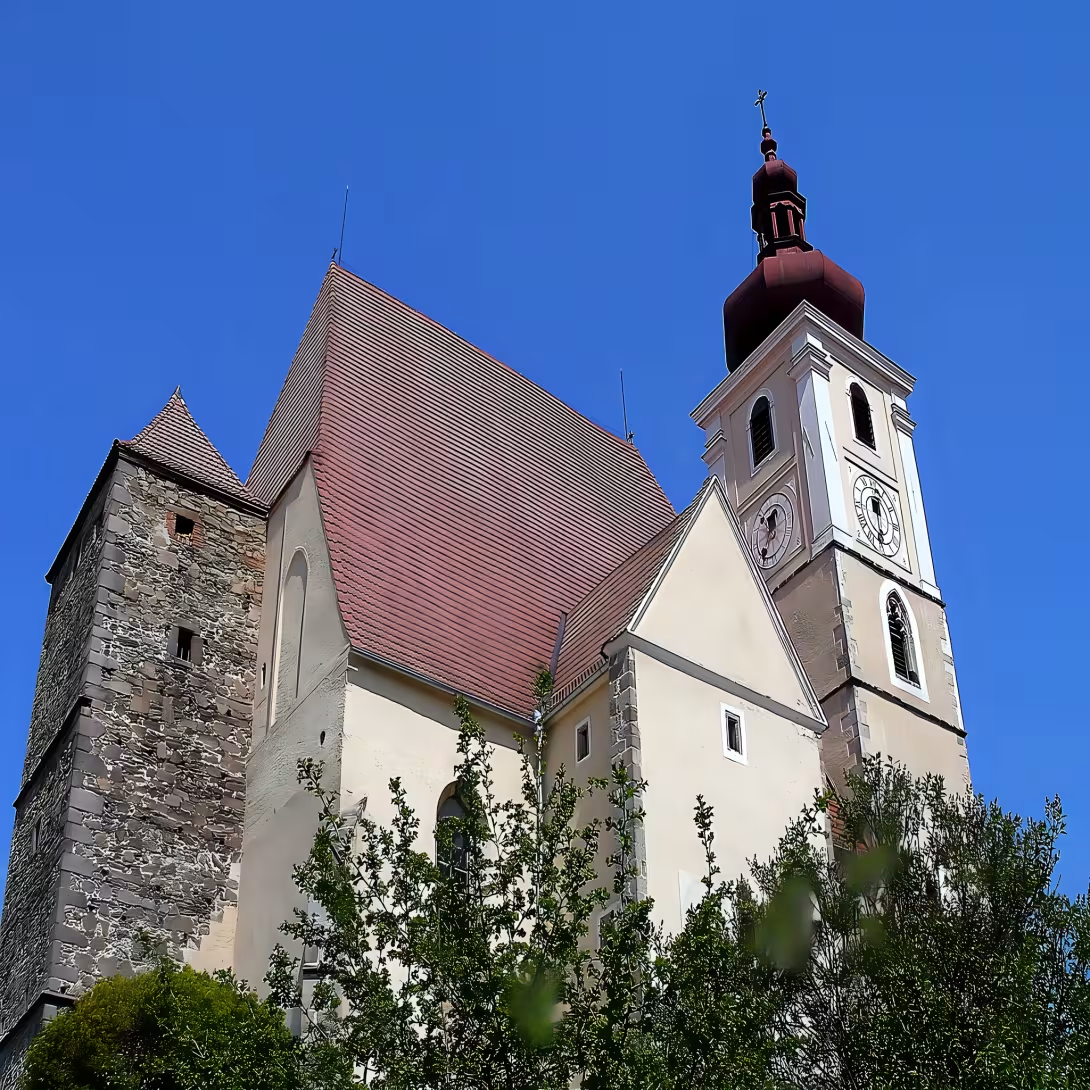
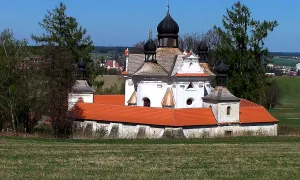
The Church of the Assumption of the Virgin Mary in Trhové Sviny is a prominent landmark and one of the most significant examples of late Gothic architecture in South Bohemia. Originally built at the end of the 13th century as an early Gothic church, it underwent major renovations in the second half of the 15th century to achieve its current form. The church stands out not only as a dominant feature of Trhové Sviny but also holds cultural significance due to its strategic location at the crossroads of four key trade routes: České Budějovice, Borovany, Nové Hrady, and Český Krumlov. Recognized for its architectural value, it has been protected as a cultural monument since 1963.
The origins of this church trace back to the late 13th century during the Přemyslid dynasty's rule in Bohemia, a period marked by growth and consolidation. The first mention of Ojíř ze Svinů, considered both the builder of the church and founder of the local castle (which no longer exists), dates to 1260. This connection highlights the historical significance of the church within the region's development.
Architecturally, the Church of the Assumption of the Virgin Mary underwent significant transformations over time. Initially built as a three-nave early Gothic structure with dimensions similar to today’s building, it experienced major changes in the second half of the 15th century. These renovations transformed it into an exemplary piece of late Gothic architecture, reflecting the influence of the Rožmberk architectural school prevalent around the turn of the 15th and 16th centuries.
Throughout its history, the church has been associated with notable figures such as Ojíř ze Svinů. In 1278, King Přemysl Otakar II presented priests to the church, and by 1280, it was consecrated in a ceremony known as patrocinium. The church's affiliation with the Doudleby deanery under the Bechyně archdeaconry further underscores its ecclesiastical importance.
The church has witnessed several key events and curiosities over the centuries. A stone plaque from the late 15th century above the southern portal bears the town’s coat of arms and a Latin inscription, though today it is replaced by a copy. The original bell tower was destroyed in a fire in 1850 and subsequently rebuilt. Additionally, the church suffered significant damage during various fires throughout its history.
Today, the Church of the Assumption of the Virgin Mary remains an important cultural and historical site. Its architectural evolution from early to late Gothic styles offers insight into the region's artistic development. Visitors are drawn not only by its historical significance but also by its role as a testament to the craftsmanship and architectural innovation of its time.
The church continues to be a valuable piece of heritage, inviting visitors to explore its rich history and appreciate its architectural beauty. Its preservation as a cultural monument ensures that future generations can experience this remarkable example of late Gothic architecture in South Bohemia.
Then and now
Drag the slider to compare how the landmark may have looked when it was built with the view today.
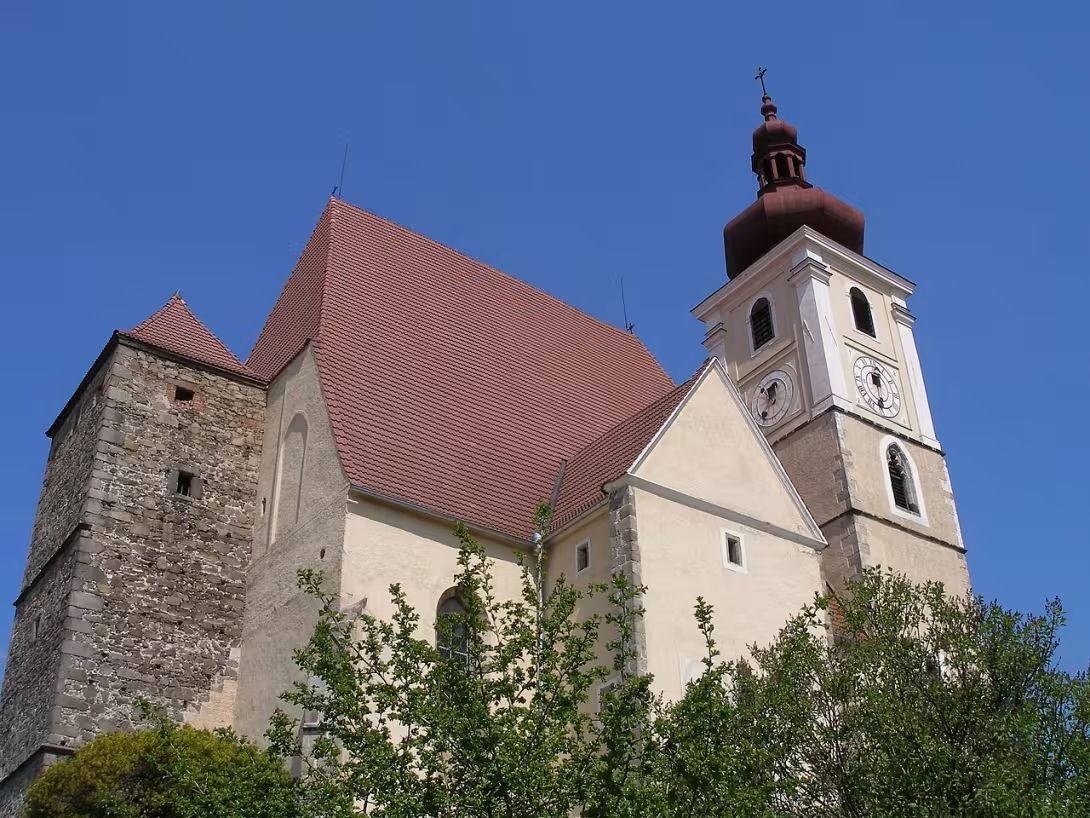
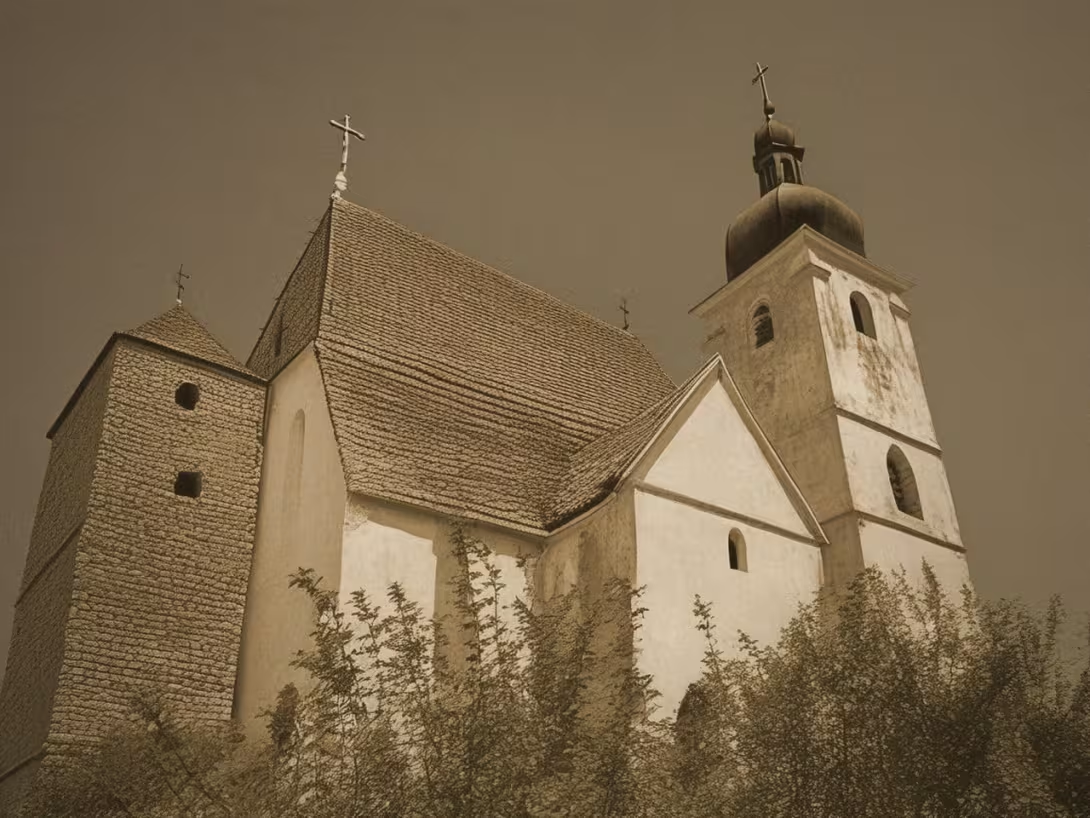
The historical appearance on the left is an AI-generated visualisation and serves as inspiration only.
Historical milestones
- 1260
- First mention of Ojíř ze Svinů.
- 1278
- The church was endowed by King Přemysl Otakar II.
- 1280
- Consecration of the church in a patronage ceremony.
- end of 13th century
- Original structure as an early Gothic church.
- mid-15th century
- Larger reconstruction into its current Gothic style.
- 1963
- Protection as a cultural monument.
Architectural development
The church's architectural development can be divided into two main phases. The initial phase in the late 13th century saw the construction of a three-nave early Gothic structure with similar dimensions to today's building. Significant changes occurred in the second half of the 15th century, transforming it into a notable example of late Gothic architecture.
Historical events
The first mention of Ojíř ze Svinů and his association with the church dates back to 1260.
In 1481, King Vladislav Jagiellon granted Trhové Sviny market rights, leading to its name change.
Points of interest
- One of the lesser-known facts about the Church of the Assumption of the Virgin Mary is that it was originally built during the Přemyslid dynasty's rule, a period known for its significant growth and consolidation in Bohemia. The church reflects this era's architectural ambitions.
- A curious historical tidbit involves Ojíř ze Svinů, who not only contributed to building the church but also founded the local castle that no longer exists. This connection highlights his dual role in shaping both religious and secular structures in Trhové Sviny.
- The church has a fascinating link to King Přemysl Otakar II, who presented priests to it in 1278, just two years before its consecration ceremony known as patrocinium. This royal involvement underscores the church's early importance within the region.
- A unique feature of the church is the stone plaque above the southern portal from the late 15th century, which originally bore the town’s coat of arms and a Latin inscription. Although now replaced by a copy, this artifact provides insight into the historical identity of Trhové Sviny.
- The original bell tower was destroyed in a fire in 1850 but was rebuilt thereafter. This event is part of the church's resilience through various fires over the centuries, showcasing its enduring significance despite such challenges.
Guide
This guide is narrated by a synthetic voice generated by artificial intelligence.
Show guide text
This text was created by artificial intelligence and has not been editorially reviewed. It may contain inaccuracies.
The Church of the Assumption of the Virgin Mary is the landmark of Trhové Sviny. It originated as an early Gothic structure in the second half of the thirteenth century and in the second half of the fifteenth century it was rebuilt to nearly its present form. It is among the most significant monuments of late Gothic architecture in the South Bohemian region and has been protected as a cultural monument since nineteen sixty-three.
The builder of the church is considered to be Ojíř ze Svinů. The town first appears in records under his name in twelve sixty. Ojíř also founded the local castle. It did not survive and its defensive function was taken over by the fortified church itself. The town grew up at the intersection of two trade routes that connected České Budějovice, Borovany, Nové Hrady and Český Krumlov.
In twelve seventy-eight Přemysl Otakar the Second presented a priest to the church and in twelve eighty the church was consecrated. It belonged to the Doudleby deanery, which fell under the Bechyně archdeaconry. The oldest structure probably had the form of a three-aisled basilica. The higher central aisle was covered with a gabled roof, the lower side aisles had shed roofs. Inside there were no supporting columns or vaults and the space was closed with a wooden ceiling. The perimeter walls had almost the same dimensions as today. From that time a northern pointed portal and traces of two original windows have survived.
In the fourteenth century the appearance of the church hardly changed, only the roof was lower and less steep. In the last quarter of the century a bell tower with a chapel was added between the aisle and the choir, today's southern tower.
The castle was occupied during the Hussite wars, fell into decay and by fourteen eighty it was completely dismantled. Its stone was used for building houses, but mainly for the reconstruction of the church. This is documented by a stone plaque above the southern portal with a coat of arms and a Latin inscription. In translation it reads: Seal of the commune of Sviny in the year of our Lord fourteen eighty-five. Today there is a copy in its place. Already in fourteen eighty-one Vladislav Jagellonsky granted the town market rights and brewing rights. This is where the name Trhové Sviny comes from.
The town was struck by a series of fires and the church suffered most in the nineteenth century. In eighteen twenty-eight a chapel that had belonged to the church since thirteen fifty-five burned down. It stood where the stone cross stands today. After another fire the dome of the southern tower had to be replaced in eighteen fifty.
Frequently asked questions
Can the monument be visited?
Religious buildings are usually open mainly during services; at other times a visit is normally arranged with the parish or the operator. We have not verified specific times.
Where is the monument?
Location: Trhové Sviny, Jihočeský kraj. The map on this page shows the exact spot.
Why is the monument protected?
It is listed in the Central List of Cultural Monuments of the Czech Republic as a cultural monument (register no. 31252/3-472).
Businesses nearby
Do you run a restaurant, accommodation, shop, museum, rental, wellness or other visitor service near this monument? Show yourself directly to the people heading to it — this is how they will see you in the app and on the web:
Accommodation nearby
Trips and activities nearby
Guided tours, tickets and activities nearby from GetYourGuide
Affiliate link: if you buy from the partner, we may receive a commission. The price for you does not change.
Search tours and activities →Themed route
Tematická výletní trasa: Kostel Nanebevzetí Panny Marie (Trhové Sviny)
1. Kostel Nanebevzetí Panny Marie
Typ: Historický kostel
Proč stojí za návštěvu: Tento barokní chrám, postavený v 18. století, je nejzajímavější architektonickou památkou obce Trhové Sviny. Jeho bohatě zdobená interiér a historie přitahují návštěvníky z celého regionu.
2. Kaple svaté Anny
Typ: Kaple
Proč stojí za návštěvu: Tato kaple, nacházející se nedaleko kostela Nanebevzetí Panny Marie, je známá svou klidnou atmosférou a krásným výhledem na okolní krajinu. Je ideálním místem pro zamyšlení a užívání si ticha.
3. Kostel svatého Vavřince
Typ: Kostel
Proč stojí za návštěvu: Tento kostel, nacházející se v blízkosti Trhových Svin, je dalším přitažlivým místem pro milovníky historie a architektury. Jeho jednoduché ale elegantní designy z 18. století nabízí pohled na tradiční náboženskou stavbu v regionu.
4. Kostel svatého Jiljí
Typ: Kostel
Proč stojí za návštěvu: Nacházející se také blízko Trhových Svin, tento kostel je známý svou historickou významností a krásnými interiéry. Je to ideální místo pro ty, kteří chtějí hlouběji pochopit místní duchovní tradice.
5. Kostel svatého Václava
Typ: Kostel
Proč stojí za návštěvu: Tento kostel, nacházející se v okolí Trhových Svin, nabízí jedinečný pohled na historickou architekturu a je důležitým místem pro místní komunitu. Jeho klidné prostředí a bohatá historie přitahují návštěvníky z celého krajiny.
Tato trasa nabízí pohled na hlavní náboženské památky obce Trhové Sviny, což umožňuje pochopit jejich historický a kulturní význam.
Seasonal recommendations
Jar: During the spring season, the Church of the Assumption of the Virgin Mary in Trhové Sviny is particularly striking due to its beautiful blooming surroundings, where vibrant and colorful nature spreads around the church. Sunny spring afternoons can highlight the architectural details of the church, while warm sunshine adds an enchanting atmosphere to the space. Visitors are encouraged to come in the early afternoon when there are fewer people, allowing for a peaceful stroll around the church. It's a good idea to wear clothing suitable for mild temperatures, which may change quickly throughout the day.
Leto: Summer brings high temperatures and long sunny days, offering ideal conditions for visiting the Church of the Assumption of the Virgin Mary. The atmosphere is full of life, especially during the main summer season when there can be an increase in tourists and local visitors. It's recommended to visit earlier in the afternoon or in the evening to avoid intense sun and crowds. Don't forget sun protection—make sure you have sunscreen with a high SPF, wide-brimmed hats, and light clothing.
Podzim: In autumn, the Church of the Assumption of the Virgin Mary offers a unique atmosphere as tree leaves change into vibrant colors. The sun is milder, and temperatures are pleasant, creating ideal conditions for a calm visit. Visitors will enjoy a clear day without excessive sun or heat. It's recommended to come in the afternoon when the atmosphere is most peaceful and there are fewer people. A good idea is to wear an outer layer suitable for mildly cool days.
Zima: The winter season brings the Church of the Assumption of the Virgin Mary into a tranquil and quiet atmosphere, as snow blankets the surrounding landscape. Sunny days can create a beautiful contrast between the white snow and the church's architecture, but long night hours require attention. Visitors are encouraged to come in the afternoon when it is open for longer, and not to forget warm clothing that protects against the cold. It's advisable to check the current opening times of the church, as they may be shorter during the winter season.
Visualizations and artistic views


The visualisations are generated by artificial intelligence and serve as inspiration.
Photos from the area
Real photos taken near the monument


Zdroj a licence jsou uvedeny u každého snímku.
Tips from visitors
No tips yet. Be the first!
Log in and add your tip.
Sources and literature
Photos: user: Sokkk y / Public domain, rozlišení zvýšeno umělou inteligencí — Wikimedia Commons. The author and licence also appear when you hover over the image.
Faktickým podkladem tohoto textu byl článek na Wikipedii, jehož autory jsou přispěvatelé Wikipedie. Článek je dostupný pod licencí CC BY-SA 4.0.
Location on the map

Příběhy a pověsti
Legendy, pověsti a příběhy spjaté s touto památkou
Fotografie návštěvníků
Zatím žádné fotografie. Buďte první, kdo přidá fotografii z návštěvy!
Log in a přidejte svou fotografii nebo hodnoťte.
Za ověřenou návštěvu v aplikaci získáte víc bodů — poznáme podle GPS, že jste na místě.
Reviews and comments