






Vojenský hřbitov (Pacov) Cemetery
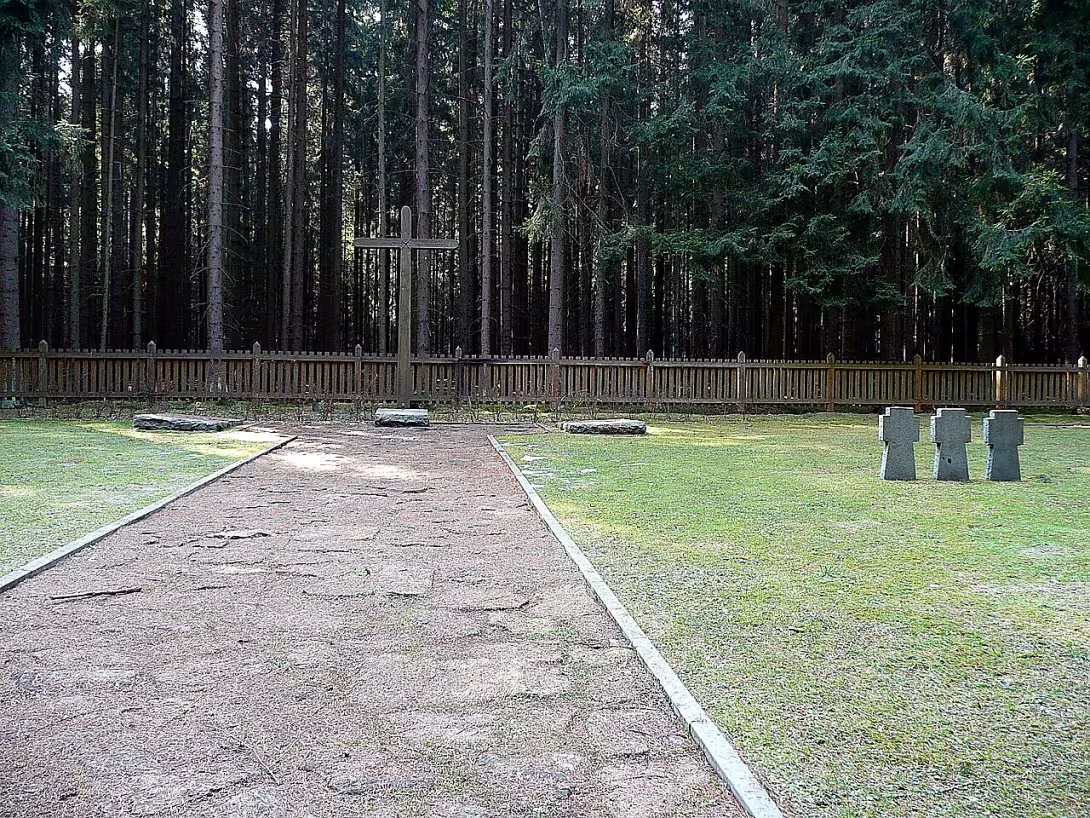
The military cemetery in Pacova in Pelhřimovsk is a piety place hidden in a forest area southwest of the city towards Eš. The cemetery was created during World War II as a burial ground of captured German soldiers from a nearby camp. Today the site is protected as a real-estate cultural monument of the Czech Republic.
The history of the site is closely linked to the period of World War II when a prison camp was set up nearby. 284 men were buried in the cemetery, who succumbed primarily to the typhoid epidemic. The creation of the burial ground reflects the war conflict, which fundamentally influenced the destinies of Central Europe when the Protectorate of Bohemia and Moravia was under Nazi occupation.
The area of approximately 1300 square metres has a rectangular floor plan and is fenced. The architectural dominance consists of a large wooden cross, which complements seven triple stone crosses and several torsional monuments. The names of the deceased are carved on four plates at the central cross.
After the war, the prison camp was abolished. The space was subsequently used by the military artillery crew and, allegedly, the tank section. Part of the land served as a military training ground and later as a motocross track. The area has been preserved by the remains of buildings, bunkers and underground facilities.
The town of Pacov is the owner of the cemetery. The town hall takes care of the maintenance and care of the memory of the dead in cooperation with the German Association for the Care of War Tombs. The cemetery is located in the forest near Ondrejov and is accessible as a historically important piety place.
Visiting the site offers the opportunity to become acquainted with a specific chapter of the region's war history. The preserved area serves as a reminder of the tragic events of the past and encourages you to reflect on the fate of the people who have found their final resting place here.
Historical milestones
- 1939-1945
- Established by the prisoner's tabor and the formation of the hunchback during the second world war
- 1945
- The end of the war, abolished by the tabor and then used by the armada
- around 1950-1990
- The use of land as a military trainer and motocross introduction
- after 1990
- Proclamation for cultural heritage and kiln o pietni place
Architectural development
The cemetery has a rectangular plan and is fenced. The dominant is a large wooden cross, supplemented by seven triple stone crosses and several torsional monuments. The names of the buried are carved on four plates placed at the central cross.
Historical events
Establishing a cemetery during World War II; the abolition of the prison camp after the war.
Owners
City of Pacov
Points of interest
The cemetery was created during World War II as a burial ground for captured German soldiers from a nearby camp. - Two hundred and eighty-four men were buried on the scene who succumbed to the typhoid epidemic. - An area of approximately 1,000 300 square meters has a rectangular plan and is fenced. - The architectural dominant is a large wooden cross, which complements seven triple stone crosses and several torsional monuments. - Part of the land used to serve as a military training ground and later as a motocross track.
Guide
Show guide text
This text was created by artificial intelligence and has not been editorially reviewed. It may contain inaccuracies.
Welcome to this quiet and thoughtful place. Right now, you're standing in front of a military cemetery located in a quiet forest area, just a short piece southeast of the city of Pacov. Before you take the next step, stop for a moment and observe the surrounding environment. You are surrounded by dense forest vegetation, which creates a natural and quiet space here, which seems to be perfectly compatible with nature. Notice how this space is different from the surrounding forest. It is clearly defined, it has its rectangular plan and it is completely fenced, which creates a line between the common forest area and this sacred place that is now in front of you. This border separates us from the daily rush and prepares us for a meeting with history.
Let us now look together at why this place is so important and what a tragic event has left its mark. In order to understand the meaning of this cemetery, we must return to the time of the Second World War, that is, between the year one thousand nine hundred thirty-nine and one thousand nine, forty-five. At this time, when the world was in the greatest chaos, a prison camp was established near this place. This place, which you see today as a quiet and relaxing area, was then built as a burial ground for the captured German soldiers who lived in this camp.
Now pay attention to what happened here within these forest borders. The history of this place is not the history of heroic fighting on the battlefield, but the history of silent and invisible fighting for life. Many men here have not buried the consequences of direct clashes, but a relentless typhus epidemic. The disease that hit the prisoners at the time was extremely destructive and fast. Imagine the despair and fear that must have prevailed in the camp. It is this disease that has taken the lives of hundreds of people and that is why this place has become their last home.
Now, if you look all over the premises, you should be aware of its scope. This area has an area of approximately 1,000 300 square meters. Although it may seem like a smaller place, his weight is huge. In this rectangle, two hundred and eighty-four men are buried. Each of these two hundred and eighty-four names represents one lost life, one unlived story and one family who lost their loved one in these difficult times. It is important to see this space not just as a piece of land, but as a place where human tragedy is concentrated.
Now I want to take you on a journey through time to understand how the view of this place changed over the decades. After the end of the war in a thousand and nine hundred forty pămeti, there was a fundamental change. The camp was cancelled and the military started using this space. For many years, from about a thousand to nine hundred fifty until the end of the 1990s, there was no peace that you now feel. This land served as a military training ground. Imagine the huge contrast. Instead of the silence of the forest and the memories there was the sound of exercise, the movement of troops and discipline.
But that was not the end of change. At a certain time, this space was used for other purposes, which appear to be almost incompatible with the sacred character of the cemetery. The site became an area for motocross races. Imagine the noise of the engines, the dust rising from the track and the viewers who were here in the past. This era, when racing motorbikes in the field, was quite different from today's quiet drinking spot. This space has undergone an incredible transformation from the burial ground to the military training ground and the racetrack, to today's form.
But after a year of a thousand nine hundred and ninety, the situation changed again for the better. People realized that this place had its historical value and that it must not be forgotten. This area was officially declared a cultural monument. He's been looking after him ever since with the respect he deserves. Today, the city of Pacov is taking care of this piety site in cooperation with the German association, which takes care of the monuments. This cooperation is very important because it shows that, despite a painful and complicated history, we can work together to preserve our memory and not forget the human destinies that have ended here.
Now I want to invite you to go through this space on your own. Take a look at the perimeter of this rectangular area, see the atmosphere of the forest, and try to imagine in your mind the two hundred and eighty-four men who rest here. Let yourself be consumed by the history that is felt in every piece of this protected monument. It's a place that requires silence and respect.
Thank you for visiting this military cemetery and for paying attention to those left behind. We wish you a peaceful walk through the forest and other interesting experiences in exploring the history of our region. You can now continue your journey on your own travels. Goodbye.
Tips for visitors
The best time to visit is during the morning or early afternoon when the sun's rays penetrate through the trees and create a peaceful atmosphere suitable for contemplation. Due to the forest environment, we recommend a visit in dry weather, when the access routes are well viable. You can easily get to the monument by a private car, which can be removed near the edge of the forest. If you use public transport, go to the city of Pacov and walk the rest of the way on marked tourist routes; Check the exact connection in the current connection search engine. For your journey, wear solid shoes suitable for forest terrain and insect repellent. Due to the piety of the site, take care to keep quiet movement and respect for the history of the burial site. For photography it is ideal to use soft scattered light between trees that highlight the details of tombstones and the atmosphere of the place. Focus on the contrast between historical elements and surrounding nature. In the surrounding area you can visit the city Pacov itself, explore the location of Ondřejov or take a walk in the places of the former military training ground and motocross racetrack which offer an interesting view of the landscape change.
Businesses nearby
Do you run a restaurant, accommodation, shop, museum, rental, wellness or other visitor service near this monument? Show yourself directly to the people heading to it — this is how they will see you in the app and on the web:
Nearby
Město Pacov, lokalita Ondřejov, bývalé vojenské cvičiště a motokrosové závodiště.
Accommodation nearby
Themed route
1. City Pacov - City. Suitable start for the entire route and tour of the local center. 2. Vojenský hřbitov (Pacov) - Cemetery. The main destination of the trip, a place of peace and honor. 3. Locality Ondříov - Local area. Interconnection between the cemetery and other points in the area. 4. Former military training ground - Historical space. A place that resembles the military history of the region. 5. Motocross racetrack - Sports complex. Space for speed lovers and motor technicians.
Seasonal recommendations
Spring: In the spring period, a beautiful flowering nature appears at the military cemetery in Pacov when flowers and trees begin to develop their colours. The sun's rays illuminate the cemetery with fine radiation, creating a calm atmosphere suitable for reflective moments. When visiting, it is advisable to wear light clothes with the possibility to cover yourself because temperatures may vary during the day. The best time to visit is in the morning, when the sun is raised and lit up, allowing full appreciation of the beauty of the cemetery.
Summer: Summer brings long sunny days and warm atmosphere to the military cemetery in Pacov. The sun illuminates the surface with its full radiation, which can be pleasant even for a moment of discomfort due to high temperatures. When visiting it is recommended to take with you protective sunglasses and enough drinking water to prevent fatigue from excessive sunlight. The best time to visit is an early afternoon when crowds are beginning to decline and temperatures are softer.
Autumn: In autumn, the areas of the military cemetery in Pacov become the colours of golden and red leaves, creating a unique and peaceful atmosphere. Sun rays light the landscape less intensively than at other times, thus increasing the sense of silence and relief from summer heat. It is advisable to wear warmer clothes when visiting because temperatures are beginning to drop. The best time to visit is a long afternoon when the leaves turn colour and the sun lights up the landscape with its soft rays.
Winter: During winter, ice surfaces and snow sheets appear in the military cemetery in Pacov, adding a mild atmosphere of peace and quiet. Sun rays illuminate the landscape with their weaker radiation, creating a sense of relief from cold days. When visiting, it is important to wear warm clothes and protective legs for snow ground, because the cemetery may not be fully operated this season. The best time to visit is an early afternoon when temperatures rise a bit and the sun lights up the landscape with its cold rays.
Visualizations and artistic views

The visualisations are generated by artificial intelligence and serve as inspiration.
Tips from visitors
No tips yet. Be the first!
Log in and add your tip.
Sources and literature
Photos: Petr Kratochvíl / CC BY-SA 3.0 — Wikimedia Commons. The author and licence also appear when you hover over the image.
Faktickým podkladem tohoto textu byl článek na Wikipedii, jehož autory jsou přispěvatelé Wikipedie. Článek je dostupný pod licencí CC BY-SA 4.0.
Location on the map
Příběhy a pověsti
Legendy, pověsti a příběhy spjaté s touto památkou
Fotografie návštěvníků
Zatím žádné fotografie. Buďte první, kdo přidá fotografii z návštěvy!
Log in a přidejte svou fotografii nebo hodnoťte.
Za ověřenou návštěvu v aplikaci získáte víc bodů — poznáme podle GPS, že jste na místě.
Reviews and comments