






Výšina sv. Metoděje Chapel
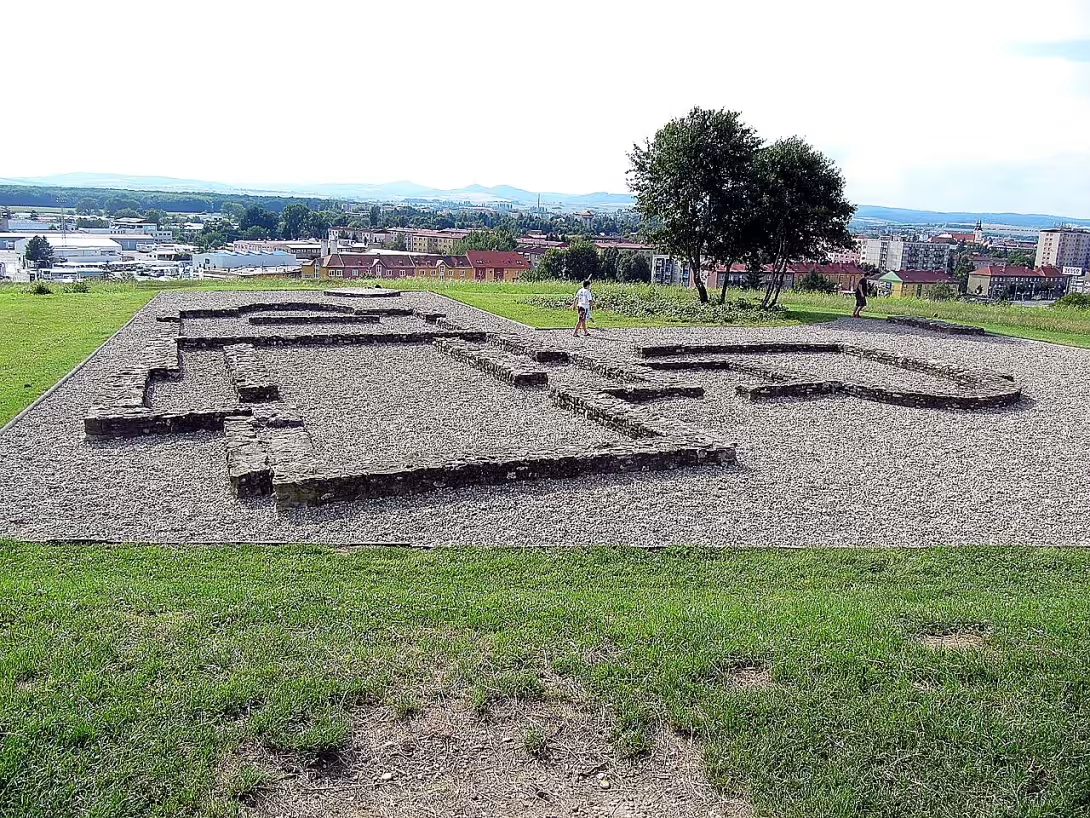
Výšina sv. Metoděje, by 2013 called the Sada or Metropolitan Heights, represents one of the most important archaeological sites in Great Moravia. It is located in the Spitálka line in the local part of Sady in Uherské Hradiště, on the northwest edge of the island, historically surrounded by the Olšavou River, which is mentioned for the first time in written sources from 1078.
Older find reports of the site date back to 1849, when a fine stone wall with a grave and clay vessel was recorded. In 1912, a skull was found here. After World War II, remains of the Great Moravian estate were discovered. In 1950, the findings were archaeologically verified by Jindr Nequasil. Only in 1959, however, the Czech archaeologist Vilém Hrubý started systematic field research, which continued until 1963 and brought decisive findings.
Research revealed the remains of an unfortified court of a church-power character. The core of the complex was a church with a cross plan and a burnt roof cover of an ancient character. It was connected to the west side of the building with a semi-circular apside, a square room on the north side and a funeral chapel with a semi-circular apside. The complex consisted of the fourth building and approximately seven meters west of it a circular Baptisterium. The buildings were built in three construction phases. In the north were the remains of fifteen cabins as the remains of the large Moravian estate, but south were the remains of the wooden hall building. Eighty-seven graves were dug.
Among the most important findings is the notable grave number 12 / 59, the bottom of which was paved with large flat sandstone stones and wood-lined walls. He buried an important great Moravian power stored in an iron-forged coffin. According to the nature of the grave, it may be King Svatopluk himself († 894). Two silver, heavily gilded buttons decorated with filigree were found in the grave. The tombstone originally consisted of a walled building with painted figural motifs.
The location is famous for its connection to the critianization of Moravia. Here was discovered a lead cross with Greek liturgical inscription and an orant image, which proves the presence of priests of Greek origin. Numerous find of scribes (styles) for wax fishing suggests the existence of a school at church. These IDs are the reason why the location is connected to the seer and Moravian Bishop Metoděj, which is believed to have been buried here in 885.
Since 1963, the complex has been protected as a cultural monument, since 1969 as a national cultural monument. The location is freely accessible, equipped with an information board and occasionally there are religious services and cultural events.
Then and now
Drag the slider to compare how the landmark may have looked when it was built with the view today.
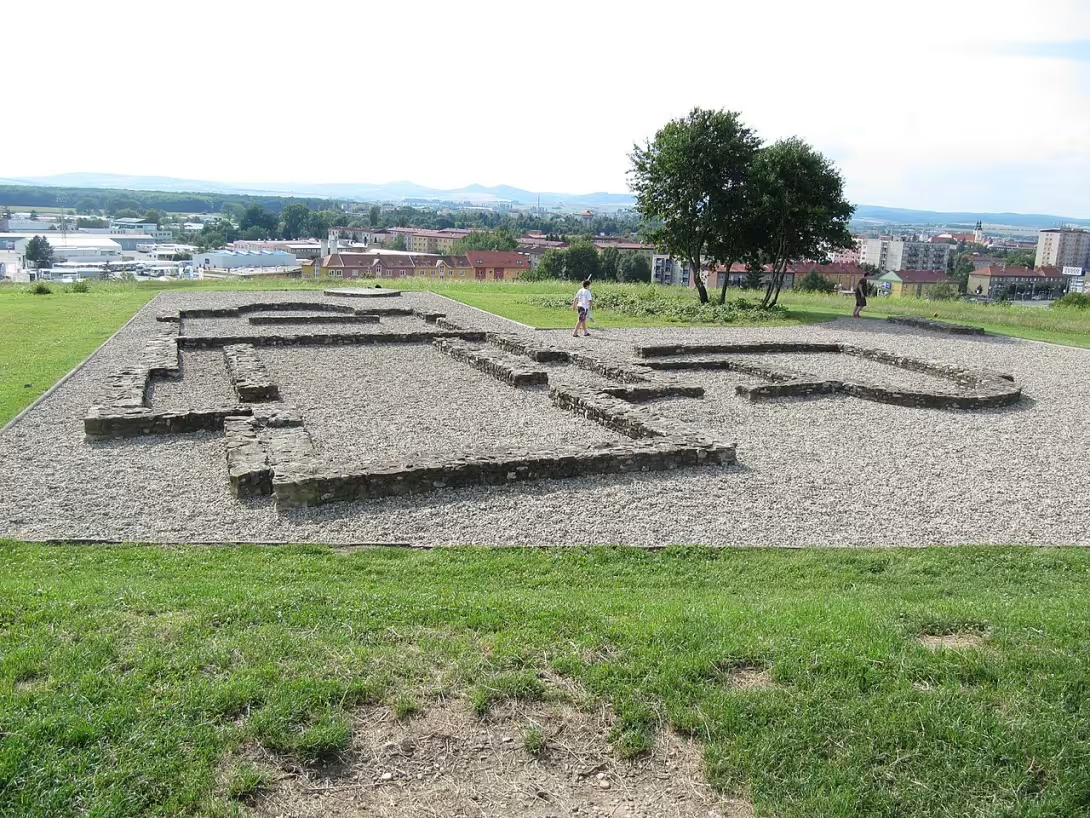
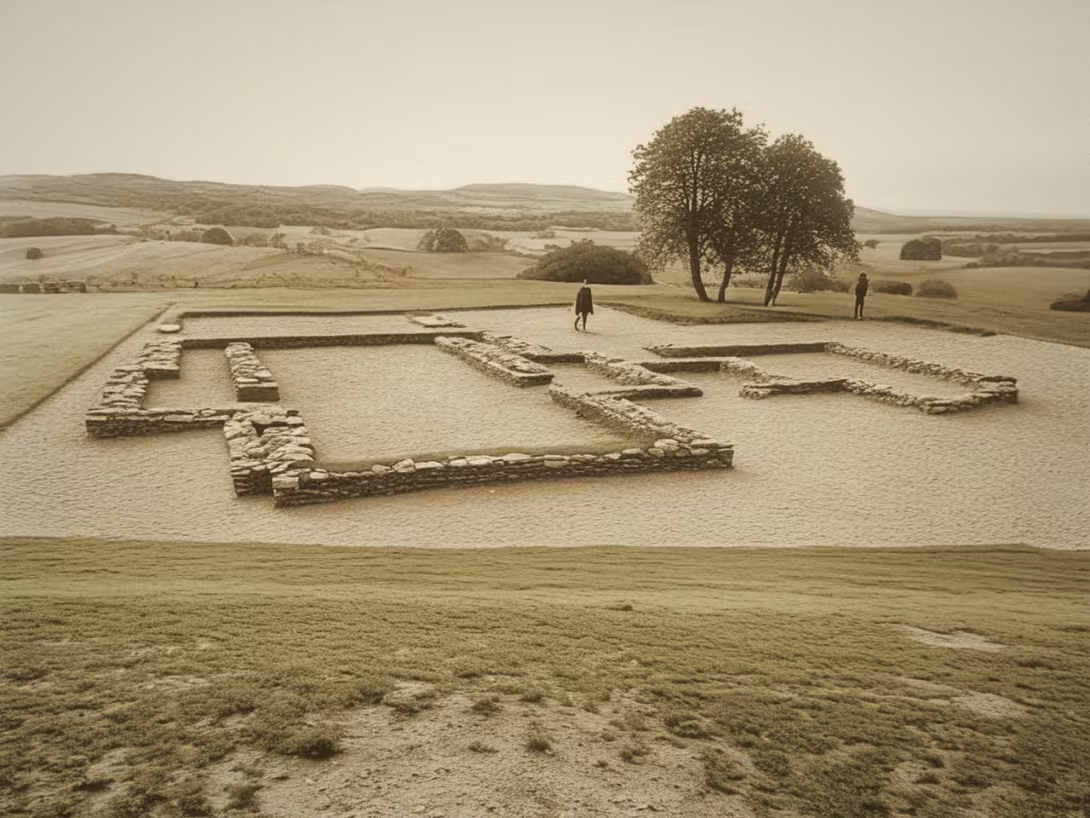
The historical appearance on the left is an AI-generated visualisation and serves as inspiration only.
Historical milestones
- 885
- The estimated year of Bishop Metoděje's funeral.
- 894
- Possible burial of King Svatopluk in grave 12 / 59.
- 1849
- The first discovery of the stone wall and grave.
- 1959
- The launch of systematic area research by Wilhelm Hrubým.
- 1963
- The area is protected as a cultural monument.
- 1969
- The area is protected as a national cultural monument.
Architectural development
The complex was built in three building stages from stone on mortar and wood. It included a church with a hint of a cross plan, a circular Baptisterium with a cast mortar floor and a funeral chapel with an apsid. North of the complex were the cabins of the great Moravian estate.
Historical events
885 - probable year of burial Metoděje; 894 - the death of Prince Svatopluka, to whom one of the graves may belong; 1959-1963 - Archaeological research of Wilhelm Hrubý.
Points of interest
- The location represents one of the most important archaeological sites in Great Moravia. - Research revealed the remains of an unfortified court of ecclesiastical power with a church and circular Baptistry. - Two silver, heavily gilded buttons decorated with filigree were found in the grand grave. The findings of the lead cross and the wax-fishing scribes suggest the presence of priests of Greek origin and the existence of a school. The area has been protected as a national cultural monument since 1969.
Guide
This guide is narrated by a synthetic voice generated by artificial intelligence.
Show guide text
This text was created by artificial intelligence and has not been editorially reviewed. It may contain inaccuracies.
Welcome to St. Metoděj. You have just entered a space that is far more than just a simple archaeological site. You stand in a place where the history of the earth touches the heavens, and beneath your footsteps are traces of ancient power, faith, and education. You may now seem to be looking at a quiet landscape near the Sad, but try to imagine for a moment what this place looked like over a thousand years ago. Feel this atmosphere, feel the silence that exists here, because it is in this silence that echoes the story of Great Moravia.
Let's go back to the ninth century together. Imagine the period when Christianity was formed in these territories and the first real political centers were built. This place wasn't just a settlement. It wasn't even a fortified chateau that you might be subconsciously imagining when you hear the word power center. On the contrary, there was a fortified court whose strength was not in the high walls, but in its importance, in its spiritual role and in its political prestige. It was a church-power compound, the heart of the early Christianity that was vibrating in this region. It was a place where people gathered looking for truth, learning and protection under the cross.
Now pay attention to what was here. Even though we are seeing mostly remains and archaeological findings today, in your mind you can draw a plan of this important complex. The area consisted of a complete whole which included a church, a funeral chapel and a very specific place for the reception of new believers - circular Baptisterium. Feel the importance of this circular shape. Baptisterium was a place where people newly admitted to the faith prepared for their spiritual life. This whole space has been designed to create wonder and respect. It was a space for rituals, for prayers, and for political decisions that shaped the fate of the entire nation.
When you look around, you realize that you're standing in an area that has been seen for centuries as an education center. It is here, in this place, that the most important people of their time have probably touched on learning. And we're talking about characters whose names we speak with respect today. Imagine Bishop Metoděj. His name is inextricably linked to this location. We believe that he worked here and that this place witnessed his tireless work on the spread of faith and scripture. It is believed that here, in the year eight hundred and eighty-five, Metoděj was buried. It's a place that carries his name as an eternal reference to his legacy.
But Metoděj wasn't the only one left behind. This site witnessed the royal supreme power. The historians are still returning to the year eight hundred and ninety-four, where there was probably the funeral of King Svatopluk. Imagine the contrast force - the spiritual authority of the bishop and the political dominance of the king, as both of these worlds connected in this place. This place was the real crossword of destiny.
However, in order to learn so much about this place, we must thank the people who have chosen to explore the country deeply. The first signs that there was something special appeared in the year of the nineteen, when the first reports of the stone wall and grave were recorded. But the real breakthrough occurred only in the year one thousand nine hundred fifty-nine, when he launched systematic, comprehensive research of Vilém Hrubý. It is thanks to his patience, his scientific approach and his love of history that these places could show up today. Thanks to him, we know that there is a large burial ground that dates from the ninth to the 12th century. This tells us how long and how intensely this place was significant.
Now I want to invite you to think of one of the greatest mysteries the archaeologists have found here. In research in one of the great tombs of the time, there was something that no one had expected until then. It was two silver, heavily gilded buttons decorated with fine filigree. Imagine the precision of work, the beauty and the value. These little objects aren't just jewelry. They're testimonies of wealth, artistic standards, and how advanced life was in early Moravian society. Who was the person who wore these buttons? What role did he play in this church center? These questions remain in the space you are currently circumventing.
You are standing in a place that was declared a cultural monument in the year one thousand nine hundred sixty-three and several years later a national cultural monument. That's not just a formal term. It's an expression of how extremely rare what you see and feel here. Every inch of this country can hide another story, another foot of ancient civilization.
But don't stop at the feeling of wonder. Continue walking, see the scope of this area. Take a look at the surroundings and see if you can draw the ancient buildings, the church spaces and the human destinies that were written here. Let history devour you, which is not only in books, but directly beneath your feet.
Thank you for choosing to visit St. Metoděj and for wanting to learn more about our roots. We wish you a pleasant continuation in discovering the beauty of this region and other secrets that history offers you. Goodbye.
Frequently asked questions
Is Výšina sv. Metoděje open to the public?
Yes, it's open to the public, but only during opening hours.
How do I get to the place by car / public transport?
The location is available by foot from the city center. The bus stop is 10 minutes' walk from the chapel.
How much is the entrance fee and is it paid on the spot?
Admission is paid on site, the current price list can be found on the official site of the sights.
Is the tour suitable for children and seniors?
Yes, the tour is also suitable for families with children and seniors. The chapel has a spacious access path and the inner space is well lit.
How long does the tour take?
The tour of the chapel takes approximately 15-20 minutes.
What are the opening times and booking is required?
Opening hours: Tuesday to Sunday, 9: 00- 17: 00. Reservation is not required, but we recommend in case of larger groups.
What's interesting in the immediate vicinity?
In the immediate vicinity there is a park with beautiful views of the city and surrounding landscape.
For kids
Imagine going back to when new Christianity was born in our parts. It was a time of great change and discovery. And that's when the chapel of St. Metoděj was created in this place.
At that time, people from different tribes and nations lived. It was the Slavs who settled in our countries and began to build their settlements and cities. The first Christians came with good news about God's mercy and love. And right here at this height of St. Metoděje began their journey in our lands.
Businesses nearby
Do you run a restaurant, accommodation, shop, museum, rental, wellness or other visitor service near this monument? Show yourself directly to the people heading to it — this is how they will see you in the app and on the web:
Events nearby

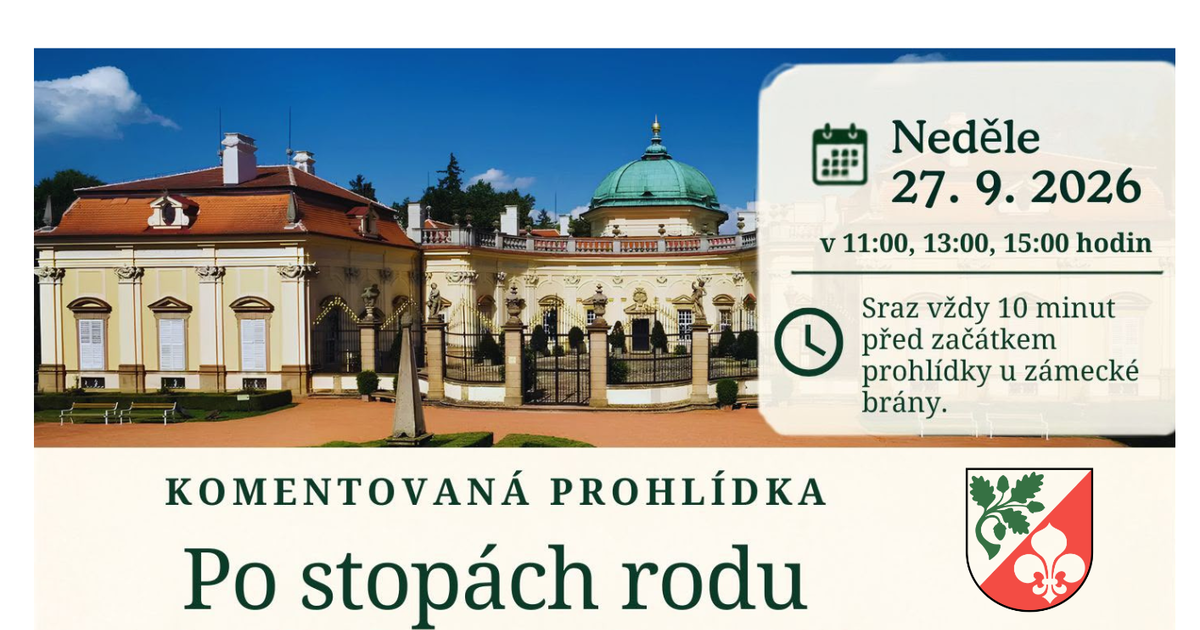
Zdroj akcí: otevřená data měst a obcí ČR (Národní katalog otevřených dat) a kalendář akcí Národního památkového ústavu.
Nearby
The location is located on the northwest edge of the islandel in the Spitálky line near the village Sady and the city Uherské Hradiště.
Accommodation nearby
Trips and activities nearby
Guided tours, tickets and activities nearby from GetYourGuide
Affiliate link: if you buy from the partner, we may receive a commission. The price for you does not change.
Search tours and activities →Themed route
Thematic cruise route to St. Metoděje
1. Výšina sv. Metoděje (archaeological sites) - Type: Archaeological site - Why is it worth a visit: This place is key to understanding the history and culture of the ancient Slavonic. Research here revealed a rich past, including churches and settlement structures.
2. Ambient forest areas - Type: Natural space - Why is it worth visiting: Forests around St. Metoděje offers beautiful opportunities to relax and walk in a quiet environment, an ideal addition to the study of historical findings.
3. - Type: Historical route - Why is it worth visiting: This route leads through historically important territory which was important for trade and cultural relations in the past. It is an ideal way to identify other aspects of regional history.
4.Local phara - Type: Religious monument - Why it is worth a visit: The parish church near St. Metoděje is a reminder of the spiritual life of the area and offers a view of the architectural elements of the region.
5. Village Sady - Type: Local center - Why is worth a visit: The village Sady provides an overview of current life in the region and offers the opportunity to explore local culture, gastronomy and traditional customs.
This route offers a combination of historical discoveries with natural tranquility and contemporary life in the region.
Seasonal recommendations
In spring, archeological remains are surrounded by fresh greenery and flowering flowers, creating a beautiful contrast between an ancient stone and a new life. The morning sun here creates a soft, scattered light that is ideal for observing terrain detail. We recommend to take with you layered clothes because the weather can be variable, and the best is to arrive in the morning when the air is purest and the traffic is still low.
The summer season offers the longest days and intense sunlight that highlights the structure of ruins. Since stone fragments can quickly absorb heat in heat, it is best to plan a visit in the early morning to avoid the largest crowds and hot air. Don't forget enough drinking water, headgear and fixed shoes suitable for uneven terrain.
Autumn moons bring a melancholy atmosphere to the place accompanied by morning fog and golden colours of decaying leaves. Light is low and dramatic in this period, which gives the ruins a mysterious touch. For a comfortable walk, waterproof shoes and warmer clothing are necessary, while afternoon hours are ideal for shooting in warm colors.
At winter time Výšina sv. Metoděje is very raw and calm, especially when the ruins are covered with snow or frost. The absence of leaves reveals the entire outlines of the monument, which are hidden in the crops at other times. Due to short days and cold, it is necessary to choose a very warm and breathable outfit and to be careful about possible slippery surfaces. Visiting is minimal during this period, which guarantees absolute silence and privacy for visitors.
Visualizations and artistic views


The visualisations are generated by artificial intelligence and serve as inspiration.
Photos from the area
Real photos taken near the monument

Zdroj a licence jsou uvedeny u každého snímku.
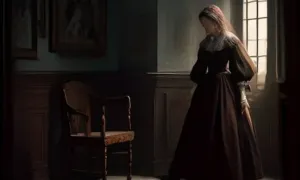
Atmosphere of the place
This atmospheric visualisation of the place and period was generated by artificial intelligence. It is not real footage of the location.
Tips from visitors
No tips yet. Be the first!
Log in and add your tip.
Sources and literature
Fotografie: Palickap / CC BY 3.0 — Wikimedia Commons. The author and licence also appear when you hover over the image.
Faktickým podkladem tohoto textu byl článek na Wikipedii, jehož autory jsou přispěvatelé Wikipedie. Článek je dostupný pod licencí CC BY-SA 4.0.
Location on the map
Příběhy a pověsti
Legendy, pověsti a příběhy spjaté s touto památkou
Fotografie návštěvníků
Zatím žádné fotografie. Buďte první, kdo přidá fotografii z návštěvy!
Přihlaste se a přidejte svou fotografii nebo hodnoťte.
Za ověřenou návštěvu v aplikaci získáte víc bodů — poznáme podle GPS, že jste na místě.
Reviews and comments