






zahradní pavilon Gazebo
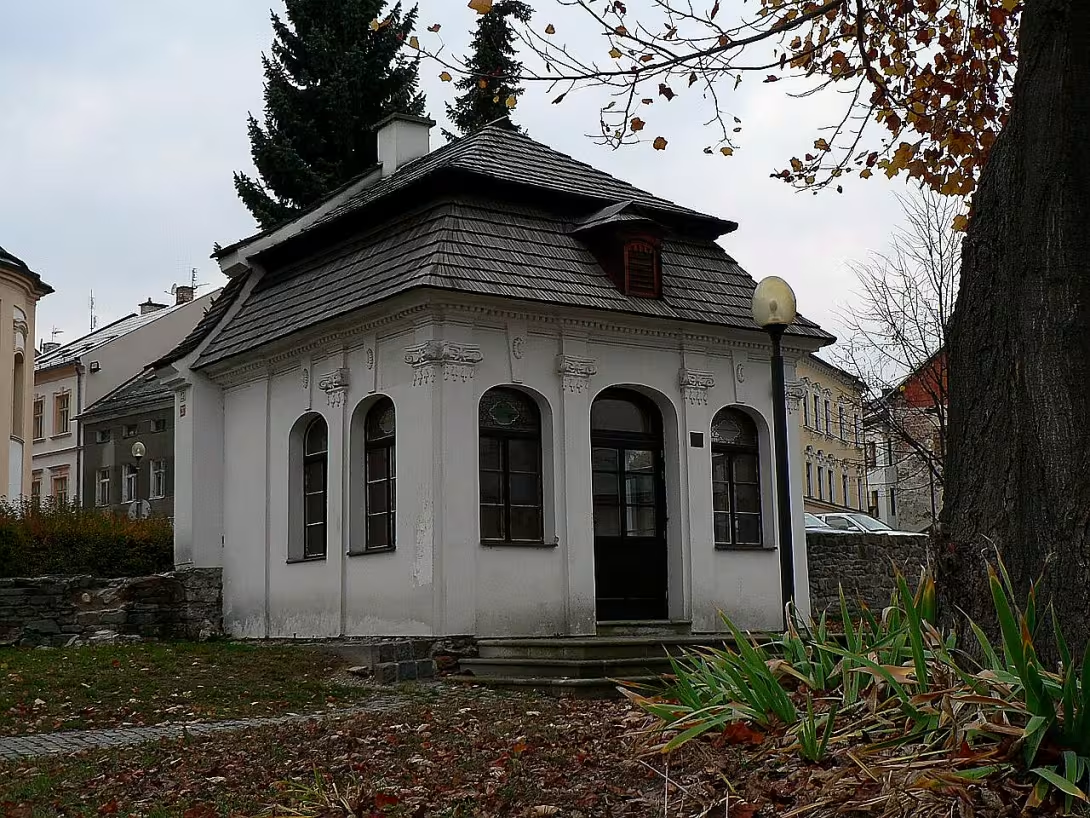
The garden pavilion in Šumperk is a late Baroque to neoclassical structure situated between Radniční and Starobranská streets. It was originally built as part of an extensive ornamental garden for the Oberleithner Palace. Dating from the turn of the 18th and 19th centuries, the building has been protected as a cultural monument since April 10, 1964. Today, following a complete renovation, it serves as a self-service photographic gallery managed by Podniky města Šumperka.
The structure was likely constructed at the turn of the 18th and 19th centuries within the park space of the former city moat, which lost its defensive function as city fortifications became obsolete. During the first half of the 19th century, textile magnate Eduard Oberleithner the Elder developed a representative ornamental garden for his city palace, located at today's Starobranská č. 249/20. This garden formed a continuous strip of greenery along the outer face of the town wall, stretching from the palace to the area of present-day Radniční street. This era reflected a broader historical context in which municipal and entrepreneurial elites repurposed former fortifications for recreation and ornamental grounds.
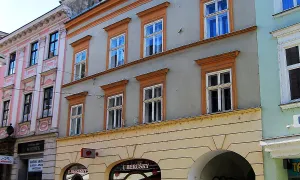
Architecturally, the detached masonry building features a rectangular floor plan. It utilizes the remnant of the original inner city defensive wall as its northwest gable wall, complete with a smoothly plastered attic. Three frontages are rhythmically organized by pilasters featuring bases and Ionic capitals. A specific decorative detail includes two hanging heart-shaped flowers on the shaft of each pilaster, alongside similar flowers on the corners. Above the pilasters runs a richly profiled crown cornice decorated with a dentil frieze. Window and door openings display segmental arches, accompanied by tall, slender keystones adorned with rosettes that reach into the lower section of the cornice. The main entrance is emphasized by a sandstone terrace with three steps. The pavilion is covered by a mansard roof with shingle cladding and a front dormer with a half-hip. The interior features a flat ceiling framed by a prominent coved cornice, with internal corners and wall surfaces broken by internal pilasters matching the exterior layout.
Throughout its existence, the property transitioned through notable owners and administrative changes. In the 19th century, it was owned by the Oberleithner family as part of their estate. During the 1940s period of the Nazi occupation, significant urban changes cut the garden with a new connecting road leading to the former Saxinger cinema, later known as kino Svět. This intervention separated the pavilion from the palace, destroyed the original park landscaping, and turned the structure into an isolated solitaire near a parking lot and a busy roadway, with its address designated as Radniční č. 2797/27. In the 21st century, the building was used commercially as a flower and gift shop before management was transferred to Podniky města Šumperka.
Key developments in the modern era include a complete repair of the structure and its current functional conversion. Legally, the monument was registered in the Central List of Cultural Monuments of the Czech Republic under registration number 37665/8-1275 on April 10, 1964. According to the National Heritage Institute, the building remains a valuable document of minor garden architecture and illustrates the historic 19th-century adaptation of town fortifications for the recreational needs of the bourgeoisie and entrepreneurial elite.
Today, despite the surrounding urban changes that placed it near a parking lot and busy roadway, the pavilion preserves its authentic architectural expression and highly decorative facades. Visitors can observe its survival as a unique historical solitaire and view exhibitions inside its newly established self-service photographic gallery. A visit offers a direct encounter with Šumperk's industrial past and the evolving use of its historical fortifications.
Historical milestones
- 1964
- The object was registered as a cultural monument on April 10, 1964.
Architectural development
The pavilion was constructed as a detached masonry building on a rectangular floor plan, incorporating a section of the former inner city wall as its northwest gable wall. Its exterior is decorated with pilasters, Ionic capitals, rosette-adorned keystones, and a richly profiled cornice with dentils. The interior features a flat ceiling with a prominent coved cornice and internal pilasters mirroring the exterior layout. It is covered by a mansard roof with shingle roofing and a front dormer with a half-hip.
Historical events
Turn of the 18th and 19th centuries: Construction of the garden pavilion. 1940s: Urban changes during the Nazi occupation split the pavilion from the Oberleithner Palace. 1964: The building was designated as a cultural monument. 21st century: Complete renovation and conversion into a photographic gallery.
Owners
Oberleithner family (19th century); Podniky města Šumperka (21st century)
Points of interest
– The garden pavilion in Šumperk was originally built as part of an extensive ornamental garden for the Oberleithner Palace. – The building dates from the turn of the 18th and 19th centuries and has been protected as a cultural monument since April 10, 1964. – Following a complete renovation, the structure now serves as a self-service photographic gallery managed by Podniky města Šumperka. – The masonry building incorporates the remnant of the original inner city defensive wall as its northwest gable wall. – During the 1940s Nazi occupation, urban changes separated the pavilion from the pal
Guide
Show guide text
This text was created by artificial intelligence and has not been editorially reviewed. It may contain inaccuracies.
Welcome to this quiet and elegant corner of Šumperk. Please, take a moment to settle in and look around you. You are standing before a building that seems to whisper stories of a more refined, slower pace of life. Right here, nestled between Radniční and Starobranská streets, you will find the garden pavilion, a structure that serves as a beautiful architectural bridge between two great eras of design. As you look at it now, try to imagine this space not as it is today, but as it was centuries ago, when it was the centerpiece of a lush, carefully manicured sanctuary.
To truly understand why this pavilion exists here, we have to travel back in time to the turn of the 18th and 19th centuries. This was a period of great transition in European art and architecture, and this building captures that shift perfectly. The pavilion was not built as a standalone structure, but as an integral part of an extensive ornamental garden belonging to the prestigious Oberleithner Palace. In those days, a garden pavilion, or letohrádek, was more than just a pretty building; it was a place of retreat, a spot for intellectual conversation, and a symbol of the owner's taste and social standing.
What makes the location of this pavilion particularly fascinating is the ground upon which it stands. If you look at the layout of the area, you are actually standing in what was once the rampart space of the former city moat. For centuries, this area served a purely defensive purpose, designed to protect the people of Šumperk from external threats. However, as the needs of the city changed and the fortifications became obsolete, this rugged military space was transformed into something entirely different: a place of beauty and leisure. The transition from a defensive moat to an ornamental garden is a wonderful metaphor for the evolution of the city itself, moving from a state of survival to a state of cultural flourishing.
Now, I invite you to step a bit closer and really examine the architecture. As you look at the facade, you will notice that the building is a fine example of the transition from the Late Baroque style to Neoclassicism. The Baroque influence is seen in the overall grace and the decorative spirit of the building, while the Neoclassical elements bring a sense of order, symmetry, and a return to the ideals of ancient Greece and Rome.
Please, direct your attention to the three frontages of the pavilion. Notice how they are organized with a very specific, rhythmic precision. Your eyes will be drawn to the pilasters—those flat, rectangular columns attached to the walls. If you look closely at the top of these pilasters, you will see the Ionic capitals. These are the scroll-like ornaments that are characteristic of the Ionic order of classical architecture, symbolizing elegance and wisdom. The way these pilasters divide the walls creates a visual harmony that is meant to soothe the eye and evoke a sense of balance.
As you continue to explore the details of the exterior, look for the decorative heart-shapes. These small but meaningful touches add a layer of warmth and charm to the structure, softening the formal lines of the Neoclassical design and reminding us that this was, above all, a place intended for pleasure and relaxation. While the names of the architects who designed this gem remain unknown to history, their skill is evident in the way they blended these different styles into one cohesive and timeless structure.
Behind the creation of this pavilion stands a key figure in the local history of the time: Eduard Oberleithner starší. As a prominent figure associated with the palace, his vision for a grand ornamental garden helped shape the urban fabric of this part of Šumperk. For the Oberleithner family, this pavilion was likely a sanctuary where they could escape the formalities of the palace and the noise of the city, surrounded by the fragrance of flowers and the greenery of their private estate. It was a place where the boundaries between nature and architecture blurred, creating a peaceful haven in the heart of the town.
For many years, the pavilion stood as a silent witness to the changing fortunes of the city. However, its historical and artistic value did not go unnoticed. On April 10, 1964, the building was officially registered as a cultural monument. This designation ensured that the pavilion would be protected for future generations, recognizing it not just as a pretty building, but as a vital piece of the architectural heritage of Šumperk. This protection allowed for the preservation of those delicate Ionic capitals and the rhythmic symmetry of the frontages that you are admiring right now.
One of the most intriguing aspects of this site is the contrast it represents. Think for a moment about the duality of this location. On one hand, you have the memory of the city moat—dark water, heavy earth, and the tension of military defense. On the other hand, you have the garden pavilion—light, air, art, and the tranquility of a private retreat. It is rare to find a place where the history of war and the history of art are layered so closely on top of one another. The pavilion essentially reclaimed a space of conflict and turned it into a space of peace.
As you stand here, take a deep breath and let the atmosphere of the place sink in. Though the extensive gardens of the Oberleithner Palace are no longer exactly as they were in the 18th century, the pavilion remains as a sturdy and elegant reminder of that vanished world. It stands as a testament to a time when architecture was used to create an emotional experience, turning a simple walk through a garden into a journey of aesthetic discovery.
Now that you have had a chance to appreciate the rhythmic beauty of the pilasters and the historical significance of the ramparts, I encourage you to take a slow walk around the perimeter of the building. Notice how the light hits the facade from different angles, highlighting the subtle curves and the classical proportions. Let your imagination fill in the gaps—imagine the sound of footsteps on gravel paths, the rustle of silk dresses, and the quiet conversations that once took place under the gaze of those Ionic capitals.
Thank you for joining me at this wonderful historical site. The garden pavilion is a small building, but it carries a heavy weight of history and a great deal of artistic grace. As you prepare to move on to the next stop of your journey through Šumperk, carry with you the image of this peaceful retreat and the story of how a fortress moat became a garden of delight. Please, take your time leaving the area, and enjoy the rest of your exploration of this beautiful city. Farewell for now.
Tips for visitors
The best time to visit the garden pavilion in Šumperk is during the spring or early autumn when the surrounding urban environment is pleasant, and you can comfortably explore the historical architecture without summer heat. Since the site functions as an isolated architectural solitaire, visiting during off-peak morning hours offers the quietest atmosphere for appreciation.
For parking and transport, the pavilion is conveniently located between Radniční and Starobranská streets, standing right near a local parking lot and a busy roadway. Because traffic can be lively, visitors arriving by car should utilize nearby public parking areas, while those using public transit can easily reach the historical center on foot from local transit stops; check current connections in your transport planner.
When visiting this late Baroque to neoclassical structure, bring a camera or smartphone to capture its unique urban setting, comfortable walking shoes for navigating the paved streets of Šumperk, and perhaps a small notebook to jot down details about its history as part of the former ornamental garden belonging to the O*** family.
For photography enthusiasts, the best spots are found by walking around the perimeter of the pavilion to capture its distinct architectural facade against the backdrop of the surrounding streets. Morning light provides the softest illumination for highlighting the historical details of the structure, contrasting with the nearby parking lot and modern roadway.
Families with children will find the visit quick and educational, making it an easy stop during a broader walking tour of Šumperk. Children can observe the unique placement of an old garden pavilion standing independently in a modern urban space, and parents can easily combine this with a stroll toward the nearby site of the former Saxinger cinema.
Businesses nearby
Do you run a restaurant, accommodation, shop, museum, rental, wellness or other visitor service near this monument? Show yourself directly to the people heading to it — this is how they will see you in the app and on the web:
Events nearby


Zdroj akcí: otevřená data měst a obcí ČR (Národní katalog otevřených dat) a kalendář akcí Národního památkového ústavu.
Nearby
The pavilion is located in Šumperk between Radniční and Starobranská streets, standing as an isolated architectural solitaire near a parking lot and busy roadway, formerly connected to the site of the former Saxinger cinema.
Accommodation nearby
Themed route
1. Garden pavilion Type: Architectural landmark Why it is worth visiting: This isolated architectural solitaire is the main destination of the trip, located in Šumperk between Radniční and Starobranská streets near a parking lot and a busy roadway.
2. Radniční street Type: Urban street Why it is worth visiting: It frames the immediate setting of the pavilion, providing access to the historical heart of the town alongside the adjacent roadway.
3. Starobranská street Type: Urban street Why it is worth visiting: Running right alongside the pavilion, it forms the second boundary of this urban location and connects the site to the surrounding town layout.
4. Former Saxinger cinema site Type: Historical site Why it is worth visiting: Located directly adjacent to the pavilion, this former cultural spot marks the historical context and the wider area connected to the monument.
Seasonal recommendations
Spring brings a fresh perspective to the garden pavilion in Šumperk as the surrounding greenery awakens from its winter slumber. The lighting during this season is particularly gentle, casting soft morning rays that highlight the historic architectural details against a backdrop of emerging buds and early blooming flora. The atmosphere is tranquil and rejuvenating, offering a peaceful escape before the busier tourist months arrive. Practical advice for spring includes wearing sturdy, waterproof footwear, as the melting ground and occasional spring showers can make park paths muddy. Crowds are generally minimal during weekdays, making it an ideal time for quiet contemplation. The best time to visit is mid-morning when the mist clears and the temperature becomes comfortable for a leisurely stroll around the grounds.
Summer transforms the Šumperk summer palace into a vibrant focal point bathed in long, sunlit days and warm evening glows. The natural surroundings are fully alive with dense foliage, providing rich, natural frames for photography and casting intricate leaf shadows across the historic stonework. The atmosphere is lively and energetic, reflecting the peak tourist season. Because summer attracts the highest number of visitors, practical advice dictates arriving early in the morning or later in the evening to avoid the midday heat and the largest tour groups. Lightweight, breathable clothing and sun protection are essential for comfort while exploring the outdoor elements. This is also the period with the longest visiting hours, allowing for relaxed late-afternoon visits as the sun dips low.
Autumn offers a dramatic shift in scenery as the park surrounding the garden pavilion bursts into rich shades of amber, copper, and gold. The lighting in this season is uniquely cinematic, with low-angled sunbeams filtering through thinning canopies, creating a melancholy yet deeply romantic atmosphere. Crowds thin out significantly after the summer rush, providing a much more solitary and reflective visitor experience. Practical advice for autumn highlights the need for layers, including a windproof jacket and a scarf, as chilly breezes can sweep through the open garden areas. The best time to experience the site is in the early afternoon when the autumn sun provides maximum warmth and the colors are at their most vivid.
Winter casts a serene, fairytale-like spell over the Šumperk monument, especially when a blanket of fresh snow covers the historic rooftop and surrounding lawns. The lighting is crisp and stark, dominated by early winter sunsets that paint the sky in muted pinks and blues by late afternoon. The atmosphere is profoundly quiet and still, offering a stark contrast to the warmer months. Practical advice for winter centers on safety and warmth, requiring heavy winter coats, thermal layers, and non-slip boots due to potential ice on the pathways. Visitors should check the schedule in advance, as operating hours are typically shorter during the colder months, and plan to arrive around noon when daylight is at its peak and temperatures are most tolerable.
Visualizations and artistic views


The visualisations are generated by artificial intelligence and serve as inspiration.
Photos from the area
Real photos taken near the monument


Zdroj a licence jsou uvedeny u každého snímku.
Tips from visitors
No tips yet. Be the first!
Log in and add your tip.
Sources and literature
Fotografie: Martin Vavřík / Public domain — Wikimedia Commons. The author and licence also appear when you hover over the image.
Faktickým podkladem tohoto textu byl článek na Wikipedii, jehož autory jsou přispěvatelé Wikipedie. Článek je dostupný pod licencí CC BY-SA 4.0.
Location on the map


Příběhy a pověsti
Legendy, pověsti a příběhy spjaté s touto památkou

Fotografie návštěvníků
Zatím žádné fotografie. Buďte první, kdo přidá fotografii z návštěvy!
Přihlaste se a přidejte svou fotografii nebo hodnoťte.
Za ověřenou návštěvu v aplikaci získáte víc bodů — poznáme podle GPS, že jste na místě.
Reviews and comments