



Pavlínin dvůr Museum building
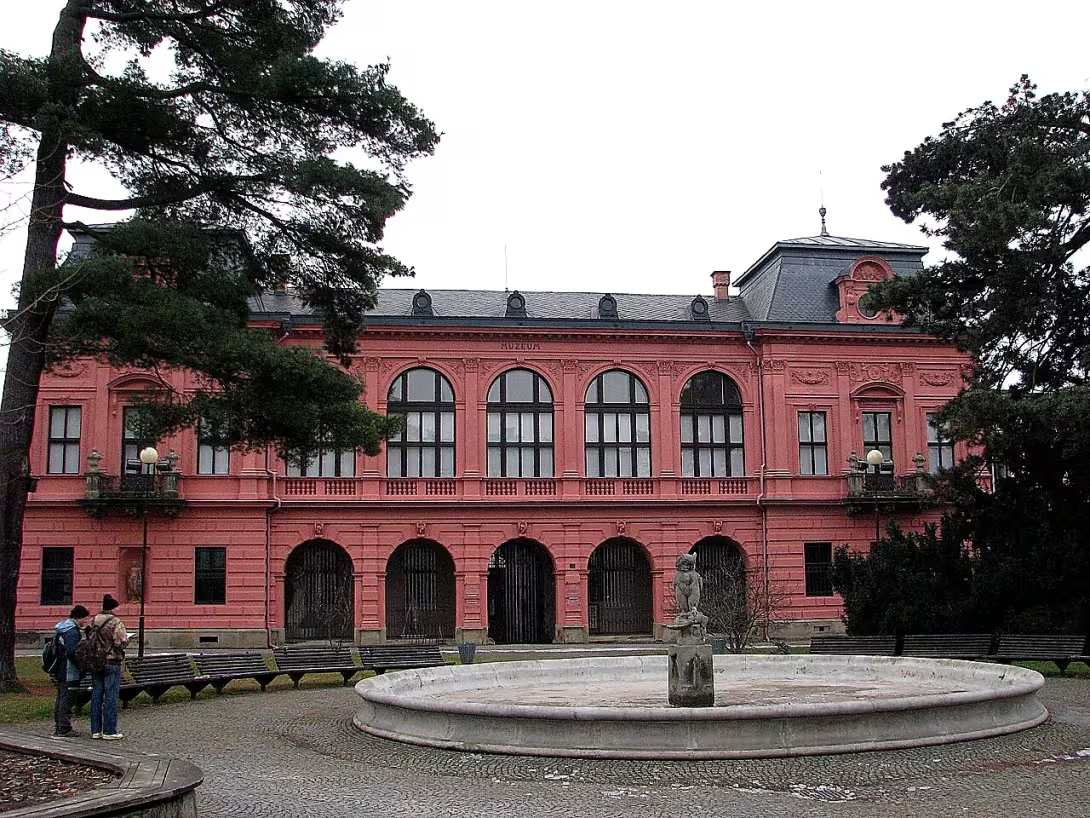
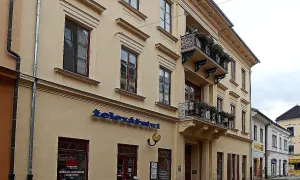
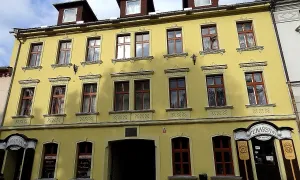
Pavlínin dvůr is an extensive quadruple complex in Šumperk, in which the National Museum is based. At the beginning of the 19th century, it was built as a suburban economic estate, but in 1875-1876 it was converted into a noble Neo-Renaissance palace. This important architecture with many preserved artistic and craft details is protected as a cultural monument.
The base of the complex was laid in 1815 by Franz Xaver Tersch, a member of the Shumper family promoted to noble state with the name von Chudwein. Historical sources, however, indicate that the economy could have been established by 1786. The original Tersch Court had a rectangular plan with an inner courtyard and was probably only partially walled. The south and west wings formed a system of jointly roofed wooden barns, while stables and various economic operations were located in eastern and northern wings. The farm was built in order to facilitate the supply of milk to the city, so it initially lacked accommodation. They were added by the son of Franz Xaver Johann Tersch around 1830. A classicist house with a mansard roof and five axes of windows was created on the north side of the complex. A regularly arranged garden was established between the Court and the Main Class.
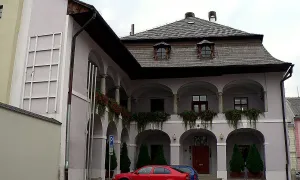
In 1861 the farm was purchased by Alois Scholz, the director of the Klein family iron plants in Sobotín. The development of the site at this time was related to the economic expansion of Šumperka, which thanks to the textile industry gained the nickname Little Vienna. A significant impetus for urban urban planning was the introduction of the railway in 1871 and subsequent planning of the castle moats. In 1875-1876, Scholz had the complex rebuilt extensively according to the design of Viennese architect Moritz Hinträger. The original Classicist house turned into a representative Neo-Renaissance palace with a characteristic central risalite and arcade ships. Despite the luxurious treatment in the spirit of the French-oriented Neoresance complex continued to perform economic function.
Around 1880, the estate was purchased by a doctor and politician Karl Chiari, who named the palace after his wife Paulina as Pavlínin dvůr. Under his leadership, cast iron construction was first used in the economic sector. At the beginning of the 20th century, Art Nouveau architect Julius Mayreder added to the north wing of the western tract with a new kitchen and dining room and used modern concrete technology. Chiari also transformed utility gardens into a vast landscape park with a tennis court and greenhouses. In 1899, in the northern part of the park, architect Wilhelm Lux had another residence - a villa of Doris, designed for the son of Eduardo Chiari. The whole complex was surrounded by a decorative cast iron fence at the time.
The last owner of the Chiari family was Manfred Chiari, whose property was confiscated in 1945 on the basis of the Beneš Decrees. The city of Šumperk initially used the space as warehouses, workshops and building yard. The park was opened to the public on May 1, 1948 as set of May 1. The Natural History Museum has gradually moved to the premises since the 1950s and in 1966 it rebuilt former stables in the west wing into an exhibition hall. The original southern wing was demolished in 1978, allowing the creation of a new House of Culture in 1982. The whole complex was declared a cultural monument in 1988 and in 2004-2008 a complex reconstruction of the facades took place in the historical form.
Today Pavlínin dvůr forms a closed four-wing complex with an inner courtyard, situated in a landscape park. In addition to museum exhibitions and exhibition halls, the Šumperska Gallery, information centre and interactive exhibition for children is located here.
Pavlínin dvůr is a unique witness to the transformation of the economic estate into a city palace and a reminder of the golden period of the Shumper industry. Visiting this complex offers insight into the history of the region and into the architecture of history.
Historical milestones
- 1815
- The establishment of the Franz Xaver Tersch complex.
- 1875
- The beginning of the extensive reconstruction into a representative palace.
- 1964
- The building was declared a cultural monument.
Architectural development
Originally, it was a partially walled farm with wooden barns. Around 1830 a classic residential building was built. In 1875-1876, the complex was completely remodeled to the style of neo-Renaissance according to the design of Moritz Hinträger.
Historical events
1815 - laying the foundations of the complex; 1875-1876 - reconstruction into a neo-renaissance palace; 1964 - a cultural monument.
Owners
Franz Xaver Tersch (1815-1861), Alois Scholz (1861-1880)
Points of interest
- Pavlínin dvůr was converted from an economic farm to a neo-Renaissance palace in 1875-1876. He named the area after his wife Karl Chiari, who purchased it around 1880. - A cast iron structure was first used under Karl Chiari's leadership in the economic sector. - Art Nouveau architect Julius Mayreder added a new kitchen and dining room to the north wing using reinforced concrete technology. - The landscape park was built in 1899 by the Doris villa intended for the son of Eduardo Chiari.
Guide
Show guide text
This text was created by artificial intelligence and has not been editorially reviewed. It may contain inaccuracies.
Welcome to one of the most important architectural units in our city. You are standing right in front of Pavlina's court, a vast and impressive quadruple area, which, by its monumental nature, immediately captures your view and creates a sense of grandeur. Feel the atmosphere where history meets the present and where each wall seems to tell its own story. Before your eyes, there is a building that is very harmonious in its structure and dimensions, even though its history was full of radical changes. Just by looking at this vast complex, you can feel that you are at an object that was not built simply for ordinary use, but with the clear intention of creating an impression of stability, wealth and culture.
However, in order to understand why this area looks like you are now observing it, we must go along with you in time, until the beginning of the nineteenth century. At the time, there was no fancy palace here. This entire space was founded in a thousand and eight hundred fifteen men named Franz Xaver Tersch. At that time, it was a completely different type of construction than the one you see today. Pavlínin dvůr was created as a suburban economic estate. So imagine this place two hundred and a few years ago - not as a representative residence, but as a functional, work-filled area, which served for livelihood and management on the outskirts of the city. It was an era where practical and useful value were first and architecture was primarily a tool for efficient operation of the agricultural economy.
But now pay attention to the incredible transformation that took place in the second half of the nineteenth century. What you see today as a beautiful Neo-Renaissance palace is the result of an extensive and ambitious reconstruction that took place in the years of thousands of eight hundred and seventy-five and thousands of eight hundred and seventy-six. In this crucial period, the character of the site has completely changed. Instead of simple economic buildings, a representative entity began to emerge, which was to reflect the growing social position of its owners. The architect Moritz Hinträger was behind this whole architectural transformation. Pay attention to the details you manage to capture when looking at the facade and individual wings of the building. Although time is inexorably moving forward, the building has retained a number of rare artistic craftsmanship details that show a high level of construction and art at the time. Feel the harmony of the four wings, which together form this closed and concentrated whole. It's an architecture designed to give an impression of order and classic beauty. This importance of the building was officially recognised in the year one thousand and nine hundred and sixty-four, when the whole complex was declared a cultural monument, confirming that you are in something truly rare and historically valuable.
Now that you're looking at these walls, you might think of who lived here and who shaped this place. In addition to the founder of Therese and architect Hinträgerage, the name Karl Chiari plays a key role here. This area was purchased around the year of the thousand and eight hundred and eighty and he is responsible for calling this place Pavlínin dvůr. It's a fascinating story, which also carries a hint of personal affection, for Karl Chiari has decided to name this noble palace after his wife. It is a beautiful example of how family ties and personal love can leave a lasting mark in history and in the names of important monuments. There are other important personalities in the history of this place, such as Alois Scholz, which only confirms that this area has been the center of important lives and social processes for decades.
I have one more interesting thing for you, which may surprise you and which carries a fascinating contrast between the elegance of the palace and the original economic use. Although there is a representative seat before you today, there is a technological progress of its time in its economic part. It was under the leadership of Karel Chiari that cast iron was first used in this part of the complex. Imagine here a combination of traditional economic traffic and modern, then top materials. It was something unusual, a combination of iron strength and an innovative approach to construction, which shows that Pavlínin dvůr was not only about aesthetic beauty, but also about advanced engineering and efforts to modernize.
Now that you know the basics of the story of this place and know the journey that has passed from a simple farm to a prized palace, it is the best time to go deeper into its secrets. Pavlínin dvůr now performs a new, very important function - serves as the headquarters of the National Museum. It is a place where you can explore the wealth of the history of our region and enjoy in peace everything this area offers. Let yourself drift through the atmosphere of this space and discover the details that you have now hidden from your sight. I wish you a pleasant tour and many experiences in discovering this architectural gem.
Tips for visitors
Best time to visit Pavlina of the Court is in the spring and autumn season, when the gardens in Sady 1st May are in their most beautiful form. The sunny days offer ideal conditions for exploring historical buildings and visiting museums.
When visiting, bring protective clothes and shoes suitable for walking on the lawn, especially if you plan to explore the gardens. Don't forget the umbrella and protective eye too, so the sun doesn't surprise you.
It is best to use early morning light or late afternoon for photography. The most beautiful views of Pavlínin dvůr can be captured from the surrounding seedlings of May 1, where it is possible to take impressive pictures of historical buildings.
In the vicinity of Pavlina Court there are 1 May Sets which are ideal for a short walk or relaxation on the bench. These gardens offer quiet rooms and beautifully maintained floral furniture.
Frequently asked questions
Can the monument be visited?
Some buildings of this kind are open for guided tours, others serve another purpose or are privately owned. We have not verified whether and when this monument is open – please ask the operator.
What are the opening hours and admission?
We have not verified the opening hours or admission. Current information is published by the operator.
Where is the monument?
Location: Šumperk, Olomoucký kraj. The map on this page shows the exact spot.
Why is the monument protected?
It is listed in the Central List of Cultural Monuments of the Czech Republic as a cultural monument (register no. 1000137988).
Businesses nearby
Do you run a restaurant, accommodation, shop, museum, rental, wellness or other visitor service near this monument? Show yourself directly to the people heading to it — this is how they will see you in the app and on the web:
Events nearby


Zdroj akcí: otevřená data měst a obcí ČR (Národní katalog otevřených dat) a kalendář akcí Národního památkového ústavu.
Nearby
May 1 orchards.
Accommodation nearby
Themed route
1. Sets of May 1 Type: Park Why to visit: For a quiet walk in the green environment before the tour.
Pavlínin dvůr Type: Museum Why to visit: The main destination of the trip offering a tour of historical collections.
3.Pavlínin dvůr Type: Tanks Why to visit: The immediate area of the sights suitable for rest.
Seasonal recommendations
Spring in Šumperk brings a particularly fresh atmosphere to Pavlín's court, where the surrounding green is awakened and soft, longer daylight highlights the historical details of the building. Nature around the monument is in this period full of flowering trees and birds, which creates a calm and inspirational character for the tour of the museum. Practically, the spring visit is ideal for those who prefer smaller groups of visitors as the main tourist season has not yet started. It is recommended to dress in layers because spring weather can be variable and cold wounds require a jacket, which then in warmer afternoon hours can be easily removed. The most suitable is the arrival on Tuesday or Wednesday morning, when the exposures are the quietest and the guides have enough time to explain in detail the history of the yard without rush.
Leto offers the longest days and bright sunlight, which reveals the full beauty of the exterior and inner spaces. The atmosphere is the most vital at this time, with a higher number of visitors and often with accompanying events that come to life in the main summer season. It is crucial for a comfortable tour to adapt to higher temperatures, i.e. to choose light, breathable clothes and impermeable shoes if you plan longer walks around the area. Due to the expected crowds, it is reasonable to come as soon as possible after opening, ideally in the morning, or on the contrary late afternoon, when visitors' flashes calm down. Don't forget to take enough drinking regime and sun protection, because the shadow on the premises may not always be sufficient.
Autumn in Pavlina's court brings unique warm tones of golden and red leaves, which contrasts with stone architecture and creates a picturesque environment for photography and reflection. Short days and softer, often gray light give the historical spaces a more intimate and dreamy working character. This season is less crowded, allowing a quiet and private visit. Clothes should be sturdy and layered, with emphasis on waterproof jacket, because autumn rain and cold are frequent phenomena. The best time to visit is usually in the afternoon, when light breaks through the windows and interiors of the museum acquire special spells, while evening cold requires quick completion of the tour.
Winter in Šumperk wraps Pavlínin dvůr into a quiet, often snow coat, creating a magical and peaceful atmosphere, ideal for thinking about history. Short days and weak winter light make visitors more focused on internal exposition, which are especially cozy during this period. In advent time the surroundings of the monument can be revived by Christmas decorations, which adds to the holiday mood. Practical advice focuses on heat and dryness: do not forget warm socks, gloves and quality winter shoes because wet walkways and ice can be slippery.
Visualizations and artistic views


The visualisations are generated by artificial intelligence and serve as inspiration.
Photos from the area
Real photos taken near the monument


Zdroj a licence jsou uvedeny u každého snímku.
Tips from visitors
No tips yet. Be the first!
Log in and add your tip.
Sources and literature
Photos: Michal Reiter / CC BY-SA 3.0 — Wikimedia Commons. The author and licence also appear when you hover over the image.
Faktickým podkladem tohoto textu byl článek na Wikipedii, jehož autory jsou přispěvatelé Wikipedie. Článek je dostupný pod licencí CC BY-SA 4.0.
Location on the map

Příběhy a pověsti
Legendy, pověsti a příběhy spjaté s touto památkou
Fotografie návštěvníků
Zatím žádné fotografie. Buďte první, kdo přidá fotografii z návštěvy!
Log in a přidejte svou fotografii nebo hodnoťte.
Za ověřenou návštěvu v aplikaci získáte víc bodů — poznáme podle GPS, že jste na místě.
Reviews and comments