



Zámecké schody Staircases
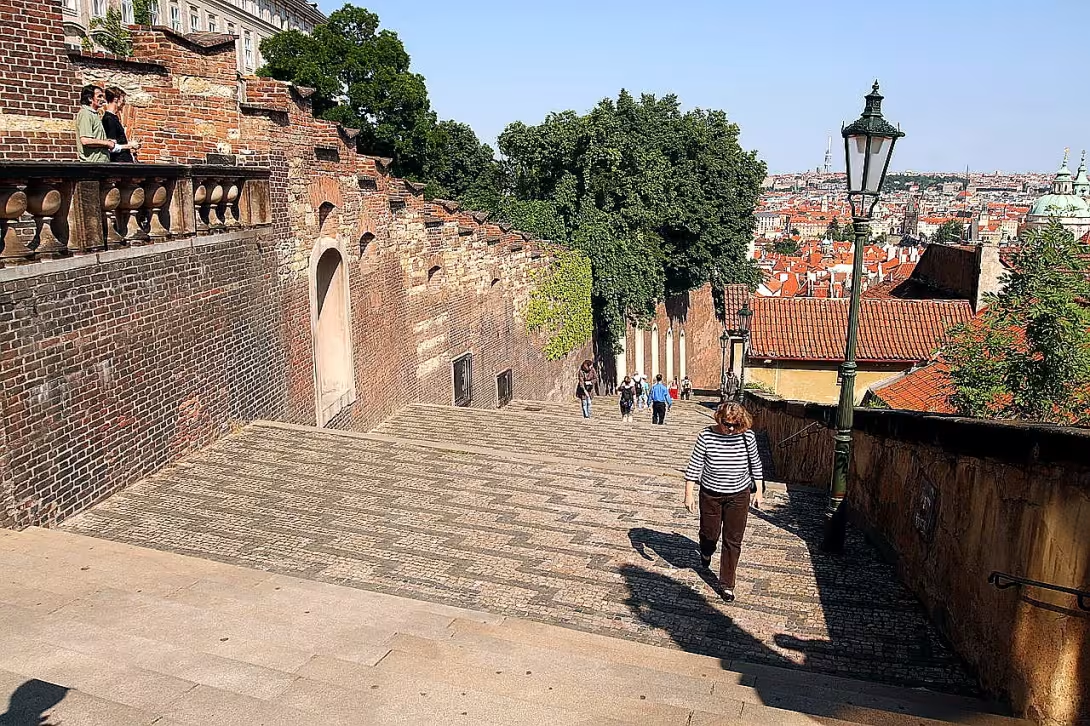
Zámecké schody is a public road for pedestrians that connects Thunovská Street on Malá Strana with the Castle ramp on Hradčanská Square in Prague 1. It lies south of Prague Castle and forms the border between Mala Strana and Hradčany. They are unofficially called the New Castle Stairs, although they are paradoxically older than the Old Castle Stairs leading from Klárovská Street to the east gate of the castle.
Stairs were built at the place of the old road, which the written springs have been bearing since 1278. In the Middle Ages, this road was known as the Strum Road. Since the 14th century, they called it the Degrees, which was later renamed Zámecké schody. Since 1829 they had briefly been named the New Castle Stairs, but since 1870 they returned to the historical name under which they are known today.
The current form of stairs essentially dates back to the mid-17th century. The first Czechoslovak Republic, when the architect Josip Plečnik modified it, brought an important adjustment. The last larger reconstruction took place between 1970 and 1972.
The route surpasses the height difference of 36.6 metres, making it physically more demanding and interesting for different types of visitors. The statue of St. Philip Neri (which originally depicted St. John Sarkander) stands at the top of the supporting wall which forms the transition to Hradčanská Square. The exhibition cycling race of the Prague Stairs, which attracted cycling enthusiasts, took place every year from 1994 to 2018. Today, Zámecké schody is one of the most frequent routes between Mala Strana and Hradčanská Square, where the historical layers of Prague meet with a physical challenge.
Then and now
Drag the slider to compare how the landmark may have looked when it was built with the view today.
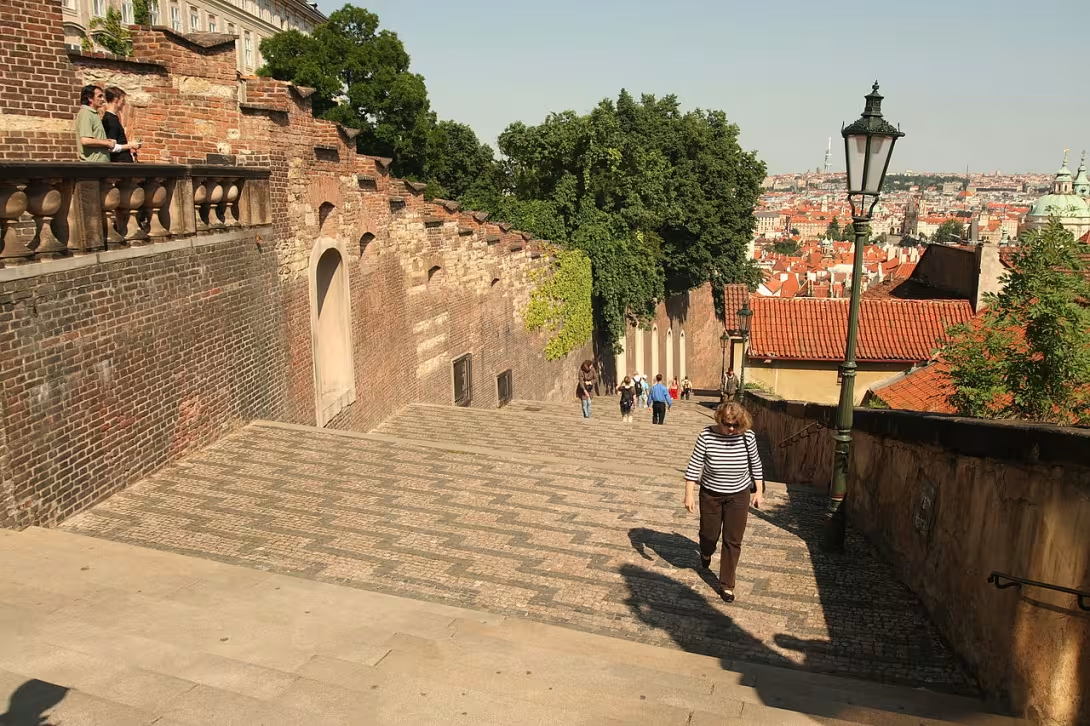

The historical appearance on the left is an AI-generated visualisation and serves as inspiration only.
Historical milestones
- 1278
- Written proof of the existence of an old road, known as the Strand Road.
- 17th century (approximately half)
- The emergence of the current form of a staircase in Baroque style.
- 1994-2018
- Annual event of exhibition cycling race Prague stairs.
Architectural development
Originally there has been a steep road, documented since 1278, known as the Strmá road or the stage. In the 17th century it was converted into a contemporary staircase with supporting walls and stairs. In the first republic they were modified by architect Josip Plečnik, who gave them modern features. The last reconstruction took place in 1970-1972.
Historical events
17th century: The staircase was built as part of the castle system
Points of interest
- Stairs connect Thunovská Street on Malá Strana with the Castle ramp on Hradčanská Square and form a border between the two Prague districts.
- Originally, this route was known as the Strand Road and later the Degree before they got the name Zámecké schody.
- Their current form dates from around the middle of the 17th century, with a significant modification made by architect Josip Plečnik in the first republic.
- They exceed the height difference of 36.6 meters, which makes them a difficult route for pedestrians.
- On top of the stairs is a statue of St. Philip Neri, who originally depicted St. John Sarkander.
Guide
This guide is narrated by a synthetic voice generated by artificial intelligence.
Show guide text
This text was created by artificial intelligence and has not been editorially reviewed. It may contain inaccuracies.
The Castle Stairs are a pedestrian connection between Malá Strana and Hradčany. They lead from Thunovská Street in Malá Strana all the way to the Castle Ramp at Hradčanské náměstí, south of Prague Castle. In the upper part, the stairs pass through the boundary between the two quarters. The stairs overcome a height difference of 36.6 meters.
An old and steep cart road led through this location. Written mentions of it date back to the year 1278, and in the Middle Ages it was called Strmá cesta. In the 14th century it was called Stupně, later Castle Stairs. From 1829 it was called the New Castle Stairs, and from 1870 it has been called the Castle Stairs again, thus the original older name.
The current appearance of the stairs basically dates from around the middle of the 17th century. During the First Republic, architect Josip Plečnik renovated them. The last reconstruction took place in the years 1970 to 1972.
Unofficially, the stairs are still sometimes called the New Castle Stairs. But that name is actually misleading. From a historical perspective, they are older than the Old Castle Stairs, which connect Klárov in Malá Strana with the eastern gate of Prague Castle.
On top of the retaining wall, where the stairs transition into Hradčanské náměstí, stands a statue of Saint Philip Neri. Originally it was a statue of Jan Sarkander.
From 1994 to 2018, an exhibition cycling race called Prague Stairs took place here every year.
Tips for visitors
The best time to visit the castle stairs is early morning or late afternoon. In these times there are fewer crowds and you can enjoy a quiet walk through historical communication. In addition, the architecture of staircases and surrounding buildings is best reflected in the morning light. If you want to experience the atmosphere of the city in full beauty, come here at a time when traditional events such as concerts or markets take place in Hradčanská Square.
Transport to the castle stairs is possible both by car and by public transport. The staircase is easily accessible from Hradčanská Square or Thunovská Street. You can find the current connection and schedule in the search engine or on the official website of the transport company.
When visiting the castle stairs, wear comfortable shoes because it is steep and stone communication. It is also convenient to take a small bag or bag to which you can put a water bottle, a mobile phone and possibly a map or a tourist guide. If you plan to stay longer in the area, you can also pack a light snack. Don't forget to protect against the sun or rain, according to current weather.
Zámecké schody offers several beautiful places for photography. The best light and composition can be found at sunrise or sunset, when light illuminates stone stairs and surrounding architecture. Especially impressive are pictures from the top of the staircase, where there is a view of the Castle ramp and Prague Castle. For interesting photos go to Hradčanská Square, where you can take a picture in front of historical buildings.
There are several interesting places around the castle stairs that are worth visiting during your trip. You can go to Prague Castle, which is just a few minutes' walk away. Another option is to visit Hradčanská Square, where there are beautiful historical buildings and churches. It is also interesting for lovers of architecture to explore Thunovska Street and the Little Party, where there are other historical monuments and picturesque streets. St. Ludmila's church, about ten minutes away by walking, is another great destination.
For families with children, the castle stairs are a great opportunity for active spending time. Children can see the historic stone steps and learn about their history. There are also small cafés and shops in Hradčanská Square or around Thunovska Street where children can relax and taste something sweet. For children's activities you can also visit Prague Castle, where it is often possible to participate in interactive programs or tours specifically designed for children.
Frequently asked questions
Can the monument be visited?
We have not verified whether this monument is accessible. Please ask the owner or operator, or the local municipal office.
Where is the monument?
Location: Hradčany, Hlavní město Praha. The map on this page shows the exact spot.
For kids
Imagine going back to the time when Prague Castle was still young and Zámecké schody was the secret of only a few selected people. It was like a game where you were the lead hero who discovered hidden treasures.
Like these people live here? What happened here? Hradčany was a small village where families and farmers liked it. The staircase was the only way to get out of the Small Town to Hradčanská Square. And right here, on the top of the street, there was a line between both parts of the city.
Businesses nearby
Do you run a restaurant, accommodation, shop, museum, rental, wellness or other visitor service near this monument? Show yourself directly to the people heading to it — this is how they will see you in the app and on the web:
Events nearby

Zdroj akcí: otevřená data měst a obcí ČR (Národní katalog otevřených dat) a kalendář akcí Národního památkového ústavu.
Nearby
Prague Castle (about 500 m to the southeast)
Castle Square (direct neighbourhood)
Thunovská Street and Malá Strana (direct neighbourhood)
St. Ludmila Church (about 600 m northwest)
Accommodation nearby
Trips and activities nearby
Guided tours, tickets and activities nearby from GetYourGuide
Affiliate link: if you buy from the partner, we may receive a commission. The price for you does not change.
Search tours and activities →Themed route
Thematic cruise route: Zámecké schody in Hradčany
1. Zámecké schody (staircase) * Type: * Historical Renaissance staircase from the 16th century, part of Prague Castle in Hradčany. Their architecture combines beauty and practicality, with views of the Hradčanská Square and the Little Party. Worth visiting for their artistic value and role in the history of the castle.
2. Castle Square * Type: * Historical square in the heart of Hradčan. It is surrounded by Baroque and Renaissance buildings, including St. Ludmila's Church. Its atmosphere is typical of the medieval heart of Prague, with the possibility of sitting in cafes and admiring architecture.
3. Church of St. Ludmila * Type: * Roman Church from the 12th century, dedicated to the first Czech queen. Its simple but impressive construction is one of the oldest sacral structures in Prague. Suitable for lovers of medieval architecture and history.
4. Thunovská Street and Malá Strana * Type: * The picturesque street connecting Hradčany with the Little Party, full of historic houses and cafés. Walk down the street offers views of Prague Castle and the possibility to visit nearby monuments such as St. Nicholas Church. Ideal for relaxing and getting to know Prague.
The route is designed so that the visitor gradually explores the nearest vicinity of the Castle Stairs, each point contributing to the overall knowledge of the historical core Hradčan.
Seasonal recommendations
Spring Zámecké schody in Hradčany in the spring season offers a unique combination of awakening nature and historical atmosphere. The sun rays illuminate the stone stages, while the first spring flowers - apple trees, slime trees and snowmobiles - bloom around. The air is fresh, but still cold, and after the rain, light reflects on the stairs like on glass. The atmosphere is calm, but not without movement: young trees in Hradčanská Square begin to grow and decorate the greenery, while the first swallows appear on the castle walls. It is convenient to wear light but warmer layers - it can be cold in the morning, but it can be without a sweater in the middle days. The best time to visit is early in the morning or after lunch when crowds of tourists are not so abundant.
Summer In the summer months, Zámecké schody will turn into a living centre that attracts not only historical value but also the view of Prague. The sun illuminates the stone stages so intensively that the shadows reflect even the smallest details - decorated balustades or old stone plates. The atmosphere is alive, but not without calm: among the crowds of tourists are the sounds of children laughing, the whispers of visitors and distant concerts from the nearby castle yard. In summer, the staircase becomes a meeting place where people stop to relax or take photographs. Light clothes are suitable, but with the possibility to hide from the sun - there is no shadow on the stairs and temperatures often exceed 30 degrees. The best time to visit is early in the morning, until 9 hours ago, or after 17 hours, when the crowds are retreating.
Autumn Autumn at the Castle Stairs brings a magical atmosphere where the sun shines down and is reflected in the golden leaves that gather on the stairs and in the surroundings. The air is cold, but pleasant, and each breath brings the delicate aroma of fallen leaves and wet ground. The atmosphere is quiet, almost mysterious - the stone walls of the staircase appear surrounded by a golden cloak, while the first clouds appear on the castle walls. In advent time visitors often settle here with hot tea and sweets, which gives the place a warm, family atmosphere. It is advisable to put on warmer layers - temperatures fall rapidly in October, and it may be cold on the stairs. The best time to visit is in the morning when the light is still sufficient and the crowds are not so abundant.
Winter In winter, Zámecké schody turns into a beautiful, quiet place that attracts its historic charm and frosty charm. The sun shines low above the horizon and is reflected in the ice crystals on the rocks, while the white carpet of snow spreads around. The atmosphere is calm, almost meditative - only the sounds of steps on stairs and distant sounds from the castle interior interrupt silence. In December visitors often settle here with hot tea and Christmas confectionery, which gives the place a warm, Christmas mood. It is convenient to wear warm clothes - temperatures often fall below zero, and the stairs may be cold. The best time to visit is in the morning when the light is still sufficient and the crowds are not so abundant. In January and February, the visit is the quietest, as tourists are less.
Visualizations and artistic views


The visualisations are generated by artificial intelligence and serve as inspiration.
Photos from the area
Real photos taken near the monument


Zdroj a licence jsou uvedeny u každého snímku.
Tips from visitors
No tips yet. Be the first!
Log in and add your tip.
Sources and literature
Photos: Matthew Black from London, UK / CC BY-SA 2.0 — Wikimedia Commons. The author and licence also appear when you hover over the image.
Faktickým podkladem tohoto textu byl článek na Wikipedii, jehož autory jsou přispěvatelé Wikipedie. Článek je dostupný pod licencí CC BY-SA 4.0.
Location on the map

Příběhy a pověsti
Legendy, pověsti a příběhy spjaté s touto památkou
Fotografie návštěvníků
Zatím žádné fotografie. Buďte první, kdo přidá fotografii z návštěvy!
Log in a přidejte svou fotografii nebo hodnoťte.
Za ověřenou návštěvu v aplikaci získáte víc bodů — poznáme podle GPS, že jste na místě.
Reviews and comments