






Zámecký pivovar v Libni Brewery building
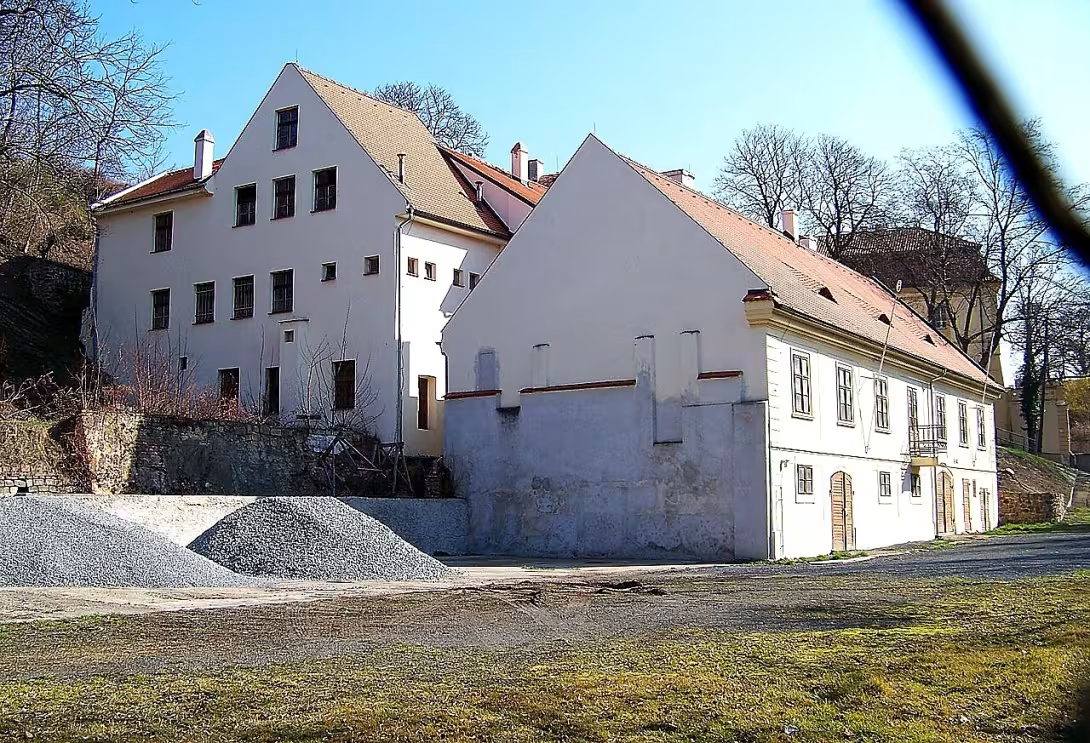
Zámecký pivovar v Libni is a former operational area situated in Prague west of the Löwit castle on the Rokytka stream. This late Baroque monument, whose history dates back to the second half of the 16th century, represents an important proof of industrial development in this location. The building is protected as a real cultural monument of the Czech Republic.
The brewery had the owner of Libna Albrecht Bryknar z Brukštejna built in 1545-1590. Over the centuries, the building replaced a number of owners, including Albrecht z Valdštejna, which held it in 1634 or Jan Hartvík z Nostic. Since 1662, Staré Město pražské has been the owner. The historical context of the operation was closely linked to political changes in the Czech countries, including the period of the Habsburg government and the impact of war conflicts, such as the Thirty Years War or the Austrian Heritage War.
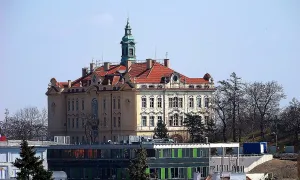
The only preserved building from the original complex is the main brewery building. It is a storey object on a rectangular plan with a saddle roof that bears the characteristics of a late baroque. The facade on the floor breaks down the mould frame and highlights the corners of the quad. The windows are lined with champagne with a bar. The interior of the ground floor is capped by compressed rolled vaults with lunettes and segmental vaults. The brewery cellars are located under a liberal castle.
The operation of the brewery was accompanied by dramatic events. During the wars on Austrian heritage in 1741- 1744, the site was destroyed and its equipment, including a copper cauldron of 300 gold, was scattered. After recovery, about 50 batches per year were cooked in 1752, corresponding to the exhibition of 516 hectolitres of beer. Another destruction came during the seven years of war, when also stocks of malt and hops were destroyed. The performance of the brewery was fluctuating over time: around 1650, the annual exhibition was around 3000 hectolitres, and in 1824 it fell to 1012 hectolitres to reach a maximum of 8750 hectolitres of beer per year before the end of operation.
Martin Stejskal, who worked here in 1846-1871 and held the office of Mayor Libna in 1866-1870, was an important character associated with the company. His son Jan later built the Smashing Brewery at Number 1. In 1899, the first Prague town brewery in Holešovice was rented by a liberal operation, but the following year's activity was definitively terminated. Subsequently there were changes of the complex: the oven was demolished, the malting house was used as a hoarder and the hop shop was converted into flats. Since 1906, the fire station for Prague VIII has used the premises and since 1969 the SKN Theatre in Libni has been based there.
Today, this building resembles the technical and economic history of Libna. Visiting the site offers the opportunity to see preserved Baroque architecture, which has survived centuries of war conflicts and subsequent building modifications. The building is a valuable witness to the changes of Prague suburbs and is worth paying attention to any interested person in the history of Czech brewery.
Historical milestones
- 1650
- Annual exhibition approximately 3000 hl of beer.
- 1824
- The annual exhibition was 1012 hl of beer.
- Before the end of operation the annual exhibition was up to 8750 hl of beer.
Architectural development
The brewery was built in the second half of the 16th century as a late Baroque building with a patronage and a saddle roof. After destruction during the wars, it was restored, but damaged again. Over the years, parts of the brewery were converted for other purposes, for example, the brewery building was converted into a fire station in 1906.
Historical events
- 1741-1744
Owners
- 1545-1590
- Albrecht Bryknar z Brukštejna
- 1634
- Albrecht z Valdštejna
- Jan Hartvík z Nostic
- 1662
- Staré Město pražské
- 1899-1900
Points of interest
- Zámecký pivovar v Libni is a late Baroque monument whose history dates back to the second half of the 16th century. The building is protected as a real cultural monument of the Czech Republic. - The owners of the brewery were for example Albrecht z Valdštejna or Jan Hartvík z Nostic. Since 16 hundred and sixty-two the owner became Staré Město pražské. - During the Austrian heritage wars, the site was destroyed and a copper boiler worth three hundred gold was scattered. Another destruction came during the seven years of war, when also stocks of malt and hops were destroyed. - Sládek Martin Stejskal, who worked in the brewery in the nineteenth century, also held the office of Mayor Libna. His son later built a brewery in Smíchov. - After the brewery was finished, the premises served as a fire station and later the theatre was housed there. The Varna was demolished and the hop factory was converted into flats.
Guide
Show guide text
This text was created by artificial intelligence and has not been editorially reviewed. It may contain inaccuracies.
Welcome, distinguished visitors. Please stop for a moment, take a deep breath and forget the rush of today. Right now, you're standing in front of a building that carries hundreds of years of history, craft, and ambition for people who once worked here. The Zámecký pivovar v Libni stands before you. It's a place where in the past the world of nobility has been blended with the hard work of brewery and miller. If you look around you, feel the atmosphere of this corner of Libna. The building you see is not just an ordinary house, but a silent witness to the transformation of the whole of Prague and its surroundings. It's located near Löwit's Mill, and that's not a coincidence. The Rokytka stream that flows through here has in the past been a living artery for the local industry. The water was necessary for the milling of malt and for the brewing process itself, which is why the brewery is located here, in the embrace of water and nature.
Let us now take a look together at how this building was created and in what context it stood at the time of its greatest glory. The history of this place goes very far, until the second half of the 16th century. So imagine the time of the Renaissance when the world's view began to change, and people were looking for new ways to run. At the time, the brewery was not just a place to make a drink, but a strategic point that brought considerable profits and social influence to the owner. At that time beer production was closely linked to the estate and the right to cook, which was a very desirable privilege. This building was created as part of a wider economic system, where the mill and brewery formed one functional unit that supplied the surroundings and brought prosperity to Libna.
Now I ask you to pay your full attention to the architecture itself. Look carefully at the building in front of you. You can see that this is a storey structure with a rectangle as a base plan. It is a typical representative of the late Baroque style, which means that its shapes are balanced, but at the same time they carry some nobility. Look up on the roof. It is a so-called saddle roof that resembles a horse's saddle shape and is very characteristic of buildings of this type and period.
Now focus on the facade details, i.e. the outer walls of the building. Note that the walls are not smooth, but are broken down by the lisen frames. These are vertical decorative stripes that optically divide the wall area and give it depth and rhythm. It's a fine architectural element that takes the building from monotony. Then please focus your view on the corner of the building, i.e. its corners. Here you will see a quadrant corner. It looks like the corners are composed of large, regularly worked stone blocks. This element was intended to symbolize the stability, strength and resistance of the building in Baroque architecture. And finally look at the windows. Notice their framing, which we call the shampoo framing. These are decorative envelopes around windows that make them more than just holes for light and air. This whole set of details makes the brewery a real architectural monument, which is now rightly protected as a real cultural monument of the Czech Republic.
When you look at these stone walls like this, try to imagine the people who once went through them. The history of this brewery is linked to names we know very well from history books. One of the most important owners was Albrecht z Valdštejna. Imagine this powerful man, one of the greatest leaders and politicians of his time, as he may have stood here and planned his next steps. Valdstejn was known for his relentless ambition and ability to build, and even this brewery was part of his extensive wealth and influence. But he wasn't the only one. At a time when ownership changed, Albrecht Bryknar z Brukštejna or Jan Hartvík z Nostic also left their trail. Each brought something of their own to the brewery management. In later times, Staré Město pražské also fell under the management of the brewery, which shows how important this place was for the metropolis itself.
An interesting aspect that can help you imagine the expansion of this place is the view of numbers, that is, how much beer was actually brewed here. Historical records tell us the fascinating story of the rise and fall. In 1650, the annual exhibitions amounted to approximately 3,000 hectolitres of beer. This was at that time a very decent amount which shows good prosperity. But time passes and circumstances change. If we look at a thousand eight hundred twenty-four, we find that production has fallen to a thousand twelve hectolitres. Maybe you're wondering why this happened. It could have been market changes, competition from other breweries or simply a change in owners' priorities. But the story doesn't end here. Before the complete completion of its operation, the brewery recovered and its annual production reached eight thousand seven hundred fifty hectolitres. It is an incredible leap that shows that there was still a huge demand for quality beer in Libni and that the building was able to produce this high.
There's something mysterious about the fact that a building that today seems so peaceful and quiet to tell its history was once a place of such excitement and hustle. Imagine the carriage of cars, the sound of empty barrels, the smell of hops and malt mixed with the damp air at the Rokytok stream. Zámecký pivovar v Libni is not just a pile of stones and mortar, it is a monument to human work and ambition. The fact that this building has been preserved in such a state is a gift to all of us. It's a bridge that connects us to the Baroque times and to the people who lived centuries ago.
Now that you know the story of this place, I suggest you take another look at the building. Try to connect the architectural details we talked about with the names of the mighty nobles and the idea of thousands of gallons of beer flowing here. Feel the contrast between the strength of the quarted corners and the fineness of the lisen frames.
Thank you for stopping by the Castle Brewery in Libni for a moment. I hope this short trip to the past helped you better understand the value of this place. Now invited to further explore the surroundings. Walk to the Rokytka stream, see the noise of water, and think about how many secrets this landscape still holds. I wish you a pleasant continuation of your journey and a beautiful day spent discovering our common monuments. Goodbye.
Tips for visitors
The best time to visit is from April to October when the weather is pleasant and you can see the facade and surroundings without problems.
With public transport you can reach Libna by bus or tram, which stops near the sights.
It is advisable to bring a camera because the facade and surroundings are very photogenic.
If you have children, you can take them for a walk around where there are many green and quiet places.
If you have time, visit Löwi Mill, which is not far from the monument.
Businesses nearby
Do you run a restaurant, accommodation, shop, museum, rental, wellness or other visitor service near this monument? Show yourself directly to the people heading to it — this is how they will see you in the app and on the web:
Events nearby

Zdroj akcí: otevřená data měst a obcí ČR (Národní katalog otevřených dat) a kalendář akcí Národního památkového ústavu.
Nearby
🏰 Historic sites (1659)
- František Thomayer 0.1 km
- Primátor Jan Podlipný 0.1 km
- Jindřiška Nováková 0.2 km
- Studentská galerie Světova 1 0.3 km Světova 523/1 web
- Otakar Löw 0.3 km
- Klára Löwová 0.3 km
- Antonín Löw 0.3 km
- František Löw 0.3 km
- Oskar Straka 0.3 km
- Zdenka Straková 0.3 km
- Marta Straková 0.3 km
- 100 km tramvajové trati na plošných panelech 0.5 km
- pamětní deska manželům Strnadovým 0.5 km web
- Emil Lustig 0.7 km
- Pomník Obětem 2. světové války 0.9 km
- MUDr. Ladislav Prokop-Procházka 1.0 km
- Film Legends Museum Prague 1.1 km Sokolovská 1207/226
- I.interní oddělení, pneumologie a hrudní chirurgie 1.1 km
- Rokoska 1.1 km
- Ida Robitschek 1.1 km
🍽️ Restaurants and dining (5447)
- U Žabáka 0.1 km
- Döner kebab 0.2 km
- Pleiku 0.2 km Zenklova 1545/39
- Pivnice u Světa 0.2 km Zenklova 465/31
- Kavárna a Cukrárna Sweetbar 0.2 km Náměstí Dr. Václava Holého 1059/17 +420 602 464 417 web
- Noor Kebab 0.2 km Zenklova 440/40 +420 774 838 474 web
- U Horkých 0.2 km Koželužská 595/8 web
- Meteor 0.2 km
- Best Kitchen 0.3 km
- Tankovna Palmovka 0.3 km Zenklova 36 web
- Kantýna Metrostav 0.3 km Koželužská 2450 web
- kopi 0.3 km Zenklova 2530/23 web
- Alf & Bet 0.3 km Světova 454/2 +420 739 765 399 web
- EMA espresso bar 0.3 km Světova 454/2 +420 739 765 399 web
- Mộ̉c Quán 0.3 km
- Bistro u Rokytky 0.3 km Na Rokytce 20
- Kolkovna DOCK 0.3 km Boudníkova 2506/1 web
- Chlebíček Store 0.3 km náměstí Dr. Václava Holého 1331/3 +420 775 513 850 web
- Light roast 0.3 km Smrčkova 2485/4 web
- U Králů 0.3 km Pivovarnická 1022/1 +420 736 134 820
🏨 Accommodation (813)
- Zastávka Meteor 0.2 km web
- Hotel Jerabek 0.4 km Primátorská 4 +420283841919 web
- Penzion Andre 0.7 km
- Penzion Koráb 0.7 km +420 778 775 525 web
- A1 Hotel 0.8 km
- Botel Marina 0.9 km U Libeňského mostu 1 web
- Olympik Tristar 1.0 km U Sluncové 71/14
- Olympik 1.0 km Sokolovská 615/138 +420 266 184 820 web
- Olympik Artemis 1.0 km U Sluncové 14 +420 266 184 891 web
- Step 1.2 km
- Arlington 1.2 km
- Hotel Harfa 1.2 km Drahobejlova 1058/17 +420774373119 web
- Hotel Čechie Praha 1.3 km web
- Carol 1.3 km
- Pension BERG 1.3 km
- Plus Prague 1.4 km +420220510046 web
- Ubytovna U Svobodárny 1.4 km
- Plaza Prague Hotel 1.4 km
- Antonie 1.4 km web
- Hostel Seven 1.4 km
🚲 Rentals and sport (532)
- Sokolovna Praha Libeň 0.1 km +420 284 825 135 web
- DOCK 0.2 km
- Lanové centrum DDM Praha 0.5 km web
- Loděnice Vltava 0.6 km
- Ski & Bike 0.6 km
- Sportovní centrum Koráb 0.7 km Krejčího 2261/2a web
- Lyže se slevou 0.8 km web
- Fitness 0.8 km
- Slackshop.cz 0.8 km web
- GYMPRA - Gymnastická Akademie Praha z.s. 0.9 km Františka Kadlece 2441 +420 720 308 060 web
- Boatpark 0.9 km Sokolovská 146 +420 284 826 787;+420 604 728 042 web
- DR SPORT 1.0 km +420223331575 web
- Cyklovrakoviště 1.0 km +420 606 605 897 web
- Přístav Holešovice 1.1 km
- Sportcentrum Step 1.2 km
- AC Praha 1890 1.2 km U Pekařky 20 web
- Arena Sparta 1.2 km web
- Cinkili 1.2 km
- Squash Holešovice 1.2 km +42083870273
- misfit.cz 1.2 km Jankovcova 1522/53
🥾 Hiking and nature (449)
- park Jana Podlipného 0.1 km
- Černá skála 0.8 km
- Bílá skála 1.2 km
- Vyhlídka Emy Destinnové 1.4 km
- Lesopark Bílá skála 1.4 km
- Sudkovy sady 1.4 km
- U Vody 1.6 km
- Kaizlovy sady 1.6 km
- Okrouhlík 1.7 km
- Prosecká vyhlídka 1.7 km
- Okrouhlík 1.7 km
- Datové centrum Vápenka 1.9 km web
- Ve vnitrobloku 1.9 km
- Vítkov 2.0 km
- Dlážděnka 2.0 km
- park Červená skála 2.2 km
- Park U Kněžské louky 2.3 km
- Exilvorstand der deutschen Sozialdemokratie 1933 bis 1938 2.3 km
- náměstí Organizace spojených národů 2.4 km
- park Krále Alexandra 2.5 km
Accommodation nearby
Trips and activities nearby
Guided tours, tickets and activities nearby from GetYourGuide
Affiliate link: if you buy from the partner, we may receive a commission. The price for you does not change.
Search tours and activities →Themed route
Thematic cruise route from Libni
1. Zámecký pivovar v Libni (brewery building)
Type: Historical building
Why it is worth a visit: This monument is a unique reminder of the former industrial development of the area. Visit and enjoy the history of this brewery, which was once the heart of the local economy.
2. Square Libeň
Type: Public space
Why is worth a visit: The square is the centre of the village and offers beautiful views of the surrounding architecture. It is an ideal place to relax after a tour of the brewery.
3. Church of St. Lawrence
Type: Religious construction
Why is it worth a visit: This church is an example of Baroque architecture and offers a view of the historical part of the village. His interior is full of works of art that interest you.
4. Port Libeň
Type: Water damping
Why is it worth a visit: This place is ideal for those who want to enjoy the peace and sight of the water. It's also a popular local recreation area.
5. Garden at the castle brewery
Type: Garden
Why is it worth a visit: After a tour of the brewery, go to the surrounding garden where you can enjoy the peace and natural beauty. It's a great way to close your visiting day.
This route offers you a view of the history and nature of the village Libeň and is ideal for those who want to know the local cultural heritage.
Seasonal recommendations
Spring brings freshness and awakening nature around the brewery. The soft sunlight highlights the texture of the old walls and trees begin to bloom in the vicinity. It is best for the visit to choose the morning hours when the air is clean and people are not so overwhelmed yet. We recommend to prepare several layers of clothing because the morning cold can still be felt.
In the summer months the atmosphere is alive and the days are very long. The strong sun hits the roof of buildings and the surrounding area very warm. Due to the increased number of visitors in the main summer season, we recommend that you come early in the morning to enjoy peace. Dress very lightly, carry water with you and use the shadow of historical objects to protect against heat.
Autumn turns the surroundings into a colorful landscape full of golden and brown shades, which gives the monument a nostalgic and calm mood. There is often a morning fog that creates a mysterious atmosphere. It is advisable to carry a waterproof jacket and tighter shoes for wet soil. The best time to observe colors is in the afternoon when light creates deep shadows.
Winter brings silence and a cool, raw atmosphere to Libna. Short day and frost make the sightseeing tour rather short but intense experience. It is necessary to have very warm clothes and headgear. Due to lower temperatures, it is recommended to plan a visit at a time when the most light is, since opening times may be shorter in this period.
Visualizations and artistic views


The visualisations are generated by artificial intelligence and serve as inspiration.
Photos from the area
Real photos taken near the monument


Zdroj a licence jsou uvedeny u každého snímku.
Tips from visitors
No tips yet. Be the first!
Log in and add your tip.
Sources and literature
Photos: ŠJů (cs:ŠJů) / CC BY-SA 3.0 — Wikimedia Commons. The author and licence also appear when you hover over the image.
Faktickým podkladem tohoto textu byl článek na Wikipedii, jehož autory jsou přispěvatelé Wikipedie. Článek je dostupný pod licencí CC BY-SA 4.0.
Location on the map
More monuments – Libeň
Show all in the municipality
Příběhy a pověsti
Legendy, pověsti a příběhy spjaté s touto památkou

Fotografie návštěvníků
Zatím žádné fotografie. Buďte první, kdo přidá fotografii z návštěvy!
Log in a přidejte svou fotografii nebo hodnoťte.
Za ověřenou návštěvu v aplikaci získáte víc bodů — poznáme podle GPS, že jste na místě.
Reviews and comments