



zámek Bystřice pod Hostýnem Chateau
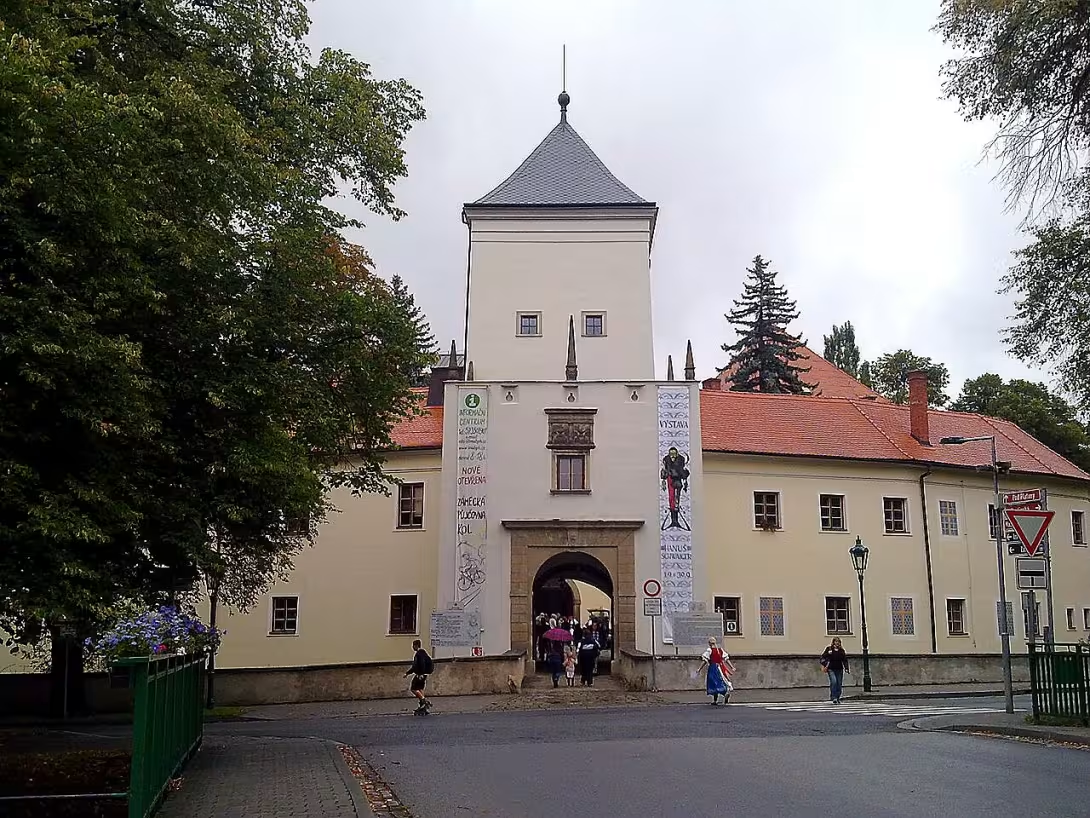
The chateau is located in Bystřice under Hostín, approximately 23 kilometers northeast of Kroměříže. Its foundations were laid by the lords of Cvorkov after the demise of the nearby Giant Chateau. The Gothic water fort was first documented in 1440 and formed both the military and administrative centre of the region. In the middle of the 16th century a Renaissance building was built on the site of the old fortress, which was better suited to the needs of the then nobility.
The chateau of its present form was published by a couple of owners - Bohunka from Vítkov and Václav Bítovský from Bítov in 1616. This period is evidenced by stone coats of arms above the entrance gate. After the White Mountain, the property was confiscated and briefly owned the Lobkovice Chateau before the Rottals, one of the influential Austrian noble families, acquired it in 1650. It was they who then secured the transformation of the building we see today.
At the end of the 18th century František Antonín of Rottal and later his daughter Marie Amalia had the chateau modified. The selon of the design of the great Moravian architect František Antonín Grimm was in 1765 to 1768 the original Renaissance chateau with two baroque wings supplemented by two new wings in classical style. This created a harmonious whole combining three architectural periods.
The end of the 18th century brought a lush cultural life to the chateau. The new owner, Count František Antonín della Rovere di Monte l'Abbate, set up a chateau theatre here and maintained his own band. On the ground floor of one of the baroque wings there was a manufacture for the production of ceramics, called Majolikakamer. In 1805, the Festival Hall obtained a romantic painting with Egyptian motifs, which has been preserved here today.
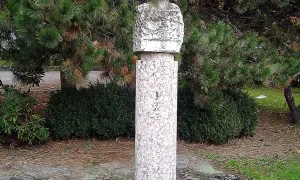
Since 1827, the chateau was owned by Loudon, descendants of the famous Austrian General Ernst Gideon von Laudon. His statue is still visible in the chateau park. This family built a neo-gothic style in the chapel, modernised the chateau facilities and created a valuable park with a greenhouse in which they grew rare exotic plants, including pineapple. In 1897 the chateau was visited by Austrian emperor Franz Joseph I., which is still dedicated to the commemorative inscription on the eastern wing. From the beginning of the 20th century, the sun clock, which Hanushi Schwaiger painted, came.
When the Loudons fell into financial trouble in the 1930s, they sold the chateau to the state. From 1935 to 1990 there were military warehouses of medical supplies. In 1991 the chateau became the property of the city Bystřice pod Hostýnem, which gradually renovates it. Since 2002 there is a permanent exhibition of works by the Eastern Bohemian sculptor Vojmír Vokolka, since 2003 the City Museum of Ceramics. The chateau now hosts concerts and exhibitions, thus continuing the tradition of cultural life, which characterises it for more than two centuries.
Then and now
Drag the slider to compare how the landmark may have looked when it was built with the view today.
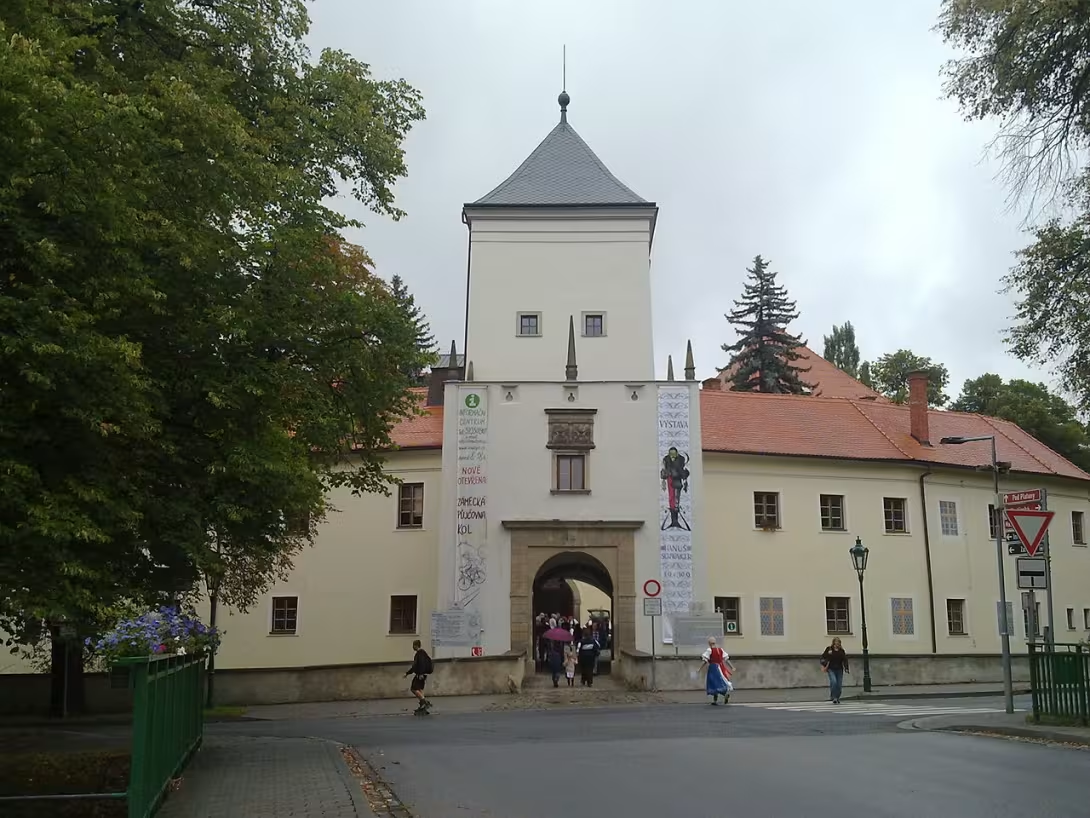

The historical appearance on the left is an AI-generated visualisation and serves as inspiration only.
Historical milestones
- 1616
- The chateau has its final form.
- 1897
- Visit of Austrian emperor Franz Joseph I.
Architectural development
The chateau was built on the basis of a Gothic water fortress. In the middle of the 16th century the Renaissance chateau was built, which later moved into a baroque and classical form. The reconstruction in 1765- 1768 completed the construction with classical wings.
Historical events
- 1616
- The chateau has its final form.
- 1765-1768
- Reconstruction of the chateau according to the design of František Antonín Grimm.
- 1805
- Getting a romantic painting in the Sacred Hall.
- 1897
- Visit of Austrian emperor Franz Joseph I.
Points of interest
- The chateau is located in Bystřice under Hostinen, approximately 23 kilometers northeast of Kroměříže. - Its foundations were laid by the lords of Cvorkov after the demise of the nearby Giant Chateau. - The chateau of its present form was published by a couple of owners - Bohunka from Vítkov and Václav Bítovský from Bítov in 1616. - At the end of the 18th century František Antonín of Rottal and later his daughter Marie Amalia had the chateau modified according to the design of architect František Antonín Grimm, which led to the formation of a harmonious celery combining three architectural periods. Since 1827, the chateau was owned by Loudon, descendants of the famous Austrian General Ernst Gideon von Laudon.
Guide
This guide is narrated by a synthetic voice generated by artificial intelligence.
Show guide text
This text was created by artificial intelligence and has not been editorially reviewed. It may contain inaccuracies.
The castle in Bystřice pod Hostýnem is a Baroque Classicist structure. It grew on the site of an older Gothic water fortress from the fifteenth century. The town is located in Kroměříž district in the Zlín region, twenty-three kilometers to the northeast of Kroměříž.
The fortress was founded by the lords of Tvorkova after the decline of Obřany castle. It is first documented in fourteen forty. In the middle of the sixteenth century, a Renaissance castle apparently arose in its place. Its final form was given to it in sixteen sixteen by the then owners Bohunka of Vítkov and Václav Bítovský of Bítov. Stone coats of arms above the entrance gate commemorate them.
After the Battle of the White Mountain, the castle was confiscated from the Bítovskýs and fell to the Lobkowicz family. However, by sixteen fifty it was acquired by the prominent Austrian Rottal family. After the middle of the eighteenth century, the last member of the family, František Antonín of Rottal, and after him his daughter Marie Amalie, had the castle rebuilt into the form that has essentially been preserved to this day. To the Renaissance forecourt with two Baroque wings, two Classicist wings were added between seventeen sixty-five and seventeen sixty-eight according to the design of Moravian architect František Antonín Grimm. From this period come also two colored coats of arms above the gate to the second courtyard.
At the end of the eighteenth century, the castle enjoyed a rich cultural life. The new owner, Count František Antonín della Rovere di Monte l'Abbate, established a castle theater here and kept a chapel. In the ground floor of one of the Baroque wings, a ceramic manufactory, the so-called Majolikakammer, was created at that time. In eighteen five, the Festival Hall received a Romantic wall painting with motifs of Egyptian landscape.
From eighteen twenty-seven, the castle belonged to the Loudon family, descendants of the famous Austrian general whose statue stands in the castle park. They built a neo-Gothic chapel and modernized the castle's furnishings. The first of the Loudons had a valuable park planted and a greenhouse built, where he cultivated rare exotic plants, among others pineapples. In eighteen ninety-seven, Emperor Francis Joseph the First visited the castle. A memorial inscription on the east wing commemorates that visit. From the beginning of the twentieth century come the sundial, which Hanuš Schwaiger painted between the windows of the second castle building.
In the nineteen thirties, the Loudons got into financial difficulties and sold the castle to the state. From nineteen thirty-five to nineteen ninety, the army stored medical supplies here. They still have supplies in the park and deploy field hospitals from there to countries affected by war or catastrophe.
In nineteen ninety-one, the castle was taken over by the city and is gradually restoring it. Concerts and exhibitions are held here. Since two thousand two, there has been a permanent exhibition of East Bohemian sculptor Vojmír Volek in the ground floor, and since two thousand three, a Municipal Ceramics Museum.
Tips for visitors
For the best experience we recommend a visit in spring or autumn months, when the weather is pleasant and the surrounding landscape offers a quieter atmosphere for a tour of historical spaces.
If you prefer to travel by public transport, check the current connection in the internet traffic search engine.
For a comfortable passage through the historic hall, we recommend taking drinking water with us and putting on comfortable shoes. Families with children can appreciate historical narratives associated with the history of the fortress, and it is advisable to inform yourself in advance of the possibilities of tours for younger visitors.
If you are interested in photography, the most appropriate moments for capturing the Baroque-Classicist facade of the chateau are during the golden watch, i.e. shortly after sunrise or before sunset, when light best highlights the details of architecture.
Frequently asked questions
Can the monument be visited?
Some buildings of this kind are open for guided tours, others serve another purpose or are privately owned. We have not verified whether and when this monument is open – please ask the operator.
What are the opening hours and admission?
We have not verified the opening hours or admission. Current information is published by the operator.
Where is the monument?
Location: Pod Platany 2, Bystřice pod Hostýnem, Zlínský kraj. The map on this page shows the exact spot.
Why is the monument protected?
It is listed in the Central List of Cultural Monuments of the Czech Republic as a cultural monument (register no. 25835/7-5896).
For kids
Businesses nearby
Do you run a restaurant, accommodation, shop, museum, rental, wellness or other visitor service near this monument? Show yourself directly to the people heading to it — this is how they will see you in the app and on the web:
Nearby
ITEX Show interactive overview of the surroundings - restaurants, accommodation, rentals and other places within a 15 km radius.
Data: OpenStreetMap contributors, 15 km radius.
‡ Historical monuments
- Divine heart of Pan (3.2 km)
- sv. Cyril (3.3 km)
- sv Pavel (3.3 km)
- sv. Petr (3.3 km)
- sv Methodij (3.3 km)
- Muzeum in Jurkovichov Hall (3.4 km)
- Fibres (5.7 km)
- Cyril and Methodij (6.4 km)
Restaurant and catering
- Tavern on Myth (5.5 km)
- Na sklep (6.3 km)
- _ (6.7 km)
- Na spy (7.0 km)
- Myslivek cottage Groňka (7.8 km)
- U Milosá (9.8 km)
- Polom (10.1 km)
- Ve (10.2 km)
Accommodation
- Guesthouse Ovčárna (3.2 km - 111)
- Apartment Rusava (5.8 km)
- Guesthouse Osičko (6.4 km - 67)
- Apartments Rusava (6.8 km)
- Marek Horák (7.4 km)
- Guesthouse U Raztoky (7.5 km)
- Pod Shaumburk (7.5 km)
- U Kůlu (7.7 km)
› Rental and sports
- Kuci (5.8 km)
- Koupalist (6.7 km)
- Gyzna Prusinovice (6.8 km - Subgarden 404)
- Paddles (9.4 km)
- SPORT CYKLO s.r.o. (10.2 km - Masarykova 651 / 11)
- EMS active life (10.2 km - Masarykova 64 / 5)
- kupily (10.2 km)
- Cykla Unite (10.4 km - Small 48)
© Tourism and nature
- Pod Kyčerou (8.1 km)
- U Mach wells (8.1 km)
- Machova studenka (8.1 km)
- Machova studenka (8.1 km)
- Portáše walkways (8.2 km)
- Rajnochovice - Kotary (11.0 km)
- Woods (11.3 km)
- Wood (spring) (11.3 km)
Accommodation nearby
Trips and activities nearby
Guided tours, tickets and activities nearby from GetYourGuide
Affiliate link: if you buy from the partner, we may receive a commission. The price for you does not change.
Search tours and activities →Themed route
1. Chateau tank (Type: Outdoor space) - Place of first meeting with architecture and entry point to the entire area. 2. Interiors and exposition (Type: Museum) - A tour of historical rooms and exhibitions that reveal the past of this residence. 3. Castle Tower (Type: Outlook) - Possibility to climb up and observe the panorama of the surrounding city and landscape. 4. Chateau park (Type: Natural site) - Space for relaxation and a peaceful walk in the immediate vicinity of the building.
Seasonal recommendations
Spring on Bystíci pod Hostýn brings an awakening landscape, where the surrounding meadows and forests of the Hostýnský mountains come to life fresh greenery and flowers. The chateau at this time appears to be a quiet oasis where architecture can be admired without disturbing noise of summer tourists. Light is soft and diffuse, which creates ideal conditions for shooting facade and gardens. Practical advice for a spring visit includes clothes layered according to variable weather, as spring days can be cold and rainy. It is best to arrive on Tuesday or Wednesday when the attendance is lowest. It is recommended that footwear with anti-slip soles, as the roads around the monument can be slippery and muddy after rain.
Summer is the main season where the chateau and its surroundings are full of life and sunlight. Nature is in full bloom, and surrounding forests provide a pleasant shadow for walks. The atmosphere here is lively, often accompanied by the noise of summer activites and more visitors. The key for the summer visit is to come as early as possible in the morning, ideally right after opening, to avoid the biggest crowds and unpleasant midday heat. Clothes should be light, breathable and from sweat-forgiving materials, hats and sunglasses are also necessary.
Autumn at Bystíci pod Hostín offers a unique atmosphere of coloured leaves that contrasts with the stone structure of the chateau. The light is warmer and lower, which highlights the texture of the facade and creates dramatic shadows. The surrounding nature is preparing for sleep, and walks around the chateau are gaining a meditation character. Practical advice for the autumn visit includes warm layers of clothing, as evenings are already cold and cold. It is recommended to wear a waterproof jacket because autumn rains are common. The late afternoon visit is ideal for capturing the "golden clock," when light hits the lock at a soft angle, while avoiding the biggest temperatures of the day.
Winter brings the chateau Bystřice pod Hostýnem a quiet and quiet atmosphere, often decorated with snow, which highlights the historical character of the building. Nature is in sleep mode, and the surroundings act like a snowy fairy tale. The light is sharp and bright when the sky is clear, creating a high contrast between white snow and dark elements of architecture. Hot clothes, including gloves, scarf and hat, and shoes with good insulation are essential for the winter visit. Visiting on Saturday or Sunday is less disturbing than in the summer months, and a quiet environment allows you to focus on the details of architecture without rush.
Visualizations and artistic views


The visualisations are generated by artificial intelligence and serve as inspiration.
Photos from the area
Real photos taken near the monument

Zdroj a licence jsou uvedeny u každého snímku.
Atmosphere of the place
This atmospheric visualisation of the place and period was generated by artificial intelligence. It is not real footage of the location.
Tips from visitors
No tips yet. Be the first!
Log in and add your tip.
Sources and literature
Photos: Sir lamoid / CC BY-SA 3.0 — Wikimedia Commons. The author and licence also appear when you hover over the image.
Faktickým podkladem tohoto textu byl článek na Wikipedii, jehož autory jsou přispěvatelé Wikipedie. Článek je dostupný pod licencí CC BY-SA 4.0.
Location on the map
Příběhy a pověsti
Legendy, pověsti a příběhy spjaté s touto památkou
Fotografie návštěvníků
Zatím žádné fotografie. Buďte první, kdo přidá fotografii z návštěvy!
Log in a přidejte svou fotografii nebo hodnoťte.
Za ověřenou návštěvu v aplikaci získáte víc bodů — poznáme podle GPS, že jste na místě.
Reviews and comments