






boží muka na Severní zastávce Wayside shrine
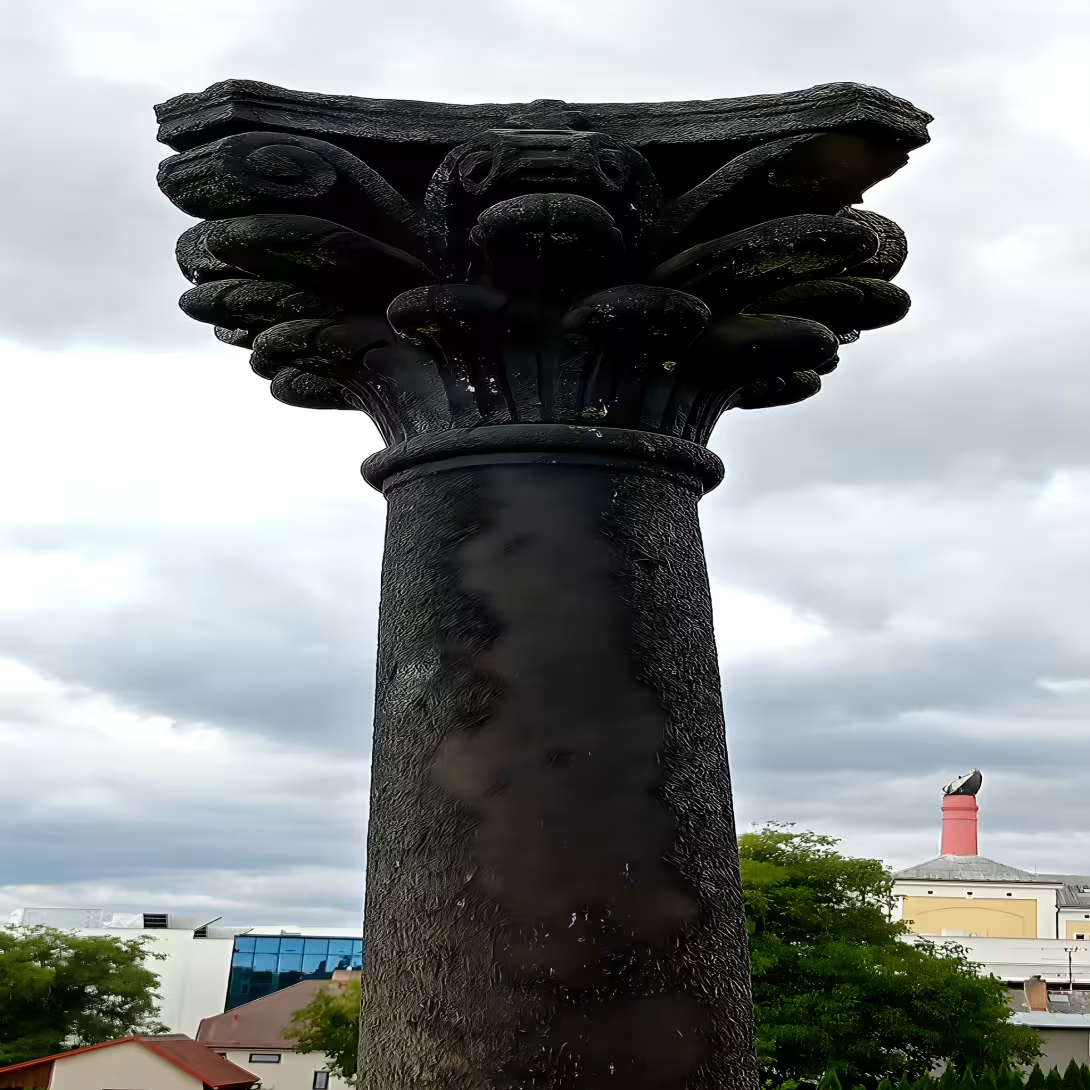
God's torture at the North stop in České Budějovice is a cultural monument that attracts attention with its historical value and architectural character. It is located in a fenced area of the training ground of the Automotoclub České Budějovice, near the train stop north of Prague's class and Karolina Svlé street. This monument is known for its connection to the period after the Thirty Years' War, when it was built as a symbol of religious renewal and baroque artistic direction.
The history of God's torture dates back to the mid-17th century, which is the time after the 30-year war. This war has left deep traces in the Czech countries, causing the need for both religious and cultural renewal. God's torment was built as a symbol of faith and hope, used to worship and remember the suffering caused by war. Its origin is closely linked to the historical context of the time when Baroque architecture became a dominant artistic direction.
Architecturally, God's torture is constructed as a column stone building. Its foundation is a four-sided pedestal with a single niche with a Tuscan granite pole on it. This column is finished with a sophisticated Corinthian header and a cover plate, which originally carried a chapel for storing images and a two-arm cross was placed on top. Although both of these upper parts are now missing, their original function contributes to understanding the historical importance of the monument.
The monument has been officially protected as a cultural monument since 1958. This status ensures its protection and care, allowing the following generations to appreciate its historical and aesthetic value. Although God's torment has been overgrown by a tree for many years, it is now purely maintained and accessible to visitors.
Today's state of God's torture at the North Station reflects its historical value and its current significance. It is located in the immediate vicinity of the northern train station and Prague class, making it easily accessible to local residents and visitors. Its location in the fenced area of the Automotoclub training site ensures its protection from damage and allows it to be kept in the right condition.
God's torment at the North Station is not only a monument with a significant history, but also a symbol of resistance and faith. Its existence resembles the importance of worship and memory of the past, which may inspire anyone who visits it. This monument is therefore not only a historical monument, but also a place that offers opportunities to reflect on your own life and the importance of faith and hope. Visiting God's torture at the North Station is therefore a valuable experience, which brings deep knowledge of the history and present day of the Czech Budejovice.
Historical milestones
- 1958
- The building was declared a cultural monument.
Architectural development
The construction consists of a granite Tuscan pole with a sophisticated Corinthian head with a cover plate. Originally, the board carried a chapel to store the images and a two-arm cross was placed on the very top. Both of these upper parts are now missing.
Points of interest
- God's torment is a cultural monument with historical value and architectural character.
- It is located in the fenced area of the training ground of the Automotoclub České Budějovice, close to the train stop at the Prague class and Karolina Svlé street.
- It was built after a 30-year war as a symbol of religious renewal and baroque artistic direction.
- It is constructed as a column stone building with four-sided pedestal, Tuscan granite shell, Corinthian head and cover plate.
- Since 1958, it has been officially protected as a cultural monument.
Guide
Show guide text
This text was created by artificial intelligence and has not been editorially reviewed. It may contain inaccuracies.
Welcome to one of the quiet but very important monuments of our Budejovice. Stop for a second, take a deep breath, and forget the rush of the city. You are standing right in front of the stony torments of God that stand at the North Station. At first glance, you may be interested in the contrast in which this building is located. Around you are modern elements, near you you hear the excitement of the Prague class and the street Karolina Svetlé, and yet here, in the fenced area of the training grounds of the Automotive Club, there is this fragile witness of ancient centuries. Look at him. It is a modest but dignified column that stands here as a guardian of time and memory, reminding us that history is not just in museums, but is entangled directly into the landscape that we go through every day.
In order to understand why this divine torture is here and what it meant to people at the time of their creation, we need to go back deep into the past in our minds, namely in the mid-seventeenth century. Imagine the landscape after the 30-year war. It was a time of deep exhaustion, but also a time of hope and recovery. Europe and our countries have recovered from unimaginable devastation. It was during this period when people were trying to rebuild their lives and restore their faith that this building was created. At the time, God's torment was not only a religious symbol, it was an expression of gratitude for survival, a request for protection, or simply an orientation point in a landscape that reminded the pilgrim and the local people of a higher order. This particular monument was built just as a symbol of religious renewal that followed years of bloody conflict. It's the massive hope of people who wanted to leave a trace of peace in a landscape that had been torn apart for so long by war.
Now I ask you to pay full attention to the architecture itself. Step closer to the memory, but maintain sufficient distance so that you can perceive it as a whole. Notice the material from which the building is lifted. It is granite, stone hard, durable and persistent, which symbolically corresponds to the very essence of this monument. Look at the bottom, the four-sided base. It's solid and stable, it forms the basis on which everything lies. If you look closely, you'll see a single niche in it. This cavity in the stone had its practical and spiritual meaning. In such notions were often placed small statues of saints, candles or other symbols of faith, which served for the short prayer of bystanders. Imagine how, hundreds of years ago, a little candle could have burned in it in a dark evening, while there was a silence that we find hard to find today.
Above the pedestal there is a pillar that is raised in Tuscan style. The Tuscan Order is the simplest and most sober in terms of ancient architecture. You will not see complex ornaments, corrugated lines or rich decorating. But it is in this simplicity that its strength lies. The Tuscan column emits stability, strength and humility. It's an architecture that doesn't scream, but it speaks in a quiet, thoughtful voice. Note the smooth surface of the granite and the purity of the lines. This sobriety was deliberate in the middle of the seventeenth century. God's torment was meant to be understood by everyone, regardless of his education or social standing. They were supposed to be an accessible stop point for anyone who walked through here.
When we look at this building today, we can ask who actually built it. Who was the architect who designed this exact shape, or which craftsman with patience carved granite blocks? History is silent in this case. The names of the creators remained unknown, they fell into oblivion for centuries. But maybe there's something beautiful about it. This monument does not belong to one particular name, but it belongs to the community, it belongs to the history of our ancestors and it belongs to all of us. It's an anonymous gift from the past that survived generations, regime changes, and the development of a modern city. The fact that we don't know the specific personalities associated with its construction makes it a universal symbol. It's not a monument to a famous person, but a monument to the faith and endurance of ordinary people.
Now let's think about one interesting thing that makes this place unique. Notice where you are. You're in the auto club training grounds. It is a space designed for technology, for motion, for modern driving skills. And right in the middle of this dynamic, technical environment stands a quiet, stone pillar from the seventeenth century. It's a fascinating clash of two worlds. On one side we have speed, engines and modern times, on the other side we have static, eternal granite and the silence of ancient history. This unusual location shows us how urban space evolved. What was once perhaps the edge of the city or the way out of populated areas became part of urban infrastructure. God's torment remained here as an island of peace in the ocean of modernity.
It's important to realize that this monument is not just a random stone. Since a thousand and nine hundred and fifty-eight, it has been officially protected as a cultural monument. This means that the state and the city have recognised its irreplaceable historical value and architectural character. In a thousand and nine hundred and fifty-eight, when the world was in a completely different situation than today, it was decided that this humble pillar deserved protection for future generations. It is a recognition that even small objects can be of great importance if they carry a story about the people who lived before us in this country.
Now that we are slowly ending our short journey together at this place, I suggest you go around the memory again. Feel how light changes on the surface of granite. Imagine how many thousands of people have gone through them in nearly 400 years. How many captivating hopes and silent pleas were spoken near this pillar. God's torment at the North Station is a reminder that even in the most turbulent times, such as the Thirty Years' War, mankind seeks a path to peace and spiritual support.
Thank you for accompanying me in this brief introduction to this hidden jewel of our Budejovice. I hope this view of the ordinary stone column helped you see much more in it. I will now invite you to continue your journey and discover other layers of history that our city so richly offers. We wish you a pleasant walk and many other fascinating discoveries. Goodbye.
Businesses nearby
Do you run a restaurant, accommodation, shop, museum, rental, wellness or other visitor service near this monument? Show yourself directly to the people heading to it — this is how they will see you in the app and on the web:
Events nearby

Zdroj akcí: otevřená data měst a obcí ČR (Národní katalog otevřených dat) a kalendář akcí Národního památkového ústavu.
Nearby
In the immediate vicinity there is a train stop in České Budějovice and Prague class.
Accommodation nearby
Trips and activities nearby
Guided tours, tickets and activities nearby from GetYourGuide
Affiliate link: if you buy from the partner, we may receive a commission. The price for you does not change.
Search tours and activities →Themed route
1. The northern train stop in České Budějovice (transport node) - A suitable starting point for visitors arriving in the city. 2. Prague class (communication artery) - Main link in the immediate vicinity leading to the destination of the journey. 3. God's torture at the North Station (monument) - The main destination of the trip and a significant local monument.
Seasonal recommendations
In spring the monument comes alive with the first green and fine light of the morning sun. The atmosphere is fresh and full of hope, where the blooming surroundings complement the spiritual character of the place. I recommend wearing more layers of clothing because the weather is variable. The best place to visit is in the morning when the air is the cleanest.
The summer season brings rich colour foliage and sharp, bright lighting that highlights the details of the monument. The air is hot and the surroundings act calmly, although there may be more visitors in the season. It is advisable to come very early in the morning to avoid heat and crowds. Don't forget light clothes and plenty of fluids.
Autumn wraps God's torment with golden leaves and frequent mists, creating a mysterious and melancholy mood. The light is softer and golden, which is ideal for capturing the atmosphere of the place. It's practical to carry a waterproof coat or umbrella for frequent collisions. The ideal time to visit is late afternoon.
In winter, the monument is a sober and silent contrast of white snow or freezing air. The atmosphere is humble and calm, stripped of the summer rush. Because of the short days, you have to plan your trip in the morning to keep up with daylight. Hot clothes, gloves and tight shoes are essential to prevent slipping.
Visualizations and artistic views


The visualisations are generated by artificial intelligence and serve as inspiration.
Photos from the area
Real photos taken near the monument


Zdroj a licence jsou uvedeny u každého snímku.
Tips from visitors
No tips yet. Be the first!
Log in and add your tip.
Sources and literature
Fotografie: Czeva / CC BY-SA 4.0, rozlišení zvýšeno umělou inteligencí — Wikimedia Commons. The author and licence also appear when you hover over the image.
Faktickým podkladem tohoto textu byl článek na Wikipedii, jehož autory jsou přispěvatelé Wikipedie. Článek je dostupný pod licencí CC BY-SA 4.0.
Location on the map


Příběhy a pověsti
Legendy, pověsti a příběhy spjaté s touto památkou

Fotografie návštěvníků
Zatím žádné fotografie. Buďte první, kdo přidá fotografii z návštěvy!
Přihlaste se a přidejte svou fotografii nebo hodnoťte.
Za ověřenou návštěvu v aplikaci získáte víc bodů — poznáme podle GPS, že jste na místě.
Reviews and comments