



Boží muka u Malsiček Wayside shrine
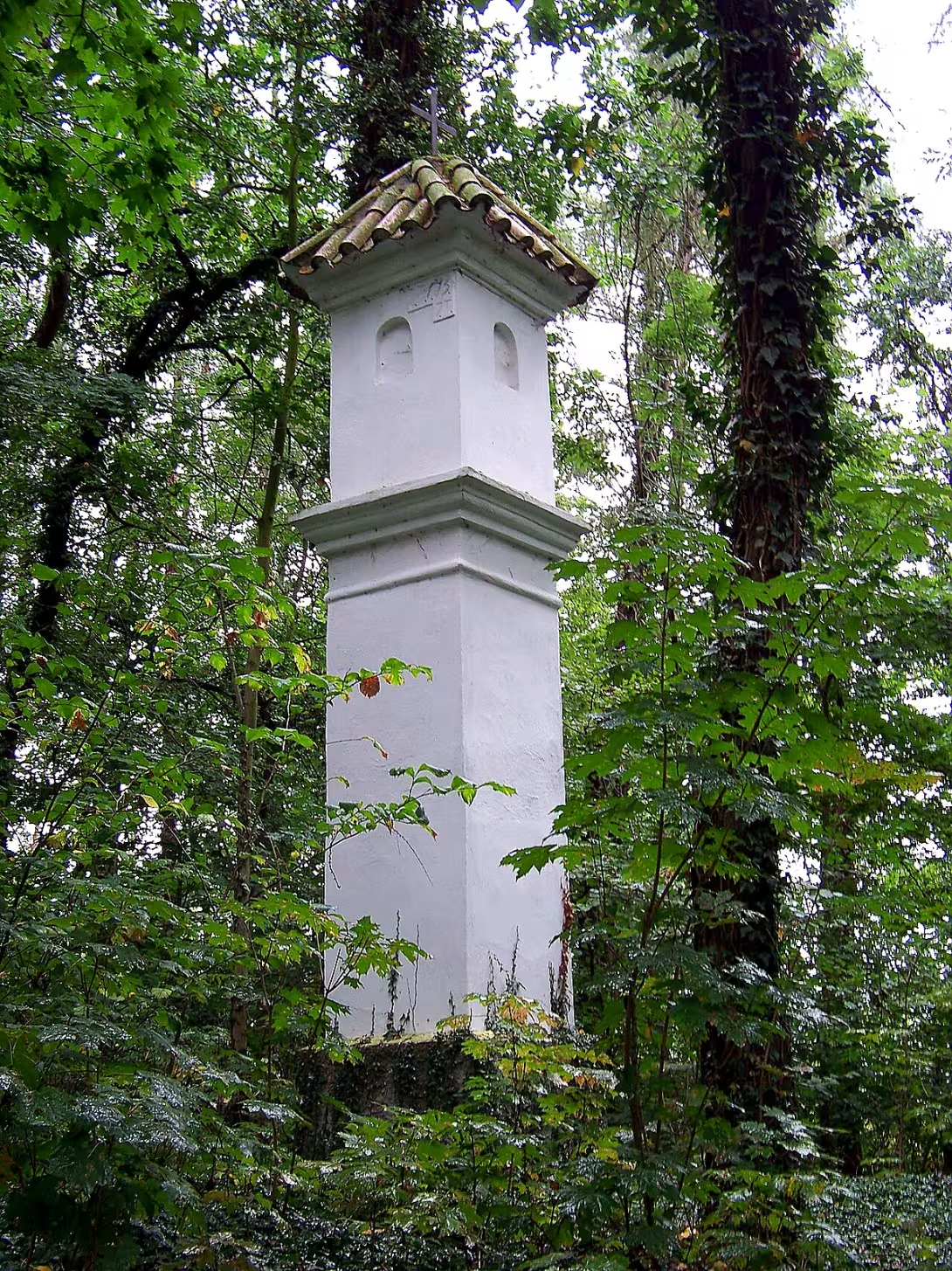
Boží muka u Malsiček are a pillar object with a top chapel and nikky in the village Volyně in the district Strakonice. This construction from the middle of the 18th century today represents an important landscape element.
From the historical records available, neither the specific circumstances of the creation nor the persons who responded for the construction are known. However, it is documented that the object was created in the middle of the 18th century.
Architectural is a pillar construction with a chapel on top and adjacent nobodies. The building is registered in the register of cultural monuments of the Czech Republic under the number 41697 / 3-4482. Coordinates 49.16257, 13.87984 can be used for precise location.
The monument is protected on the territory of the village Volyně and its presence still defines the character of the local landscape.
This historical object offers a view of architecture that shaped the surrounding environment several centuries ago. It is advisable to visit it when exploring this part of the South Bohemia.
Historical milestones
- around 1750
- The creation of a pillar object with a chapel and nobodies
- 20th century
- Registration of cultural monuments
Points of interest
- It's a pillar object with a top chapel and nobodies from the mid-18th century. - The construction represents an important element of the landscape in the village Volyně. There are no specific persons or circumstances in which the object was created. - The monument is registered in the register of cultural monuments of the Czech Republic.
Guide
Show guide text
This text was created by artificial intelligence and has not been editorially reviewed. It may contain inaccuracies.
Welcome to one of the silent but significant traces of the past in the region of South Bohemia. You are standing in front of God's anguish near Malsíček, which stands around the village Volyně in the district of Strakonice. The first impression of this place is a sense of peace and respect. In front of you is a vertical structure that, with its simplicity and nobility, attracts the attention of anyone who passes through here. It's a place where time has stopped and where you can forget the hustle and bustle of the world today and listen to the noise of the surrounding nature.
If we stop at the question of when and why this building was built, we will find ourselves in the unknown. The exact time of its creation is not mentioned in the records and the names of the people who designed or built it have remained hidden in the veil for years. But it is this ignorance that gives the place some charm. God's torment was built in our lands for many reasons. It could serve as a sign of a journey, as an expression of gratitude for a dangerous moment survived, or as a place of prayer for pilgrims and locals. Even though we do not know who specifically laid the first stone, we know that this monument is now recognised as a cultural monument of the Czech Republic, which confirms its value for all of us.
Now let's focus together on the architecture itself that you have right in front of you. Note that this is a so-called pillar structure. This means that the foundation is a fixed, vertical column that carries its superstructure. Please see above where the top chapel is located. It's the top part that ends the whole building and gives it its characteristic shape. Now pay attention to the details in the pillar body. Notice the nic, which is a small deepening in the structure. These niche were used in the past to place paintings, statues of saints or candles that people had lit here during their short stops in the road. See how these elements are distributed and how they form a harmonious whole. Although the construction time has left its mark, it still smells of craftsmanship and respect for tradition.
When we look for specific stories or personalities that are connected to this place, we find that history is silent. The names of great monarchs and famous builders are not written here. But that is what the true power of God's torments lies in Malsice. They are not monuments of power or wealth, but monuments of faith and popular worship. They're witnessing thousands of anonymous lives, people who walked through here, stopped, prayed, and then continued their journey. Each of them brought his own story to this place, his own hope or his own sadness. So you're standing in front of a place that belongs to everyone and no one at the same time.
Perhaps at this point you can think of a question as to whether there are any secrets attached to this building. It is the unknown about the time of creation and the authors that is the greatest mystery. Who was the person who decided that this torture would stand right here in Malsice? Was he a local landlord, or perhaps a traveling craftsman who wanted to leave a mark of his presence? Who, over the centuries, stood by these niche looking for comfort? These empty spaces in history allow us to engage our own imagination and try to imagine what the landscape around Volyně looked like when this building was new and bright.
Let us now perceive the atmosphere of this place as a whole. God's torment is not just a stone object, it is the silent guardians of the landscape. Notice how the building is inserted into the surroundings and how it creates a unified whole with nature. It is a reminder that even small buildings can be of enormous importance if the memory of previous generations remains in them.
Thank you for having me accompany you to this beautiful monument. I hope you've found a moment to think about it, and that the architecture of this pillar object with its chapel and nothing has intrigued you. Now, let's invite you to further explore the area. Go through the surrounding roads slowly, feel the silence of the South Bohemian countryside and be guided by curiosity. Who knows what other hidden treasures await you around Volyně. I wish you a pleasant continued journey and a beautiful day spent discovering our cultural values. Goodbye.
Tips for visitors
The best time to visit is the spring and summer months when the surrounding landscape blooms and the monument is surrounded by greenery. Transport to the village Volyně is possible by car and public connections. Check the specific routes in the current timetables.
To visit we recommend to wear comfortable shoes suitable for the field and plenty of water.
For the best photos we recommend to come in the morning or late afternoon light, which highlights the details of the top chapel and niche in the pillar. The best angles are from the immediate surroundings of the monument where its vertical axis stands out.
Families with children can use a visit for a short trip in nature and to explain the function of these religious columns in the landscape. There are no other specific targets around the monument, so it is recommended to focus on the object itself and the surrounding landscape.
Frequently asked questions
Can the monument be visited?
This is a structure in a public space that can usually be seen from outside free of charge. We have not verified that this particular one is freely accessible.
Where is the monument?
Location: Volyně, Jihočeský kraj. The map on this page shows the exact spot.
Why is the monument protected?
It is listed in the Central List of Cultural Monuments of the Czech Republic as a cultural monument (register no. 41697/3-4482).
Businesses nearby
Do you run a restaurant, accommodation, shop, museum, rental, wellness or other visitor service near this monument? Show yourself directly to the people heading to it — this is how they will see you in the app and on the web:
Events nearby
Zdroj akcí: otevřená data měst a obcí ČR (Národní katalog otevřených dat) a kalendář akcí Národního památkového ústavu.
Nearby
➜ Zobrazit interaktivní přehled okolí – restaurace, ubytování, půjčovny a další místa v okruhu 15 km.
Data: OpenStreetMap contributors, okruh 15 km.
🏰 Historické památky
- zřícenina tvrze Čestice (5.5 km)
- Věnec (7.1 km)
- Dobrš (9.4 km)
- Helfenburk (9.7 km)
- hrob Švandy Dudáka (10.6 km)
- Muzeum Středního Pootaví (10.7 km)
- Kopie sochy moai (10.7 km)
- Morový sloup (11.0 km)
🍽️ Restaurace a stravování
- Na Nové (1.2 km)
- Hospoda Pod kapličkou (4.4 km – 3)
- Amber Hotel Bavor (10.8 km)
- Sedmička (11.0 km)
- Motorest Skalka (12.8 km – 1. máje 595)
- Restarace U Vondrášků (12.9 km)
- Fastfood Factory (14.2 km – 1. máje 144)
- U jelena (14.3 km – Pivovarská 75)
🏨 Ubytování
- Na Nové (1.2 km)
- Anna Vaňková (4.4 km)
- Country statek Jedraž (5.8 km)
- zámek Skalice (9.0 km)
- zámek Skalice (9.0 km)
- Ubytovna Šumavská (9.9 km)
- Pavel Mráz - Pension Hanka (10.0 km)
- Autokemp Podskalí (10.5 km)
🚲 Půjčovny a sport
- Koupaliště Volyně (1.2 km)
- Sportareál Na Muškách (9.8 km)
- HUDY sport (11.0 km – U Sv. Markéty 117)
- Sportisimo (11.3 km)
- Hokejový stadion (11.3 km)
- Plavecký bazén (11.4 km)
- Sportovní areál na sídlišti (11.7 km)
- Tělocvična II. ZŠ Smetanova (13.6 km)
🥾 Turistika a příroda
- pod Věncem 2009 (6.6 km)
- Věnec (7.2 km)
- Věnec (7.2 km)
- Horosedly (7.7 km)
- Boží kámen (10.9 km)
- Mlýny (11.1 km)
- Vacov (11.4 km)
- Kůstrý (12.7 km)
Accommodation nearby
Themed route
Boží muka u Malsiček Walk on the grounds of the monument. Focus on the details of the stone column with the cross and observe the surrounding landscape in the immediate vicinity of this religious object.
Seasonal recommendations
In spring the surroundings of the monument awaken to life and the landscape around Volyně green. The light is fine and the air is fresh, which creates a calm atmosphere for a short walk. We recommend shoes suitable for wet grass and visit in the morning when dew is most visible.
In the summer months they dominate the radiant sun and full of flowers in the surrounding nature. It is advisable to choose light clothes and a sun hat, taking the best time to visit is early morning or late evening to avoid the greatest heat.
Autumn brings golden colours and fog to the South Bohemian landscape, which give the place a mysterious and melancholy touch. The lighting is soft and warm, which is ideal for capturing the mood of the place. It's practical to bring with you a waterproof jacket and tight shoes that can handle fallen leaves and muddy roads.
In the winter, the atmosphere of God's torture is quiet and rough, especially if snow covers the landscape. The contrast between the white landscape and the stone of the monument creates a strict but beautiful picture. It is necessary to wear warm layers of clothing and non-slippery shoes, and we recommend a visit around winter solstice when the day is shortest.
Visualizations and artistic views


The visualisations are generated by artificial intelligence and serve as inspiration.
Photos from the area
Real photos taken near the monument


Zdroj a licence jsou uvedeny u každého snímku.
Tips from visitors
No tips yet. Be the first!
Log in and add your tip.
Sources and literature
Photos: ŠJů (cs:ŠJů) / CC BY-SA 3.0 — Wikimedia Commons. The author and licence also appear when you hover over the image.
Location on the map




Příběhy a pověsti
Legendy, pověsti a příběhy spjaté s touto památkou
Fotografie návštěvníků
Zatím žádné fotografie. Buďte první, kdo přidá fotografii z návštěvy!
Log in a přidejte svou fotografii nebo hodnoťte.
Za ověřenou návštěvu v aplikaci získáte víc bodů — poznáme podle GPS, že jste na místě.
Reviews and comments