



Centrální dispečink DPP Building
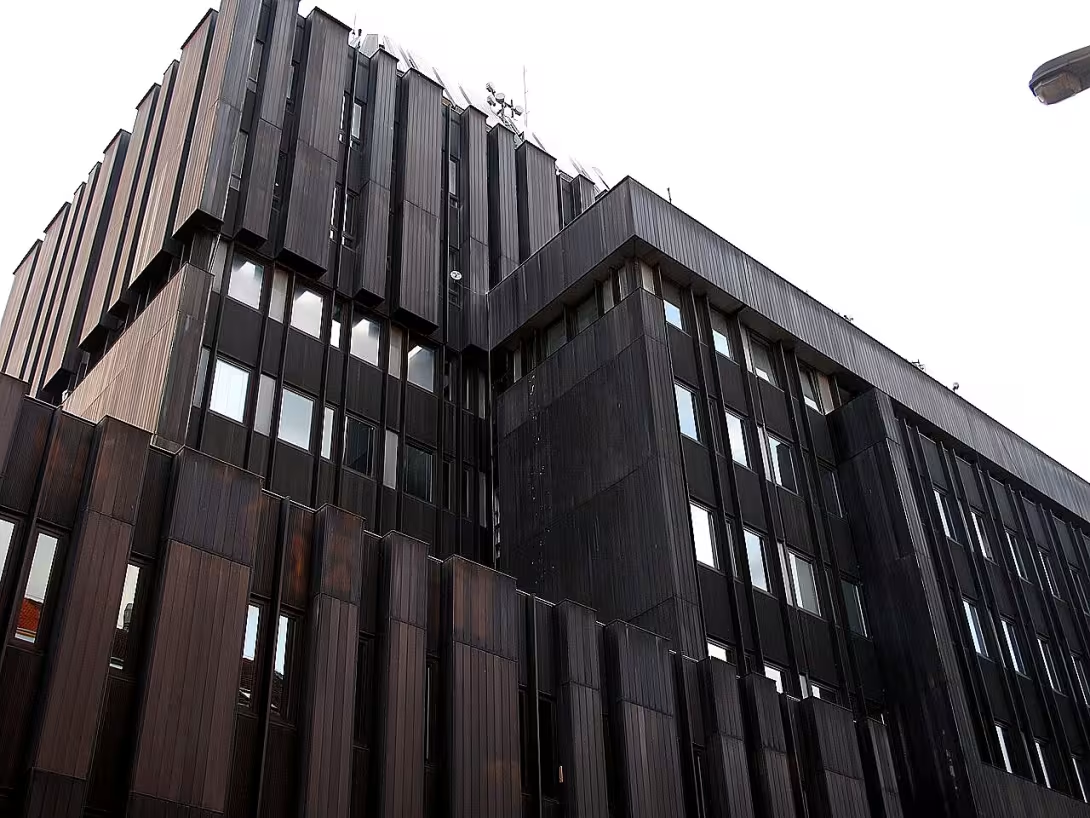
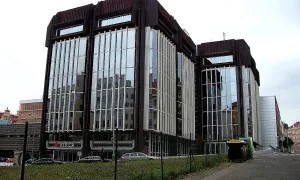
The central dispatching centre of the Transport Enterprise of the Capital City of Prague is a brutalist building located in the street Na Bojiste on New Town in Prague 2. This building, which serves as a central dispatching centre for urban transport - namely metro, tram and bus - is marked by its ten above and four underground floors. It exceeds the surrounding installation by three floors and its facade consists of formed tin elements in dark brown to black.
The building was built on the site of six demolished Neo-Renaissance tenement houses. Originally planned for 1970, the construction began in 1972 and was completed in 1978. The architects Eva Růžičková and Vratislav Růžička from the Regional Design Institute were behind the proposal, carried out by the national enterprise Metrostav. Subway dispatch in the underground part worked from the beginning, but the train dispatching in the upper floors was not operational in 1983.
The building is not protected by a monument, but it is located on the territory of the Prague Heritage Reserve, which is part of the UNESCO World Heritage Site. The National Monument Institute's commemorative catalogue evaluates it as a brutal intervention into the city conservation, which affected not only the particular block, but the entire Prague panorama. According to architect Petr Kucera, the building caused rather negative reactions and was included in the cycle of the ugliest architecture of Prague. It has nicknames like "Mordor" or "rusty radiator," also referred to as an ulcer on the Prague panorama and the embodiment of communist evil.
The ownership of the building belongs to the Transport Company of the capital city of Prague. Within the organization it is marked by CD, which also appears on the facade in stylized design. The building serves as a headquarters for public transport control hubs - metro, tram and buses - as well as offices. There are various departments and units of the Transport Undertaking, including operational and technical dispatches. On the ground floor there is a central pre-sale of tickets to Prague Integrated Transport and the additional cash register, which are accessible to the public.
Today, the building is still in operation as a key dispatch for urban transport. Its unique architectural style and history make it interesting for visitors, especially those interested in urban planning and urban development history. Despite negative responses to its appearance, the building is an essential part of Prague transport infrastructure, making it worth considering for every traveller to the capital.
Historical milestones
- 1972
- Start of construction of DPP central dispatcher
- 1978
- Completion and opening of the DPP central dispatcher
- 1983
- The streetcar still hasn't been operational
Architectural development
The building was built on the site of six demolished Neo-Renaissance tenement houses. Architects Eva Růžičková and Vratislav Růžička have designed a building implemented by the national enterprise Metrostav. The facade consists of tin elements in dark color.
Historical events
- 1970
- According to the original studies, the building was planned at the site of house No. 929.
- 1972
- Construction started.
- 1983
- The underground subway dispatch system has been operating since the beginning, but the tram dispatch has not.
Owners
Transport business in Prague
Points of interest
- The building stands at the site of six demolished Neo-Renaissance tenement houses and its construction began in 1972, although it was originally planned for 1970. - Metro dispatch in the underground part worked from the beginning, but the train dispatching in the upper floors was not operational in 1983. - The building has ten floors above ground and four floors below ground, thus exceeding the surrounding building by three floors. - The building has nicknames like "Mordor" or "rusty radiator" and is referred to as an ulcer on the Prague panorama. - The facade consists of moulded tin elements in dark brown to black and bears a stylized abbreviation CD.
Guide
Show guide text
This text was created by artificial intelligence and has not been editorially reviewed. It may contain inaccuracies.
Welcome to Prague two. You're standing right where the history of the old town meets the technical power of modern age. In front of your eyes is a building with incredible strength and uncompromising character. Perhaps at first glance you surprise her unusual look and how different she is from everything you've seen in this part of town so far. This building is not just an ordinary house. It's the brain of the entire urban movement, a place where it's decided how thousands of people will flow through and under the streets.
The view must immediately welcome you with its unusual size. Notice how this structure dominates the whole neighborhood. If you look at the neighboring houses, you'll see that this building is significantly higher from them. It goes above the building by three floors, which gives it a feeling of constant supervision over the whole neighborhood. It's a building that doesn't try to be subtle. On the contrary, by its mass and scope, it clearly tells you that it has a very important role here. It has ten floors that stand above the ground, but its true power extends much deeper. It also has four floors hidden deep beneath the surface of the earth, where there is constant movement and control.
Now let's move forward in time and understand why this colossus is standing here. To understand the present, we need to look at what was here before. Imagine this place over 50 years ago. The place where you now see this modern and difficult whole, there once stood six beautiful tenement houses. They were built in the style of a new Renaissance, with rich details and finer shapes that were typical of Prague. These houses formed a coherent and human face of the street on the battlefield. However, with the arrival of a new era and the effort to modernise the city, there has been a great change. These old houses were demolished to make room for something to symbolize progress and technical maturity.
The way to build this building was not easy. The plans for its creation were originally planned for the year one thousand nine hundred seventy, but reality was different. The construction began only in the year one thousand nine and seventy-two. This process lasted several years until the construction was completed and opened in the year one thousand nine-eighty-eight. There's tension between great ambitions and practical realization that was so typical of that time.
Now pay attention to the architecture itself, which you are now observing. This building is built in so-called brutalist style. What does that mean for you as an observer? It means the honesty of materials and the emphasis on massive shapes. There is no unnecessary decorating to mask the nature of the building. Instead, you see strength and functionality. Look at the facade that forms the main face of the entire object. Its surface is not smooth or fine. It consists of specially shaped elements of sheet metal. These elements are dark brown, which gives weight and seriousness to the building. This dark metal look creates an interesting contrast with the outside world and gives an almost impenetrable whole atmosphere. It's like armor that protects the heart of urban transport.
There are two people behind this whole proposal and implementation who put their professional vision into this building. They're architects Eva Růžičková and Vratislav Růžička. It was their work that created this monumental object, which today serves as a central dispatcher for the transport business of the capital city of Prague. It's a place where you coordinate subway, tram and bus movements. Imagine the constant work, the concentration that takes place inside these walls.
And this is where we come to one of the most interesting mysteries of this place. Although the building seemed ready and functional, its inner life developed very unevenly. It's a fascinating story about technical difficulties and unexpected delays. When the building started to be used, its underground part, which serves to control the subway, was operational from the very beginning. That was a big success. However, the upper floors, which were to be home to the train dispatcher, were still not fully functional at that time. It is incredible, but even several years after the completion of the construction, namely in the year one thousand nine hundred eighty-third, the dispatcher for trams was still not fully able to fulfil his full role. Imagine the situation - the building stands, its facade shines in brown sheet metal, but in its upper floors there was still something like technical waiting. Why did it take so long? Was it the complexity of the technique, or perhaps the unexpected obstacles to driving? This remains a question that gives this place some mystery.
You're standing in front of a building that witnessed the transformation of Prague. It's a monument to a time when it was believed in huge structures and technical rolling of the old world. It's a place that links the loss of old Renaissance houses to the victory of the modern, iron and concrete era.
I hope this view of the central dispatcher helped you better understand its importance and its unusual character. This building is not just a part of the city, it is its heartbeat. Her dark facade and massive figure will remind you how complex and fascinating the movement of people in the metropolis is. Now that you know what's behind this tin-metal look, I invite you to continue your walk and look for further traces of history in the streets of Prague two. Thank you for your attention and I wish you a pleasant continuation in discovering our city.
Tips for visitors
The best time to visit the DPP Central Dispatch is in the early afternoon when there are fewer people and the light is ideal for photography. The building features a unique brutalist architectural style, making it interesting for lovers of modern design.
The best way to get here is to use buses or trams. The current connection can be easily found using an online route search engine.
When you visit, remember the camera because the building offers impressive footage thanks to its unique architectural style. Photography is best in direct sunlight, which highlights hard lines and texture of concrete walls.
In the vicinity of the building there is the National Technical Museum, which can be visited within short walks. The museum offers interesting exhibitions about the history and present day of industry and technology.
For families with children, it is advisable to visit the nearby garden of the Trojan Palace after visiting dispatch, where children can move in the open area and enjoy quiet moments.
Frequently asked questions
Can the monument be visited?
The building is in use (offices, a school, shops and the like). The interior is generally accessible only during operating hours and tours are not usually offered; we have not verified the details. You can see the exterior from the street.
Where is the monument?
Location: Praha 2. The map on this page shows the exact spot.
Why is the monument protected?
It is listed in the Central List of Cultural Monuments of the Czech Republic as a cultural monument (register no. 1999990636).
Businesses nearby
Do you run a restaurant, accommodation, shop, museum, rental, wellness or other visitor service near this monument? Show yourself directly to the people heading to it — this is how they will see you in the app and on the web:
Events nearby

Zdroj akcí: otevřená data měst a obcí ČR (Národní katalog otevřených dat) a kalendář akcí Národního památkového ústavu.
Nearby
🏰 Historic sites (1683)
- Olga Töpferová 0.1 km
- Artur Töpfer 0.1 km
- Oskar Töpfer 0.1 km
- Gertruda Töpferová 0.1 km
- Fany Klominková 0.1 km
- Karel Töpfer 0.1 km
- Max Töpfer 0.1 km
- Armin Gipsz 0.1 km
- Regina Gipszová 0.1 km
- Muzeum Antonína Dvořáka 0.1 km Ke Karlovu 462/20 +420 224 918 013 web
- Muzeum Legií 0.1 km +420 224 266 235 web
- Arnošt Lederer 0.2 km
- Robert Vogel 0.2 km
- Marta Ledererová 0.2 km
- Ludmila Vogelová 0.2 km
- Marie Ann Guth 0.2 km
- Otto Vogel 0.2 km
- Mudr. Arnošt Kalmus 0.2 km
- Elsa Kalmusová 0.2 km
- Božena Němcová 0.2 km
🍽️ Restaurants and dining (5505)
- Švejk Hostinec U Kalicha 0.1 km Na Bojišti 12 web
- Maču Pikču Restaurace 0.1 km +420774178181 web
- Rendez Vous 0.1 km
- Kaviár 0.1 km Na Bojišti 1989/8 +420 608 714 582 web
- Café Purkyně 0.1 km Sokolská 31
- Biwon korea 0.1 km Sokolská 1792/52 +420 739 078 927
- Cukrcafé 0.1 km
- U Graffů 0.1 km náměstí I. P. Pavlova 6 +420 732 765 309 web
- Mlynářské pelmeně 0.1 km Ječná 522/40 web
- Legenda 0.1 km
- U Ječmene 0.1 km web
- Lemberg 0.1 km Legerova 47
- Miss sophis 0.1 km
- Legenda 0.1 km
- Coffee Factory 0.2 km
- La Mouka 0.2 km Ječná 243/39a +420 773 201 771 web
- Bao Bao 0.2 km Ječná 1763/43
- Annamalai 0.2 km
- Kavárna snů 0.2 km Ke Karlovu 12
- Honest Taste 0.2 km Legerova 33
🏨 Accommodation (823)
- NABO Apartments 0.0 km Na Bojišti 22
- Hotel DaVinci Wenceslas Square 0.1 km Sokolská 25
- Hotel City Central de Luxe 0.1 km Sokolská 21 +420 242 430 003 web
- Hostel Centre 0.1 km Sokolská 29
- Hotel Brixen 0.1 km Sokolská 44
- Hotel Tivoli 0.1 km Sokolská 1794/48 +420 296 114 401 web
- Hotel S42 0.1 km Sokolská 42/1797 web
- Hostel Advantage 0.1 km Sokolská 11
- Ibis Praha Wenceslas Square 0.1 km Kateřinská 36
- Novotel Praha Wenceslas Square 0.1 km Kateřinská 38
- Anyday Apartments 0.1 km Sokolská 9
- Ankora 0.1 km Kateřinská 42 +420224242863 web
- Sophie's Hostel 0.1 km
- Legie 0.1 km Sokolská 33 +420 775 564 968 web
- Pension Brezina 0.1 km Legerova 39
- LaNoblessa 2 0.1 km Legerova 45
- Alfons Boutique 0.1 km Legerova 1821/41 web
- Miss Sophie's New Town 0.1 km Melounová 3 +420 210 011 210 web
- Hotel Residence Select 0.1 km Sokolská 34 +420 734 729 646 web
- Miss Sophie's New Town & Wellness 0.1 km Melounová 3
🚲 Rentals and sport (542)
- Ski & Surf 0.3 km
- Tělocvičná jednota Sokol Pražský 0.3 km Žitná 1438/42 +420 221 965 311 web
- 11 Teamsports 0.4 km
- Husky 0.6 km Žitná 669/1 +420 222 220 950 web
- BEL Sport 0.7 km
- Festka 0.8 km Jana Masaryka 281/28 +420 775 264 543 web
- Rossignol 0.8 km +420 733 626 382
- A3 SPORT 0.8 km +420 222 240 690 web
- Sportovní hala Folimanka 0.8 km
- HUDYsport 0.8 km Slezská 8 web
- Centrum volného času Botič 0.9 km
- Oasis City 0.9 km Václavské náměstí 36
- Sport Servis 0.9 km
- Hanibal Sport 0.9 km Korunní 732/16 +420 222 522 416;+420 220 920 820 web
- Kieser Training 0.9 km
- Centrum Služeb Pre 1.0 km web
- World Class Fitness Center Wenceslas 1.0 km Václavské náměstí 22
- Moira 1.0 km Budečská 1020/20 +420 222 515 544 web
- Honzovy 1.0 km +420 777 493 182
- Kola-Lyže-Výtoň 1.0 km Vyšehradská 7 +420 777 307 205 web
🥾 Hiking and nature (481)
- Mind Maze 0.3 km
- Čelakovského sady 0.5 km
- Čelakovského sady 0.5 km
- Národní muzeum věž 0.6 km
- Novoměstská radnice 0.7 km
- Zítkovy sady 1.0 km
- Dancing House viewpoint 1.0 km
- grotta 1.2 km
- Štulcovy sady 1.2 km
- Karlachovy sady 1.2 km
- Slavín 1.2 km
- Thrill Park 1.3 km Provaznická 11 +420 774 413 313 web
- Vyšehrad 1.3 km
- České loutky 1.3 km web
- Na Příkopě 1.4 km
- Dienzenhoferovy sady 1.4 km
- Na Příkopě 1.4 km
- Celetná 1.5 km
- Celetná 1.5 km
- Celetná 1.5 km
Accommodation nearby
Trips and activities nearby
Guided tours, tickets and activities nearby from GetYourGuide
Affiliate link: if you buy from the partner, we may receive a commission. The price for you does not change.
Search tours and activities →Themed route
1. Centrální dispečink DPP (Building) - The main destination of the journey, which serves as the brain of urban transport. 2. Internal parts of the building (Space) - Here you can see what the technical background and workplace of dispatcher looks like. 3. The immediate area of the building (surrounding area) - Walk around the building in its vicinity.
Seasonal recommendations
Spring brings soft, scattered light and the first signs of green, giving the building a fresh look. The atmosphere is optimistic and the air is clear. For the best experience I recommend visiting the morning when there are even fewer people. Dress in a straight dress so that you can easily adjust to variable temperatures.
In the summer months the sun is strong and the color of the building is very clear. The city is the most busy and crowded at the time. Due to high temperatures and crowds, it is best to arrive first thing in the morning before the biggest heat and rush of visitors. We recommend light clothes and carrying water.
Autumn season offers golden shades and morning fog that create a calm and a little mysterious mood. The light is ideal at this time to capture the details of the construction. It is advisable to wear a windbreaker or coat because it can cool. The number of people on the streets usually falls, which allows for more peaceful observation.
Zimą is light low and shadows are long, which highlights the shapes of the building in a cool environment. The atmosphere is quiet and the city is more peaceful. Due to the frost and shorter time of day, I recommend a visit around noon. It is necessary to have very warm clothes, including coat and gloves, to make you uncomfortable.
Visualizations and artistic views

The visualisations are generated by artificial intelligence and serve as inspiration.
Photos from the area
Real photos taken near the monument


Zdroj a licence jsou uvedeny u každého snímku.
Tips from visitors
No tips yet. Be the first!
Log in and add your tip.
Sources and literature
Photos: Juandev / CC BY 3.0 — Wikimedia Commons. The author and licence also appear when you hover over the image.
Faktickým podkladem tohoto textu byl článek na Wikipedii, jehož autory jsou přispěvatelé Wikipedie. Článek je dostupný pod licencí CC BY-SA 4.0.
Location on the map
Příběhy a pověsti
Legendy, pověsti a příběhy spjaté s touto památkou
Fotografie návštěvníků
Zatím žádné fotografie. Buďte první, kdo přidá fotografii z návštěvy!
Log in a přidejte svou fotografii nebo hodnoťte.
Za ověřenou návštěvu v aplikaci získáte víc bodů — poznáme podle GPS, že jste na místě.
Reviews and comments