






dřevěná lávka v Prudké Wooden bridge
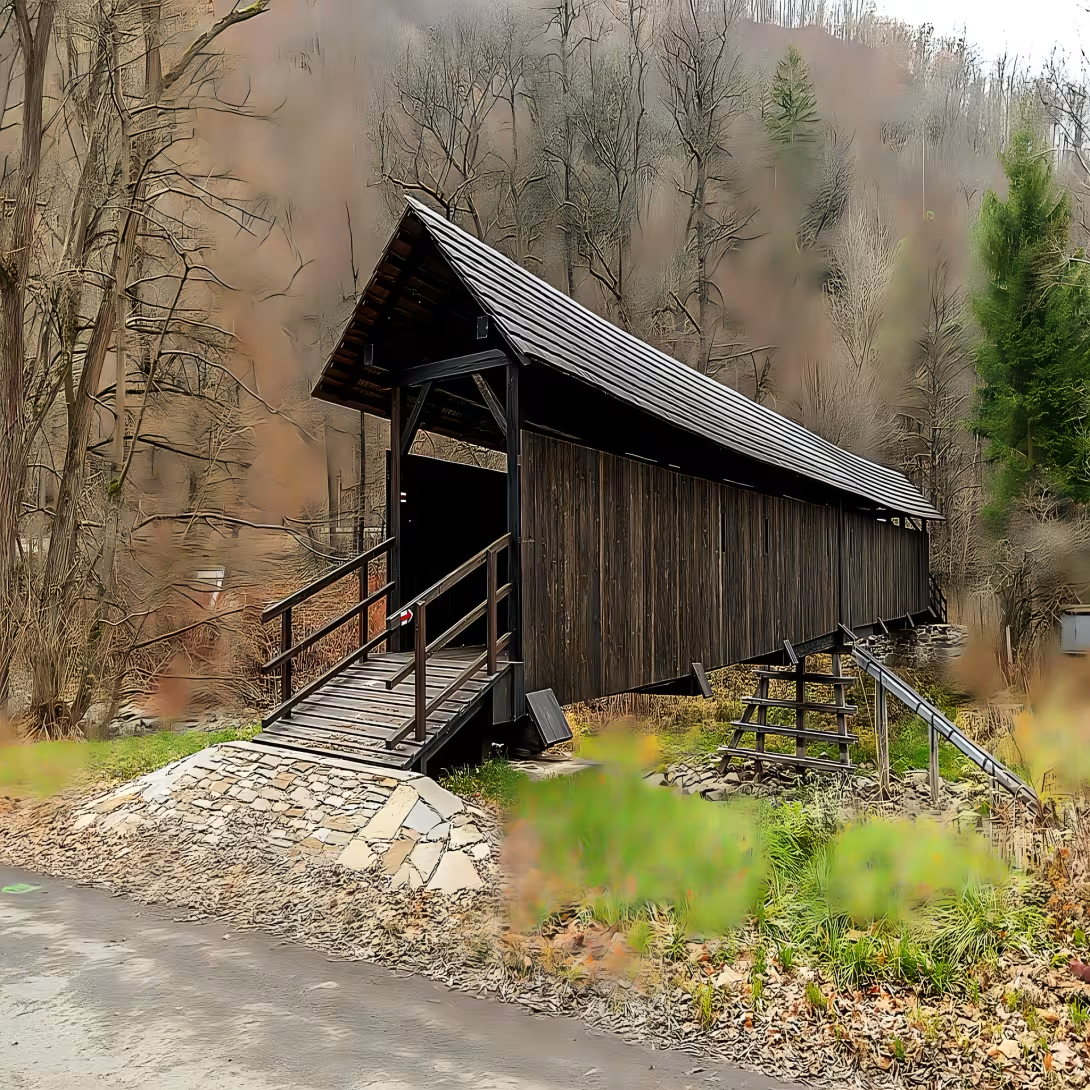
The wooden bridge in the village Prudká, which is part of the town Doubravník in the district of Brno-rural, is a covered historical bridge over the river Svratku built in 1899. This technical monument has been protected since 1994. It is an important document of the industrial history of the region and after the complete reconstruction completed in 2021 it serves its purpose again.
The construction was built at the end of the 19th century, during the expansion of industrial construction and the expansion of the railway network in Austria-Hungary. The author was the carpenter master Jan Nejez from Iron. The bridge was created for the needs of the workers of the pulp mill C. M. Kopriva, which stood on the left bank of the river Svratky. In 1905, the railway line between Žďár nad Sázavou and Tišnov was opened in the vicinity, while Prudká stopped serving the public only in the 1950s.
The construction of a bridge with a total length of 33 metres, a width of 2,4 metres and a height of 3,9 metres makes use of a double-booted lock system. Carrier beams are made of fir wood, while a boar with leprosy is oak. Other elements such as pillars, braces, straws and transverse beams make up spruce or larch wood. The bridge is located approximately 3 metres above the river surface and is carried by three pairs of longitudinal beams. The coating consists of vertical boards 2 metres high, above which is a projection of 0.75 metres high. The saddle roof is covered by a split blue shingle, which replaced the previously used asphalt cardboard. On the left bank, the object is placed on a stone support, in the middle of the stream there is a wooden boat and on the right bank there is a stone pillar with a subsequent inclined wooden ramp.
After 1999, when the partial correction took place, the bridge became subject to restitution disputes and began to lose its way. In 2007, non-technical reinforcement of the supporting parts was carried out by laying another beam without the knowledge of the National Heritage Institute. For this reason the construction was ranked among the most endangered real estate monuments in the Czech Republic. The break brought the total reconstruction started in 2019, which removed the non-original modifications and returned the building to its historical form.
Today, the footbridge in the Poverty fully restored technical monument is open to the public. Its value lies in the preservation of the original carpentry craft and in an authentic link with the history of the local industry. The visit to this place offers the opportunity to see a unique covered construction, which is once again a safe part of the landscape of Doubravník thanks to the sensitive restoration.
Then and now
Drag the slider to compare how the landmark may have looked when it was built with the view today.
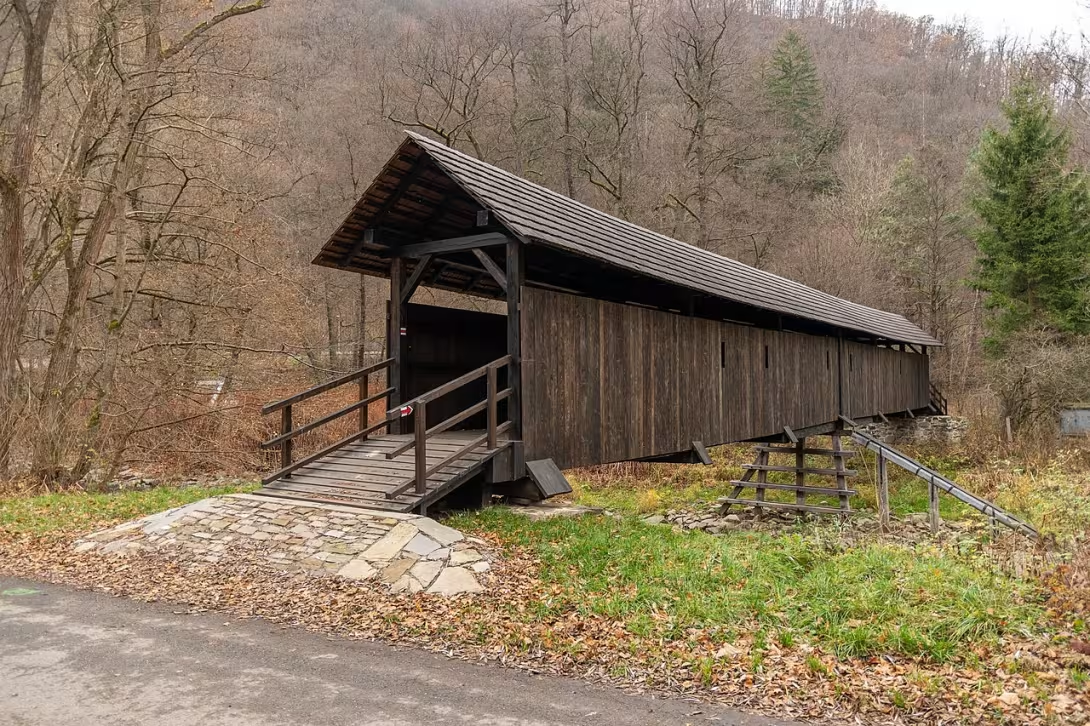
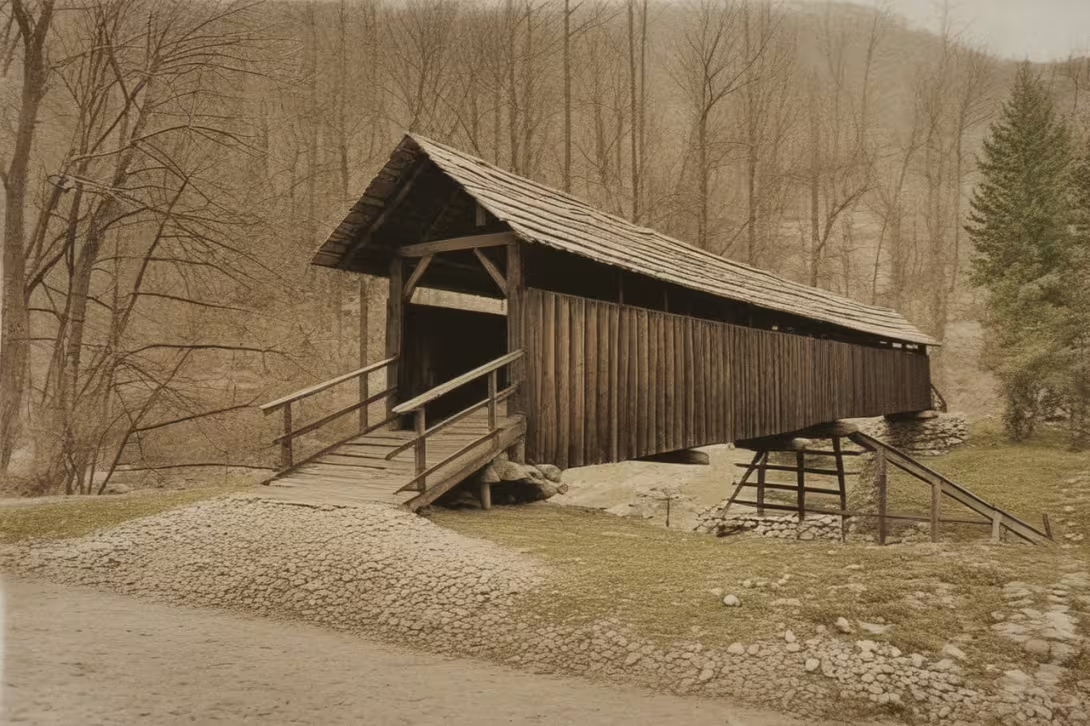
The historical appearance on the left is an AI-generated visualisation and serves as inspiration only.
Historical milestones
- 1899
- The construction of the footbridge by Master Jan Nejejem.
- 1994
- Lávka was declared a cultural monument of the Czech Republic.
- 2019
- Opening of the overall reconstruction after a long period of decaying.
- 2021
- Completion of reconstruction and restoration of shingles roof.
Architectural development
The original construction from 1899 uses a combination of fir, oak, spruce and larch wood. In 2007, a non-technical modification of the carrier parts was carried out, which was removed only during general repair. Reconstruction in the years 2019- 2021 gave the bridge its historical form including shingles cover.
Historical events
1899: Construction of a footbridge for paper workers. 1994: Declaration for cultural heritage. 2019-2021: Total reconstruction of the building.
Points of interest
- The covered historical bridge over the Svratku River was built in 1899 by the carpenter's master Jan Nejjez from Železný. - The footbridge was built for the needs of the workers of the C.M. nettle mill, which stood on the left bank of the river. - The construction uses a system of double rasher and is made of a combination of fir, oak, spruce and larch wood. - In 2007 the construction was ranked among the most endangered real estate monuments in the Czech Republic due to the non-professional reinforcement of the supporting parts. - The total reconstruction completed in 2021 removed non-original modifications and returned the building to its historical form.
Guide
Show guide text
This text was created by artificial intelligence and has not been editorially reviewed. It may contain inaccuracies.
Welcome to Prudká village. You are standing in front of one of the most distinctive and picturesque symbols of this location. Before your eyes is a wooden footbridge that humbly surpasses the flows of the Svratka River. Feel the atmosphere of calm that prevails here, and see how the wooden structure naturally enters the surrounding landscape. This covered bridge is not just an ordinary passage through the water, it is a living witness to history that has endured centuries, extinction and renewal.
Let us now return together in time towards the end of the nineteenth century. Imagine 1899. At that time this area was strongly linked to industrial activity and the rhythm of work in local plants. This footbridge was not built for tourist walks as it is customary today, but it had a very practical, vital purpose. She had to serve the workers of the local paper mill, which was on the left bank of the river at that time. For the thousands of people who did their work here every day, this footbridge was a key ally, a path that allowed them to safely and quickly overcome the water flow.
Behind all this successful przedsiery was a man named Jan Nejez. He was a carpenter's master of Iron, who put not only his expertise in this building, but also a piece of his artistic feeling. It was his hands and his decision to use specific materials and techniques that allowed this building to resist time trials. Don't eat just the builder, he was the creator of something that was meant to serve generations.
Now, please, pay attention to the very structure that you are observing right now. If you look at the actual body frame of the bridge, you might notice an unusual solution. The whole building is using a system called a double rack. It is a brilliant design principle that allows edible wood beams to effectively decompose the weight and ensure the stability of the entire object. Notice how these carrier elements are integrated into the whole. The fir wood was chosen for its strength and its ability to withstand the load, which was absolutely essential to the paper mill's needs at the time.
Raise your eyes above now. Above you is a saddle roof that protects the entire bridge from rain, snow and direct sun. This protection is crucial for the lifetime of the entire wooden body. Look at the details of the roof. See those tiny, thin wooden plates? It's a blue shingle. The larch is known for its extreme weather resistance and its use here shows a high quality of craftsmanship. These shingles form the protective skin of the bridge and ensure that the internal fir structure remains dry. It is this combination of materials - fir for weight and larch for protection - that gives this construction its unique characteristic.
When we talk about the history of this place, we can't forget the character C.M. nettle. His name is inextricably linked to a local paper mill that was the main engine of the development of this region. The needs of his staff and the needs of the paper mill as a whole were the primary reason why Jan Nejez implemented this construction. The footbridge and the paper mill were two pillars which worked closely together, forming one functional unit within the economic life at that time.
However, I must now take you to one important report concerning the fate of this building. Even though the footbridge seems firm and stable today, its path to today's form has been very challenging. After a long period when the construction gradually faded and its technical condition deteriorated, it seemed that it could be lost forever. It was an age of uncertainty when wood was subject to the effects of time and moisture.
The break occurred in 1994. This year, the footbridge was officially declared a cultural monument of the Czech Republic. This was the moment when her fate changed from a normal transport facility to a rare cultural heritage that we must protect for future generations. However, this protection also required concrete action. After a long time of waiting and rescue efforts, an overall, in-depth reconstruction was launched in 2019. It was a demanding work that required not only modern technology, but also a return to traditional craft practices. The whole process was completed in 2021, when the very characteristic shingles roof that you are now seeing was successfully restored. Thanks to this reconstruction, the bridge again became a proud part of the landscape.
The interesting thing that may surprise you is how much this bridge is linked to human effort. We often look at historical monuments as things that are simply there, but this footbridge is proof of the constant struggle between man and nature and time. Every beam, every shingle plate tells a story about carpentry art, which must not give in to decay. It is fascinating that the construction designed in 1899, after all the attacks of the weather and after the period of neglect, still stands here and allows you this experience.
Now please don't hesitate to slowly cross this historic footbridge. Can you feel the sound of wood under your feet? Feel the sense of security that this reconstructed structure provides. At every step, remember the workers who passed through here over a hundred years ago, and Master Nejez, who planned this trip.
I wish you this walk across the Svratku River to bring you peace and deep perception of history, which is right below your feet. Thank you for your attention and I wish you a wonderful further journey to explore our sights.
Tips for visitors
{'when to visit': 'The best time to visit is during the morning or late afternoon, when soft light beautifully depicts the details of the wooden structure of the footbridge. In the summer months you will enjoy a pleasant shadow under the roof of the bridge, while autumn offers a picturesque set of coloured leaves around the Svratky River.', 'Transportation _ and _ parks': 'The bridge is easily accessible by train, Prudká stop is located in the immediate vicinity. If you are travelling by car, use the available parking space around the Prudká settlement or in nearby Doubravník. The current train connections we recommend to verify in the official connection search engine.', 'equipped with _ and _ photographers': 'Don't forget to take the camera, because the covered bridge construction offers unique geometrical views. The best pictures are taken from the bank of the Svratky River, where the total silhouette of the bridge stands out. We recommend fixed shoes to move in the field around the river bed.', 'of all _ and _ families': 'In the surroundings you can visit the picturesque town of Doubravník, which is a pleasant walk from the bridge. For families with children, the footbridge is an interesting goal due to its history associated with the local paper mill and the proximity of the railway line, which often fascinates children. The whole area is ideal for easy family tourism along the river flow.'}
Businesses nearby
Do you run a restaurant, accommodation, shop, museum, rental, wellness or other visitor service near this monument? Show yourself directly to the people heading to it — this is how they will see you in the app and on the web:
Events nearby

Zdroj akcí: otevřená data měst a obcí ČR (Národní katalog otevřených dat) a kalendář akcí Národního památkového ústavu.
Nearby
Cities Doubravník, River Svratka, railway line Zdar nad Sazavou - Tišnov, stop Prudká.
Accommodation nearby
Themed route
Thematic cruise route from Doubravník to wooden footbridge in Pruďí
1. Cities Doubravník - Type: Historical city center - Why is it worth a visit: The city Doubravník offers a beautiful view of architecture with rich history. It is an ideal place to understand the cultural background of an area where you can start your trip.
2. Svratka River - Type: Natural landmark - Why it is worth a visit: The River Svratka is one of the most famous tributaries of the Vltava and offers beautiful landscapes for relaxation and observation of nature. It is an ideal place for a picnic or a short walk along the shore.
3. Stopping Prudy - Type: Railway station - Why is it worth a visit: The stop on the line Zdar nad Sázavou - Tišnov is a key point for access to the wooden footbridge. This stop allows you to easily cross over to the main destination of your route.
4. Wooden footbridge in Prudová (bridge) - Type: Memorial - Why is it worth visiting: Wooden footbridge is a historic bridge that crosses the Svratku River. It is a unique work of architecture and is worth exploring both in terms of construction technology and in terms of views of the surrounding landscape.
5. Railway line Zdar nad Sazavou - Tišnov - Type: Historical Railway - Why is it worth a visit: The route offers a look at the history of transport in the region. By exploring the surrounding landscapes and watching train passes, you can experience a sense of the past that gives you the interest of your journey.
This route offers a combination of historical, natural and technical experiences within the Doubravník area.
Seasonal recommendations
Spring: In spring, dřevěná lávka v Prudké is a special place where nature wakes up from its winter sleep. Trees and shrubs are starting to bloom, which gives the landscape a wonderful color shine. The atmosphere is full of warmth and hope when the sun gradually returns to our days. It is recommended to visit the footbridge in the afternoon, when the light is the most beautiful and nature shows full development. In addition, it is advisable to carry light clothes as temperatures increase rapidly during the day. Although crowds are not much, in spring there is an increase in tourist traffic, so it is good to come early and enjoy a quiet time.
Summer: In summer dřevěná lávka v Prudkém gets its best charm. The sun illuminates every piece of the bridge, while nature is in full power and surrounding forests offer shade and refuge from heat. The atmosphere is charged with energy, making the footbridge an ideal place for family trips or picnics. To ensure comfort during the visit we recommend to arrive early in the afternoon to avoid the peak hours of the crowd. Don't forget the protective sunglasses and plenty of drinking water because temperatures can be very high.
Autumn: In autumn days, dřevěná lávka v Prudkém offers a cozy atmosphere. The trees turn into shiny shades of yellow, orange and red, creating an unforgettable view. The sun is less intense and temperatures are pleasant, thus increasing the comfort of visitors. The best time to visit is the afternoon when the light is perfect for the photo and the corridor along the bridge is calmer. We recommend to carry light clothes on top layer, which can be easily added or removed according to temperature.
Winter: In winter months, dřevěná lávka v Prudkém becomes mysterious and calm. When snow settles on the bridge, this place becomes a true winter beauty. Sun rays reflected in the icy surface of the river add something magical to the atmosphere. Due to the shorter daylight and cold temperatures, it is best to visit the footbridge at noon to enjoy the longest day. It is important to carry warm clothes and suitable footwear barriers for the snow surface. Winter visit is calmer because the crowd is not so much, which allows you to enjoy quiet moments on the bridge.
Visualizations and artistic views


The visualisations are generated by artificial intelligence and serve as inspiration.
Photos from the area
Real photos taken near the monument


Zdroj a licence jsou uvedeny u každého snímku.
Tips from visitors
No tips yet. Be the first!
Log in and add your tip.
Sources and literature
Fotografie: Michal Gregor / CC BY-SA 4.0, rozlišení zvýšeno umělou inteligencí — Wikimedia Commons. The author and licence also appear when you hover over the image.
Faktickým podkladem tohoto textu byl článek na Wikipedii, jehož autory jsou přispěvatelé Wikipedie. Článek je dostupný pod licencí CC BY-SA 4.0.
Location on the map
More monuments – Doubravník
Show all in the municipality
Příběhy a pověsti
Legendy, pověsti a příběhy spjaté s touto památkou
Fotografie návštěvníků
Zatím žádné fotografie. Buďte první, kdo přidá fotografii z návštěvy!
Přihlaste se a přidejte svou fotografii nebo hodnoťte.
Za ověřenou návštěvu v aplikaci získáte víc bodů — poznáme podle GPS, že jste na místě.
Reviews and comments