



Dům čp. 100 (Kadaň) House
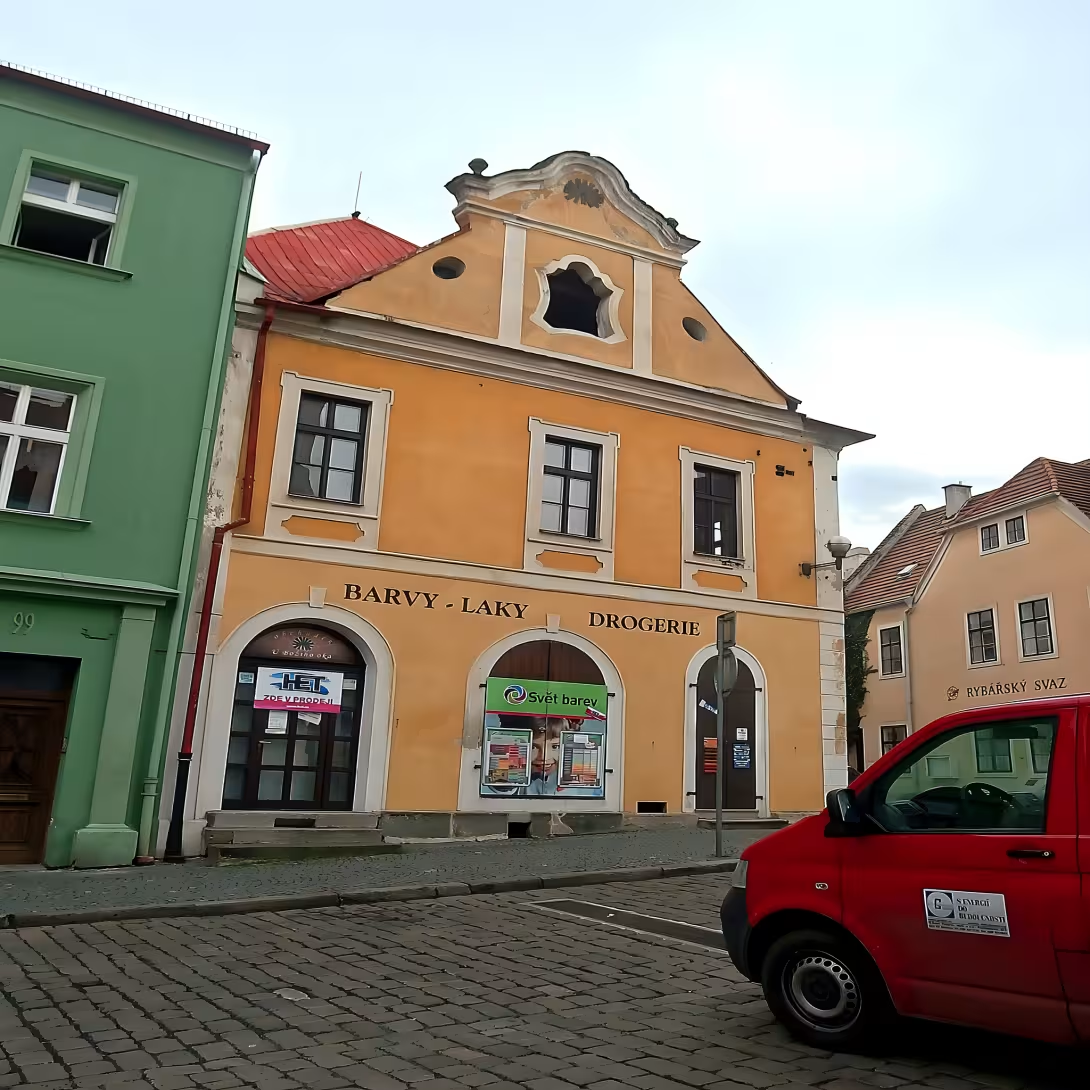
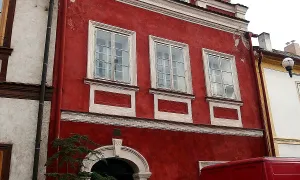
House No. 100, known as the House of God's Eye, is originally a Gothic townhouse in Žatecká Street on the Old Town of Kadani. The building is remarkable with its high baroque shield with unique home signs and preserved Gothic cellars.
There are limited reports of the oldest history of the building. However, the architectural elements show that it originally served as the seat of one of the rich Kadan townsfolk.
The building is an object with a Gothic core, which is confirmed by preserved vaulted cellars. Later modifications brought a high baroque shield that dominates the appearance of the building. A significant detail is the metal home sign in the form of God's eye in a triangle from which the rays come. This symbol points to the Holy Trinity and the lasting presence of God in the world. It was installed on the shield probably in the 18th or 19th century.
In 1882 the owner of the house was named the baker's master Oswald Hickman. Here until the early 20th century he operated one of the largest and most prosperous bakery in the city. Around 1916, married Josef and Theresia Papzien took over the business. Their family also owned a house No. 90 across the street, where they operated a hardware store since 1860. The bakery was subsequently taken over by the son of Karl Heinrich, who, before 1927, extended the family property to the neighboring house No. 99. During the war the operation was led by the baker's master Karl Würl, probably to bring the owner to the front. The city records of 1943 show that Würl unsuccessfully applied for a building permit for a new chimney furnace.
In addition to documented facts, there is a reputation associated with a home sign. According to her, the symbol of God's eye was placed by a pious Catholic townsman who suspected his neighbors of secret evangelism. He was supposed to be convinced that these people were meeting at the Ohre River, specifically the Lutheran cemetery behind the hospital outside the kadani bridge. This cemetery was intended for Lutheran buyers from Saxony, but at some point it could serve as a secret gathering place for persecuted cadadian evangelists.
The House of the Eye of God today represents a typical example of the development of urban buildings in the historical core of Kadana. For visitors there is a valuable testimony about the craft tradition of the city and period symbols of home signs. Thanks to the combination of Gothic foundations and baroque appearance, they deserve attention.
Historical milestones
- 1882
- In the house is documented owner and baker Oswald Hickman.
- 1916
- The bakery business in the house was taken over by married Joseph and Theresa Papzien.
- 1943
- The baker Karl Würl applied for a building permit for a new furnace, which was rejected.
Architectural development
The core of the house is Gothic, which is confirmed by preserved vaulted cellars. Later, the house was supplemented with a high baroque shield. In the 18th or 19th century, a tin symbol of God's eye was installed on the shield.
Historical events
1882: In the house is listed as owner baker master Oswald Hickman. 1943: The baker Karl Würl unsuccessfully requested permission to build a new furnace with a chimney.
Owners
Oswald Hickman (until the beginning of the 20th century), married Joseph and Theresa Papzien (from about 1916), Karl Heinrich Papzien
Points of interest
- The House of the Eye of God has a Gothic core with preserved vaulted cellars and a high baroque shield. - On the shield is a metal sign in the form of the eye of God in a triangle with rays that symbolizes the Holy Trinity. - Until the early 20th century, the baker's master Oswald Hickman ran one of the largest and most prosperous bakery in the city. - Rumor has it that the symbol of God's eye was placed by a pious Catholic townsman who suspected his neighbors of secret evangelism. - The building originally served as the seat of one of the rich Kadan townsfolk.
Guide
Show guide text
This text was created by artificial intelligence and has not been editorially reviewed. It may contain inaccuracies.
Welcome to the heart of Kadana, the part called Old Town. Right now, you're standing in Žatecká Street, and in front of you is one of the most distinctive houses in the area, a house with the number 100. The first thing you're probably interested in is his corner position and a very high shield heading towards the sky. It is a building that carries layers of many centuries and tells the story of wealth, craftsmanship and the daily life of the people of this city. Stop for a moment, take a breath and let yourself be transferred to a time when these streets looked completely different, but this house was already a silent witness to history.
When we look at the origin of this place, we find that the house has its roots deep in the past. Its core is Gothic, which means the basic structures go back to the Middle Ages. At that time, the houses thus built were a symbol of the stability and status of their owners. This particular object has served for centuries as a residence for rich townsfolk who lived here, did business and influenced life in the city. Imagine the people who once crossed these thresholds and the discussions about trade and politics in these walls. It is fascinating to think that although the exterior appearance of the house changed over time, its foundation remained the same.
Now I ask you to pay attention to the architecture and details that you can see right in front of you. Look up at the top of the house. The dominance is a high baroque shield that gives the building its characteristic silhouette. The Baroque has brought some pomp and dynamism to urban architecture, which we can clearly see here. But the most interesting detail is even higher. Notice the metal home sign. It is a symbol in the form of the eye of God, which is placed in a triangle with rays. At a time when people could not read and houses had no numbers, such signs served as landmarks. This particular sign is not just an ornament, but it bears profound meaning because it symbolizes the Holy Trinity. It's a beautiful element that connects faith to everyday life on the street.
Although we see a baroque face from the outside, the house hides secrets even underground. In the building are preserved gothic vaults. Even if you can't see into them right now, realize that under your feet there are ancient vaults that were used to store food and goods. These cellars are proof of the original Gothic character of the building and are one of the most valuable elements of the whole house.
Now let's move on to the people who left their trail in this house. The House of God's Eye is not only a set of stones and metal, but above all a place of human work. In later history, a thriving bakery was established here, which became an important part of local life. In a thousand and eight hundred and eighty-two, the owner and the baker named Oswald Hickman are documented here. He was a man of his craft and ran one of the largest and most important bakery in the area. Imagine the smell of fresh bread that spilled down the Zatecka Street every morning and attracted people from all around.
But time passes, and the trade passes into the hands of others. In the year of a thousand and nine hundred and sixteen baker's trade in the house were taken over by the husbands Josef and Theresia Papzien. The married couple probably put a lot of effort and care into their business to keep the bakery successful even in the troubled times of the early twentieth century. It's interesting to see the fate of different families intermingling in one house, which may not be known, but it connects them with the same passion for their craft and the same place in the city tissue.
Here we come to one of the last documented stories associated with the bakery in this house. In the year one thousand nine hundred forty-three, that is, at the time of the Second World War, the baker Karl Würl applied for construction permission. He wanted to build a new furnace in the house, probably to modernize the production and manage more pastries. However, his request was rejected. It's a little detail from history, but it shows us that even in a house like this, there were limits and rules that owners had to respect. Perhaps it was because of this rejection that part of the inner structure of the house remained in the form that was recognised at the time.
When you look at the whole house as a whole, you see a fascinating combination of medieval Gothic, baroque style and practical use as a craft workshop. The House of the Eye of God is such a mirror of Kadana. It combines the spiritual symbolism represented by the tin mark on the shield with a very earthly activity such as bakery. It's a place where high art architecture meets the daily work of bakers.
Try to see the facade again. Feel the atmosphere of this place. Imagine the noise of cars on the coachwork, the call of merchants and the smell of pastries that once ruled here. This house reminds us that history is not only about great battles and kings, but above all about the people who lived here, worked and built their homes.
The House of God's Eye is today a silent witness to the transformed city, but still retains its dignity. Its high shield is still guarded by the corner of Žatecká Street and the symbol of the Trinity still resembles ancient traditions. It is an example of how the city of Kadaň evolved and how different epochs intersect.
Thank you for joining us in discovering the secret of this house. We hope you are interested in this short trip to the past and that you are now seeing this house in a new light. We now invite you to explore the beauty of the Old Town of Kadani. Walk the surrounding streets, admire other historic buildings and be accompanied by the atmosphere of this beautiful city. We wish you a pleasant continued journey and many new discoveries. Goodbye.
Tips for visitors
The best time to visit is the late afternoon when the sun lights up the baroque shield and details of the facade of the house at the eye of God. Transportation to the centre of Kadana is possible by car and public connections; Search the exact possibilities in the current timetables.
You don't need special equipment to search the outside, you just need comfortable shoes to walk through the historic core of the city. We recommend taking the camera with you because the corner location of the building in Žatecká Street offers interesting points of view.
For the best pictures we recommend you find a place where you can see the contrast between the Gothic elements and the Baroque roof finish. The ideal light for shooting the facade is in clear days when the details of the arched spaces are most visible.
During a short walk in the surrounding area you can visit the River Ohře, the Kadani Bridge or the Lutheran cemetery. With children you will appreciate a walk along the river, which is a pleasant addition to observing ancient houses.
Frequently asked questions
Can the monument be visited?
This is a residential or farm building, not a museum with opening hours. Please view it from public space and respect the owners' privacy. We have no information about access to the interior.
Where is the monument?
Location: Kadaň. The map on this page shows the exact spot.
Why is the monument protected?
It is listed in the Central List of Cultural Monuments of the Czech Republic as a cultural monument (register no. 1000135534).
Businesses nearby
Do you run a restaurant, accommodation, shop, museum, rental, wellness or other visitor service near this monument? Show yourself directly to the people heading to it — this is how they will see you in the app and on the web:
Nearby
Řeka Ohře, kadaňský most, luteránský hřbitov.
Accommodation nearby
Themed route
Here is the design of the thematic route:
1. Dům čp. 100 (Kadaň) - the main monument. The walk begins at this important house, which represents the unique architecture of the city.
2. Lutheran cemetery - cemetery. A place of calm and reflection where the history of the local community can be discovered.
3rd Kadaň Bridge - bridge. The building allows you to cross over the water and offer a nice view of the surroundings.
4. River Ohře - water flow. A walk along the shore serves to relax and finish the whole trip in nature.
Visualizations and artistic views

The visualisations are generated by artificial intelligence and serve as inspiration.
Photos from the area
Real photos taken near the monument


Zdroj a licence jsou uvedeny u každého snímku.
Tips from visitors
No tips yet. Be the first!
Log in and add your tip.
Sources and literature
Photos: Palickap / CC BY-SA 4.0, rozlišení zvýšeno umělou inteligencí — Wikimedia Commons. The author and licence also appear when you hover over the image.
Faktickým podkladem tohoto textu byl článek na Wikipedii, jehož autory jsou přispěvatelé Wikipedie. Článek je dostupný pod licencí CC BY-SA 4.0.
Location on the map
More monuments – Kadaň
Show all in the municipality
Příběhy a pověsti
Legendy, pověsti a příběhy spjaté s touto památkou
Fotografie návštěvníků
Zatím žádné fotografie. Buďte první, kdo přidá fotografii z návštěvy!
Log in a přidejte svou fotografii nebo hodnoťte.
Za ověřenou návštěvu v aplikaci získáte víc bodů — poznáme podle GPS, že jste na místě.
Reviews and comments