






Dům Řásnovka House
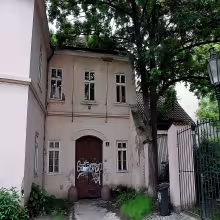
Dům Řásnovka is a notable bourgeois house situated in Prague's Old Town on Za Haštalem Street. The property stands on original Gothic foundations and is officially protected as a cultural monument of the Czech Republic.
The site originally featured a medieval Gothic structure before parts of the land were acquired in the 17th century during the Baroque era under Habsburg rule. In 1667 and 1679, Jan Řásný z Řásnova, who served as the bailiff of the Strahov Monastery, purchased sections of the plot along with dilapidated buildings. Later developments occurred during the Austrian Empire period when the late-classical edifice was erected between 1834 and 1835.
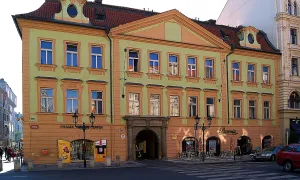
The main building features a T-shaped ground plan. The street facade along Za Haštalem displays a two-axis avant-corps, a three-story exterior with a string course, a portal featuring a stone segment with driveway bollards, and windows without architraves that have direct cornices. The courtyard elevation includes vaulted gallery corridors. In 1877, a two-wing, two-story courtyard annex with galleries on corbels was added to the property by master builder Josef Blecha, though its southern wing has been partially demolished.
Ownership and functional changes shaped the history of the site over the centuries. Following the acquisitions by Jan Řásný z Řásnova, M. Hausknecht commissioned the construction of the late-classical building in the 1830s. By the early 20th century, the edifice housed the Provincial Central Beekeeping Association for the Kingdom of Bohemia and served as the editorial office for the magazine Český včelař.
A notable curiosity associated with the property is that the adjacent street Řásnovka was named directly after the house. In recent times, the structure underwent reconstruction in 2013, with additional plans formulated to add a new four-story building to the site.
Today, the monument stands as a preserved cultural property within the historic district of the Old Town, surrounded by historic urban architecture and streets such as Za Haštalem and Řásnovka. Visitors exploring the historic streets of Prague can observe its distinct architectural features from the exterior as a representative example of layering from the Gothic era through the late-classical period.
Historical milestones
- 1667
- Jan Řásný z Řásnova purchased part of the plot and dilapidated structures.
- 1679
- Jan Řásný z Řásnova acquired further parts of the property.
- 1834
- Construction of the late-classical building by M. Hausknecht began on Gothic foundations.
- 1877
- A courtyard building was added to the property by builder Josef Blecha.
- 2013
- The building was reconstructed with plans to add a new four-story structure.
Architectural development
The site originally featured a Gothic house before parts of the land were acquired in the 17th century. A late-classical building was erected on these Gothic foundations between 1834 and 1835. In 1877, a two-wing, two-story courtyard building with galleries on corbels was added by builder Josef Blecha, though its southern wing has been partially demolished.
Historical events
In 1667 and 1679, Jan Řásný z Řásnova purchased parts of the plot containing dilapidated structures. In 1834-1835, a late-classical building was constructed on the Gothic foundations. In 1877, a courtyard building was added by builder Josef Blecha. In 2013, the building underwent reconstruction.
Owners
Jan Řásný z Řásnova (acquired parts of the plot in 1667 and 1679); M. Hausknecht (built the late-classical building in 1834-1835).
Points of interest
– The property stands on original Gothic foundations and is officially protected as a cultural monument of the Czech Republic. – Parts of the land and dilapidated buildings were purchased in 1667 and 1679 by Jan Řásný z Řásnova, who served as the bailiff of the Strahov Monastery. – The adjacent street Řásnovka was named directly after the house. – In the early 20th century, the edifice housed the Provincial Central Beekeeping Association for the Kingdom of Bohemia and served as the editorial office for a magazine.
Guide
Show guide text
This text was created by artificial intelligence and has not been editorially reviewed. It may contain inaccuracies.
Welcome to Staré Město. As you stand here on the street Za Haštalem, take a moment to breathe in the atmosphere of one of the most historic quarters of Prague. You are standing directly in front of Dům Řásnovka, a building that serves as a silent witness to the many layers of history that have shaped this city. At first glance, you are looking at a notable bourgeois house, a structure that exudes the elegance and stability of a bygone era. It possesses a certain dignity that commands your attention, standing as a testament to the architectural transitions that have occurred within these narrow streets over many centuries. As you observe the facade, try to see past the immediate surface and imagine the various hands that have shaped, rebuilt, and preserved this site.
To truly understand what you are looking at, we must travel back in time, long before the current classical elegance was established. The story of this property is one of gradual accumulation and transformation. The roots of this site reach back to the seventeenth century. In 1667, a man named Jan Řásný z Řásnova began the process of acquiring parts of this plot and the dilapidated structures that occupied it. He was a man of significant influence, serving as the bailiff of the Strahov Monastery, and his involvement suggests that this location held importance even then. A decade later, in 1679, Jan Řásný z Řásnova expanded his holdings, acquiring further parts of the property. This period laid the groundwork for what would eventually become a significant urban residence, transforming a collection of older, perhaps crumbling buildings into a unified estate.
As we move forward through the centuries, the building underwent a profound metamorphosis that defines its character today. While the origins are much older, the appearance you see before you is largely the result of a major reconstruction that took place in the 1830s. This was an era of great change in Prague, where the old medieval patterns were giving way to the structured grace of the nineteenth century. In 1834, construction began on the late-classical building we recognize today. This work was led by the architect M. Hausknecht, who built upon the existing, much older foundations. It was Hausknecht who gave the house its current sense of order and proportion, translating the needs of the rising bourgeoisie into the language of late-classical architecture.
If you direct your attention to the architectural details of the facade, you can begin to appreciate the specific choices made during that transformative period. Notice the structure of the building itself; it follows a T-shaped ground plan, a design that allows for a sophisticated arrangement of interior spaces. As you look at the street-facing side, pay close attention to the two-axis avant-corps. This architectural element, which projects slightly from the main body of the building, adds depth and a sense of rhythm to the facade, breaking up the flat surface and creating a more dynamic visual experience. Below this, you might also notice the portal, which features a stone segment. This entrance serves not just as a functional doorway, but as a formal introduction to the residence, marking the transition from the public street to the private domain of the house.
The evolution of Dům Řásnovka did not stop in the 1830s. The property continued to grow and adapt to the needs of its owners and the changing urban landscape. In 1877, the property was further expanded when a courtyard building was added. This addition was the work of the builder Josef Blecha, another name that has left a permanent mark on the history of this site. His contribution helped to complete the ensemble of buildings that make up the property, creating the complex of structures that we see today. This layering of architectural styles—from the early acquisitions of the seventeenth century to the classical reconstruction of the nineteenth and the later additions—is what gives Dům Řásnovka its unique character.
It is fascinating to consider the individuals who were so closely tied to this location. We have the influential Jan Řásný z Řásnova, whose early investments in the seventeenth century set the stage for everything that followed. We also have the architects and builders, M. Hausknecht and Josef Blecha, who translated the ambitions of the era into stone and mortar. These men were not just workers; they were the creators of the urban fabric of Staré Město, shaping the way the city looks and feels. When you stand here, you are standing in the legacy of their vision and their labor.
Now, I want to share something with you that is not immediately obvious to the casual observer. While the late-classical facade presents a face of nineteenth-century refinement, there is a hidden history beneath your feet. The building stands on original Gothic foundations. This means that beneath the elegant lines and the classical proportions of the 1830s reconstruction, the ancient, medieval bones of Prague are still very much present. This hidden layer connects the building to an even deeper past, a time of narrow alleys and much older structures that predated the era of the bourgeoisie. It is a reminder that in a city like Prague, nothing is ever truly new; everything is built upon the echoes of what came before. This connection to the medieval period is one of the reasons why the building is officially protected as a cultural monument of the Czech Republic. It is a piece of living history, preserved to ensure that these layers of time are not lost to the modern world.
Even in more recent times, the building has continued to be a subject of interest and change. In 2013, the property underwent further reconstruction, which included plans to integrate a new four-story structure into the site. This demonstrates that Dům Řásnovka is not a static relic of the past, but a living part of the city that continues to adapt to the requirements of contemporary life.
As you prepare to move on, I invite you to take one last look at the building. Consider the transition from the Gothic foundations to the classical facade, and the way this single location has evolved from a collection of dilapidated structures into a significant cultural monument. The street Za Haštalem has many more stories to tell, and as you continue your walk through Staré Město, you will find that every corner and every facade holds a piece of the magnificent puzzle that is Prague. Thank you for joining me in exploring Dům Řásnovka. Please, continue your journey and enjoy the wonders of this extraordinary city.
Tips for visitors
The best time to visit Dům Řásnovka is during the morning hours on weekdays, which allows you to experience the historic atmosphere of Staré Město with fewer crowds and softer light. Arriving early also gives you a peaceful environment to appreciate the unique architectural layers of the building.
Reaching the site is convenient using public transportation or by walking through the historic district, as the building is located on Za Haštalem street. Since specific bus or tram line numbers vary and should be checked in advance, visitors traveling by car should note that parking in the historic center of Prague is generally limited and restricted to designated zones.
When visiting, be sure to bring comfortable walking shoes suited for the uneven cobblestone streets surrounding the area, along with a camera or smartphone to capture the architectural details. Because this is primarily an exterior and structural historic site, dressing in weather-appropriate layers is recommended as you explore the surrounding streets.
For photography enthusiasts, the best spots include angles from Za Haštalem and Řásnovka streets, where you can frame the historic bourgeois house against the surrounding urban architecture. Morning and late afternoon provide the most flattering natural light for capturing the Gothic foundations and historical facade textures.
While exploring the immediate vicinity of Staré Město, visitors can easily spend time within a short walking radius admiring the historic urban architecture along Za Haštalem and Řásnovka streets. Families with children will enjoy a gentle, educational stroll through these historic pedestrian-friendly streets, making it an easy stop during a broader historical walking tour of the neighborhood.
Businesses nearby
Events nearby
Zdroj akcí: otevřená data měst a obcí ČR (Národní katalog otevřených dat) a kalendář akcí Národního památkového ústavu.
Nearby
Located in the historic district of Staré Město in Prague, surrounded by historic urban architecture and streets such as Za Haštalem and Řásnovka.
Accommodation nearby
Trips and activities nearby
Guided tours, tickets and activities nearby from GetYourGuide
Affiliate link: if you buy from the partner, we may receive a commission. The price for you does not change.
Search tours and activities →Themed route
Welcome to a thematic walking tour through the historic district of Staré Město, Prague, where you'll explore the charming area surrounding Dům Řásnovka and its nearby streets.
1. Dům Řásnovka: Begin your journey at this exquisite example of Art Nouveau architecture. The building is renowned for its intricate design and historical significance in Staré Město, making it a must-see for anyone interested in Prague's architectural heritage.
2. Za Haštalem Street: A short walk from Dům Řásnovka will take you to Za Haštalem street. This area is rich with historic urban architecture that offers a glimpse into the past life of Staré Město. Strolling down this street, you'll encounter beautifully preserved facades and quaint shops that add to the district's charm.
3. Řásnovka Street: Continue your exploration along Řásnovka street itself. This street is not only home to Dům Řásnovka but also features other notable buildings from different eras, showcasing a blend of architectural styles. The street provides an excellent opportunity to appreciate the detailed craftsmanship and historical layers that define this part of Prague.
4. Local Cafés: As you walk through these historic streets, take a moment to enjoy one of the local cafés along Řásnovka or Za Haštalem. These spots offer a perfect setting to relax and reflect on the architectural beauty you've just experienced while enjoying traditional Czech coffee or pastries.
5. Historic Public Squares: Conclude your tour by visiting any nearby historic public squares in Staré Město. These areas are often surrounded by significant buildings and provide a serene environment for appreciating the district's rich history and cultural atmosphere.
This walking tour offers an intimate look at the architectural and historical treasures of Staré Město, centered around Dům Řásnovka and its immediate surroundings.
Seasonal recommendations
Spring: Visiting Dům Řásnovka during spring offers a refreshing experience as the city of Staré Město begins to bloom with vibrant colors from budding trees and flowers. The natural light is softer, casting a gentle glow over the historic architecture, enhancing its charm. Springtime sees moderate crowds, making it an ideal time for those who prefer a quieter visit. It's advisable to wear layers, as temperatures can be unpredictable with occasional chilly mornings or warm afternoons. Early morning visits are recommended to enjoy the site in relative solitude before larger groups arrive.
Summer: Summer at Dům Řásnovka provides a lively atmosphere with extended daylight hours that illuminate the historic details of the building beautifully into the evening. The city buzzes with activity, and visitors should expect larger crowds, especially during peak tourist season. To avoid long lines, it's wise to arrive early in the day or later in the afternoon when most tourists have left. Light, breathable clothing is recommended due to warmer temperatures, along with comfortable shoes for exploring on foot.
Autumn: Autumn at Dům Řásnovka offers a picturesque setting as Staré Město transforms with warm hues of reds, oranges, and yellows from the changing leaves. The atmosphere becomes cozy and inviting, perfect for leisurely strolls through the historic streets. While visitor numbers start to decrease compared to summer, it's still advisable to plan your visit during weekdays or off-peak hours to fully enjoy the site. Layered clothing is recommended to accommodate cooler temperatures as the season progresses.
Winter: Winter visits to Dům Řásnovka in Staré Město provide a magical experience with the historic streets often blanketed in snow, creating a fairy-tale-like atmosphere. The lighting during this time can be particularly enchanting, especially if there are festive decorations around the area. However, expect shorter opening hours and potentially fewer visitors due to colder weather. It's essential to dress warmly, including hats, gloves, and scarves, to stay comfortable while exploring. Early visits are recommended to make the most of daylight hours before they shorten further as winter progresses.
Visualizations and artistic views


The visualisations are generated by artificial intelligence and serve as inspiration.
Photos from the area
Real photos taken near the monument

Zdroj a licence jsou uvedeny u každého snímku.
Tips from visitors
No tips yet. Be the first!
Log in and add your tip.
Sources and literature
Fotografie: Ben Skála, Benfoto / CC BY-SA 3.0, rozlišení zvýšeno umělou inteligencí — Wikimedia Commons. The author and licence also appear when you hover over the image.
Faktickým podkladem tohoto textu byl článek na Wikipedii, jehož autory jsou přispěvatelé Wikipedie. Článek je dostupný pod licencí CC BY-SA 4.0.
Location on the map

Příběhy a pověsti
Legendy, pověsti a příběhy spjaté s touto památkou
Fotografie návštěvníků
Zatím žádné fotografie. Buďte první, kdo přidá fotografii z návštěvy!
Přihlaste se a přidejte svou fotografii nebo hodnoťte.
Za ověřenou návštěvu v aplikaci získáte víc bodů — poznáme podle GPS, že jste na místě.
Reviews and comments