



Kaprova Street
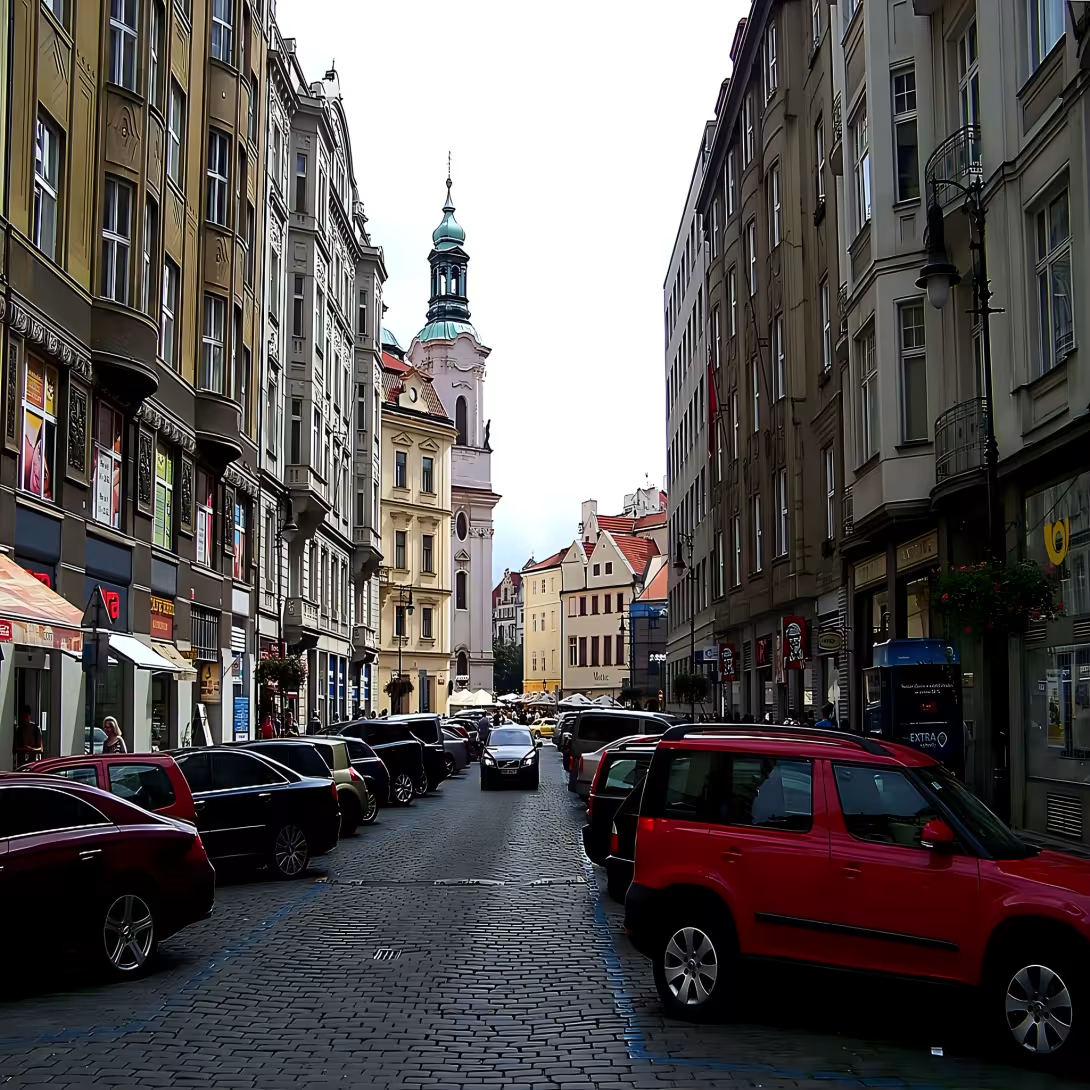
Kaprova street is a historical communication in Prague that connects Jan Palach Square with Franz Kafka Square. This medieval journey served as an important link between the marketplace on the Old Town Square and the Vltava Brod.
In the Middle Ages, the street was called Svatovalentinská. It referred to St. Valentine's Church, which stood on the corner of Kaprava and Valentine's Street. The first written mention of this temple dates back to 1253, but the building was demolished in 1794 as part of the Josephine reforms. Since the mid-16th century the names Kapuric, Caprava or Kaprova have been used. The current name is linked to Pavel Kapra from Kaprštejn. He owned the House of Three Carp and in 1565- 1671 he held the post of Mayor of the Old Town of Prague.
The building of the street includes buildings from different periods. Significant objects include the house U Three carp (number 8) and corner house Na Kocanda at Kaprova 2 and Crožovnická 14. In the street there is also a tenement house on the number 3 and Valentinská 10. The modern element in the urban structure is two entrances to Staroměstská Metro Station, which lies at a depth of 28 meters below the surface.
Nowadays the street serves as a seat of various institutions and companies. The Faculty of Philosophy of Charles University is located at Kaprova 1 and Jan Palach 2. In the street we can also find Czech Post at number 12 and the company Brothers Šulco at number 13, which was involved in imports of motorcycles by the brand B.S.A. The cultural element is the memorial of Jaroslav Ježek in the so-called Blue Room at the number 10 / 45.
Kaprova Street presents an authentic fragment of the historical heart of Prague. It combines a medieval business function with the Renaissance influence of rich urban families. Its visit offers the possibility to monitor the layering of history from the original roads to modern transport infrastructure.
Then and now
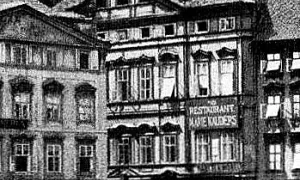
Drag the slider to compare how the landmark may have looked when it was built with the view today.
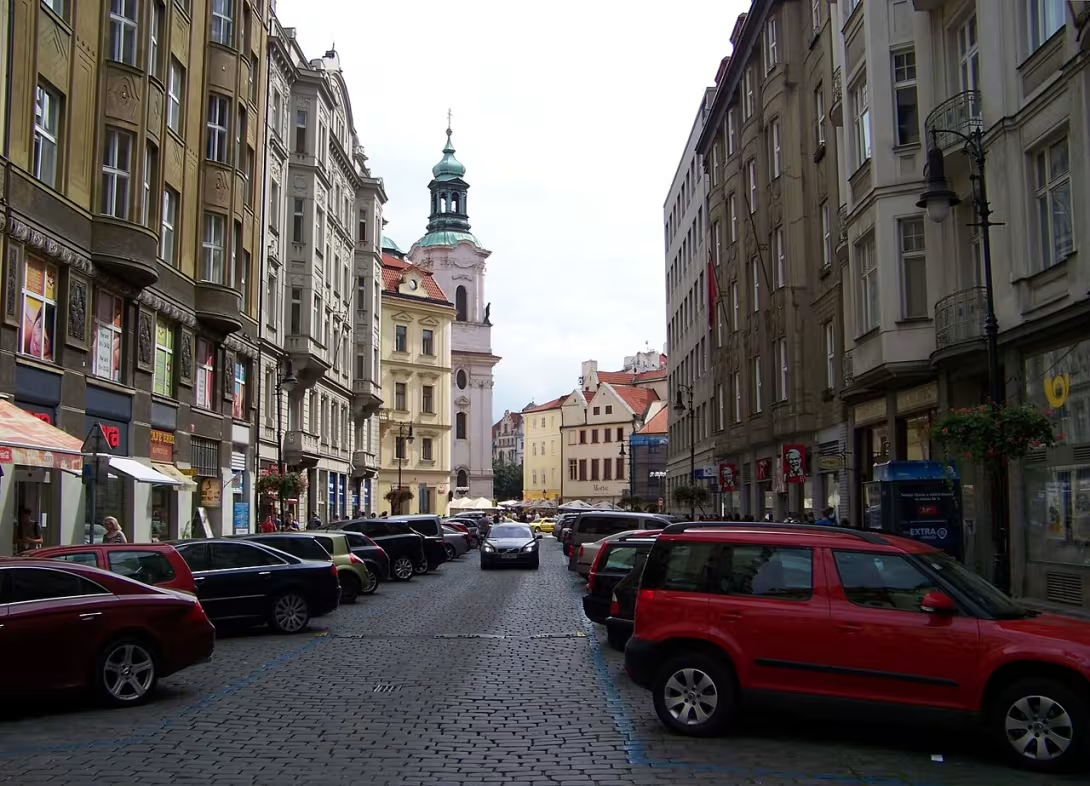

The historical appearance on the left is an AI-generated visualisation and serves as inspiration only.
Historical milestones
- 1253
- First written mention of St. Valentine's Church on the corner of the street.
- 1565
- Pavel Kapra z Kaprštejna becomes Mayor of Old Town.
- 1794
- The demolition of St. Valentine's Church.
Architectural development
The street has preserved its medieval function as an interconnector of important places. Within the building there are buildings of different periods such as the House of Three Capers or the House of Na Kocanda. The modern element is Old Town Metro Station with entrances directly from the street.
Historical events
1253 - first written mention of St. Valentine's Church in the street; 1794 - the demolishing of St. Valentine's Church in the context of Josephine's reforms.
Owners
Praha
Points of interest
- This medieval road connected the marketplace in Old Town Square with the Vltava Brod. - In the Middle Ages, the street was called Svatovalentinsky, according to St. Valentine's Church, which was demolished in 1794. - The current name relates to Pavel Kapra of Kaprštejn, who owned the Three Carp house. - In the street there is a memorial of Jaroslav Ježek in the Blue Room. - Underneath the surface of the street lies at the depth of the 28m metro station Old Town.
Guide
This guide is narrated by a synthetic voice generated by artificial intelligence.
Show guide text
This text was created by artificial intelligence and has not been editorially reviewed. It may contain inaccuracies.
Welcome to the heart of the Old Prague City. You're standing right where time seems to be denser and where every step of this old surface can carry you back several centuries. In front of you is Kaprova street, which is not just a common road between two points on the map, but a living thread that connects two major Prague squares. If you look now towards Jan Palach Square, and then turn to Franz Kafka Square, you will realize that it is here, in this narrow and fascinating space, that history, science and the everyday life of the city meet.
Feel this atmosphere. Can you feel the weight of the buildings surrounding you? Even though their faces have changed over the years, you still feel the presence of people who walked through here before you. This street has been the key heart of the city for centuries. Imagine it in the Middle Ages. It was not only a path for pedestrians, but a vital link that led directly from the busy marketplace in the Old Town Square towards the Vltava bank and the ford there. It was a journey that carried the goods that were moved by merchants, craftsmen and citizens of the city who needed to cross the river. Every day there was a life that shaped the face of the whole of Prague.
Now let's move on a little bit in time and look at what this street meant to society at the time. Previously, this journey was not called Kaprova at all. If you came back here a few centuries ago, you'd probably find her under a different name. It was called St. Valentine's Street. This name was not random. He derived directly from the church of St. Valentine, which was just on the corner of this street. The first written mention of this church dates back to a thousand two hundred fifty-three. Imagine that time when this church was dominant in this place and provided spiritual support to all those who passed through here on the way to the river. Unfortunately, history can be relentless and this important building element has finally disappeared. In the 174th century, the church of St. Valentine was torn down, which changed the appearance of this corner of the city forever and also the name of the street itself.
Now pay attention to why the street is called that. The name Kaprova is closely associated with one of the important figures of the old Prague administration. It's Paul Kapr from Caprstein. This man was a very important figure in the second half of the 16th century because he became mayor of Old Town. That was one thousand five hundred sixty-five. Pavel Kapra was not only a political representative, but a man who had strong ties in this area. He owned a house called Three Carp. It is because of its importance and ownership in this area that its name has become a permanent part of this street over time. It's fascinating how people's names can survive in space, even though people themselves have long since left.
Now, if you look around and look at the facade of the buildings surrounding you, notice their present character. This street no longer serves full-basket traders, but it has become a home for the world of science and education. Feel the intellectual atmosphere that rules here. It is here because of the presence of major academic institutions, including the Faculty of Arts, for example. That is why history today meets modern thinking. Students, scholars and scholars walk through the same streets that once headed for the ford, bringing new energy and new questions to this place.
There were other people in these areas whose names are linked to the history of this city and its culture. These include, for example, Jaroslav Ježek, whose presence in the history of this place adds another layer of importance to the whole area. Although the streets seem quieter than the busiest class in Prague, there is a story in every corner of the street waiting to be discovered.
The interesting thing that may surprise you is the constant transformation. The street, which began as a religious path to the church, became a business road to the river and eventually turned into an academic corridor. It's like every epoch has been rewritten on the same page of the book, but it didn't erase what was there before. This continuity is what makes Kapova Street so special. It's a place where the old man meets the new ideas of the university classrooms with cups of goods from the marketplace.
Now, please, continue your search. Let yourself be carried away by what you see in the other streets of Old Town. Every next step can welcome you with a new story, a new name or a new view of how Praha has been changing for centuries. Thank you for joining us on this short journey through time. Prabrig takes another journey through these historic streets and enjoy every moment spent in the heart of our metropolis. We'll say goodbye and wish you a wonderful rest of your trip.
Tips for visitors
The best time to walk this historic path is early morning, when the streets are empty and the atmosphere of the old town is the most felt. Traffic to the city centre is possible by car and public connections. Check specific possibilities in maps.
You don't need special equipment to visit, you just need comfortable shoes to walk on old paving blocks. We recommend having a camera with us because the architecture of houses is very valuable.
For best photos, use the morning or late afternoon light to highlight the facade details. You can get the best angles when looking towards Franz Kafka or Jan Palach.
Within a short time you can walk to Vltava, Jan Palach Square, Franz Kafka Square or Old Town Square.
Frequently asked questions
Can the monument be visited?
This is a structure in a public space that can usually be seen from outside free of charge. We have not verified that this particular one is freely accessible.
Where is the monument?
Location: Staré Město, Hlavní město Praha. The map on this page shows the exact spot.
For kids
Imagine going back to the past when Castle Kaprova was at its peak of power and glory. It was like entering a fantastic fairy tale where secrets and adventures were hidden.
It was the year 1300 when the first written mention of Kaprovi Castle came from. By then, this place was already a solid fortress with high walls and towers that protected citizens from external danger. Imagine you're a little knight in your great armor about to conquer the castle! How did it look? Who lived here? What happened here?
Businesses nearby
Do you run a restaurant, accommodation, shop, museum, rental, wellness or other visitor service near this monument? Show yourself directly to the people heading to it — this is how they will see you in the app and on the web:
Events nearby


Zdroj akcí: otevřená data měst a obcí ČR (Národní katalog otevřených dat) a kalendář akcí Národního památkového ústavu.
Nearby
Náměstí Jana Palacha, náměstí Franze Kafky, Vltava, Staroměstské náměstí.
Accommodation nearby
Trips and activities nearby
Guided tours, tickets and activities nearby from GetYourGuide
Affiliate link: if you buy from the partner, we may receive a commission. The price for you does not change.
Search tours and activities →Themed route
Here is the design of the thematic route:
1. Old Town Square (square) - The ideal beginning of the trip in the historical centre where you can admire the surrounding architecture. 2nd Kaprova (street) - The main destination of the trip, which will guide you through a picturesque journey between the old houses. 3. Square of Franz Kafka (square) - A place dedicated to a famous writer who is located near the main route. 4. Jan Palach Square (Square) - An important place with a deep historical sense, located within a short distance of the previous point. 5. Vltava (river) - The final stop by the river bank, which offers peace and the possibility of relaxing after a walk.
Seasonal recommendations
In the spring, the surroundings awaken to life and the fresh greenery in the streets of the Old Town create a fresh contrast with the historic stone. Light is soft and pleasant in this period, which is ideal for observing details from outside. We recommend light coating of clothing and visiting in the morning when the air is the cleanest.
Summer brings intense sun and high temperatures that highlight the colors of facades. The atmosphere is very lively, but the streets are full of people. The best time for a tour is early morning or late evening, when it is colder. Don't forget the hat and enough water to handle a walk in the heat.
In the autumn, the city shrouds into golden tones and with the coming fog gets a mysterious touch. The lighting is rich and warm, which gives the monument a nostalgic form. Suitable are waterproof clothes and comfortable shoes for walking on a moist surface. We recommend a visit in the afternoon when the sun lights up the detail beautifully over the horizon.
Zimą is in the centre of a quieter, cool, but cozy atmosphere, especially in advent time. The landmark in winter seems sober and elevated. It is necessary to wear warm winter clothes, gloves and scarf. The best thing to do is to go out in the dark, when urban lighting creates a contrast to the dark sky.
Visualizations and artistic views


The visualisations are generated by artificial intelligence and serve as inspiration.
Photos from the area
Real photos taken near the monument

Zdroj a licence jsou uvedeny u každého snímku.
Atmosphere of the place
This atmospheric visualisation of the place and period was generated by artificial intelligence. It is not real footage of the location.
Tips from visitors
No tips yet. Be the first!
Log in and add your tip.
Sources and literature
Photos: ŠJů (cs:ŠJů) / CC BY-SA 3.0, rozlišení zvýšeno umělou inteligencí — Wikimedia Commons. The author and licence also appear when you hover over the image.
Faktickým podkladem tohoto textu byl článek na Wikipedii, jehož autory jsou přispěvatelé Wikipedie. Článek je dostupný pod licencí CC BY-SA 4.0.
Location on the map
More monuments – Staré Město
Show all in the municipality


Příběhy a pověsti
Legendy, pověsti a příběhy spjaté s touto památkou
Fotografie návštěvníků
Zatím žádné fotografie. Buďte první, kdo přidá fotografii z návštěvy!
Log in a přidejte svou fotografii nebo hodnoťte.
Za ověřenou návštěvu v aplikaci získáte víc bodů — poznáme podle GPS, že jste na místě.
Reviews and comments