



Karoliny Světlé Street
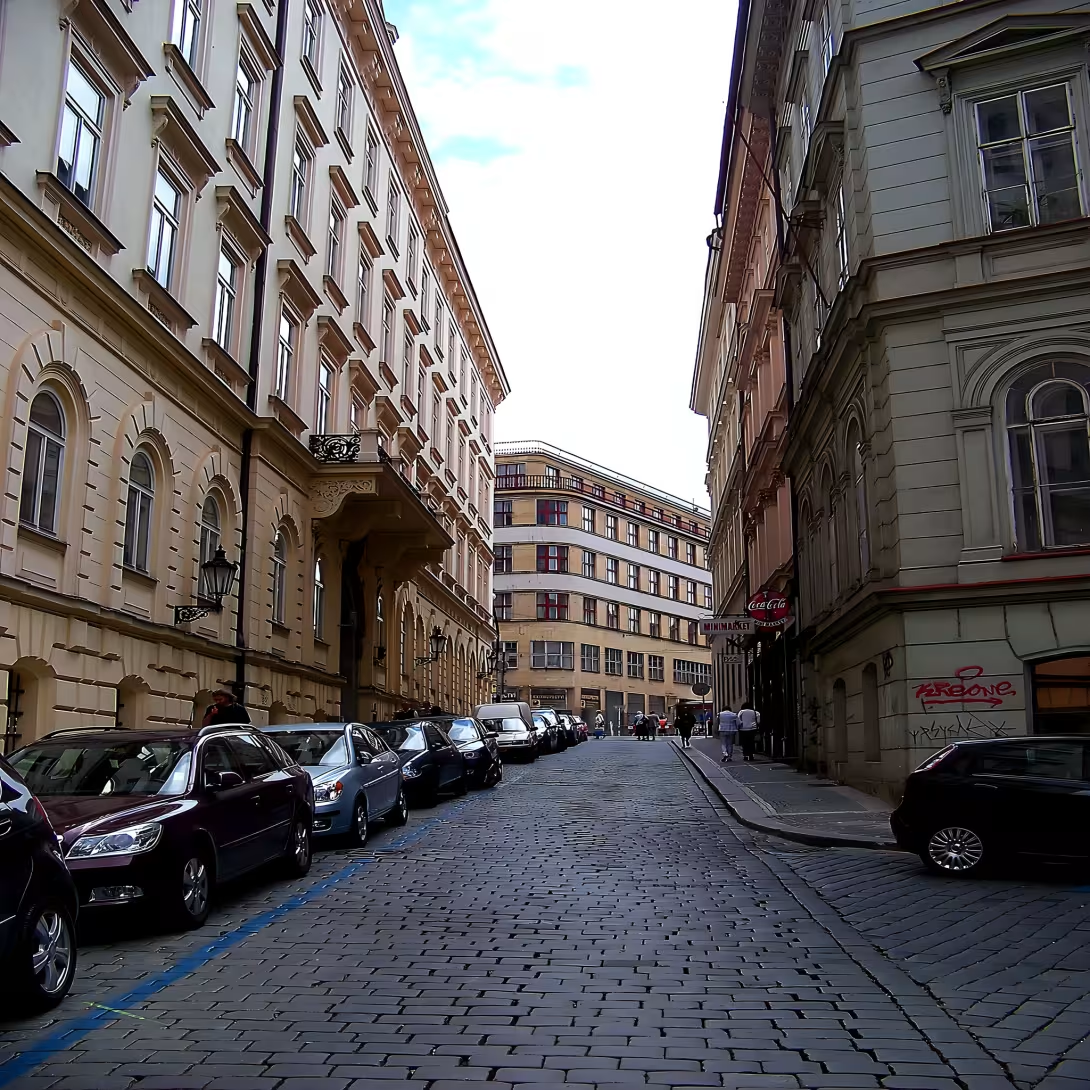
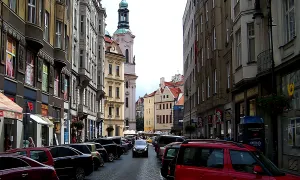
Karoliny Světlé is a historical communication in Prague's Old Town. It connects the National Class to Smetana's waterfront. It is remarkable of its medieval origins, the concentration of Renaissance and Neo-Renaissance buildings and the link to the life of the founder of the genre of the village novel, Caroline Shlálá.
Since the Middle Ages, this street served as part of the road from Vysehrad to the Vltava ford. Her name has changed several times over the centuries. The southern part has since the 13th century been called Svatoštěpánská according to the church which was demolished in 1789; In 1780 she then carried the name Stephen Square. The northern part was originally referred to as the Holy Cross smaller or the Holy Cross Ondrej, since the 17th century as Poštovská or Stará poskytská. The whole street was united under the name Poštovská in 1870 and since 1898 it has been named Karoliny Světlé.
The architectural street represents the layering of different periods. The oldest one is originally the Gothic house U Sobotecký (no. 283 / I). The Renaissance houses no. 285 / I and the House U three kings, also known as the White pretzel (no. 284 / I), both of which have been rebuilt twice over time. An important example of Czech neo-Renaissance is the three-storey flat house No. 1035 / II in the style of the Palladian Renaissance, designed by architects Antonín Wiehl and Jan Zeyer. In the street there are also buildings U Zlaté Váže and U Vratislavů, also Theatre U Valše, formerly known as Koukolovský House or Portus.
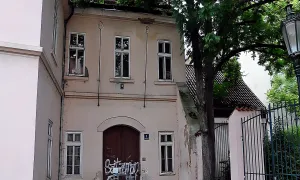
The key point is the house No. 22, the birthplace of the writer Caroline Light. Above its entrance portal is a commemorative plate with a bust from 1956 created by Marta Jirásková. Another dominant element is the Rotunda of the Holy Cross on the corner with Bethlehem Street. As part of the historical development in the area, the gate of St. Stephen and the church of St. Stephen the Smaller disappeared.
Nowadays, the street connects the historic pit with modern life. There are several cafés, bars and restaurants in its premises. Some of the buildings serve as the headquarters of civil associations, such as the organization for seniors Life 90.
Karoliny Světlé offers a concentrated view of the development of Prague architecture over short distances from goth to neo-Renaissance. It is a meeting point of literary history with the urban history of Old Town, which makes it a valuable destination for every visitor.
Then and now
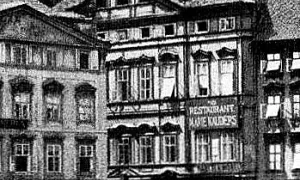
Drag the slider to compare how the landmark may have looked when it was built with the view today.
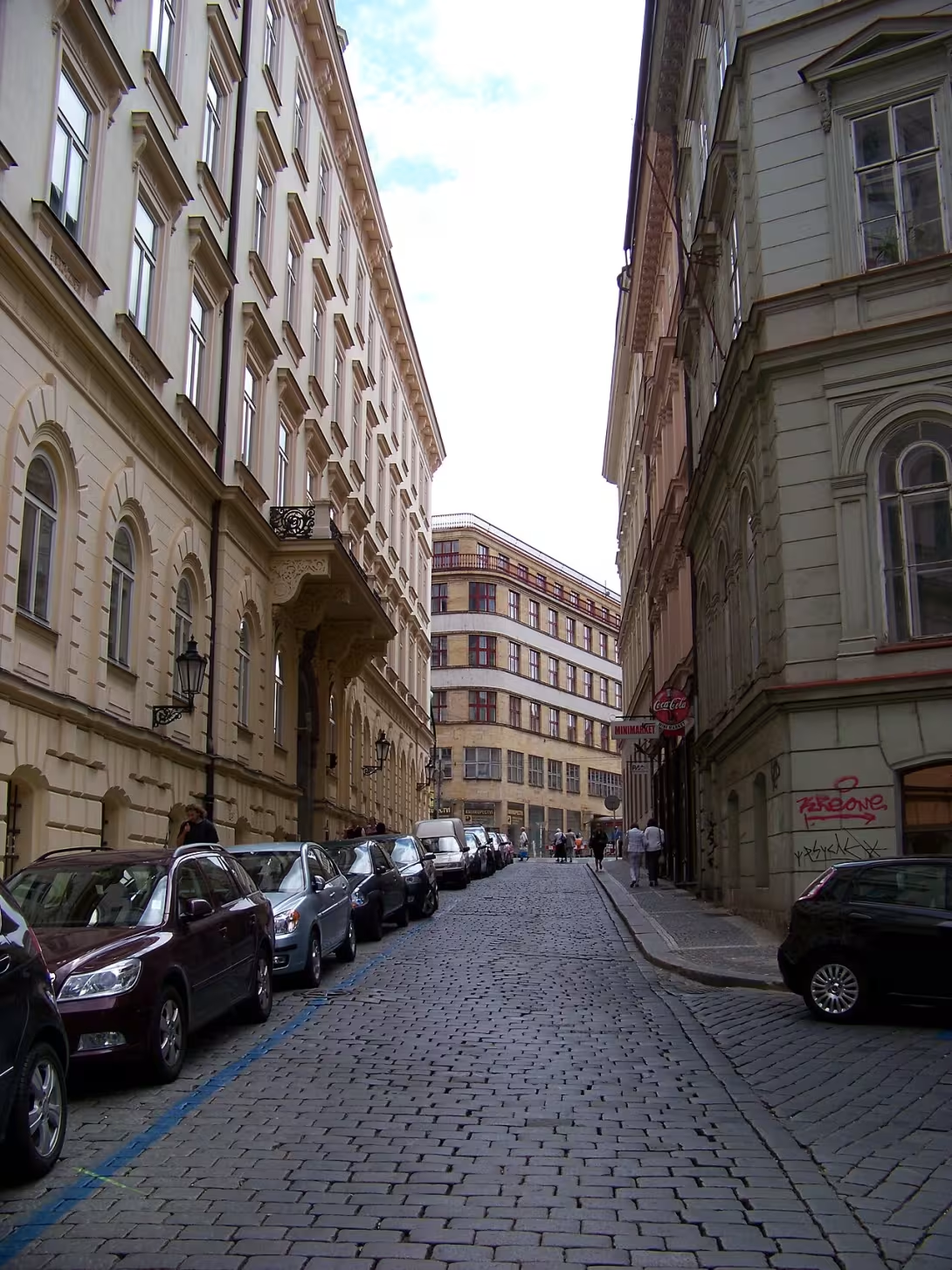
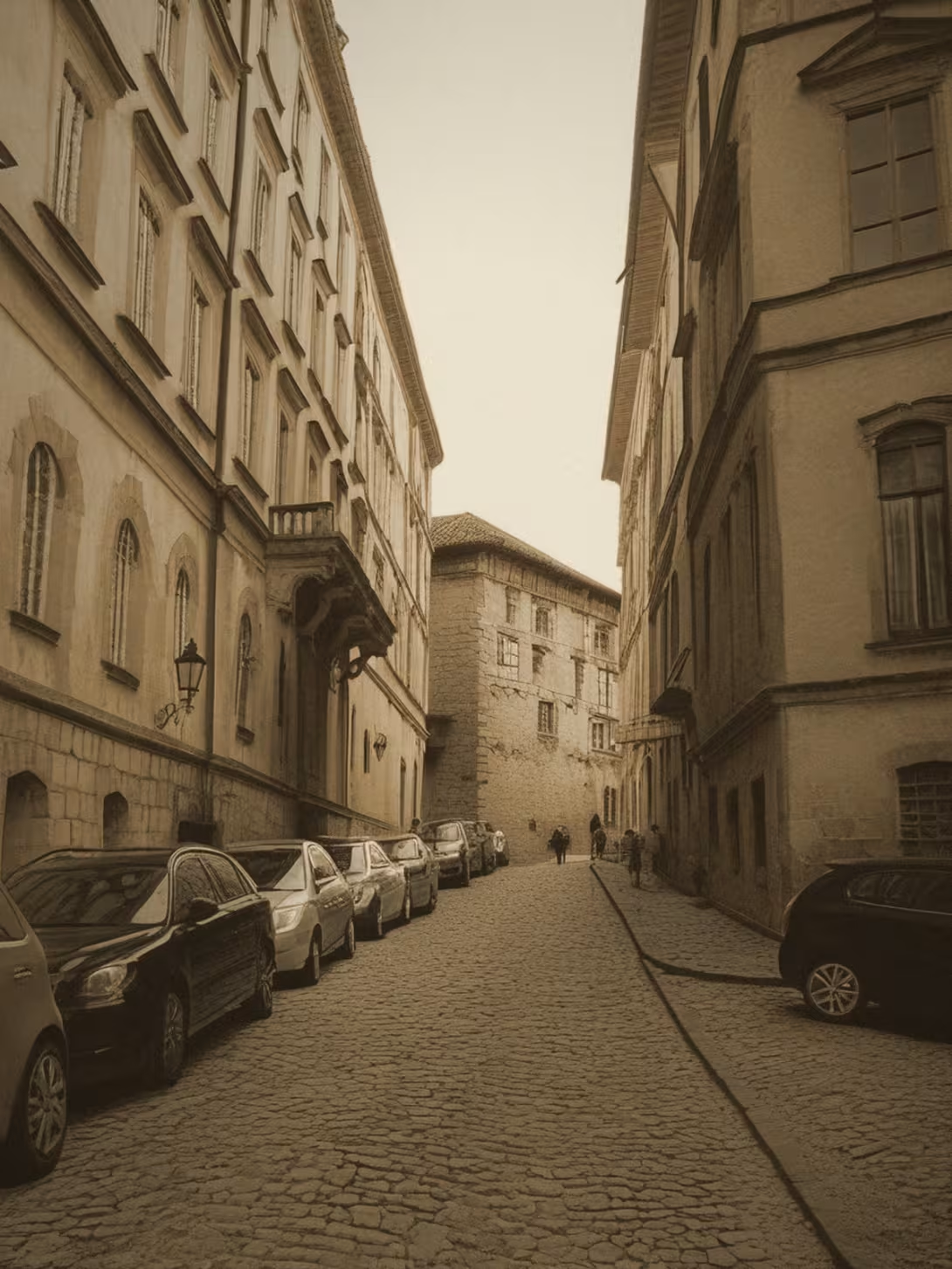
The historical appearance on the left is an AI-generated visualisation and serves as inspiration only.
Historical milestones
- 13th century
- The name Svatoštěpánská was used for the southern part of the street.
- 17th century
- The street was known as Post Office or Old Post Office.
- 1780
- The south part of the street was called Štěpánské Square.
- 1870
- The whole street got called Post Office.
- 1898
- The whole street was named Karoliny Světlé.
- 1956
- Placing a memorial plate with a Caroline Light bust at her home.
Architectural development
The street has medieval origins and served as a road to the Vltava ford. During it there are buildings in Gothic, Renaissance and Neo-Renaissance style. Some houses have been rebuilt several times over the centuries.
Historical events
In the 13th century, the southern part of the street was known as Svatoštěpánská. In 1870 the entire street was named Poštovská. In 1898 the street was renamed Karoliny Světlé.
Owners
Wow
Points of interest
- The street is of medieval origin and used to serve as part of the road from Vyšehrad to the Vltava ford. - There's a house number 22 on the street, which is the birthplace of the writer Caroline Svetlé. - On the corner of Bethlehem Street is the Rotunda of the Holy Cross. - The oldest buildings include originally Gothic House U Sobotecký. - The street offers a concentrated view of the development of architecture from Gothic to neo-Renaissance.
Guide
This guide is narrated by a synthetic voice generated by artificial intelligence.
Show guide text
This text was created by artificial intelligence and has not been editorially reviewed. It may contain inaccuracies.
Welcome to the heart of Prague's Old Town. You have just entered the street Karoliny Světlé, which now surrounds you with its calm yet noble atmosphere. If you look around you, you will see a short but very important communication that naturally links the busy National Class to the waterfront of the Vltava River. It's a place where the history of old houses clashes with the silence of forgotten corners of the center of our capital. Stop for a moment, take a deep breath, and feel the spirit of this place that follows you every step of the way.
Let us now look deeper into the past together to understand why this journey is so important. This street is not just a common passage between two points. Its roots date back to the Middle Ages, when it served as a key part of the road from Vyšehrad to the Vltava ford. So imagine how knights, merchants and craftsmen have walked through here for centuries, heading from the castle to the river. It's fascinating to think the life of the city was flowing through here in the 13th century. At that time, the southern part of the street was called Svatoštěpánská, which refers to the deep religious tradition of that time.
But time passed, and with it, names changed. In the seventeenth century this journey was known as Poštovská or Stará poskytská. It is possible that this name was related to postal transport, which was at the time the only possible transmission of messages. Later, in the year seven hundred and eighty, the southern part of the street was briefly called Stepan Square, before it reunited in the year one thousand eight hundred seventy under the name Poštovská. Only in the year of a thousand eight hundred ninety-eight did the street get its present name in honor of one of our most important writers.
Now that you know its history, pay attention to the surrounding architecture. Look at the facades of the houses surrounding you. Notice the diversity of structures that stand next to each other. During the street you can see a number of historically valuable buildings. Your eyesight can capture the beauty of renaissance houses, which tell about the city's flourishing, but also the Neo-Renaissance tenement house, which shows the later development of Prague's urbanism. Note the details on the facades that are the result of the work of recognized creators such as Antonín Wiehl or Jan Zeyer. Even though we are looking at the overall picture today, each of these houses carries the story of its builders and residents.
If we move on, I suggest you focus your attention on a house with number 22. This is where the native place of author Karoliny Světlé is located. It is the place where a woman was born, who deeply influenced Czech literature in her letters. In order to remember her, there was a memorial in the year one thousand nine hundred fifty-six in the form of a plate with her bust. Stop at this place and think about how powerful one person can influence the culture of an entire nation. Karolina Light was a symbol of intellectual power and sensitivity, and it is only natural that this street today bears her name.
Besides the author's home, there are other gems in this street. If you look towards the corners of Bethlehem Street, you'll find one of the oldest monuments in the entire centre. It's the Rotunda of the Holy Cross. This small but powerful building is a silent witness to the millennium of Prague history. It's incredible how different epochs meet in such a short space. And if you're looking for the oldest buildings in the area, pay attention to the house U Sob, which originally has a Gothic core. Gothic is present in many places in Prague, but here, in a narrow alley, it is very intimate and authentic.
The interesting thing that may interest you is the transformation from business and road to silent memory. Imagine the contrast. Once upon a time, cars coming from Vyšehrad to the bridge, dust from the roads rose into the air and the street was full of noise and excitement. Today it is a place where you can observe the architectural details and feel the proximity of the Vltava River, which is only a few steps away. It's a little island of peace in the middle of a hurried Old Town.
This street is like an open book. Each house, every stone in a tile and every memorial plate is one word in the story of Prague. From medieval roads to postal stations to a celebration of literary talent. You'll find it all here at a few dozen meters. It's a reminder that history isn't just in museums, but it's right under our feet and around us, in buildings that we go around every day.
Now that you have learned about the fate of the people and buildings on Karoliny Světlé, I suggest you continue to explore. You can go towards Smetana's waterfront and get swallowed up by the sight of the river, or go back to the National Class and feel the heart of the modern city. Before that, however, look around you again, feel the rhythm of this street and perhaps you will find in it your own favorite detail, which you are most interested in.
Thank you for coming through a piece of Prague history with us. We hope this short trip to the past has helped you better understand the beauty and importance of this place. We wish you a pleasant further journey through the city and many other discoveries in the forgotten streets of our capital. Goodbye.
Tips for visitors
The best time to visit Karoliny Světlé is early in the morning or late in the afternoon when the sun shines at an angle and the facade receives soft gold light. In spring and autumn there are fewer people around and the atmosphere is quieter, which makes it easier to observe the details of architecture. Traffic availability is excellent - Karoliny Světlé is located in the heart of Old Town, so it is easily accessible by foot from the National Class and Smetana's waterfront. What to take with you: comfortable shoes to walk on paved streets, bottle of water, or umbrella or raincoat for unpredictable weather and camera or smart phone with good camera. It is practical to have a brief map of Old Town or an application with an offline map to make it easy to navigate. Photography: The best angles are from the opposite side of Smetana's waterfront, where you can capture the entire length of the street with the river Vltava in the background. The light during the golden hour will highlight historical details and colored stones. What to visit in the area: during short walks (within 30 minutes) you can discover the National Class with its cafes and shops, walk along Smetana's waterfront overlooking the river, explore the atmosphere of Bethlehem and Konviktské Street with their historic buildings and finish the trip through the exit to Vysehrad, from where the panoramic view of the whole city comes.
Frequently asked questions
Can the monument be visited?
This is a structure in a public space that can usually be seen from outside free of charge. We have not verified that this particular one is freely accessible.
Where is the monument?
Location: Staré Město, Hlavní město Praha. The map on this page shows the exact spot.
For kids
Imagine going back to a time when the Czech landscape was full of castles and castles. One of them was the castle Karoliny Světlé, which stood by the river Sazava.
At the time there was a Count who had a beautiful castle with a large courtyard and garden. The Count was interested in literature and supported artists who came to his castle. It was like a game where the heroes of the books lived in the real world.
Businesses nearby
Do you run a restaurant, accommodation, shop, museum, rental, wellness or other visitor service near this monument? Show yourself directly to the people heading to it — this is how they will see you in the app and on the web:
Events nearby


Zdroj akcí: otevřená data měst a obcí ČR (Národní katalog otevřených dat) a kalendář akcí Národního památkového ústavu.
Nearby
Národní třída, Smetanovo nábřeží, Betlémská ulice, Konviktská ulice, Vyšehrad.
Accommodation nearby
Trips and activities nearby
Guided tours, tickets and activities nearby from GetYourGuide
Affiliate link: if you buy from the partner, we may receive a commission. The price for you does not change.
Search tours and activities →Themed route
Here is the design of the thematic route:
1. Bethlehem Street (Street) - Walk through the historical centre where there is a significant monument connected with the Czech language. 2. Konvict Street (street) - The road to the main destination that leads through the old parts of the city. 3. Karoliny Světlé (monument) - The main stop route dedicated to a major writer. 4. National class (street) - Walk on one of the most famous Prague roads with beautiful architecture. 5. Smetana's waterfront (waterfront) - Relaxation walk along the river overlooking the water.
Seasonal recommendations
In the spring, the surroundings flourish and the city gets a fresh look. Soft spring light is ideal for observing facade details. We recommend visiting the place in the morning when the air is clean, and wearing a light jacket or raincoat.
In the summer months, the intense sun and hot air dominate the space. The atmosphere is very lively, but accompanied by a large number of people on the streets. The best is to come early in the morning or late in the evening to avoid heat, and not forget the comfortable shoes and hat.
Autumn brings golden colors and melancholy mood to Old Town. Layer clothes and waterproof jacket are suitable because the weather is unstable.
In winter there is a monument in contrast to freezing air and a short day. The evenings are brightened with city lamps and in advent time there is a sense of the expectations of the holidays. It is necessary to wear a warm sweater, wool hat and gloves in order to make the stay outside pleasant.
Visualizations and artistic views


The visualisations are generated by artificial intelligence and serve as inspiration.
Photos from the area
Real photos taken near the monument


Zdroj a licence jsou uvedeny u každého snímku.
Atmosphere of the place
This atmospheric visualisation of the place and period was generated by artificial intelligence. It is not real footage of the location.
Tips from visitors
No tips yet. Be the first!
Log in and add your tip.
Sources and literature
Photos: ŠJů (cs:ŠJů) / CC BY-SA 3.0, rozlišení zvýšeno umělou inteligencí — Wikimedia Commons. The author and licence also appear when you hover over the image.
Faktickým podkladem tohoto textu byl článek na Wikipedii, jehož autory jsou přispěvatelé Wikipedie. Článek je dostupný pod licencí CC BY-SA 4.0.
Location on the map
More monuments – Staré Město
Show all in the municipality


Příběhy a pověsti
Legendy, pověsti a příběhy spjaté s touto památkou
Fotografie návštěvníků
Zatím žádné fotografie. Buďte první, kdo přidá fotografii z návštěvy!
Log in a přidejte svou fotografii nebo hodnoťte.
Za ověřenou návštěvu v aplikaci získáte víc bodů — poznáme podle GPS, že jste na místě.
Reviews and comments