






Palác hrabat z Lissau Palace
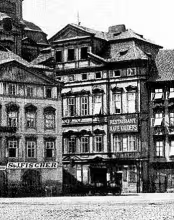
In the northern front of the Old Town Square, the palace was built in the first decade of the 18th century, which is connected with two prominent figures of the then Prague - builder Rudolf Josef Count of Lissau and architect Jan Blazej Santinim-Aichle. Today's visitor on site No. 935-I will remember nothing about the decayed construction of the high baroque, as it was the victim of Prague's rendering in 1896.
Rudolf Josef Count of Lissau (born 19.3.1665) was the imperial chamber and captain of the Old Town of Prague. The family from Lissau was originally from Brandenburg; only the count's ancestor - his grandfather Johann von Lissau - gained an incubate and affiliation to the state of government in Bohemia. Emperor Leopold was promoted to the count by Rudolf Josef himself by the First Charter of 10 July 1702. It was in the early 18th century that he joined the generous reconstruction of the older houses in the square in a representative family palace and invited the fast-growing star of Czech architecture - Jan Blazej Santiniho-Aichl. The reconstruction and partial new construction were completed by 1705.
The palace was located in the immediate neighbourhood of the presbytery of St. Nicholas' church, on the interface of Old Town and Joseph, on the corner of the northern front of the Old Town Square and the then crooked Maisel Street, at that time called the Three-Vall Street. In the neighbourhood was the so-called Kreno house (no. 936-I), a four-wing Baroque building that largely overshadowed the facade of the Lisovsky Palace. This house was removed from Old Town Square in 1901, five years after the demolition of the palace itself.
The appearance of the main facade is reconstructed from historical photographs of F. Friedrich (around 1870) and J. Eckert (1895) and from the Langweil model of Prague. Michal Brix processed the painting reconstruction of the facade. Santini laid out the main front in nine axes, stressing the five-axis risalite at the centre of which he still applied a flat attachment in the width of three axes - a motive that belonged to his favorite. In the extreme axes, the entry portals opened symmetrically. The central portion was completed with a gazebo planted above the crown ledge; The gazebo was decorated by a triangular cloud front, on whose sides the high Mansard roofs were lined with sections of split front. The distinctive horizontal cordon ledge, plastically developed parapets and the belt under the windows of the upper half-floor carried a firm rhythm into the facade. The facade rose above the ground floor in two equally high lines of rhythmised narrow rectangular windows.
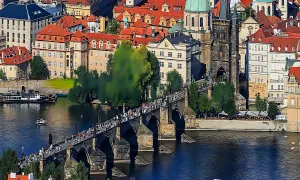
The cooperation of Rudolf Josef with Santinim did not only exceed construction contracts. In 1707, the Count issued a commission to Santini's work at the Černín Palace in Hradčany to help him open the door to other prestigious clients. The relationship between both men was personal: the Earl of Lissau testified at Santini's children's christening. The massive testimony of this friendship is the statue of St. Anne Saméthird on the Charles Bridge, created in 1707 on the Donor's order from the sculptor Matìj Václav Jäckel. On the base of the statue you can see the lineage coat of arms of the Earl of Lissau and it is assumed that Santini was involved in the design of this plinth.
The visitor of today's Old Town Square will not see the palace with his own eyes - the reconstruction of the place took place during the rendering. Who wants to catch at least a trace of his builder, goes to the Charles Bridge: Jäckel's statue of St. Anne Saméthird with the count's coat of arms from Lissau on the pedestal is still in place today and reminds him of the man who made one of Santini's remarkable Prague works.
Then and now
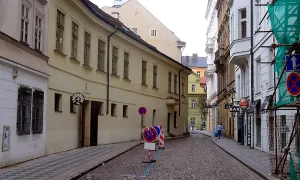
Drag the slider to compare how the landmark may have looked when it was built with the view today.
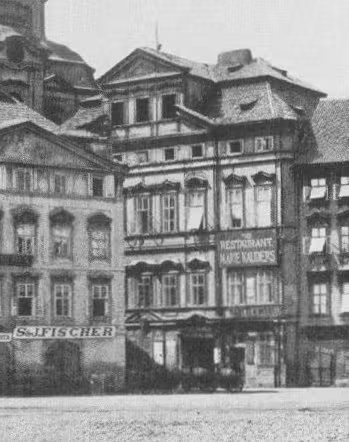
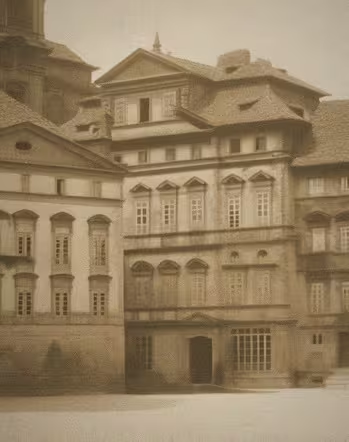
The historical appearance on the left is an AI-generated visualisation and serves as inspiration only.
Historical milestones
- 1700-1705
- Implementation of the palace under the leadership of Jan Blazej Santini-Aichl.
- 1707
- Santini collaborated on the coat of arms of the Earl of Lissau for the statue of St. Anne Samethird on Charles Bridge.
- 1896
- The death of the palace in the rendering of the Old Town.
Architectural development
The palace was built in Renaissance style, later rebuilt.
Historical events
- 1702
- Rudolf Josef from Lissau promoted by Emperor Leopold I to count state.
- 1705
- Completion of reconstruction and extension of original houses to the palace.
- 1896
- Palace destroyed during Prague rendering.
Owners
{'Rudolf Josef Count of Lissau': {'since': 'beginning of the 18th century', 'to': '1896'}}
Points of interest
- Palác hrabat z Lissau was built in the first decade of the 18th century on the north side of the Old Town Square and disappeared in 1896 during the Prague rendering.
- The building of the palace was initiated by Rudolf Josef Count of Lissau, the Imperial Chamber and Chief of the Old Town, who was promoted to count by Emperor Leopold I in 1702.
- The palace was designed by architect Jan Blazej Santinim-Aichle, who completed it until 1705.
Guide
This guide is narrated by a synthetic voice generated by artificial intelligence.
Show guide text
This text was created by artificial intelligence and has not been editorially reviewed. It may contain inaccuracies.
Welcome to the heart of old Prague. You are standing in one of the most important places in our city, in the Old Town Square, where every tile and every shadow tells stories about ancient glory, the rise and the inevitable dust of time. While you're looking around at the current face of the square, try to close your eyes for a moment and let yourself be carried away by the idea of what this place looked like thirty or even hundreds of years ago. It was here, in the place where other buildings now stand, that once dominated the baroque triumph - the palace to dig from Lissau. Even if you don't see him physically today, his spirit still permeates the atmosphere of this square and his legacy remains a solid part of Prague's history.
Let us return together to the beginning of the eighteenth century. Imagine Prague at a time when the Baroque style had only been fully dilated in the cities and when the nobles tried to demonstrate their position within the imperial court through the architecture of their settlements. In the first decade, a thousand seven hundred years, a building was built here to be a symbol of power and elegance. The main mover of this project was Rudolf Josef Count of Lissau. But he wasn't just a common nobleman. As the Imperial Chamber and captain of the Old Town, he held in his hands really important positions, which gave him a voice even in the highest circles of the then society. His ambitions were not only political, but aesthetic. He wanted to own a residence that would correspond to his newly acquired count, to which he was promoted by Emperor Leopold himself.
Now pay attention to whoever was responsible for this ambitious project. When it comes to the greatest builders of the Baroque, the name of John Blazej Santini-Aichl cannot be omitted. He was the man who left his indelible mark in this place. The Lisovsk Palace was not just another building in a row; he was considered one of his top works, especially because Santini here could prove his genius beyond strictly religious objects that formed the basis of his reputation.
If you could stand in time and see the palace in its full glory, what would you see? Imagine a monumental four-wing building that, by its structure, created a coherent and representative whole. Look in your mind how the palace facade was richly divided. Santini was a master at work with form and rhythm. Notice how your eyes would move around his facade, which was not flat and boring, but dynamic and alive. The key element was the risalite, the elevated part of the facade, which provided the whole construction depth and strong character. This work with architectural detail made the palace a prime example of the Baroque of Prague, where mathematical precision was combined with incredible richness of expression.
This palace was not just stone material, it was a living organism in which events took place in the form of a city back then. Rudolf Josef from Lissau hosted important personalities here and his presence here was a constant reminder of the link between Prague's nobility and the Imperial Court. Although the names of other residents of this house may have disappeared a little in history, the importance of the place itself as a family residence remains undoubted.
But now I must take you to one of the most dramatic chapters of this story. Every big building has its rise, but some have its sudden and relentless end. In the year one thousand eight hundred ninety-six, Praha decided to make a radical change. The time has come for the so-called rendering of the Old Town. Modernization, which aimed to improve the hygiene conditions and organize the chaos of the old city, became the fate of many historical treasures. Even the palace rake from Lissau, this masterpiece of Santini, fell victim to this urban reconstruction. In one moment, within the framework of extensive demolition work, one of the most beautiful Baroque residences disappeared from the map of Prague. It left only memory and fragments in historical documents.
Yet, even though the building has disappeared, there is a fascinating connection that may interest you today as you walk through the city. Welcome to the secret that links this extinct palace to one of the world's most famous bridges. Santini, who designed the palace, collaborated in the year thousand seven hundred and seven to create the coat of arms of the Earl of Lissau. This coat of arms was not only an ornament on the palace facade, but it became part of a much wider work of art. It is thanks to this cooperation that this heraldic symbol was used for the statue of Saint Anne Samethird, which you can see today on Charles Bridge. It is an incredible example of how architecture, heraldic and sculptural art intersect in one historical line. So next time you look at statues on Charles Bridge, remember the man who had his home built here.
Today you're standing in a space that is different from what you can imagine, but its history is still alive. Palác hrabat z Lissau does not exist, but its existence shaped what Staré Město is today. Santini's genius, the ambition of the Earl of Lissau and the tragic fate of the rendering are the fibers from which the tapestry of Prague's history is woven.
I hope that this short journey over time has helped you see this place deeper than just the square. Let yourself remain inspired by the beauty of the surroundings, continue to walk around the Old Town and every time you look at baroque facades or statues ask what other stories are hiding beneath the surface of today's metropolis. Thank you for your attention and I wish you a pleasant continuation in exploring our beautiful city.
Frequently asked questions
Is Palác hrabat z Lissau open to the public?
Yes, he's open to the public. The palace is open during seasonal holidays and admission fee is payable on site.
How do I get to the place by car / public transport?
Palác hrabat z Lissau is located near the city center. It is best to arrive by bus No. 27 from the station 'Square' or to park in a nearby parking lot and walk to the palace.
How much is the entrance fee and is it paid on the spot?
Payment takes place at the cash register.
Is the tour suitable for children and seniors?
Palác hrabat z Lissau is suitable for visiting families with children and seniors as there are wide pavement and accessible rooms.
How long does the tour take?
A tour of the Palace of Rakes from Lissau can be completed within 30-60 minutes, depending on your pace and interest in history.
What are the opening times and booking is required?
The Palác hrabat z Lissau is open from April to October, every day from 9: 00 to 5: 00. Reservation is not mandatory, but we recommend it for larger groups.
What's interesting in the immediate vicinity?
There is a beautiful park garden with several statues and fountain in the vicinity of the palace of the dig from Lissau. There is a local museum nearby, which represents the history of the region.
For kids
Imagine going back to the past in the Middle Ages, the period where many noble families were replaced. We are in the Palace digging from Lissau, which is now an important cultural monument.
It was like a game where the roles of the rich and powerful were played. The Earl of Lissau could see him sitting on his throne while his wife prepared food in the kitchen or nursed children. The Palace was their home, but it was also a place of important events and meetings.
Businesses nearby
Events nearby
Zdroj akcí: otevřená data měst a obcí ČR (Národní katalog otevřených dat) a kalendář akcí Národního památkového ústavu.
Nearby
{'Church of St. Nicholas': {'distance': 'right near the neighborhood', 'description': 'Gothic church with a presbytery that was adjacent to the palace.'}, 'Maisel Synagogue': {'distance': 'several hundred meters east', 'description': 'A preserved 16th-century synagogue in the centre of the former Jewish ghetto.'}, 'Old Town Square': {'distance': 'on the corners', 'description': 'Historic Centre of Prague with dominance as the Old Town Council.'}, 'Church of St. James': {'distance' about 300 meters', 'description': 'Gothic Church in the Old Town'}}}}
Accommodation nearby
Trips and activities nearby
Guided tours, tickets and activities nearby from GetYourGuide
Affiliate link: if you buy from the partner, we may receive a commission. The price for you does not change.
Search tours and activities →Themed route
Thematic cruise route: Baroque and Jewish Praha in the heart of Old Town
1.Palác hrabat z Lissau * Type: * Renaissance palace with Baroque modifications. * Why visit? * A unique example of a 16th century noble residence, which maintains the original available even later reconstruction. Its location on the corner of Old Town Square offers a view of the historical centre.
2. Church of St. Nicholas * Type: * Gothic parish church with presbytery. * Why visit? * He's sitting directly with the palace, and his presbytery was once part of the wall. The interior with late Gothic and baroque elements reflects centuries of religious history of the city.
3. Maisel Synagogue * Type: * A preserved Jewish prayer house from 1592. * Why visit? * One of the oldest preserved synagogue in Prague, lying in the former Jewish ghetto. An architecturally valuable building with a rich history of Prague's Jewish life.
4. Old Town Square * Type: * Historical centre with dominoes. * Why visit? * From the palace is only a step - here stands the Old Town Hall with the clock, the Týnské Temple and other monuments. The square is the heart of Prague's history and an ideal place for photos and relaxation.
* The route leads along walking paths in close proximity to the main targets, without deflections. *
Seasonal recommendations
Spring During the spring, the area of the demolished Palace offers a unique combination of historic atmosphere and awakening nature. When the sun starts to shine longer and temperatures move around pleasant 10- 15 ° C, the decaying wall of the palace creates dramatic contrast with flowering trees and young grass in the surrounding area. The best time to visit is early in the morning, when light falls sideways and creates long shadows on the remains of the walls that highlight their original size. Comfortable shoes are recommended because the terrain around is often uneven and wet after spring rains. There are fewer visitors in this period than in summer, but it is still worth watching the weather forecast - sudden showers can change plans.
Summer The main summer season is dominated by the hot sun and lively atmosphere of the Old Town, which is also reflected in the space of the former palace. The temperatures often exceed 25 ° C, so it is best to visit the ruins in the morning when the shadow is still long and the heat is tolerable. The surrounding area offers shadows from surrounding houses and trees, which is suitable for a longer tour. Light, but protective clothes and plenty of water are recommended, because in the summer months there is a high humidity in the centre of Prague. Since tourists and locals come here in the summer, it is good to count on a short wait at the entrance to nearby monuments that may be overpopulated.
Autumn Autumn brings golden leaves and cooler air to the palace, which gives the ruin a mysterious and nostalgic atmosphere. The temperatures drop to 5- 15 ° C, so it is advisable to put on layered clothes that allow you to adapt to rapid weather changes. The most magical moments arise in October when the sun sets behind the roofs of Old Town and the light breaks in scattered stones. There are fewer tourists in this period than in the summer, but it is still worth choosing calmer days off the weekends. The tour can be completed by visiting nearby cafés where warm wine or tea is served.
Winter The winter visit to the demolished Palace of the dig of Lissau is an experience for those who appreciate the quiet and mysterious atmosphere of the snowy city. Cold air and short days create dramatic lighting, where the sun hardly penetrates between houses and the ruins look like from another century. The temperatures often fall below the freezing point and therefore warm but moving clothing, gloves and solid footwear are essential. The best time is the afternoon when the last rays of the sun are reflected on the walls and long shadows are formed. In winter the area is almost deserted, which allows for quiet photography and a tour without crowds. In addition, dawn and sirloin lighting are increasing in advent time, which gives the place even more magic.
Visualizations and artistic views


The visualisations are generated by artificial intelligence and serve as inspiration.
Photos from the area
Real photos taken near the monument


Zdroj a licence jsou uvedeny u každého snímku.
Tips from visitors
No tips yet. Be the first!
Log in and add your tip.
Sources and literature
Fotografie: Jan Maloch / Public domain — Wikimedia Commons. The author and licence also appear when you hover over the image.
Faktickým podkladem tohoto textu byl článek na Wikipedii, jehož autory jsou přispěvatelé Wikipedie. Článek je dostupný pod licencí CC BY-SA 4.0.
Location on the map

Příběhy a pověsti
Legendy, pověsti a příběhy spjaté s touto památkou
Fotografie návštěvníků
Zatím žádné fotografie. Buďte první, kdo přidá fotografii z návštěvy!
Přihlaste se a přidejte svou fotografii nebo hodnoťte.
Za ověřenou návštěvu v aplikaci získáte víc bodů — poznáme podle GPS, že jste na místě.
Reviews and comments