



Dům U černého Noha House
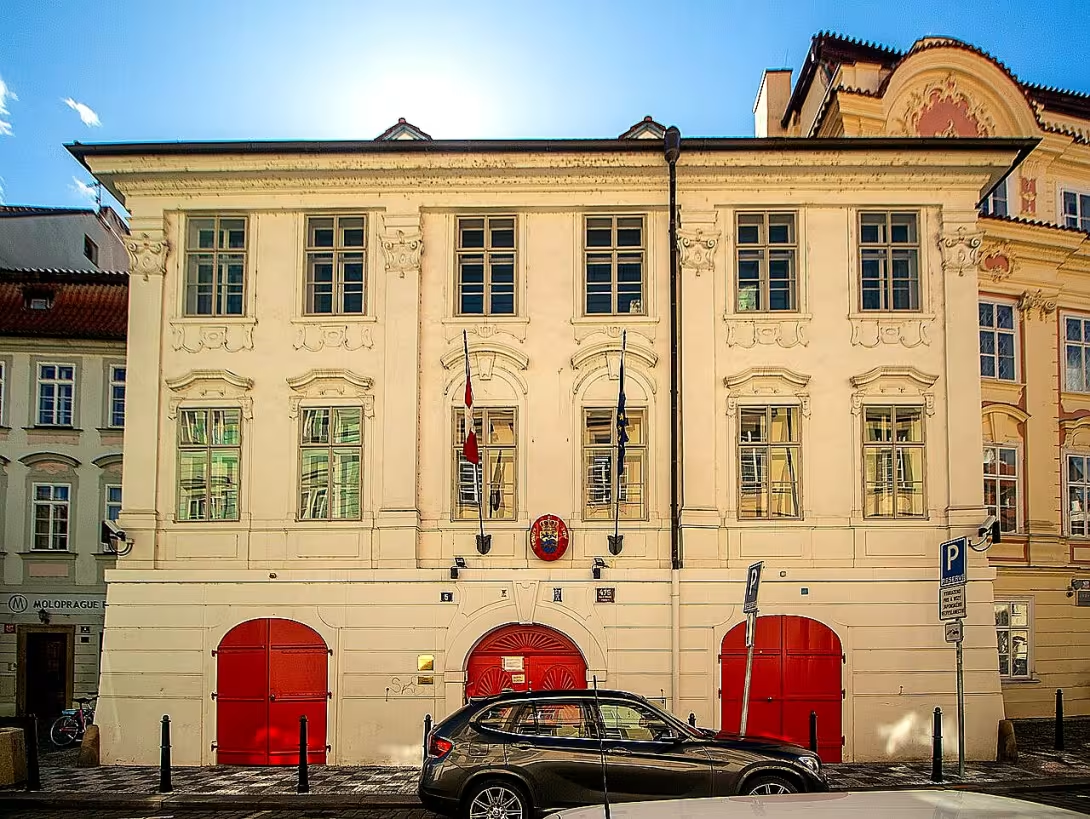
The house U Černý Noha, also known as Jäger's house, is an important townhouse in Maltez Square on Prague's Malá Strana. This late Baroque building has been protected as a cultural monument since 1964. It is a valuable example of urban architecture and currently serves as the headquarters of the Embassy of the Kingdom of Denmark.
The first written mention of the house dates back to 1576, when the object was referred to as On the Carb. Originally, the Renaissance building underwent transformations over centuries that reflected period trends. In the second half of the 17th century, the house was named U Black Noh, or U Black Gryf, because at that time the noh and griff terms were identified.
The present form of the building was printed by a late Baroque reconstruction carried out between 1767 and 1770. The author and investor of the modification was Josef Jäger, which also built the neighbouring Turby Palace at the same time. The two-storey building has a significant entrance into the area of the Maltese Square and its street facade is divided by six axes with stucco decoration. The original Renaissance layout included an arch on the ground floor which was later adapted to the business premises. The court wing of the house is younger and comes from the second quarter of the 19th century.
The historical context of the reconstruction falls under the reign of Marie Theresa. At that time, enlightenment reforms were promoted in the Czech countries and architecture gradually transformed from the maturing Baroque towards Classicism. Josef Jäger as owner and builder made a significant contribution to the then form of Maltese Square.
The building is currently privately owned and serves as the seat of the Danish Embassy. Due to diplomatic use, it is not normally accessible to the public, but its exterior remains an important part of the historical building of the Mala Strana. Visitors of Prague can appreciate its architectural quality in the vicinity of other monuments such as the Church of the Virgin Mary under a chain or nearby Charles Bridge. The preservation of this house is a proof of the continuity of the building, which, after centuries, forms an integral part of the nature of the Prague Heritage Reserve.
Historical milestones
- 1576
- First written mention of the house under the name on the ship.
- 1767
- Opening of the late Baroque reconstruction according to Josef Jäger's design.
- 1964
- The house was declared a cultural monument.
Architectural development
Originally a Renaissance townhouse with a flooring on the ground floor was rebuilt in the second half of the 18th century into a late Baroque form. In the 19th century the court wing was added and the original arch was adapted to the business premises.
Historical events
1576 first written mention of the house under the name On a ship. 1767-1770 late Baroque reconstruction of the building. 1964 declaration for cultural heritage.
Owners
Josef Jäger in the 18th century, currently a private owner.
Points of interest
- In 1576, the house was referred to as "The Carb." - In the second half of the 17th century he acquired a house named U Black Foot or U Black Gryf, because that's when these concepts were identified. - The current form of the building was printed by a late Baroque reconstruction between 1767 and 1770, the author and investor of which was Josef Jäger. - The original Renaissance layout of the house included an arch on the ground floor which was later converted into a commercial space. - The object currently serves as a seat of the Embassy of the Kingdom of Denmark and is not normally accessible to the public.
Guide
Show guide text
This text was created by artificial intelligence and has not been editorially reviewed. It may contain inaccuracies.
Welcome to Maltez Square in Malá Strana, one of the most memorable places in Prague. You are standing in front of a historical monument known as the House of Black Foot, which is also referred to as Jäger's house. Look up at this impressive six-axis facade with its rich stucco decoration and feel conquered by the time each line tells a story.
This house has a long history. The first written mention of him dates back to 1576, when he was known as The Carb. After centuries of transformation and development, the transformation took place in 1767- 1770, when Josef Jäger carried out a late Baroque reconstruction of this townhouse. This architectural work printed the house its present form and highlighted it on the map of Prague as an important monument.
Now let's focus on the architecture surrounding you. Note the stucco decoration of the facade and attention is drawn to the 19th century court wing. These elements are evidence of the complex history and artistic sense that was embodied in this place.
The House of Black Foot is also associated with interesting stories. See what the name of the house evolves: from the 16th century to the Black Foot or the Black Gryf in the second half of the 17th century. These names reflect the cultural and historical context of the time when these concepts were identified.
There is also an interesting thing to note: the house has been given a protected status as a cultural monument since 1964. This only confirms its invaluable contribution to the heritage of Prague.
Let's move on to the other mysteries this house holds. Every angle and every decoration can tell stories about the inhabitants of the past and their lives. Imagine what would happen here when the late Baroque style began to shape his appearance.
We are ready for further exploration of the Little Party and its many other monuments. The House of Black Foot is only one of the chapters of the long history of this neighborhood that stands before you. I hope your visiting day is full of discoveries and inspiration. Farewell is with the hope that you find the other beauty this historic neighborhood offers.
Tips for visitors
For a quiet tour of the exterior of the house we recommend the morning hours during the working week, when the least people are in Maltese Square and the light ideally depicts the Baroque facade. Take with you comfortable shoes for walking on historic tiles and a camera, with the best pictures of the house taken from the opposite side of the square, where its architectural rationality stands out. In the immediate vicinity you can visit the Palace of the Turbo, the Church of the Virgin Mary under a chain or walk to the nearby Charles Bridge. For families with children, the location is suitable due to the proximity of open spaces where children can relax from sightseeing, but take care of increased traffic in nearby narrow streets.
Frequently asked questions
Can the monument be visited?
This is a residential or farm building, not a museum with opening hours. Please view it from public space and respect the owners' privacy. We have no information about access to the interior.
Where is the monument?
Location: Malá Strana, Hlavní město Praha. The map on this page shows the exact spot.
Why is the monument protected?
It is listed in the Central List of Cultural Monuments of the Czech Republic as a cultural monument (register no. 1000151538).
Businesses nearby
Do you run a restaurant, accommodation, shop, museum, rental, wellness or other visitor service near this monument? Show yourself directly to the people heading to it — this is how they will see you in the app and on the web:
Events nearby

Zdroj akcí: otevřená data měst a obcí ČR (Národní katalog otevřených dat) a kalendář akcí Národního památkového ústavu.
Nearby
Maltézské náměstí, palác Turbů, kostel Panny Marie pod řetězem, Karlův most.
Accommodation nearby
Trips and activities nearby
Guided tours, tickets and activities nearby from GetYourGuide
Affiliate link: if you buy from the partner, we may receive a commission. The price for you does not change.
Search tours and activities →Themed route
Explore the beauty of the Small Party by starting your trip at Dům U černého Noha, a historical monument known for its architectural beauty and rich past. This house is an excellent example of baroque style, which reflects life in Prague of the 17th century.
The second point of our route will be Maltese Square, a small and quiet place where Dům U černého Noha is located. This square is an ideal place to relax and see the surrounding architecture, including other historic houses with rich decoration.
Then we move on to the palace of the Turbos, just a few minutes walk from the Maltese Square. This palace is famous for its elegant Baroque architecture and beautiful courtyard, which offers a view of the historic atmosphere of the area.
The fourth goal will be the church of the Virgin Mary under a chain, one of the oldest sacral buildings in Prague. This church is famous for its Gothic architecture and legendary painting that attracts many visitors.
We close our route by looking at Charles Bridge, just a short walk from the church. This bridge is an iconic monument of Prague, famous for its history and views of Vltava and Old Town.
This route offers a view of the rich history and architecture of Malá Strana, which makes it an ideal experience for anyone interested in cultural monuments of Prague.
Seasonal recommendations
Spring: In the spring, the Little Side awakens to life and the surrounding gardens begin to bloom. The light is soft and pleasant in this period, which greatly highlights the historical details of the house. It's the perfect time for first walks. We recommend you take light layers of clothing that you can add as needed. It is best to arrive in the morning to enjoy the peace before the arrival of larger groups of people.
Summer: The summer season brings intense sun and high temperatures to narrow alleys. The atmosphere is very lively and full of visitors who enjoy long days. For the sake of large crowds, we recommend you come as early as possible in the morning to avoid the biggest rush. Dress very lightly and remember enough fluid. Shadows of old buildings will give you the necessary cold during the day.
Autumn: Autumn brings a nostalgic atmosphere to the area and beautiful golden colors of leaves. The morning mist often covers historical facades, which gives the place a mystery. It is necessary to prepare for cooling, so choose the coat coating. For the best visual experience we recommend a visit in the afternoon when the sun shines below and the colors are the most distinctive.
Winter: In winter the days are short and the light is rather dim and grey, which underlines the seriousness of the monument. In Advent Time, the atmosphere is very cozy, even when it's cold. It is necessary to wear warm clothes, including jackets and scarves. Although there are fewer people in this period than there are in the summer, you can count on the fact that due to the short days the tour time may be limited.
Visualizations and artistic views

The visualisations are generated by artificial intelligence and serve as inspiration.
Photos from the area
Real photos taken near the monument

Zdroj a licence jsou uvedeny u každého snímku.
Tips from visitors
No tips yet. Be the first!
Log in and add your tip.
Sources and literature
Photos: VitVit / CC BY-SA 4.0 — Wikimedia Commons. The author and licence also appear when you hover over the image.
Faktickým podkladem tohoto textu byl článek na Wikipedii, jehož autory jsou přispěvatelé Wikipedie. Článek je dostupný pod licencí CC BY-SA 4.0.
Location on the map

Příběhy a pověsti
Legendy, pověsti a příběhy spjaté s touto památkou

Fotografie návštěvníků
Zatím žádné fotografie. Buďte první, kdo přidá fotografii z návštěvy!
Log in a přidejte svou fotografii nebo hodnoťte.
Za ověřenou návštěvu v aplikaci získáte víc bodů — poznáme podle GPS, že jste na místě.
Reviews and comments