



Dům U černého orla (Plzeň) House
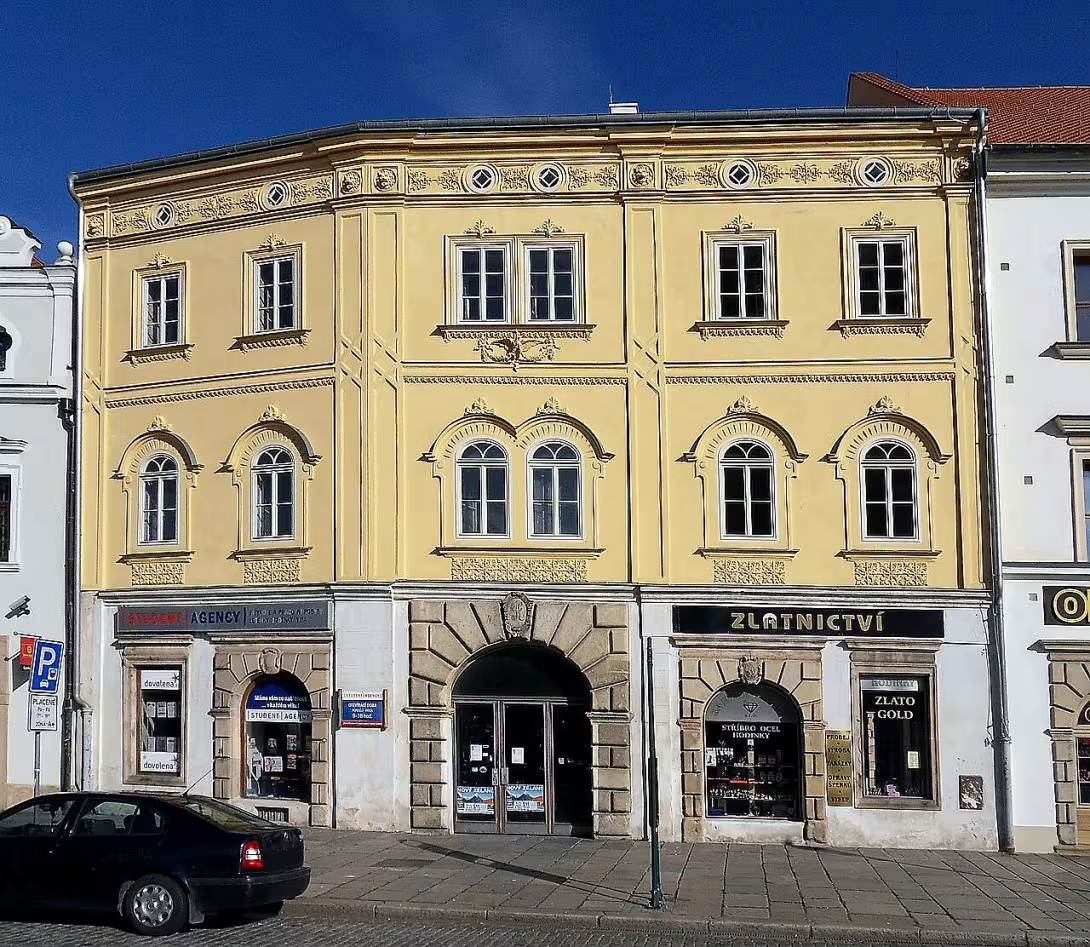
The Black Eagle House is a two-storey townhouse in the eastern front of the Plzeň Square of the Republic. The construction combines elements of the New Romanesque and Neo-Renaissance style. Since 1958, it has been a protected cultural monument.
The core of the building probably dates back to the beginning of the 17th century when Pilsen was an important business centre of the Czech countries. At the beginning of the 18th century the house underwent a Baroque reconstruction. Another major change occurred around 1860. The Renaissance shields were removed and the facade was modified in a romantic style. This intervention reflected the then European trend of history and nostalgia over the Middle Ages.
The house in the floor plan is slightly broken. It ends with a longitudinal saddle roof with bags. The New Romanesque and Neo-Renaissance elements are decorated with facade and interiors. The ground floor is dominated by a central barefoot portal with cartouche at the top. It is completed by two smaller groups of input, which today serve as expenses. The floors are broken by moldings and lizens. The windows on the first floor are arched and grouped in the middle, while in the second are rectangular and set in profiled shambles. Under the crown ledge is placed stucco frieze decorated with lion's heads.
The history of ownership dates back to the Stehlek family from Čenkov, who owned the house from 1617 to 1705; The Pilsen townsman Bartoloměj Stehlík st. from Čeňkov lived briefly here. In 1705 the Object was purchased by the Plzeň Mayor Jan Petr Vodička. At that time the construction was devastated by a large fire from 1693. Since the middle of the 19th century he subsequently operated the pharmacy Vilém Peitner.
There were various establishments in the building in the past, such as the malting plant, which lived here until 1814. In the second half of the 20th century the house was used only minimally, namely in the premises of shops in the parterre, which led to gradual decaying.
Complete renovation took place in 2017- 2018. Thanks to it, the house was nominated for the Patrimonium Futuro Award in the category Restoration Monuments. During it, the barefoot was restored and the main portal received a replica of the original door. A replica of the wooden stoves was installed on the east wing in the yard. In the interior were repaired wooden stairs and parquet floors. The original gold paper wallpaper was also preserved and supplemented.
The Black Eagle House is a valuable example of a Pilsen city house with layered architectural history. When walking through the city centre, it is advisable to visit it and observe the detailed elements of the historical facade.
Historical milestones
- 1617
- Beginning of ownership of the family Stehlíks from Chenkov
- 1705
- The purchase of the house by Mayor Jan Petr Vodíčka
- 1814
- End of operation malting room in house
- 1958
- Registration of the house as cultural monuments
- 2018
- Complete renovation of the house
Architectural development
The original building from the beginning of the 17th century was rebuilt in Baroque style at the beginning of the 18th century. The Renaissance shields were removed around 1860 and the facade was modified in a romantic style. The current form combines new Romanesque and Neo-Renaissance elements with a barefoot portal and stucco with lion heads.
Historical events
1693 - a big fire that destroyed the house; 1958 - declaration of a house protected by a cultural monument; 2017- 2018 - complete renovation of the object.
Owners
family Stehliks from Čenkov (1617- 1705), Jan Petr Vodička (from 1705)
Points of interest
- The building combines elements of the New Romanesque and Neo-Renaissance style and has been a protected cultural monument since 1958. - The core of the building is probably from the beginning of the 17th century and in the 18th century it underwent a Baroque reconstruction. - Under the crown ledge is a stucco frieze decorated with lion's heads. - The building was located until 1814 and since the middle of the 19th century Vilém Peitner operated a pharmacy. - During the renovation in 2017- 2018, the original golden paper wallpaper was preserved and supplemented.
Guide
Show guide text
This text was created by artificial intelligence and has not been editorially reviewed. It may contain inaccuracies.
Welcome to the heart of Pilsen, the historic center of the city, where in every stone there is a story from ancient times. You're standing in front of the Black Eagle House, which is part of the east side of Republic Square. If you look at it now, you will see an elegant two-storey townhouse, which, in its face, connects the different periods of our history. It's a building that, with its purity and its freshness, attracts the attention of anyone who passes by and carries the weight of hundreds of years of history.
Let us now come together to see how this house was created and who it was actually inhabited by over time. The core of this building will take us very far, probably until the beginning of the seventeenth century. Imagine Pilsen at the time, when the city was evolving and expanding. The first important owners we associate with this place were the Stehliks family from Chenkov, whose ownership began in the year six hundred and seventeen. It was a time when houses in the city centre served not only as housing, but often as places of craft and trade.
Now pay attention to the architecture itself, which is right in front of you. If you look at the facade, you will see the result of a large renovation that was completed in two thousand eighteen. The facade is very interesting today because it combines elements of the New Romanesque and Neo-Renaissance style. It is a kind of dialogue between different epoch that gives the house a unique character. Please take a look above, towards the top of the house. Notice the place under the crown ledge. Right here is a very fine detail you could easily overlook if you were just rushing around. It's a stucco frieze, which is kind of a decorative belt, which is decorated with lion heads. These lion heads are a symbol of strength and dignity and provide the building with a certain whim of nobility.
When we think about who lived and worked here, we have to mention the personalities who left their mark in this house. In addition to the already mentioned Stehlers, namely Bartholomew Stehík the Elder, Jan Petr Vodička, who was the mayor, appeared here in the year seven hundred and five. Imagine the weight and significance of this function at the time and the life that had to take place in these walls. Later, the name of William Peitner joined the house. The history of this house is not only about the people, but also about the activities that have taken place here. An interesting detail is, for example, the fact that the house in the past had a malting plant. Imagine the specific smell of malt that had to fill the space around the house at some point. However, this production gradually ceased and in the year one thousand eight hundred fourteen the operation of the malting plant was definitively terminated.
Now let's think about how the house was changing in time. Although we see newer elements today, the house underwent a Baroque reconstruction in the eighteenth century, which gave it a very fashionable and representative look at the time. Later, a romantic character, which is typical of the period when people began to rediscover the beauty of old styles and seek inspiration in them. It's this level of activity that makes the Black Eagle house such a fascinating object. It's basically a stone book where each chapter represents a different century and a different taste in architecture.
Note also that this house is not just an ordinary private building. Since the year nine hundred fifty-eight has been officially registered as a cultural monument. That means the state has recognised its irreplaceable value for our ancestors and culture. Protection as a cultural monument ensured that even in subsequent repairs its essence and historical truths were preserved. When you look at it today, you see the result of careful care, which culminated in the year two thousand and eighteen, when the complete renovation was completed so that the house could become the decoration of Plzeň Square again.
You might be wondering why this house is so important in the context of the entire square. It is precisely because it naturally fits into the eastern front of buildings and connects different styles. While some houses are strictly in one style, this one here is braver. The combination of neo-Romanesque and neo-Renaissance elements creates a dynamic image that is not boring, but also acts harmonically. It is a reminder that the city is a living organism that is constantly changing, adapting and developing.
Stop for a moment and just feel the atmosphere of this place. Imagine how many generations of people around this house have passed, how many conversations have taken place here and how many changes in Pilsen these walls have been watching. From the time of the Stehlice family to the mayor of Vodice to today's visitors who, like you, are looking for clues of the past in architecture. It is a fascinating feeling to know that you are standing in front of a building that has survived for centuries and still stands in full glory.
Now that you've become familiar with the main features of the Black Eagle House, I suggest you observe the facade details for a while and try to reconstruct the path from the original 17th century core to today's renovated appearance. Notice how lion heads on the surface guard the entrance to the house and how the colors of the facade match the surrounding surroundings of the square.
Thank you for a short journey together through the history of this beautiful house. I hope that this information has enriched you and that you are now seeing the Black Eagle House in a new light. The Pilsen Center has many other hidden treasures waiting for your discovery. I invite you to another walk through the city, explore other streets and discover other monuments that tell the story of our city. I wish you a pleasant rest of the day and many other beautiful experiences while exploring Pilsen. Goodbye.
Tips for visitors
The best time to visit is in the morning or late afternoon when the sun hits the east side of the square and illuminates the facade of the house beautifully. Since it is a residential building, we recommend a quiet passage and observation of details from the sidewalk.
You can reach the place by car or public transport; Check the specific connection and stop options in the current search engine. Due to the location in the city centre we recommend to use transport with low impact on the surroundings.
You don't need any special equipment to visit, you just need comfortable shoes to walk the city. We recommend taking a camera or a phone to capture the architectural elements of the house.
For the best photos, stand opposite the house on Republic Square. Watch the light game on the walls that highlights the historical details of the house from the seventeenth century. Focus on the top of the building and its rhythm in a number of city houses.
During a short walk around you can visit the Square of the Republic, which surrounds this and other historic houses. It is ideal for families with children to search for different animals and symbols in the names and decorations of houses in this area.
Frequently asked questions
Can the monument be visited?
This is a residential or farm building, not a museum with opening hours. Please view it from public space and respect the owners' privacy. We have no information about access to the interior.
Where is the monument?
Location: Vnitřní Město. The map on this page shows the exact spot.
Why is the monument protected?
It is listed in the Central List of Cultural Monuments of the Czech Republic as a cultural monument (register no. 1000149535).
Businesses nearby
Do you run a restaurant, accommodation, shop, museum, rental, wellness or other visitor service near this monument? Show yourself directly to the people heading to it — this is how they will see you in the app and on the web:
Events nearby

Zdroj akcí: otevřená data měst a obcí ČR (Národní katalog otevřených dat) a kalendář akcí Národního památkového ústavu.
Nearby
Náměstí Republiky v Plzni
Accommodation nearby
Trips and activities nearby
Guided tours, tickets and activities nearby from GetYourGuide
Affiliate link: if you buy from the partner, we may receive a commission. The price for you does not change.
Search tours and activities →Themed route
Here is a proposal for a short walk:
1. Square of the Republic (open space) - Main heart of the city where you can admire the architecture and atmosphere of the centre. 2. House U Black Eagle (memorable object) - A unique building with a rich history that serves as the main destination of your visit.
Seasonal recommendations
In spring, the facade of the house lights up with fine morning sun and the surrounding alleys begin to bloom. It is an ideal time to observe the details of the building in a mild breeze. We recommend light raincoats and a visit in the morning when the air is the cleanest.
In the summer months, the atmosphere of hot urban space and sharp noon light dominates the building's colours. Due to high temperatures and larger numbers of people in city centers, it is best to leave early in the morning or at dusk. Don't forget the comfortable shoes and the sun hat.
Autumn brings golden shades and melancholy spirits to the inner city. The building looks very cozy in the setting sun, especially accompanied by fallen leaves nearby. Suitable is layered clothing and a visit in the afternoon when the light is softest.
Zimą works in contrast with freezing air and possible snow on the ledge. In advent time, the area is lit up and the expectations of the holidays rule. It is essential to wear warm winter clothes and firm shoes, while the best experience offers an evening walk under artificial lighting.
Visualizations and artistic views

The visualisations are generated by artificial intelligence and serve as inspiration.
Photos from the area
Real photos taken near the monument

Zdroj a licence jsou uvedeny u každého snímku.
Tips from visitors
No tips yet. Be the first!
Log in and add your tip.
Sources and literature
Photos: Jik jik / CC BY-SA 3.0 — Wikimedia Commons. The author and licence also appear when you hover over the image.
Faktickým podkladem tohoto textu byl článek na Wikipedii, jehož autory jsou přispěvatelé Wikipedie. Článek je dostupný pod licencí CC BY-SA 4.0.
Location on the map
Příběhy a pověsti
Legendy, pověsti a příběhy spjaté s touto památkou
Fotografie návštěvníků
Zatím žádné fotografie. Buďte první, kdo přidá fotografii z návštěvy!
Log in a přidejte svou fotografii nebo hodnoťte.
Za ověřenou návštěvu v aplikaci získáte víc bodů — poznáme podle GPS, že jste na místě.
Reviews and comments