



Dům U Červeného srdce House
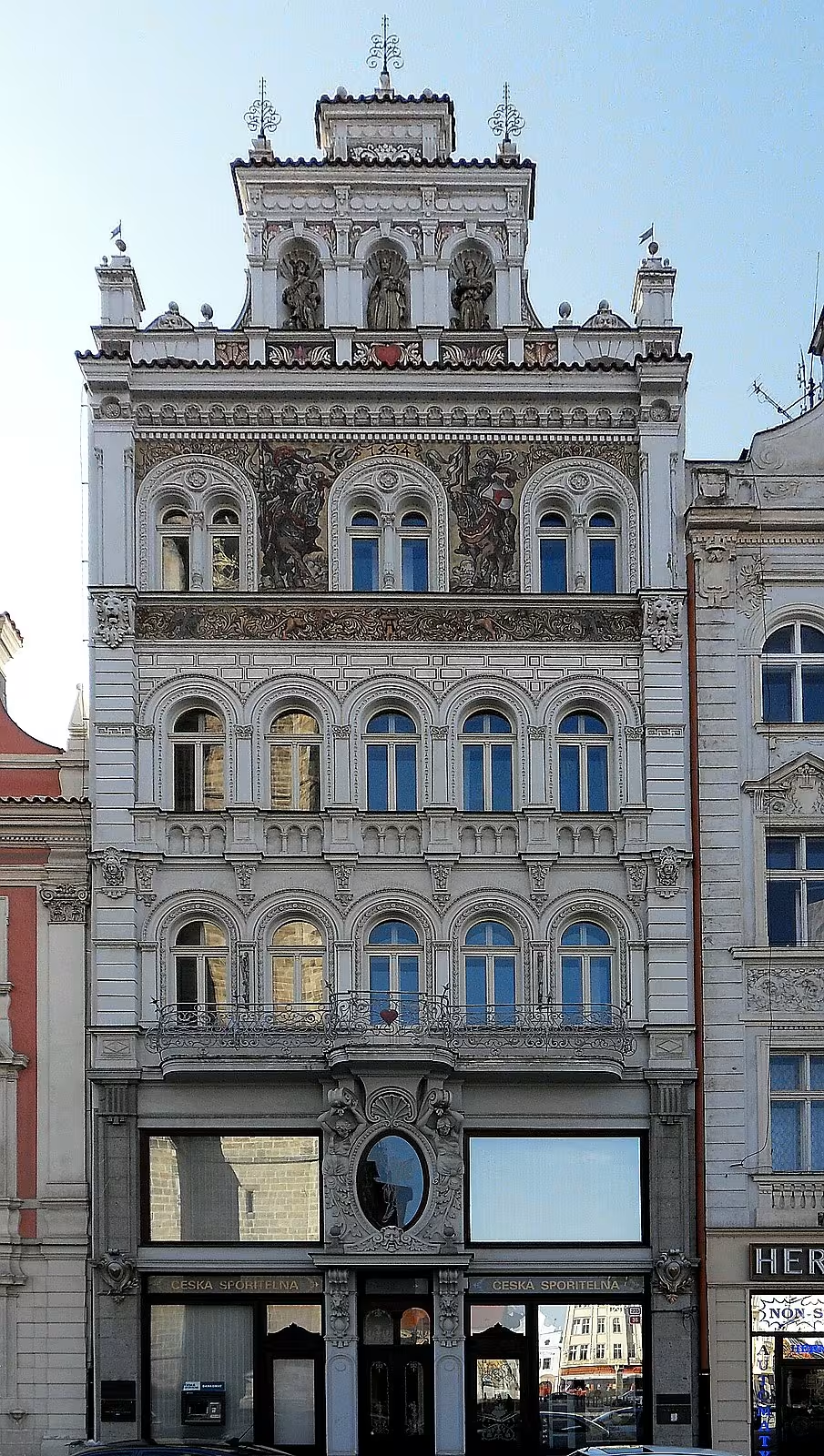
Dům U Červeného srdce is a Neo-Renaissance building from 1894, located in Pilsen on the Republic Square in close proximity to the bishop. The building is excellent with rich decoration from painter Mikoláš Alš and is protected as a cultural monument of the Czech Republic.
The current construction was built in 1894 by the builder Rudolf Štech. It originated at the site of the original Renaissance house with the same name. The construction in this period reflected the boom of historism and national revival in Bohemia, which reflected a return to Renaissance and Baroque architectural elements. In 1996, the building underwent an adjustment.
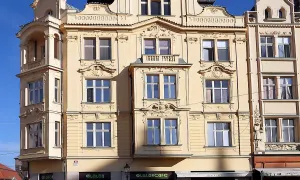
Architecturally dominates the Neo-Renaissance style with detail in the form of historizing double windows on the third floor. The entrance portal on the ground floor is decorated by two maidens with mussels supporting the balcony on the first floor. Above the door is a round glass window with an angel's image, while on the sides of the entrance stands columns with two golden hearts. A metal red heart is placed on the railing of the balcony on the first floor.
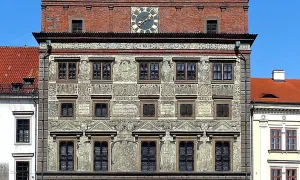
An important artistic element is the sgraffiti on the third floor, which was designed by Mikoláš Alš and realized by Henry Duchoslav Krajíček. This decoration depicts two knights riding with battalions.
The ground floor part of the building is currently used by Česká spořitelna, where the ATM is also located. The upper floors of the house are for living.
Dům U Červeného srdce represents a valuable example of Pilsen historism and cooperation of recognized creators of its time. We recommend to visit it especially for the unique decoration of the facade.
Historical milestones
- before 1894
- It says here the original Renaissance house with the same name
- 1894
- Rudolf Štech has built a modern Neo-Renaissance building
- 1996
- The building has been modified
Architectural development
Originally there was a Renaissance house, which was replaced in 1894 by the current Neo-Renaissance building. In 1996 the house underwent an adjustment. The facade is decorated with sgraffiti and plastic elements.
Points of interest
- The 1894 building in Pilsen stands out with a rich decoration from the painter Mikolas Alš. - It was created in Neo-Renaissance style at the site of an original Renaissance house with the same name. - The entrance portal is decorated with two maidens with mussels, gold hearts by the pole and glass window with angel. - A metal red heart is placed on the railing of the balcony on the first floor. - Sgraffiti on the third floor depicts two knights riding with battalions.
Guide
Show guide text
This text was created by artificial intelligence and has not been editorially reviewed. It may contain inaccuracies.
Welcome to the very heart of Pilsen, its historical part. Right now, you're standing in front of one of the most beautiful buildings in Republic Square. In front of you is the Red Heart house, which will impress you with its elegance and rich looks at first sight. It is a building that carries within itself the spirit of its time and at the same time fits beautifully into the surroundings where, for example, the bishop is located. Stop for a moment, take a breath and let your eyes slowly wander the facade of this house.
If you look at this building, you see the result of the work from the late nineteenth century. The current form of the house dates back to a thousand eight hundred and ninety-four. At that time, however, there was another house, which, although bearing the same name, was built much earlier, during the Renaissance. The original house, however, was no longer sufficient for the needs of the time and was therefore replaced by this new, representative building. The author of this project was the recognized builder Rudolf Štech, who chose a style called neo-Renaissance. This direction returned to the foundations of Renaissance architecture at that time, but added modern elements and greater pomp. The building thus served as a symbol of prosperity and the taste of its owners.
I now ask you to pay full attention to the details surrounding you. Look carefully at the front of the house. It's fascinating to see how carefully everything was planned. Notice the entrance portal, that is where it enters the building. Right here you'll find the elements that make this house the most unique. Look at the characters of two virgins with mussels that decorate the entrance. It's a delicate detail that gives the house a hint of subtlety and nobility. If you look even closer to the column, you'll see little gold hearts that are a direct reference to the name of the whole house. And don't forget to look up a little glass window where you can see the angel figure. It's the little things you can easily overlook, but it's the real beauty of this house.
When your eyes go further up, focus on the first floor. Note the balcony railing, which complements the overall impression of the building. This whole visual world that you now admire is not a work of chance. Behind the rich decoration surrounding the house is a significant figure of Czech art, painter Mikoláš Alš. He designed these decorative elements that make the building a real jewel of Plzeň Square. Alš was known for his ability to combine national character with high artistic craft, and this is also evident here. It is a beautiful combination of the architecture of Rudolf Štech and the artistic perception of Mikolas Alš.
It's also interesting how the house evolved in time. Although the basic form of the year is eight hundred and ninety-four, the building was not left behind. In a thousand and nine hundred and ninety-six, it underwent extensive adjustment to preserve its environment and to continue to serve its citizens. It's fascinating to think about how the function of the house changed. While on the ground floor today you will find a banking institution that represents the modern world of finance, the upper floors remain faithful to their original destination and are used for housing. It is a kind of dialogue between public business space and private home, all under the same roof, which is recognised as a cultural monument of the Czech Republic.
Try to imagine what this place looked like over a century ago. People in period clothes passing by, carriages in the square and this house, which was at that time a novelty and a symbol of modernity. Imagine how the painter Alsh carefully designed every heart and every shell to tell his own story. Dům U Červeného srdce is not just a pile of stone and mortar, it is a monument to human creativity and desire for beauty.
Now, if you look at the whole structure again, feel it as a whole. From ground floor to balcony details. It's a harmonious whole that's been with us for decades. It's where the history of the Renaissance meets, the ambition of the Neo-Renaissance and the care of modern times.
Thank you for stopping by this beautiful house with me. I hope you're interested in the details of Mikolash Alš and Rudolf Štech's history. You can now continue to discover other glories of Pilsen's inner city. We walk through streets that have thousands of years of stories, and the Red Heart House is just one of the many keys to understanding the spirit of this city. I wish you a pleasant continuation of your journey and many other beautiful experiences in your discovery of Pilsen. Goodbye.
Tips for visitors
The best time to visit is in the morning or late afternoon, when the sun hits the neo-Renaissance facade at a pleasant angle and highlights the details of the building. You can reach the centre of Pilsen by car or public transport; Check the specific connection and stop options in the current search engines.
Since it is a residential building that can only be admired from the outside, you do not need to prepare any special equipment. You need comfortable shoes to walk through the historical centre. Photography is recommended from the opposite side of the square where you can get the best overview of the overall architecture of the house and its relation to the surrounding building.
During a short walk around, within a half hour walk, you will definitely visit the Pilsen Bishopric, which is located close to the house. This combination allows you to compare various architectural styles in the heart of the city.
For families with children, we recommend a game to find details in the Neo-Renaissance facade. Children can explore the decorative elements of the house and compare them with other buildings in the Republic Square.
Frequently asked questions
Can the monument be visited?
This is a residential or farm building, not a museum with opening hours. Please view it from public space and respect the owners' privacy. We have no information about access to the interior.
Where is the monument?
Location: Vnitřní Město. The map on this page shows the exact spot.
Why is the monument protected?
It is listed in the Central List of Cultural Monuments of the Czech Republic as a cultural monument (register no. 1000134768).
Businesses nearby
Do you run a restaurant, accommodation, shop, museum, rental, wellness or other visitor service near this monument? Show yourself directly to the people heading to it — this is how they will see you in the app and on the web:
Events nearby

Zdroj akcí: otevřená data měst a obcí ČR (Národní katalog otevřených dat) a kalendář akcí Národního památkového ústavu.
Nearby
Budova se nachází v centru Plzně na náměstí Republiky v těsné blízkosti plzeňského biskupství.
Accommodation nearby
Trips and activities nearby
Guided tours, tickets and activities nearby from GetYourGuide
Affiliate link: if you buy from the partner, we may receive a commission. The price for you does not change.
Search tours and activities →Themed route
Here is a proposal for short walks in the city centre:
1. Dům U Červeného srdce (Memorial House) - The main destination of the journey, which will capture its architecture and history. 2. Square of the Republic (city square) - Space in close proximity to the house where you can perceive the atmosphere of the centre. 3. Pilsen Bishop (Religious Office) - The building is located next door, which represents the spiritual administration of the region.
Seasonal recommendations
In spring, the house will be displayed in fresh light and the surrounding streets will begin to bloom. It's the perfect time to observe the facade detail in a mild sun. We recommend light but laminated clothing and a visit in the morning when the air is the cleanest.
In the summer months, the atmosphere of heat and bright lighting dominates the building's colours. The main season is in the center of the city the most people, therefore it is best to come early in the morning to be quiet. Don't forget the hat and comfortable shoes for walking around the old paving blocks.
Autumn brings golden colors and softer, nostalgic light to the inner city that hits the walls of the house. The air is getting colder, so it's appropriate to wear a jacket or coat. The best time for outdoor photography is shortly before sunset.
In winter, the building is cosy, especially in advent time, when the surroundings are illuminated by lamps and ornaments. The atmosphere is quieter and quiet. It is necessary to wear warm winter clothes, gloves and a hat, because in narrow alleys you can feel a frosty draft.
Visualizations and artistic views

The visualisations are generated by artificial intelligence and serve as inspiration.
Photos from the area
Real photos taken near the monument

Zdroj a licence jsou uvedeny u každého snímku.
Tips from visitors
No tips yet. Be the first!
Log in and add your tip.
Sources and literature
Photos: Jik jik / CC BY-SA 3.0 — Wikimedia Commons. The author and licence also appear when you hover over the image.
Faktickým podkladem tohoto textu byl článek na Wikipedii, jehož autory jsou přispěvatelé Wikipedie. Článek je dostupný pod licencí CC BY-SA 4.0.
Location on the map
Příběhy a pověsti
Legendy, pověsti a příběhy spjaté s touto památkou
Fotografie návštěvníků
Zatím žádné fotografie. Buďte první, kdo přidá fotografii z návštěvy!
Log in a přidejte svou fotografii nebo hodnoťte.
Za ověřenou návštěvu v aplikaci získáte víc bodů — poznáme podle GPS, že jste na místě.
Reviews and comments