



Dům U České orlice Building
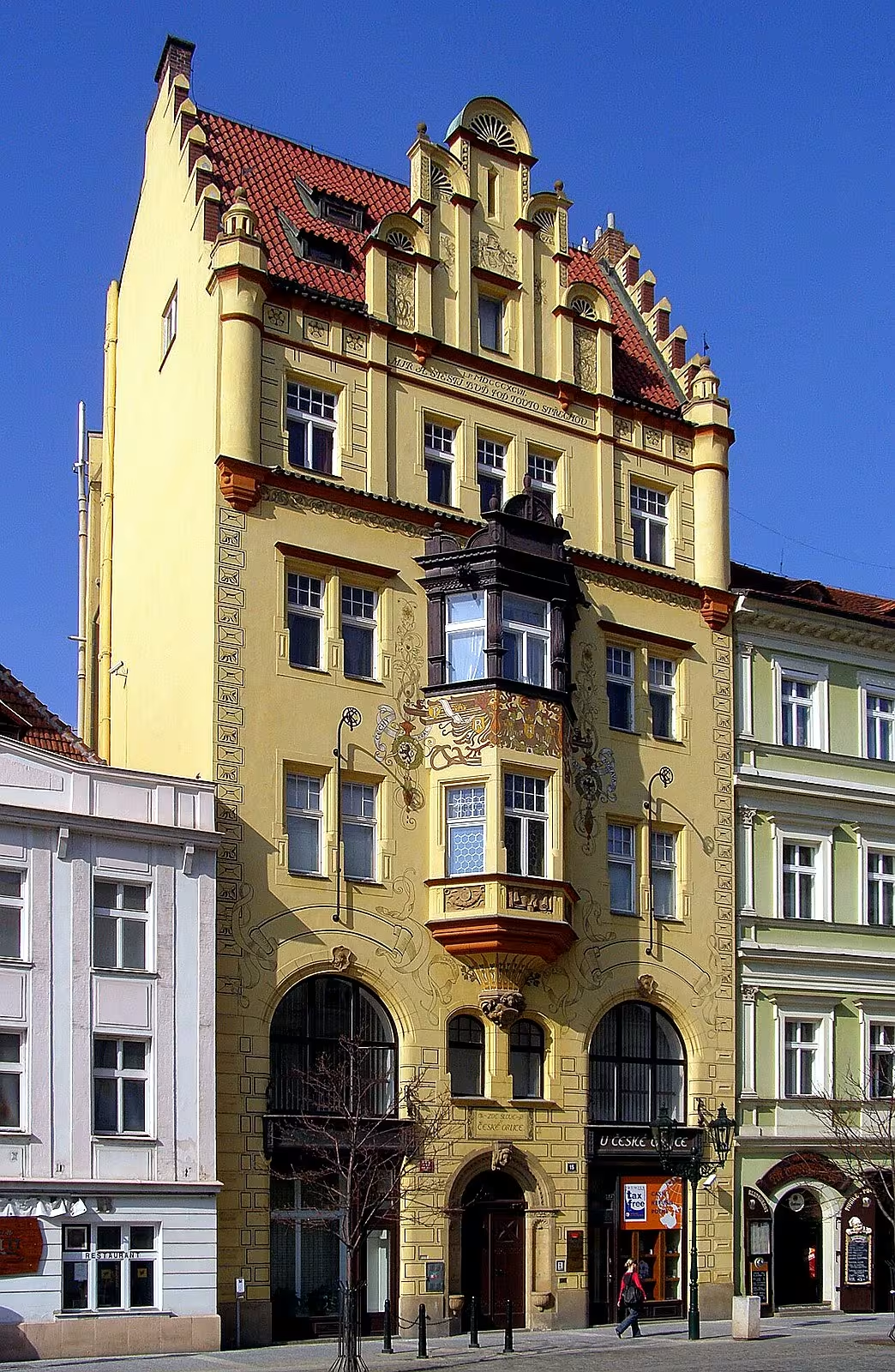
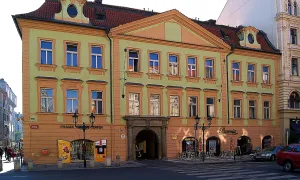
Dům U České orlice, also known as Bubnov House, is a historical monument in the heart of Prague's Old Town. It is located on the Fruit Market and Celetná Street, specifically under number 567 / I. This townhouse was built in a neo-gothic style with elements of Czech neo-Renaissance. It is remarkable in its architectural value and historical context. The facade is decorated with the sgraffiti decoration of Mikolas Ales, which underlines its uniqueness. Since 1958, the building has been protected as a cultural monument.
The construction was started in 1896 by Prague doctor Čeněk Klika, who together with his wife Matylda planned to build a family apartment with a medical practice. The place was selected by an older Baroque building, which belonged to the count's family from Bubno and Litice and was rebuilt into this style in the 17th century. The pre-metal building was torn down as part of the rendering of Prague, which was common in medieval cities at the time. The design was drawn up by Czech-Austrian architect Friedrich Ohmann, then already professor at Prague School of Arts. The building was completed in 1897, while in 1907 Quido Bělský made modifications including the sgraffite decoration of Mikolas Ales.
The architecture of the house is an example of eclecticism, which combines elements of neo-gothic and Czech neo-Renaissance. Originally, the four-storey building has a two-storey bay with a decorated roof and a neo-gothic shield in the facade axis on the main front of the fruit market. Mikoláš Aleš has created a distinctive heraldic set with Czech eagle, Czech two-tail lion and Moravian eagle, which underlines the historical and national importance of the work. The arch is decorated with writing tapes with the names of architect Friedrich Ohmann and builder Quid Belski.
After completion in 1897, the Klitz family settled in the house. For example, prof. MUDr. Antonín Heveroch and architekt Jan Kotěra were frequent visitors. Dr. Čeněk Klika became co-founder of Czech scouting in 1911 and the first head of the Scout Squad in the Czech Republic; One of the rooms of the house therefore served as a Boy Scout clubhouse. The house is privately owned and is today a protected cultural monument.
Today, the ground floor space on the Fruit Market is used as an antique shop, while the second front facing Celetná Street serves as the headquarters of the Commercial Bank. Dům U České orlice is not only an architectural work but also a witness to the history of the Czech city and its social changes.
This monument is worth visiting not only because of its architectural beauty, but also a rich history associated with the Klitz family and its importance for Czech scouting. Visit it and appreciate its unique location in the Old Town where the past meets the present.
Historical milestones
- 17th century
- Reconstruction of the original Baroque building into Baroque style
- 1896
- Opening of the new house Čenkem Klikou
- 1897
- Completion of construction of the building in neo-Gothic and neo-Renaissance style
- 1907
- Making modifications and sgraffiti decorations by Mikolas Ales
- 1911
- Čeněk Klika becomes co-founder of Czech scouting
- 1958
- The building is officially declared a protected cultural monument
Architectural development
The original one-storey Baroque building was torn down and in its place in 1897 built a new house in the style of historism. In 1907 Quido Bělský made modifications to the house, which included sgraffite decoration of Mikolas Ales.
Historical events
- 1897
- Finishing the building of the house.
- 1958
- Protected as a cultural monument.
Owners
In 1896 the Prague physician Čeněk Klika commissioned construction. The house is privately owned (2022).
Points of interest
The house served as a Boy Scout clubhouse for the first Czech Boy Scout squad.
The facade is decorated with the graphic decoration of Mikolas Ales, which includes heraldic elements.
Guide
Show guide text
This text was created by artificial intelligence and has not been editorially reviewed. It may contain inaccuracies.
Welcome to one of the most beautiful and oldest corners of our city. You are standing in the heart of old Prague, where history touches the present in every detail of the surrounding streets. Before your eyes is a building that bears the proud name Dům U České orlice. If you look around now, you'll see you're on the border of the Fruit Market and Celetna. It is a place that pulses through life, but at the same time carries the peace and nobility that only this neighborhood can offer. Please feel the atmosphere of old Prague, feel the weight of the history that is hidden here in every stone. This house you're looking at right now is not just an ordinary building in a number of urban houses. He is a living witness for many centuries who has undergone transformations that correspond to every new era.
Let us now look together deeper beneath its surface and find out how this view of the facade has formed at all. The history of this place goes much further than it may seem. Already in the seventeenth century, there was another building, which was built in the prevailing Baroque style. Imagine the period streets, carriages and baroque richness that once ruled here. But the city's time and needs have brought about changes. At the end of the nineteenth century, the needs of this place changed and a radical new step was decided. In a thousand and eight hundred and ninety-six, a process was initiated to completely transform this space. Thanks to the efforts of Čenka Klitka, a new building began to emerge, which was meant to reflect the modern spirit of the time while respecting tradition. The entire construction was completed a year later, in the year one thousand eight hundred ninety-seven, and the result was this fascinating object you admire today.
Now pay attention to the architecture itself, which is so unusual and fascinating. If you look at the overall structure of the house, you'll notice an interesting combination of different architectural directions. The building is built in a neo-gothic style, which adds some elegance and historical depth, but at the same time you will find strong elements of Czech neo-Renaissance. This connection was not random; to express national identity and cultural rise at that time. Now look carefully at the facade itself, at its surface. What you see is not just plain plaster. It's a work of art. In the year one thousand and nine hundred and seven, the building was enriched with sgraffiti decoration created by one of the most important Czech artists of all time, Mikoláš Aleš. Sgraffito is a technique in which layers of different colors and then empties to create an image. Notice the details on the walls. You'll see a heraldic routine, that is, characters and symbols that have great significance. And right here, in the middle of everything, you will find the main motive by which the house is called - the Czech eagle. It is a symbol of strength and national pride that shines here in beautiful form.
When you look at these details, you might wonder who's behind this place. The architecture of this house is the result of the work of prominent personalities. Friedrich Ohmann and Quido Bělský worked on it to help create this harmonious whole. But the house isn't just about stones and colors, it's about the people who lived here or worked here. One of the most interesting men associated with this place was Čeněk Klika. He was not only a key figure in construction, but he was also a man with a great influence on the life of young people. Klika became co-founder of Czech scouting. Imagine the young, enthusiastic people who later found their place in these premises. The building also housed a family housing unit and served as a place for a medical practice where Professor Antonín Heveroch worked. In this house, therefore, the private life of families, professional medical care and large social movements were mixed.
Now I want to invite you to think about one very interesting thing that makes this house truly special. You might expect a house like this in the city centre to serve only as a luxury living, but its history also has a very human and community-based side. Welcome to a place that once was a scout club. Yes, this is where the first Czech scouts were formed. Imagine the energy, the joy and the effort to build the character of the young generations that spread on these streets. This house was the heart of young explorers who planned their expeditions here and learned responsibility. It is a fascinating idea that this noble building with its rich decoration was also a place full of youthful enthusiasm and adventure.
This house is so important that it was officially declared a protected cultural monument in the year one thousand nine hundred fifty-eight. This means that its beauty and history must remain preserved for all future generations, just as they are now for you. Every detail you're looking at right now, from the sgraft eagle to the very shape of the windows, is part of this great heritage.
I hope you enjoyed this brief view of the history of Dom U České ealice. You're standing in a place where every coin and every work of artists meets big human stories. Before you go on your trip to Old Prague, stop for a while, feel the silence and noise of the city and let this view of national art and history still enjoy a little bit. Please continue on the streets that await you and let yourself be surprised by what other parts of our city reveal. I wish you a nice walk and many other experiences in discovering the beauty of our monuments. Goodbye.
Tips for visitors
For the best experience, we recommend a visit during the morning or late afternoon when the light is softer and better accentuates the neo-gothic and neo-Renaissance details of the facade.
You can easily reach the monument by foot or public transport; Check your search engine for the current connection.
Bring comfortable shoes for walking on historic tiles and water. For families with children, walking around this house is interesting thanks to its rich architecture and proximity to historical places.
For shooting is the best position right on the street from where you can capture the entire face of the building. In the vicinity you can visit Tyn Temple or Charles University during a short walk.
We recommend paying attention to the rich decorative elements that decorate the house and observe how the appearance of the building changes depending on the time of day.
Frequently asked questions
Can the monument be visited?
The building is in use (offices, a school, shops and the like). The interior is generally accessible only during operating hours and tours are not usually offered; we have not verified the details. You can see the exterior from the street.
Where is the monument?
Location: Staré Město, Hlavní město Praha. The map on this page shows the exact spot.
Why is the monument protected?
It is listed in the Central List of Cultural Monuments of the Czech Republic as a cultural monument (register no. 1000152989).
Businesses nearby
Do you run a restaurant, accommodation, shop, museum, rental, wellness or other visitor service near this monument? Show yourself directly to the people heading to it — this is how they will see you in the app and on the web:
Events nearby

Zdroj akcí: otevřená data měst a obcí ČR (Národní katalog otevřených dat) a kalendář akcí Národního památkového ústavu.
Nearby
Dům se nachází na Starém Městě Prahy, blízko Ovocného trhu a Celetné ulice. V okolí jsou další historické památky jako Týn chrám nebo Karlova univerzita.
Accommodation nearby
Trips and activities nearby
Guided tours, tickets and activities nearby from GetYourGuide
Affiliate link: if you buy from the partner, we may receive a commission. The price for you does not change.
Search tours and activities →Themed route
Thematic cruise route including Dům U České orlice
1.Dům U České orlice - Type: Historical building - Why is it worth a visit: This architecturally interesting building is part of the rich history of Old Town. It is known for its unique baroque stucco and impressive facade, which attracts the attention of many visitors.
2. Fruit market - Type: Historical site - Why is it worth a visit: It is located just a few minutes of the sidewalk from Dom U České ealice and it is a classic local center where you can get a taste for traditional Czech food. It is also a living example of historical trade in Prague.
3. Celná street - Type: Historical aisle - Why it is worth a visit: Celetná is one of the oldest and most beautiful places in Prague, full of history and architectural pearls. It is a short course to Dom U České ealice and offers a view of the ancient structure of the Old Town.
4. Tyn Temple - Type: Historical landmark - Why is it worth a visit: This Gothic church is one of the most important architectural works of Old Town. Its views and history attract many tourists who want to know the deeper history of Prague.
5. Charles University - Type: Historical institution - Why is it worth a visit: The oldest university in the Czech Republic offers not only an academic atmosphere but also a beautiful architectural complex. It is an ideal place for those interested in the history of education and university life.
This route offers a view of the most beautiful parts of Old Town, connecting architectural beauty with historical monuments.
Seasonal recommendations
Spring: In the spring season Dům U České orlice is transformed into a haven full of life and color. The sun's rays illuminate the building with their love rays, while the blooming trees around it add to the atmosphere a touch of a new beginning. At this time, it is advisable to visit the memory in the early afternoon time, when we are still avoiding crowds and can enjoy a quiet walk around Old Town. It is recommended to wear clothes suitable for mild temperatures, with the possibility of adding or removing layers according to weather change.
Summer: Summer is Dům U České orlice in full bloom of tourist activity. Sun day and warm atmosphere attract many visitors, which means it is advisable to visit the memory early in the morning or late in the afternoon to avoid the peak hours of crowds. Early arrival also allows you to enjoy a quiet tour and the possibility of shooting without curtains. Clothes should be light, with sun protection such as hats or sunglasses.
Autumn: In autumn, Staré Město and Dům U České orlice offer a cozy atmosphere. Leaves on trees turn into vivid colors, which adds a unique touch to the tour. This period is ideal for a quiet walk because we avoid crowds and enjoy a quieter environment. Clothes should be warm, with the possibility of adding layers according to cold weather, which often occurs during this period.
Winter: A winter visit to Dom U České ealice offers a magical view of the building covered with snow. Sun rays reflecting from snow roofs and streets create a unique atmosphere that is unforgettable. This season visitors should visit the memory early in the morning due to shorter opening times and cold weather, which often occurs. Hot clothes with wind protection are essential for a comfortable stay on the outside.
Visualizations and artistic views


The visualisations are generated by artificial intelligence and serve as inspiration.
Photos from the area
Real photos taken near the monument

Zdroj a licence jsou uvedeny u každého snímku.
Tips from visitors
No tips yet. Be the first!
Log in and add your tip.
Sources and literature
Photos: JiriMatejicek / CC BY-SA 3.0 — Wikimedia Commons. The author and licence also appear when you hover over the image.
Faktickým podkladem tohoto textu byl článek na Wikipedii, jehož autory jsou přispěvatelé Wikipedie. Článek je dostupný pod licencí CC BY-SA 4.0.
Location on the map

Příběhy a pověsti
Legendy, pověsti a příběhy spjaté s touto památkou
Fotografie návštěvníků
Zatím žádné fotografie. Buďte první, kdo přidá fotografii z návštěvy!
Log in a přidejte svou fotografii nebo hodnoťte.
Za ověřenou návštěvu v aplikaci získáte víc bodů — poznáme podle GPS, že jste na místě.
Reviews and comments