



Dům U Čtyř sloupů House
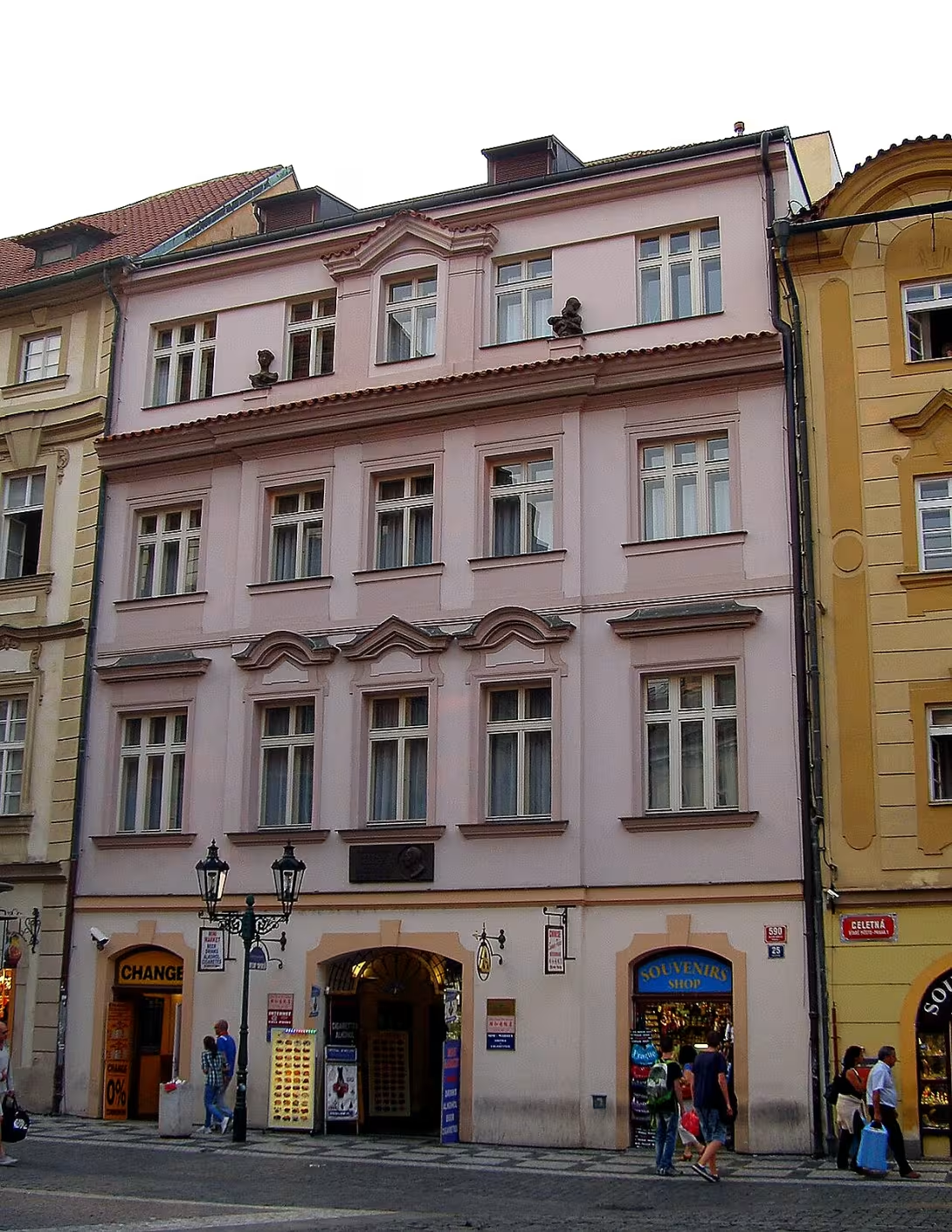
The Dům U Čtyř sloupů, also known as the Manas' house, is an ordinary transit palace in Celetná Street 25 on Prague's Old Town. The building represents a unique combination of medieval foundations with modern functionalist building and since 1958 it has been protected as a real cultural monument.
The first written mention of the house dates back to 1361, when it was owned by the butler Frencil. From 1364 to 1373 the house was held by the imperial butler Pešlin and due to the price of 150 kgs of grosches, the object was referred to as a palace. In 1378 the house was acquired by Rector of the Law Faculty of Prague University Jan Slepekov, who had the stone gate painted. It is assumed that this gate, probably decorated with four columns, gave the house its present name.
The house underwent a major reconstruction in 1927, initiated by the owner of the chocolate factory LUNA František Slabý. The builder Matěj Schneiberg and Václava Nequasili chose the method of plug-in, which preserved the original classical facade to Celetná Street, Gothic cellars and perimeter walls. A new three-storey building with a reinforced concrete structure was inserted into this historical framework. The atrium, which is covered by a glass needle, passes through the centre of the house.
The house is closely connected with a number of prominent personalities. In 1641 Jakub Křepelka lived here, in 1787 Emil Mühlwenzel died in the house, the last abbot of Slavic benedictines from Emauz. Since 1786, the Italian merchant Bernard Pompeius Bolzano has owned the house, which has run a gold, silver and gallantry shop. In the house he was born and in 1848 here also died his son, an important philosopher Bernard Bolzano.
On 26 May 1929, the Luna shopping arcade was opened in the house, which served the public until the 1990s. After subsequent modifications involving the construction of a glass restaurant in the yard and adaptation of premises for bank offices, the passage was renamed Bolzano. The interesting thing is that she sang a song by Petra Chernocká about the Luna passage in 1986.
Today, the house serves as a transparent building between Celetna and Stupice Street and offers insight into the history of Prague architecture, where the Gothic foundations meet with functionalist solutions. Visiting this place allows you to perceive the layering of history in the heart of Prague, from medieval palaces to modern commercial premises of the first republic.
Historical milestones
- 1361
- First written mention of the house held by butler Frencil.
- 1786
- The house was bought by an Italian merchant Bernard Pompeius Bolzano.
- 1929
- Opening a new Luna shopping passage.
- 1958
- House declared a real-estate cultural monument.
Architectural development
The original medieval house was fundamentally rebuilt in 1927, while the Gothic facade and cellars were preserved. The new construction is reinforced concrete with atrium covered with glass needles. The Celetná Street facade has retained a classic look.
Historical events
1361 first written mention of the house, 1927 beginning the reconstruction of the department store with passage, 1929 opening of the shopping passage Luna.
Owners
Frencil (1361), Pešlin (1364- 1373), Jan Slepekov (1378), Bernard Pompeius Bolzano (from 1786), František Slabý (from 1927).
Points of interest
- The house is also known as the Manas house and since 1958 it has been protected as a real-estate cultural monument. - The name of the house probably comes from a stone gate decorated with four columns, which was painted by the Rector of the Law Faculty Jan Slepekov. - In the reconstruction in 1927 the method of plug-in was used to preserve the original facade, Gothic cellars and perimeter walls. - A great philosopher Bernard Bolzano was born in the house and also died, whose father used to run a gold, silver and gallantry shop here. - In 1986, the singer Petra Chernocká sang about the shopping passage of Luna, which was opened in the house in 1929.
Guide
Show guide text
This text was created by artificial intelligence and has not been editorially reviewed. It may contain inaccuracies.
Welcome to the heart of the old town. You are standing in one of the most important streets in Prague, Celetná Street, where you touch history with every step. In front of your eyes is a building that at first sight can act as a peaceful part of an old urban development, but believe me, under this apparent calm there is a fascinating story connecting different centuries and completely different worlds. You're standing in front of the Four Column House. You may notice how this object is trying to align with the environment, how its facade matches the rhythm of the old houses that have been standing here for centuries. But this house is much more than a beautiful facade. It's a fascinating combination of medieval roots and modern thinking.
Let us now return together deep into the past to understand how this house came into being and why it is so special. Its roots go much further than it might seem. This whole building is based on medieval foundations that form a solid basis for everything you see today. The first paper trail of this place appeared in the year one thousand three hundred sixty-one. At that time, the house was held by a man named Frencil, who held the butler's office. Imagine that time when the streets hadn't replaced today's surface and life in this town had a completely different, slower rhythm. Since then the house has undergone many changes, it has been owned by various genera and merchants. In the year one thousand seven hundred eighty six, the Italian merchant Bernard Pompeius Bolzano bought it, which only confirms how important and strategic this part of the city was for business and life. The house witnessed many events that formed the face of Prague, and each layer of its walls tells a different story.
Now pay attention to the architecture itself that you are currently observing. What you see in front of you is a masterpiece in finding balance. The historical facade you are now watching serves as a face that retains the appearance of old Prague and does not violate its historical character. But underneath this layer is something completely unusual. In the years closest to the year one thousand nine hundred twenty-nine there was a major and revolutionary reconstruction. The architects Matěj Schneiberg and Ludvík Kysela created something in this place that was absolutely unique at the time. Under the old box is a modern, four-wing department store. This object is built in a style we call constructivism. It is a style that places enormous emphasis on functionality, clean shapes and the logic of space.
Notice how deep the house is. It's not just an ordinary block of buildings, but a complex that has an open space in it in the middle, known as atrium. This inner courtyard allows the light to penetrate deep into the interior of the building and creates a sense of openness in the middle of a dense urban development. In the year one thousand and nine trăm twenty-nine there opened a new shopping passage under the name Luna. This passage became a symbol of modern lifestyle and shopping at the time. A very advanced construction method was used in this large reconstruction, which is called the socket method, which was at that time an extremely modern concept. This entire building is so important that since the year one thousand nine hundred fifty-eight it is protected as a real cultural monument.
Dům U Čtyř sloupů is not only about stones, mortars and architectural directions, but especially about people who have left a trail. When you look at these walls, remember that there were thoughts in these areas that affected the whole of European thinking. One of the most important names associated with this place is the philosopher Bernard Bolzano. He not only lived here, but also ended his earthly life here. His presence gives this place depth and intellectual weight. The house was home to many other prominent personalities such as Jan Slepekov, Jakub Křepelka or Emil Mühlwenzel. Every name we give here is part of the complex tissue of the history of this house. If you look at the facade, try to imagine all the people who walked through here, traded or thought about the meaning of the world.
And now I'm going to tell you something that might interest you and what you can focus on looking at the house. Why is the house even called that? The answer lies in details that may seem tiny. The name probably refers to a stone gate that was once part of this place. This gate was decorated with four columns. And you know who took care of her looks? He wasn't just a random craftsman, he was a rector of the law school Jan Slepekov who had the gate painted. The house is also known under a different name, as the Manas' house. These two names, the one about the columns and the Manas, are two different faces of the same history that you're experiencing.
I hope this short journey through time has helped you better understand this fascinating object. Dům U Čtyř sloupů is living proof of how Prague is constantly changing, how new ideas are placed in old frames, but at the same time it can preserve its soul and its history. It's a place where the medieval spirit meets a modern vision. Please continue to walk on Celetná Street and pay attention to the other treasures that the old town hides inside. Every building here has its own voice. Thank you for your attention and I wish you a beautiful rest of the day when exploring the beauty of Prague.
Tips for visitors
For a visit, choose the morning hours on working days, where there is less movement of people in the historical centre and the architecture of the facade in the morning stands out better. Take with you comfortable shoes for walking on historic tiles and a camera, with the best façade pictures taken from the opposite side of the street in the light of day. In the immediate vicinity, you can visit the Old Town Square, the Dust Gate, the Municipal House or take a walk through Stupata Street, all available for a short walk. For families with children, the passage space is interesting thanks to the connection of historical elements with the modern atrium, which offers safe and indoor space for a short rest during the tour of the centre.
Frequently asked questions
Can the monument be visited?
This is a residential or farm building, not a museum with opening hours. Please view it from public space and respect the owners' privacy. We have no information about access to the interior.
Where is the monument?
Location: Staré Město, Hlavní město Praha. The map on this page shows the exact spot.
Why is the monument protected?
It is listed in the Central List of Cultural Monuments of the Czech Republic as a cultural monument (register no. 1000150674).
Businesses nearby
Do you run a restaurant, accommodation, shop, museum, rental, wellness or other visitor service near this monument? Show yourself directly to the people heading to it — this is how they will see you in the app and on the web:
Events nearby

Zdroj akcí: otevřená data měst a obcí ČR (Národní katalog otevřených dat) a kalendář akcí Národního památkového ústavu.
Nearby
Staroměstské náměstí, Prašná brána, Obecní dům, Štupartská ulice.
Accommodation nearby
Trips and activities nearby
Guided tours, tickets and activities nearby from GetYourGuide
Affiliate link: if you buy from the partner, we may receive a commission. The price for you does not change.
Search tours and activities →Themed route
Thematic cruise route: Old town square and surroundings
1. Old Town Square (Square) This is the heart of the historical centre of Prague, known for its beauty and architectural richness. The visit is worth looking at gothic houses, including Dům U Čtyř sloupů, and for an atmosphere full of history.
2. Dům U Čtyř sloupů (Palace) The main goal of the route is this impressive palace with its unique Gothic elements and rich history. It is important for its architectural meanings and an interesting past.
3. Dust gate (gate) This Renaissance Gate is one of the most famous monuments of Old Town. It is necessary to visit for its historical significance and beautiful artistic details that attract many visitors.
4. Municipal House (historical object) It is located near the Dust Gate and is an important historical building with a rich past. It is interesting for visitors who want to know more about local administration and the history of the village.
5. Štupartská street (street) A short walk down this street brings a view of the classicist houses and the old-town architecture that is characteristic of this area. It is suitable for those who want to enjoy a quiet moment in the historic environment.
This route offers a view of the most significant architectural and historical elements of the Old Town, each stop bringing a new chapter into the knowledge of this rich urban area.
Seasonal recommendations
Spring: In the spring period, Dům U Čtyř sloupů is transformed into both light and living places when flowers and trees come to life. The sun illuminates the architecture of the palace in a pleasant way, allowing a clear visualization of the details of the building. Flower flowers and young leaves provide space for freshness and beauty. It is advisable for visitors to come at an early afternoon time when crowds are decreasing, and to wear a little warmer clothes for cold spring air. This is also the ideal time to visit, because the exhibitions are full of life and offer new exhibitions.
Summer: The Dům U Čtyř sloupů becomes a place with warm atmosphere thanks to long days and beautiful evenings. The sunlight illuminates the palace in a special way, which highlights architectural details. This season it is advisable to visit in the early afternoon or evening to avoid large crowds that are common during the summer months. The good idea is to bring sunglasses and UV cream. In addition, you might need light clothes because the temperature may be high during the day.
Autumn: In autumn, Dům U Čtyř sloupů offers a beautiful atmosphere with colorful tree leaves and lighter light, which gives the palace a nostalgic look. Due to the colder weather, the crowds are decreasing and you can enjoy a calmer visit. It is advisable to visit during the day when the sun provides enough lighting to explore all the details of the construction. It is recommended to wear more layers of clothing and maybe take an umbrella with you because autumn can sometimes be wet.
Winter: In winter, Dům U Čtyř sloupů offers a unique atmosphere where the palace is decorated with ice and snow. The sunlight illuminates architecture in a special way, which can be very interesting. Visitors should come in the early afternoon or even in the evening when the temperature is lighter and lighting is ideal for photography. It is important to wear warm clothes because outside the palace can be cold. In addition, you might need a protective sock or umbrella for a snow or wet day.
Visualizations and artistic views


The visualisations are generated by artificial intelligence and serve as inspiration.
Photos from the area
Real photos taken near the monument

Zdroj a licence jsou uvedeny u každého snímku.
Tips from visitors
No tips yet. Be the first!
Log in and add your tip.
Sources and literature
Faktickým podkladem tohoto textu byl článek na Wikipedii, jehož autory jsou přispěvatelé Wikipedie. Článek je dostupný pod licencí CC BY-SA 4.0.
Location on the map

Příběhy a pověsti
Legendy, pověsti a příběhy spjaté s touto památkou
Fotografie návštěvníků
Zatím žádné fotografie. Buďte první, kdo přidá fotografii z návštěvy!
Log in a přidejte svou fotografii nebo hodnoťte.
Za ověřenou návštěvu v aplikaci získáte víc bodů — poznáme podle GPS, že jste na místě.
Reviews and comments