



Dům U Ježíška (Karmelitská) House
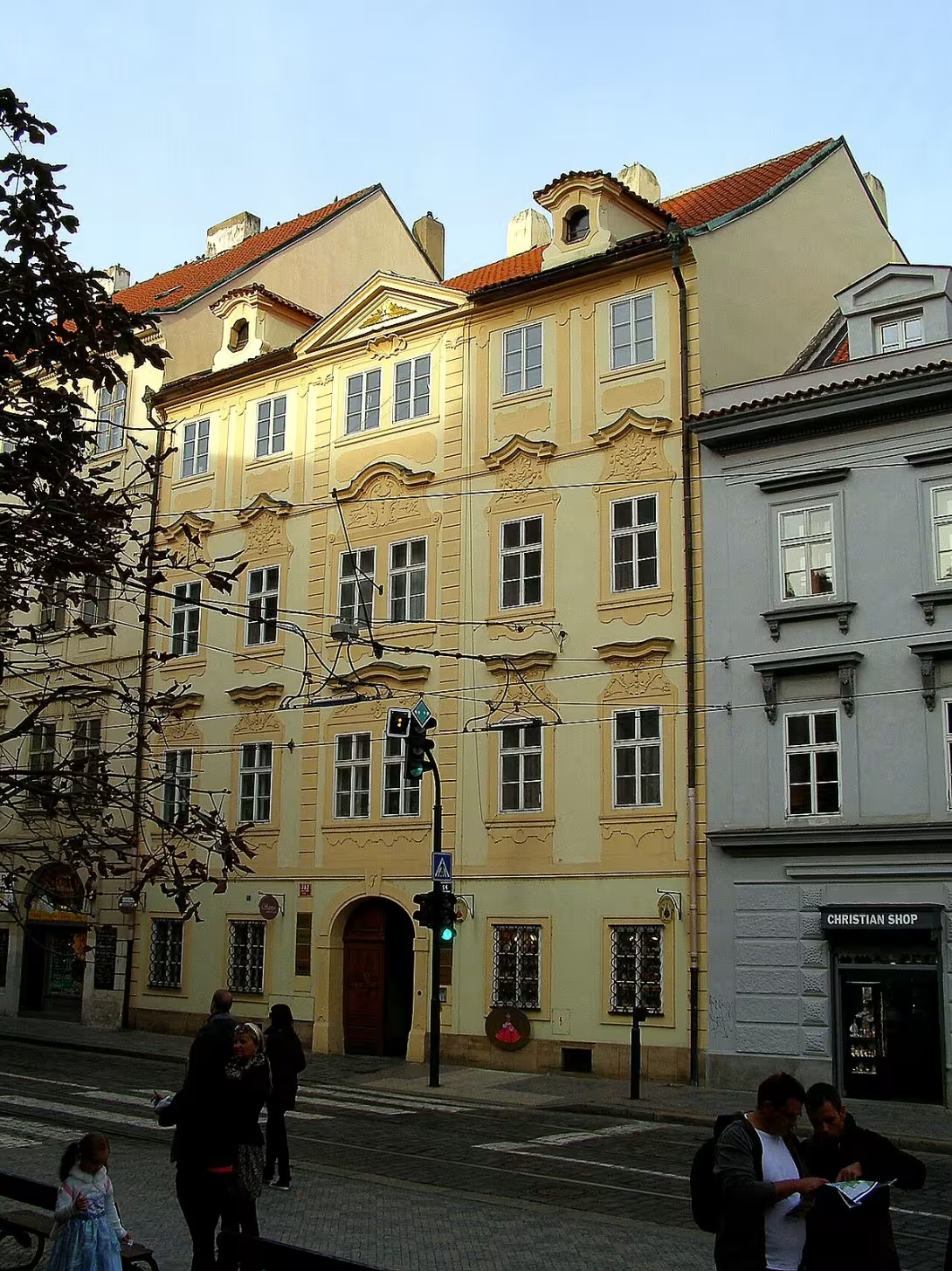
The House U Jeszka, also known as Šporkovský or Malá Musconová House, is a historic tenement building in Carmelite Street No. 382 / 14 on Prague's Malá Strana. Since 1964, it has been protected in the sights.
The construction was carried out in 1669-1673 Santino de Bossi opposite the Church of Our Lady of Victory and Saint Anthony of Paduan, the famous statue of Prague Jesulina. Today's western facade won the house after modifications around 1738, with the third floor probably added only in the last third of the 18th century. In the north, the object is adjacent to the Musconi Palace, sometimes called the Great Muscona Palace. However, the Small Musconi House was previously also covered by the neighbouring House No. 479 in Maltese Square, which was connected to the palace.
In 1799 the house was inherited by Leopoldin (1772- 1845), the wife of Jan Leopold Špork (1758- 1841), from which comes the name Šporkov Palace. At the turn of the 19th and 20th centuries, the building was owned by a member of the Czech Regional Assembly Karel Brand.
The facade to Carmelite Street is five-axis. The centre axis with shallow risalite contains joined windows and culminates with a low triangular shield, on whose sides there are baroque skylights. The rear east wing dates back to 1884; is single storey and has a terrace on the second floor. The south wing was originally also a single-storey wing, but in 1920 it was increased by one floor and the floors were glazed. The north side of the court closes a high wall separating the house from the Musconi Palace.
In the passage there is a metal commemorative plaque reminiscent of the fact that in the years 1920-1974 there lived and formed an art historian, painter, graphic artist and illustrator Pavla Fořtová (1886-1974).
The House U Jeszka excels with Baroque architecture and rich history, which makes it one of the important monuments of Mala Strana. It was created in the second half of the 17th century, when the Czech countries were in the period of the high Baroque after the 30-year war. The then European absolutism and the emerging Baroque culture had a major impact on the form of the Prague building.
The object is connected with the fates of noble families such as the Sporks, as well as the life of an important art historian Pavla Forítová. The owners took turns in time - from Leopoldina Šporková to Karl Brand.
Visiting the house offers an opportunity to admire Baroque architecture and soak up the atmosphere of historical Prague. The immediate proximity of the Church of the Virgin Mary of the Victory and Saint Anthony of the Paduan and Musconian palaces also contributes to the attractiveness of the place.
Historical milestones
- 1669
- Construction of the house by Santino de Bossi
- 1738
- Modification of street facade
- 1964
- Declaration for cultural monument
- 1920
- Increase of the South Court Wing
Architectural development
The original Baroque building from the 17th century was supplemented by a new street facade in 1738. The third floor was probably built in the last third of the 18th century. In the 19th and 20th centuries there were modifications of the courtyard wings, including construction of the terrace and glazing of the stalls.
Historical events
1669-1673: Construction of the house by Santino de Bossi. 1738: Adjustments to the street facade. 1964: Registration among cultural monuments. 1920: Increase of the south wing and glazing of the stalls.
Owners
Leopoldina Šporková (from 1799), Jan Leopold Špork, Karel Brand (turn of the 19th and 20th centuries).
Points of interest
The house has been protected historically since 1964. - The construction was carried out between 1669 and 1673 Santino de Bossi opposite the church, which is famous for the statue of Prague Jesulina. - The name Šporkov Palace comes from Leopoldina, who inherited the house in 1799 and was married to Jan Leopold Špork. - There is a metal commemorative plaque in the passage, which resembles the life and creation of an art historian, painter, graphic and illustrator Pavla Forítová. - The rear east wing dates back to 1884, is single storey and has a terrace on the second floor.
Guide
Show guide text
This text was created by artificial intelligence and has not been editorially reviewed. It may contain inaccuracies.
Welcome to Carmelite Street in the heart of Mala Strana, where today we will take a closer look at one of the most important monuments of this historical part of Prague - the House of Jesus. You stand in front of an impressive building whose baroque facade immediately engulfs you with its details and historical depth. Look up and you'll see a wonderful decorating facade that tells the story of the past century.
Jesus' house has a long history behind its walls. Its origin dates back to 1669 to 1673, when it was built under the leadership of Italian architect Santino de Bossi. Originally designed as an apartment building, he went through several modifications over time, especially in the 18th century, when the facade was modified and added additional floors, which gave him his present baroque form. In 1964, the house was declared a cultural monument, which ensured its preservation for future generations.
Notice now the architectural details surrounding you. The Baroque facade is full of decorating and geometric forms that are characteristic of this time. In the passage inside the building there is a statue of Prague Jesulina, which has named the whole house and is one of the most famous characters of this place. This statue attracts the attention of many tourists and is a symbol of love and goodness.
The House of Jesus is also connected to several key historical personalities. The most significant one was Leopoldina Šporková, wife of General Jan Leopold Špork. After his death in 1799 Leopold inherited the house and became known as the Šporkov Palace. Another personality associated with this monument is Karel Brand, which had its seat here.
Its long-term cultural importance and constant preservation are also interesting. The House of Jesus has been home for centuries to many prominent personalities and today stands as witness to the rich history of the Little Party.
Now let's move on to further examination. This monument offers many possibilities for a deeper understanding of its history and architecture, so take your time and look at some of the available exhibits. I hope you've gained new knowledge of the House of Jesus with this guide. Thank you for your attention and have a nice day at the next Little Party tours!
Tips for visitors
We recommend a visit in the morning during the working week, when there is less activity in Carmelite Street and you can enjoy the Baroque front of the house without crowds of tourists.
The location is very well accessible by public transport, take advantage of stops near Carmelite Street.
Take comfortable shoes suitable for walking on historic tiles and camera. The best light to capture the details of the facade of the house is in the morning, when the sun lights the facade directly from the opposite side of the street.
In the immediate vicinity, you can visit the spiritual place of the Church of the Virgin Mary of the Victory and Saint Anthony of Paduan, admire the architecture of the Musconian Palace, take a walk in Maltese Square or climb into the Petrín orchards for city views.
For families with children the location is ideal thanks to the proximity of Petrín orchards, where you will find a place to relax and play. The house itself is a historical building, which is why we recommend telling children stories about the old Prague during a walk on the Lesser Side.
Frequently asked questions
Can the monument be visited?
This is a residential or farm building, not a museum with opening hours. Please view it from public space and respect the owners' privacy. We have no information about access to the interior.
Where is the monument?
Location: Malá Strana, Hlavní město Praha. The map on this page shows the exact spot.
Why is the monument protected?
It is listed in the Central List of Cultural Monuments of the Czech Republic as a cultural monument (register no. 1000151469).
Businesses nearby
Do you run a restaurant, accommodation, shop, museum, rental, wellness or other visitor service near this monument? Show yourself directly to the people heading to it — this is how they will see you in the app and on the web:
Events nearby

Zdroj akcí: otevřená data měst a obcí ČR (Národní katalog otevřených dat) a kalendář akcí Národního památkového ústavu.
Nearby
Kostel Panny Marie Vítězné a svatého Antonína Paduánského, Musconský palác, Maltézské náměstí, Petřínské sady.
Accommodation nearby
Trips and activities nearby
Guided tours, tickets and activities nearby from GetYourGuide
Affiliate link: if you buy from the partner, we may receive a commission. The price for you does not change.
Search tours and activities →Themed route
1. Petrin Sets (Park) - A great place for a peaceful start to nature. It offers beautiful views and a place to relax. 2. Maltese Square (Square) - Historical area with pleasant atmosphere. It's the perfect place to observe the surrounding architecture. 3. Musconi Palace (Palace) - Magnificent building with rich architecture. He's very noble around here. 4. Church of the Virgin Mary of Victory and Saint Anthony of Paduan (Church) - A place with deep meaning and beautiful form. He's fascinated by his beautiful architecture. 5. Dům U Ježíška (Karmelitská) (Memorial) - The main destination of your route with exceptional appearance. This building is the real jewel of this area.
Seasonal recommendations
Spring: In the spring season, the House of Jesus boasts beautiful flowers and revived nature, when the whole surrounding green is full of life. The sunny days offer ideal light for photography, which emphasizes the historical appearance of the monument. This time of year is usually less demanding for mass transport, which allows a more peaceful tour. We recommend wearing friendly clothes with the possibility to zoom in on an umbrella or raincoat in case of suddenly appearing rain.
Summer: In summer, the House of Jesus is a popular place for tourists who enjoy warm days and long evenings. Solar lighting highlights architectural details of the monument, while the beautiful flower market in the surroundings adds to the atmosphere. Summer is the main season for tourists, so we recommend visiting a memory earlier in the day to avoid special crowds. Wear light and light clothes as well as sunglasses and sun protection cream.
Autumn: In autumn, the House U Jeszka offers a unique atmosphere with colorful tree leaves and mild climate. This time of year is ideal for quiet tours because crowd traffic is decreasing. Sundays are beautifully lit by long sunsets, creating a charming effect on historical facades. We recommend to wear something warmer and prepare for morning freezes or evening cold.
Winter: In winter months, the House of Jesus is surrounded by snow, creating a romantic and quiet atmosphere. Lighting is often adapted for holiday times, which adds visitors to the magic. Visiting it on a day without snow is ideal because the effort to walk on the snow streets is to minimize and enjoy a calm winter atmosphere.
Visualizations and artistic views


The visualisations are generated by artificial intelligence and serve as inspiration.
Photos from the area
Real photos taken near the monument


Zdroj a licence jsou uvedeny u každého snímku.
Tips from visitors
No tips yet. Be the first!
Log in and add your tip.
Sources and literature
Photos: Michal Kmínek / CC BY-SA 3.0 — Wikimedia Commons. The author and licence also appear when you hover over the image.
Faktickým podkladem tohoto textu byl článek na Wikipedii, jehož autory jsou přispěvatelé Wikipedie. Článek je dostupný pod licencí CC BY-SA 4.0.
Location on the map

Příběhy a pověsti
Legendy, pověsti a příběhy spjaté s touto památkou

Fotografie návštěvníků
Zatím žádné fotografie. Buďte první, kdo přidá fotografii z návštěvy!
Log in a přidejte svou fotografii nebo hodnoťte.
Za ověřenou návštěvu v aplikaci získáte víc bodů — poznáme podle GPS, že jste na místě.
Reviews and comments