



Dům U Svatého Václava House
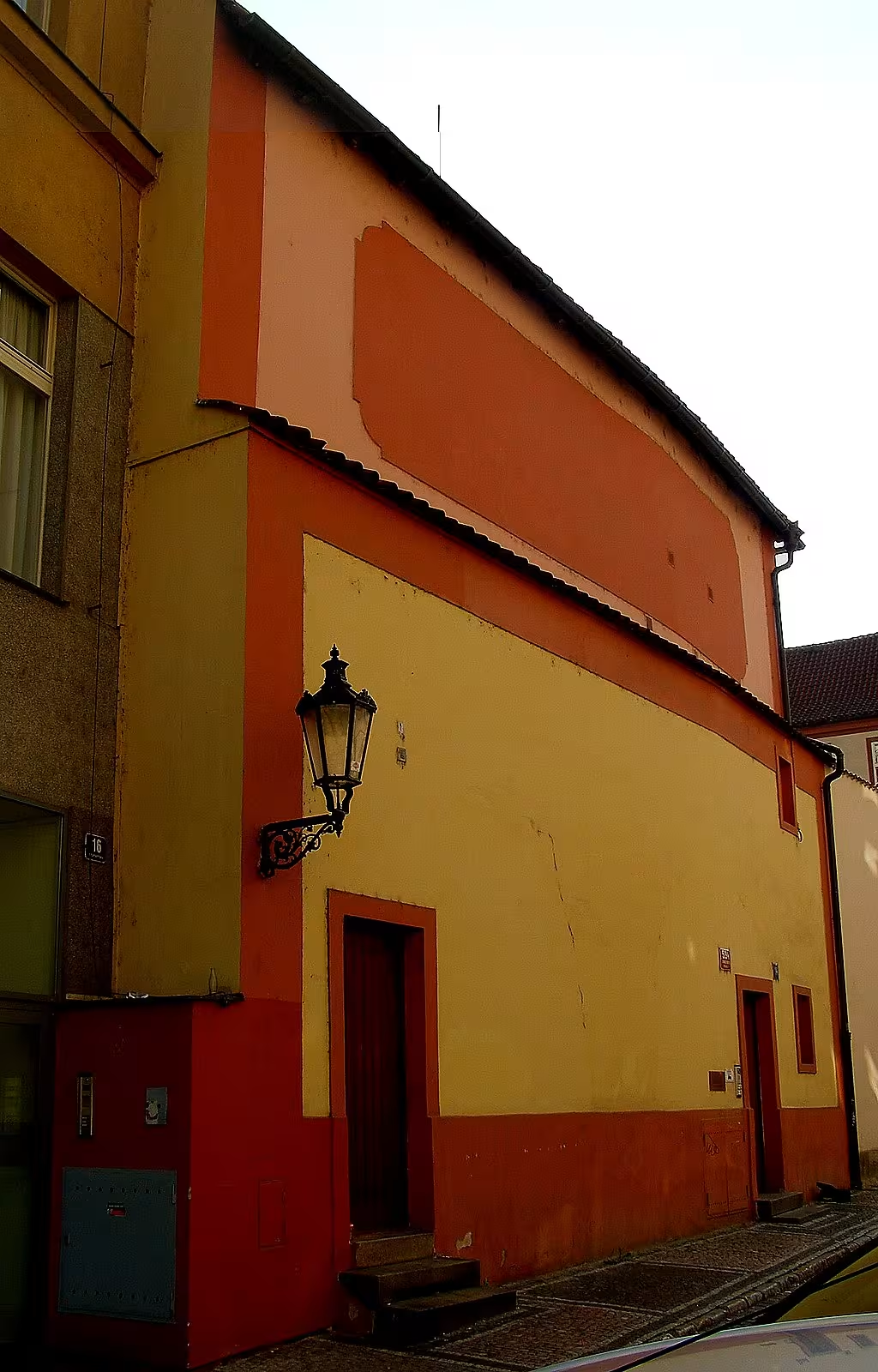
Dům U Svatého Václava is a three-storey medieval house in Celetná Street, Prague 1. The building is remarkable with its Z-shaped floor plan, a rare preserved garden headed for Stupata Street and a building connection to the neighbouring house. Since 1964, it has been included in the national list of cultural monuments.
The first mention of the house dates back to 1405, when it was owned by Ely, the widow of Václav Otto. In 1414 the owner Mikuláš Lunkovic first connected him to the neighbouring house with the number described 593 / I. In the second half of the 15th century, Jan, cousin of Václav, had the building rebuilt. Two Renaissance adjustments followed around 1610 and 1630, which increased the value of the property. In 1641, he owned Ondřej from Prydersdorf.
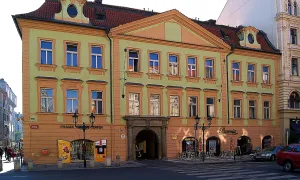
Architecturally dominates the building's track to Celetná Street. It is the oldest and largest of the four parts of the house and has a Gothic cellar. The current entrance facade has a smooth classical facade with a symmetrical seven-axis window arrangement. In the 19th century the windows were stripped of baroque stucco frames and set in the shale. In 1958, the portal with doors was shut down. A series of Gothic fragments survived in the side wing. In the interiors were discovered Renaissance painted ceilings, which are mostly destroyed.
Significant changes in appearance and disposition were brought about by Baroque reconstruction between 1710 and 1735. In the third quarter of the 18th century, the goldsmith Jan Seitz lived here. It's assumed he was the one who had the house signs gilded. In 1773, the carpenter František Melitsch was already buying an object under the name U zlatený Václav. The painted sign itself above the entrance was not preserved; His very little noticeable remains were recorded by František Ruth last in 1904.
The object is unique in the fact that it was the only one in the area that kept a garden with four grown trees. It is bounded by a wall and has two goals to Stupata Street. The operating connection with the neighbouring house is now visible even in the orientation numbers 19 and 21.
Dům U Svatého Václava presents a layered historical record of Prague buildings from Gothic to Renaissance and Baroque to Classicism. It is a valuable witness to the development of the Old Town architecture. Visitors are advised to focus on facade details and unique buildings within the historical centre.
Historical milestones
- 1405
- First mention of the house owned by Ely
- 1710
- Beginning of Baroque reconstruction
- 1964
- Entry into the state list of cultural monuments
Architectural development
The building has a Gothic cellar and preserved Gothic fragments in the side wing. The Renaissance reconstruction took place between 1610 and 1630 and the Baroque reconstruction took place between 1710 and 1735. The contemporary symmetrical facade with smooth façade is in a classical style, the last reconstruction took place in the 19th century and 1958.
Historical events
1414 connection of the house with the neighbouring house no. 593 / I, 1964 entry into the state list of cultural monuments.
Owners
to 1405 Ela (widow of Wenceslas Otto), 1414 Mikuláš Lunkovič, 2nd half of the 15th century Jan (cousin of Václav výboch), 1641 Ondřej z Prydersdorf, 3rd quarter of the 18th century Jan Seitz, 1773 František Melitsch
Points of interest
- The building has a remarkable ground plan in the shape of a Z. She was the only house in the neighborhood that kept a garden with four grown trees. - The building is connected to the neighboring house. - In the interiors were found Renaissance painted ceilings, which are mostly destroyed. - The oldest and largest part of the house has a Gothic cellar.
Guide
Show guide text
This text was created by artificial intelligence and has not been editorially reviewed. It may contain inaccuracies.
Welcome to the heart of Prague's Old Town, one of the oldest and most beautiful streets of our capital city. You're standing in front of St. Wenceslas's. Stop for a moment, take a breath and feel the atmosphere of this place where history touches every stone. In front of you is a three-storey townhouse that has been writing its presence into the history of Celetní Street for hundreds of years. When you look at it, you see a building that, by its simple exterior, hides a number of fascinating secrets. It is a place that has survived centuries of changes, fires and reconstructions, and yet still stands here as a silent witness to the past.
Let us now look together deeper into time. To understand what this house means, we have to go back very far. The first written mention of this place dates back to a thousand and four hundred and five, when the house was owned by a person named Ela. Imagine what this street looked like in the late Middle Ages, as the merchants, craftsmen and residents of Prague at the time flowed through it. The house gradually changed its faces and owners until it got into the hands of the goldsmith John Seitz. The name of this house is connected to him. It is assumed that the building received its name thanks to the home sign, which probably took the form of St. Wenceslas at the time and was also gilded to attract the attention of passers and customers of the goldsmith workshop.
Now pay attention to the architecture itself. Even though it looks like a regular house on the outside, it has a very unusual solution. If you could look at the plan of the building from a bird's-eye perspective, you would find it has a remarkable ground plan in the shape of the letter Z. Such a solution of the space is very rare in the dense construction of the Old Town and shows how the builders had to adapt to the available space and surrounding buildings. Note also that this object is not completely separate, but it is connected to a neighbouring house, which creates one large city unit.
When we think about the appearance of the house, we have to mention the period around the year of the thousand seven hundred and ten. It was at this time that a great Baroque reconstruction began, which gave the house the form we know for the most part today. The Baroque brought new dynamics and elegance to Prague, and this house became a part of the time. It is fascinating to think that a building that began as a medieval building was gradually transformed in accordance with its period taste. Due to its historical value, the house was entered in a state list of cultural monuments in the year thousands of nine hundred sixty-four, which means it is protected as a valuable piece of our national heritage.
Let's now examine the details that are not visible at first sight, but that form the soul of this place. In the interior of the house, Renaissance painted ceilings were found in the past. Although today these beautiful decorations are mostly destroyed, the very fact of their existence tells us about the wealth and taste of the people who once lived here. Imagine the color patterns and symbols that once decorated the ceiling rooms and created an atmosphere of luxury and art. It is sad that time has done its work and many of these details have disappeared, but we still feel the scent of the ancient elegance.
And now I'm going to lead you to one of the most interesting things that separates this house from everyone else in the area. In the centre of the Old Town, where the houses are poked close together and the space is used up to the last centimeter, almost unthinkable is any free space. Yet this house has something quite extraordinary. As the only house in this immediate neighborhood, he kept his own garden. And it's not just a small piece of green, but a garden with four grown trees. Imagine the contrast between the hK and the rock of the narrow street and the quiet, green shelter inside the house. It's a real urban paradise that has survived centuries of urbanization. This garden is now one of the rarest elements of the entire building.
When we look at this house, we see more than walls and roofs. We see layers of time. From the medieval Ely, to the goldsmiths' workshops with a gilded mark, to the Baroque reconstruction and today's status of cultural monument. It's a story about adapting, about craftsmanship and the ability to preserve a piece of nature in the middle of a big city. The oldest and largest part of the house reminds us of the roots from which everything grew, while later modifications point to the boom of Prague as a centre of culture and trade.
Now that you know the story of St. Wenceslas's house, I suggest you stay at his facade for a while. Imagine what that gold-plated holy symbol would look like, once hanging over the front door and shining in the setting sun. Feel the silence this building carries, and think about how many thousands of people have gone through it in the last 600 years. Each of them had their own story, their own hopes and their own worries, and gave them all this house a shadow and shelter.
Thank you for accompanying me on this short trip to history. I hope you're interested in this house with its unusual shape and secret garden. We now invite you to explore the beauty of the Old Town. Please continue your journey, admire the surrounding architecture and be guided by curiosity. When you are ready, turn on the next part of your guide. I wish you a beautiful day full of discoveries and pleasant walks through our historic streets. Goodbye.
Tips for visitors
The best time to visit is early morning or late evening, where there are fewer people in Celetna Street and you can view the facade of the house in peace. Transportation to the centre of Prague 1 is possible by car and public connections; Check the specific routes and connections in the maps.
Since it is a residential building, there is no need to bring any special equipment, only comfortable shoes for a walk through the historical centre. The building is only viewed from the outside, so focus on its architecture and details.
For the best photos we recommend using natural light falling into the street in the morning. The best angles for the pictures are from Celná Street, where the shape and appearance of this row house is visible.
During a short walk in the surrounding area you can visit Stupitská Street or take a walk along Celetná street in the heart of Old Town. For families with children, the ideal way is to find interesting details on the facades of houses nearby.
Frequently asked questions
Can the monument be visited?
This is a residential or farm building, not a museum with opening hours. Please view it from public space and respect the owners' privacy. We have no information about access to the interior.
Where is the monument?
Location: Staré Město. The map on this page shows the exact spot.
Why is the monument protected?
It is listed in the Central List of Cultural Monuments of the Czech Republic as a cultural monument (register no. 1000150680).
Businesses nearby
Do you run a restaurant, accommodation, shop, museum, rental, wellness or other visitor service near this monument? Show yourself directly to the people heading to it — this is how they will see you in the app and on the web:
Events nearby

Zdroj akcí: otevřená data měst a obcí ČR (Národní katalog otevřených dat) a kalendář akcí Národního památkového ústavu.
Nearby
Celetná ulice, Štupartská ulice, historické centrum Prahy 1.
Accommodation nearby
Trips and activities nearby
Guided tours, tickets and activities nearby from GetYourGuide
Affiliate link: if you buy from the partner, we may receive a commission. The price for you does not change.
Search tours and activities →Themed route
Here is the design of the thematic route:
1. Celetná street (street) - A walk through this historic path will lead you straight to the heart of the city. 2. Dům U Svatého Václava (monument) - The main destination of the trip where you can admire the architecture and history of the building. 3. Štupartská street (street) - A short walk to the side alley for a sense of peace in the center. 4. Historical Centre Prague 1 (area) - Final walk through the surrounding spaces, which make up the unique atmosphere of the whole area.
Seasonal recommendations
Spring: When spring comes, the surroundings gain freshness and the light is fine, which beautifully highlights the face of the house. The air is nice, but the weather can change quickly. It is advisable to take layered clothes that allow you to react easily to temperature changes. The best time for a tour is in the morning when the light is clean and the atmosphere is quieter.
Summer: During the summer, the days are long and the sun shines intensively, causing strong glare on historical facades. The heat can be very sensitive in narrow alleys. I recommend choosing light and airy clothes and protecting your eyes from bright light. The most appropriate visit is in the early hours of the morning before the greatest heat occurs.
Autumn: Autumn brings golden shades and often morning fog to the old town, which give the place a nostalgic touch. The colours of leaves on the surrounding trees create a beautiful contrast to architecture. Prepare warmer layers like a coat or a scarf, because cooler air can be unpleasant. Ideal is a visit in the afternoon to achieve soft lighting.
Winter: Zimą days are short and light is often grey or weak, which creates a quiet and serious atmosphere. If you come in advent time or during snow, the house is very cozy. It is necessary to wear very warm clothes, including gloves and hats, because when watching from the outside you can get tired quickly. It's best to visit a place in the time of the greatest daylight.
Visualizations and artistic views

The visualisations are generated by artificial intelligence and serve as inspiration.
Photos from the area
Real photos taken near the monument

Zdroj a licence jsou uvedeny u každého snímku.
Tips from visitors
No tips yet. Be the first!
Log in and add your tip.
Sources and literature
Photos: Dobroš / CC BY-SA 4.0 — Wikimedia Commons. The author and licence also appear when you hover over the image.
Faktickým podkladem tohoto textu byl článek na Wikipedii, jehož autory jsou přispěvatelé Wikipedie. Článek je dostupný pod licencí CC BY-SA 4.0.
Location on the map

Příběhy a pověsti
Legendy, pověsti a příběhy spjaté s touto památkou
Fotografie návštěvníků
Zatím žádné fotografie. Buďte první, kdo přidá fotografii z návštěvy!
Log in a přidejte svou fotografii nebo hodnoťte.
Za ověřenou návštěvu v aplikaci získáte víc bodů — poznáme podle GPS, že jste na místě.
Reviews and comments