



Dům U zlatého a bílého jednorožce House
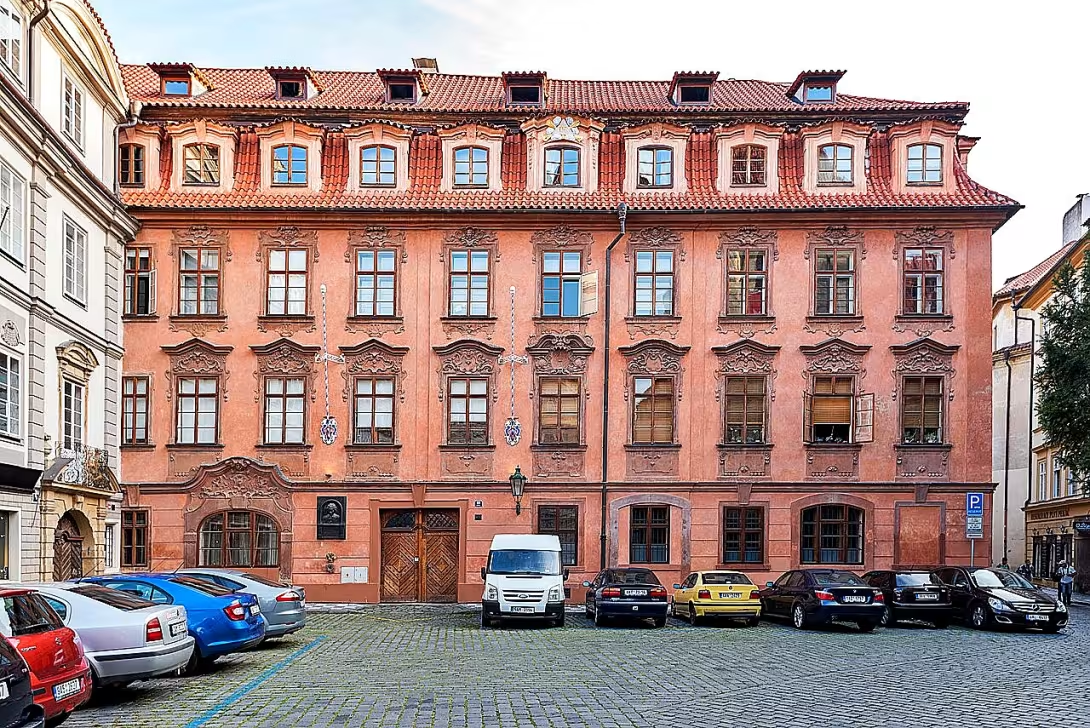
Dům U zlatého a bílého jednorožce, also known as the Wolkenstein House or Beethoven Palace, is a Baroque town palace in the Prague part of Malá Strana (Prague 1). This historic building is located in Spa Street No. 11 and is protected as a real-estate cultural monument of the Czech Republic. The building excels not only with its architecture but also with its history - for example, famous music composers Wolfgang Amadeus Mozart and Ludwig van Beethoven hosted in its premises.
The house was built in the first half of the 18th century by a gradual reconstruction and extension of two older objects on the site of the original cemetery of johanites. Its roots date back to the Baroque era, when the Czech Republic, under the influence of the Habsburgs, became an important centre of culture and music. This period has brought prosperity and prosperity to Prague, which reflects the architecture at the time.
It's a two-story corner building with a mansard roof. The facades from 1731-1759 are typical of Baroque style and are broken down by steepers. The interior was preserved with rich stucco decoration of ceilings and Renaissance decorative paintings. Classicist reconstruction from 1839 added new elements such as pillar three-arm staircase.
From the mid-18th to early 19th century, the house served as the famous Prague hotel "The Golden Unicorn," led by Václav Treml from 1787. The guests were Wolfgang Amadeus Mozart in 1789 and Ludwig van Beethoven was present in 1796. The memory of these musical giants is revered by the relief from sculptor Otakar Španiel, located next to the entrance to the building.
In 1878 Engelhard-Dietrich became the new owner, the Earl of Wolkenstein-Trostburg, along with his wife, Arnoštka Karolina, which led to a change of name to the Wolkenstein house. In the 20th century the building served as an administrative building until it was renovated in the years 2004-2005 at a luxury residence.
Today Dům U zlatého a bílého jednorožce stands as a witness to the rich history of Prague. Its architecture, associated with memorable events and personalities, makes it a necessary destination for anyone interested in the cultural heritage of the city.
Visiting this palace offers an opportunity not only to admire architectural treasure, but also to immerse yourself in the past. It is a place where history intersects with the present, making it a living symbol of Prague's heritage and inspiration for future generations.
Historical milestones
- 1731-1759
- The origin of the original form of external facades
- 1789
- Stay of music composer Wolfgang Amadeus Mozart
- 1796
- Stay of music composer Ludwig van Beethoven
- 1839
- Classicist reconstruction of the building
- march 20, 1927
- Unveiling a memorial plate with the relief of Ludwig van Beethoven from sculptor Otakar Španiel
- 2004-2005
- Reconstruction of the house including roof for luxury living
Architectural development
The building was created by a gradual reconstruction and the addition of two older objects on the parcel of the original johanite cemetery, where the remains of the johanite building are visible on the ground floor. The original form of the external facades dates from 1731- 1759 and the facade to the yard is broken down by the partridges. In 1839 an extensive classical reconstruction took place, creating a new pillar three-arm staircase. The house was reconstructed in 2004-2005, including the roof space.
Historical events
Significant historical events associated with this object include the residence of composer Wolfgang Amadeus Mozart in 1789 and Ludwig van Beethoven in 1796. On 20 March 1927 a memorial plate with the relief of Beethoven by sculptor Otakar Španiel was revealed next to the entrance. In the years 2004-2005 there was extensive reconstruction of the house including roof for luxury accommodation.
Owners
In the middle of the 18th century until the beginning of the 19th century the house served as a hotel operated by M. Pinskorn and Václav Treml. About 1878 the house was acquired by Engelhard-Dietrich hrabě z Wolkensteina-Trostburgu with the wife of Ernest Karolina and until the 1920s it was called the Wolkenstein House. During the 20th century he served as an administrative building.
Points of interest
- Dům U zlatého a bílého jednorožce is also known as the Wolkenstein House or Beethoven Palace. - The famous music composers Wolfgang Amadeus Mozart and Ludwig van Beethoven hosted in the premises of this building. - The house was created by a gradual reconstruction of two older objects at the site of the original cemetery of johanites. - From mid-18th to early 19th century, the house served as the famous Prague hotel "The Golden Unicorn." - The memory of Mozart and Beethoven is revered by the relief from sculptor Otakar Španiel, located next to the entrance to the building.
Guide
Show guide text
This text was created by artificial intelligence and has not been editorially reviewed. It may contain inaccuracies.
Welcome to Spa Street in the heart of Prague, where stands a historical monument known as Dům U zlatého a bílého jednorožce, often referred to as the Wolkenstein House or Beethoven Palace. You are standing in front of an elegant Baroque building with richly decorated facades, which will immediately impress you with their beauty and historical depth.
Let's dive into its creation. This house has roots dating back to the first half of the 18th century when it was built on the site of a former cemetery of johanites. The façades that you see before you were created between 1731 and 1759. The architects of that time combined and rebuilt the older objects to create this townhouse of the palace type. In the middle of the 18th century, the famous Prague hotel "The Golden Unicorn" was developed here, which contributed to its fame.
Look up and notice the rich decorations that characterize the Baroque style of this building. Here is every detail full of history, from elegant arches to refined sculptures. Note also the commemorative plate with the relief of Ludwig van Beethoven, which was placed on the facade in 1927 thanks to the sculptor Otakar Španiel. This board is also a reminder of Beethoven's residence in this house in 1796.
Dům U zlatého a bílého jednorožce has a rich history associated with significant personalities. In 1789 Wolfgang Amadeus Mozart hosted here, which contributed to its fame. He followed Beethoven, who passed through this house in a time of creative tension. Other historical figures associated with this building are Václav Treme and Engelhard-Dietrich hrabě z Wolkensteina-Trostburgu, who contributed to its rich heritage.
The interesting thing is that this house was not just a place of residence for famous musicians. In 1839 a classical reconstruction was carried out, which further sealed its historical significance. Moreover, between 2004 and 2005 the house was renovated, which prepared it for luxury housing, making it a unique blend of past and modernity.
Now that you've noticed these details, we'll invite you to further explore. Look around you and let your heart charm you with the beauty and history of this local heritage. Whether you are interested in architecture, music or history, Dům U zlatého a bílého jednorožce has something interesting for you. We hope you enjoyed your stay, and have a nice day!
Tips for visitors
The best time to visit is early morning or late afternoon. At this time the light is finer, which will better highlight the details of the Baroque facade and architectural elements of the house.
The location is available by car and by public transport; Check the current connection in the search engine. We recommend that you take with you comfortable shoes, which is suitable for walking after the historical paving of the Little Party.
When shooting, we recommend focusing on the face side of the building and detail showing unicorn. The best light for pictures is when the sun directly lights up Spa Street.
Close to the house there is a Johanite commenda and other important baroque monuments. This area offers ideal space for a short walk through the historical centre of Prague.
A great experience for families with children is finding the unicorn symbol on the facade together. The walk around is quiet and safe, making it a pleasant activity for children and adults.
Frequently asked questions
Can the monument be visited?
This is a residential or farm building, not a museum with opening hours. Please view it from public space and respect the owners' privacy. We have no information about access to the interior.
Where is the monument?
Location: Malá Strana. The map on this page shows the exact spot.
Why is the monument protected?
It is listed in the Central List of Cultural Monuments of the Czech Republic as a cultural monument (register no. 1000151327).
Businesses nearby
Do you run a restaurant, accommodation, shop, museum, rental, wellness or other visitor service near this monument? Show yourself directly to the people heading to it — this is how they will see you in the app and on the web:
Events nearby

Zdroj akcí: otevřená data měst a obcí ČR (Národní katalog otevřených dat) a kalendář akcí Národního památkového ústavu.
Nearby
Dům se nachází v historickém centru Prahy na Malé Straně v Lázeňské ulici, v blízkosti Johanitské komendy a dalších významných barokních a historických památek.
Accommodation nearby
Trips and activities nearby
Guided tours, tickets and activities nearby from GetYourGuide
Affiliate link: if you buy from the partner, we may receive a commission. The price for you does not change.
Search tours and activities →Themed route
1. The Johanant commendation, a historical building, represents an important place in this part of the city. 2. Spa street, street, leads you directly to the main destination of your tour. 3. Dům U zlatého a bílého jednorožce, the palace, is the main point of the route and offers a view of the rare architecture. 4. Baroque monuments, historical objects, around the palace you can observe other beautiful buildings of this period.
Seasonal recommendations
In the spring, the Little Side wakes up and trees begin to bloom in the surrounding area. The light is soft and rough in this period, which highlights the facade details beautifully. I recommend you take several layers of clothing because the morning air can still be cold. The best time for observation is in the morning when the light is the purest.
In the summer months, the streets around the house are very lively and the sun hits the historic walls. The atmosphere is hot and full of energy. For a comfortable survey, prepare light fabrics and don't forget the sun cap. If you want more peace, come early in the morning before the biggest heat starts and the biggest movement of people around you.
Autumn brings golden shades and often morning fog to the district, which gives the building a mysterious form. The sun is lower, so the shadows are longer and the colors are deeper. It is advisable to wear a warmer coat and scarf. It is ideal to visit a place in the afternoon when leaf colors best match the color of the house.
Winter is the palace in a cold and quiet environment, especially when the walls are covered with frost. The days are short and the light is often blue. The need is fixed shoes, warm gloves and strong jacket. Since daylight is rapidly disappearing, plan a visit around noon so you can see the building in good light.
Visualizations and artistic views

The visualisations are generated by artificial intelligence and serve as inspiration.
Photos from the area
Real photos taken near the monument

Zdroj a licence jsou uvedeny u každého snímku.
Tips from visitors
No tips yet. Be the first!
Log in and add your tip.
Sources and literature
Photos: Tilman2007 / CC BY-SA 4.0 — Wikimedia Commons. The author and licence also appear when you hover over the image.
Faktickým podkladem tohoto textu byl článek na Wikipedii, jehož autory jsou přispěvatelé Wikipedie. Článek je dostupný pod licencí CC BY-SA 4.0.
Location on the map

Příběhy a pověsti
Legendy, pověsti a příběhy spjaté s touto památkou
Fotografie návštěvníků
Zatím žádné fotografie. Buďte první, kdo přidá fotografii z návštěvy!
Log in a přidejte svou fotografii nebo hodnoťte.
Za ověřenou návštěvu v aplikaci získáte víc bodů — poznáme podle GPS, že jste na místě.
Reviews and comments