



dům U Zlatého slona Tenement house
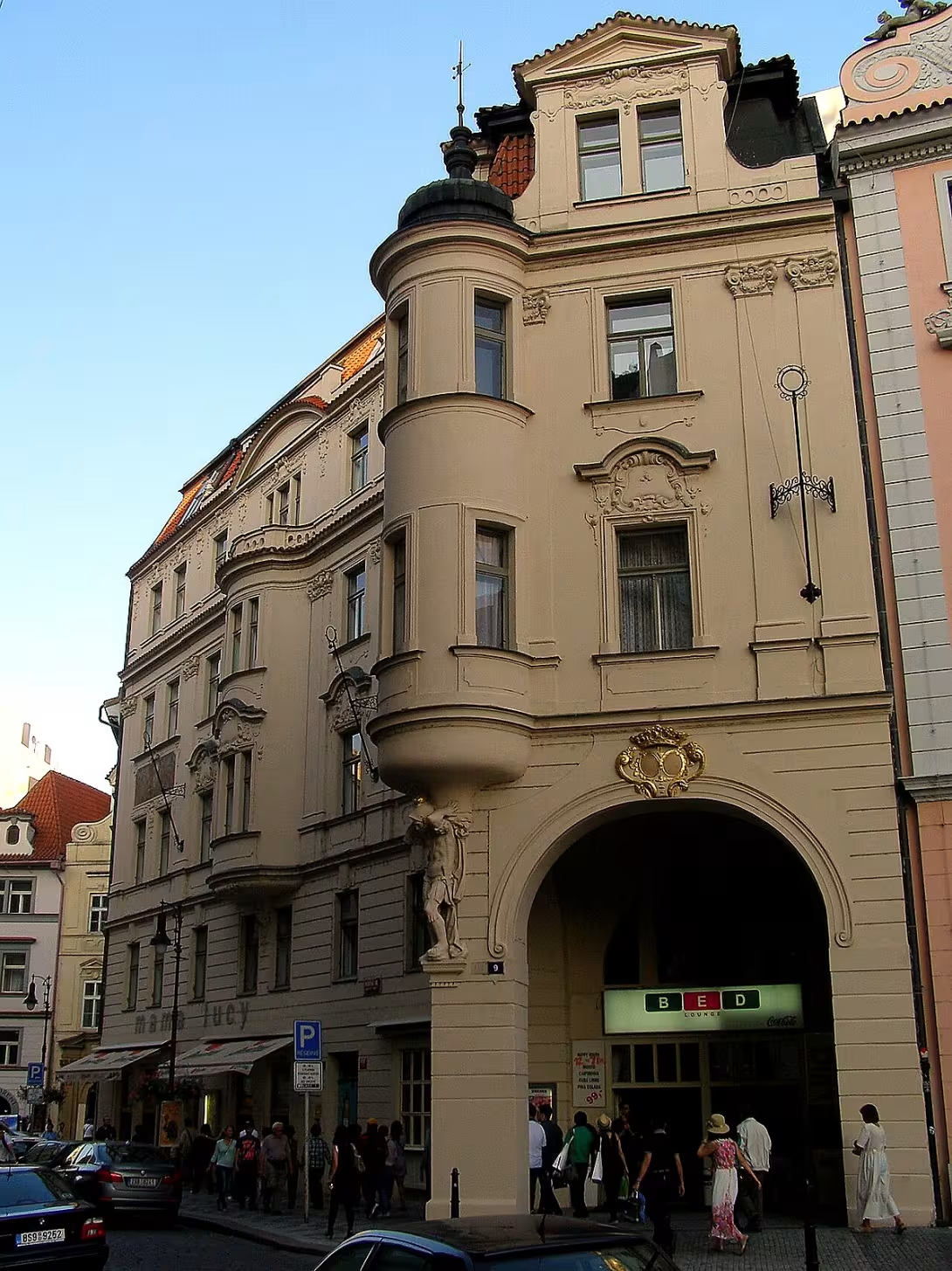
The Golden Elephant House, located on the corner of the Old Town Square, Long Classes and Týnská Street in Prague 1, is a Neo-Baroque building built in 1905. It is a protected cultural monument since 1958, which attracts attention to its eclectic architecture combining elements of Baroque and Renaissance styles. The house is important not only for its location in the center of the historic Old Town, but also for rich history dating back to the 14th century.
The history of the Golden Elephant House is a long series of property changes and architectural reconstructions. The first written owner was Franca Rokczaner around 1357, followed by Cuncz Long (Kunc Long), who chose his name by street. In 1428 the house is mentioned in the chronicle of Bartoška of Drahonice and a year later it becomes the place of a tragic event when Hussite's captain Hynek of Kolstejn was found dead after the villain Makowec killed him and thrown him out the window into the yard. This history suggests that the house has served as an inn since the Middle Ages.
In 1629 Kateřina Ludmila Dvoříková, a born Countess Šliková, bought the house and after that other owners took turns. Václav Josef Count Sugar of Tamfeld and his wife Maria Anna of Trauttmansdorffu-Weinsberg rebuilt the house in 1719 to a late Baroque style, which is evident in the facade and the statue of the Atlanta carrying an arch. After their death, the property was transferred to their son Jan Erasma Cukra of Tamfeld.
In the 19th century, the Jewish merchant Moses Koppelmann Latch lived in the house with his wife Barbora, who after their death without offspring transferred the property to the Jewish community. In 1902 the house was sold to the city of Prague and in 1904 it was demolished as part of the rendering of old Prague, when Gothic elements were discovered as stone ribs of vaults and painted beams of ceilings.
The new dům U Zlatého slona was built in 1905 according to the design of architect František Schlaffer. The three-storey building with the fourth floor in the Mansard roof is characterized by its eclectic architecture, which combines baroque and Renaissance elements. The facade to the Old Town Square is adapted to the neighboring house U black ball, while the main facade to the Long Class is decorated with two fields of wall paintings. One of them depicts Hussite's captain Hynek from Kolstejn in a duel with the attackers, the second coming of George of Podebrad to election king.
Since 1958, the house has been protected as a cultural monument. In the years 1958- 1993, parts of the premises and the court were used by the Funeral Institute of the City of Prague, where the restaurant of the lowest price group was located on the ground floor. After 1968, there were dissidents and other poor guests who called the inn "The coffins.".
Today dům U Zlatého slona is an important monument not only for its history, but also for architectural value. Its location on the corner of three streets makes it dominant in remote views from nearby streets. For tourists and locals, this is where history and modernity meet, making it worth visiting.
The Golden Elephant House represents not only architectural value, but also a rich history of changes and owners. Its existence is a testament to the development of modern Prague and the rendering of old parts of the city. For visitors it offers an opportunity to explore the history of Old Town from the perspective of one of its most characteristic monuments.
Historical milestones
- 1438
- Hussite captain Hynek from Kolstejn was found dead after the villain Makowec killed him and threw him out the window into the yard.
Architectural development
Originally a Renaissance building which was converted into a late Baroque style in 1719. In 1905 the house was demolished and a new eclectic building was built by František Schlaffer.
Historical events
- 1427
- House mentioned in the chronicle of Bartoška of Drahonice.
- 1438
- Hussite captain Hynek from Kolstejn was found dead after the villain Makowec killed him and threw him out the window into the yard.
- 1904
- The house was demolished as part of the rendering of old Prague.
Owners
- 1357
- 1427
- 1629
- 1719
- 1902
- 1904
Points of interest
- The current Neo-Baroque building from 1905 combines elements of Baroque and Renaissance style. - In 1429, there was a tragic event where Hussite Chief Hynek of Kolstejn was killed and thrown out the window. - When the original house was demolished in 1904, Gothic stone ribs were found vaults and painted beams of ceilings. - The facade to the Long Class is decorated with wall paintings depicting Hynka from Kolstejn and Jiří from Poděbrad. - In the years 1958-1993, the Funeral Institute was based here and dissidents met in an inn called U raquice.
Guide
Show guide text
This text was created by artificial intelligence and has not been editorially reviewed. It may contain inaccuracies.
Hello! You are standing in front of one of the most famous and best maintained historical sites in Old Town, dům U Zlatého slona. This beautiful Neo-Baroque object is located at the crossroads of Old Town Square, Long Classes and Týnská streets. As you look around you, you will see an elegant facade with a rich architecture that combines elements of Baroque and Renaissance style.
The Golden Elephant House has an interesting origin. It was built in 1905 on the site of an older building, which is a testimony not only of changes of architectural but also of historical ones. Before this neo-baroque decree, events took place here in the 15th century. In 1438, Hussite's captain Hynek from Kolstejn was found dead after the villain Makowec killed him and threw him out the window into the yard. This tragic story is one of many history associated with this monument.
Take a look up to the facade, where you will notice a rich decoration characteristic of the neo-Baroque style. František Schlaffer, the architect who designed this house, was able to create harmony between baroque and Renaissance elements. It's a combination of elegant lines with rich ornaments, which creates a unique view.
Apart from architectural details, this site is connected to key stories and personalities. As I mentioned, here, Hussite Chief Hynek of Kolstejn was tragically missing in 1438. This historical figure is part of many stories about this place.
The interesting thing that might interest you is that during the demolition of the original house in 1904, Gothic stone ribs and painted beam were discovered. These sites today allow us to feel connected to the past as we pass through this place.
We will now invite you to explore the Old Town. This dům U Zlatého slona is just one of many historical gems waiting to be discovered. See the surrounding streets and squares with new eyes and enjoy every moment in this rich history area. When you return, remember to share your impressions of this fascinating city. Goodbye and have a nice day!
Tips for visitors
The best time to visit the Golden Elephant Home is in the spring or autumn season when there are fewer people and the light is ideal for photography. This house offers a beautiful view of Old Town and the surrounding streets, making it a perfect place for architecture lovers.
You can check the current connection with the online traffic search engine.
When visiting, take your purse or raincoat with you because autumn and winter weather can be cold. Long gloves are also suitable for a more comfortable walk through the streets.
Photography is best in the early morning or evening when light is softer and shadow effects are more attractive. The best places for photos include long-class corners and Týnská streets where it is possible to capture elegant architecture of the house.
In the vicinity you can visit the Old Town with its historic city hall or walk through the Long Class where you will find a number of shops and restaurants. For families with children there is a Týnská street which leads to the church of St. Nicholas, where children can see the interior and the bells.
Frequently asked questions
Can the monument be visited?
This is a residential or farm building, not a museum with opening hours. Please view it from public space and respect the owners' privacy. We have no information about access to the interior.
Where is the monument?
Location: Staré Město, Hlavní město Praha. The map on this page shows the exact spot.
Why is the monument protected?
It is listed in the Central List of Cultural Monuments of the Czech Republic as a cultural monument (register no. 1000156895).
Businesses nearby
Do you run a restaurant, accommodation, shop, museum, rental, wellness or other visitor service near this monument? Show yourself directly to the people heading to it — this is how they will see you in the app and on the web:
Events nearby

Zdroj akcí: otevřená data měst a obcí ČR (Národní katalog otevřených dat) a kalendář akcí Národního památkového ústavu.
Nearby
Staroměstské náměsto, Dlouhá třída, Týnská ulička
Dům U černé koule (čp. 610/I)
Accommodation nearby
Trips and activities nearby
Guided tours, tickets and activities nearby from GetYourGuide
Affiliate link: if you buy from the partner, we may receive a commission. The price for you does not change.
Search tours and activities →Themed route
Thematic cruise route Staré Město
1. Old Town Square - Type: Public area, historical centre - Why is it worth a visit: This is the heart of Prague, known for its beautiful stone floor and surrounding architectural buildings. The square was an important place of historical events and is home to the monument as Old Town Hall.
2. Long Class - Type: Historical street - Why is it worth a visit: This street connects the Old Town Square with the Malotranska Bridge and offers a view of a number of historic buildings, including important commercial houses. It is known for its rich architecture and long tradition.
3. Golden elephant house (rental house) - Type: Historical rental house - Why is it worth visiting: This house is an example of the rich history and architecture of Old Town. Its unique appearance and historical importance make it an interesting destination for history lovers.
4. Tyne Lane - Type: Small street, architecturally interesting - Why is it worth visiting: This alley leads to the church of St. Nicholas and is known for its narrow passage and beautiful architecture. It's a place where you can see the smaller but fascinating details of the Old Town area.
5. House U black ball (no. 610 / I) - Type: Historical House - Why is it worth a visit: This house is another example of the rich history of Old Town and its architectural peculiarities. Its unique appearance makes it an interesting destination for visitors looking for less famous historical monuments.
This route offers a view of the most characteristic and historically important parts of Old Town, allowing visitors to explore the rich architecture and heritage of the area.
Seasonal recommendations
Spring: In the spring season, dům U Zlatého slona becomes a light lit when the sunlight penetrates through the newly growing leaves and illuminates the historical structure. The atmosphere is full of renewal and hope, with flowering surroundings that add color to the city panorama. It is advisable for visitors to come on Wednesday when the lighting is best and the crowds are not too many. Clothes should be mild, with the possibility to add a layer for cooler spring evenings.
Summer: During the summer period dům U Zlatého slona is a popular destination for visitors seeking relief from urban life. The sunny weather and warm night calm attract crowds more than in other seasons. The best time to visit is early morning when the atmosphere is calm and the lighting is mild. The important thing is to carry protective sunglasses and plenty of drinking water, while light clothes help keep yourself comfortable.
Autumn: In autumn, dům U Zlatého slona offers a unique atmosphere with darker leaf colours and colder air. The sun rays are shorter, which creates a nice touch of nostalgia on the streets of Old Town. The best time to visit is in the afternoon when the sun still illuminates the building and the crowds are not so much. It is recommended to wear layered clothes to prepare you for colder weather.
Winter: In winter, dům U Zlatého slona is lit by light, which is projected through the snow cover and creates a magical atmosphere. The cold air and the shorter day bring a calmer attendance, allowing you to enjoy the memory without the stress of the crowd. The best time to visit is at noon, when the lighting is best captured. Hot clothes and rain protection are key to a comfortable experience.
Visualizations and artistic views


The visualisations are generated by artificial intelligence and serve as inspiration.
Photos from the area
Real photos taken near the monument


Zdroj a licence jsou uvedeny u každého snímku.
Tips from visitors
No tips yet. Be the first!
Log in and add your tip.
Sources and literature
Faktickým podkladem tohoto textu byl článek na Wikipedii, jehož autory jsou přispěvatelé Wikipedie. Článek je dostupný pod licencí CC BY-SA 4.0.
Location on the map

Příběhy a pověsti
Legendy, pověsti a příběhy spjaté s touto památkou
Fotografie návštěvníků
Zatím žádné fotografie. Buďte první, kdo přidá fotografii z návštěvy!
Log in a přidejte svou fotografii nebo hodnoťte.
Za ověřenou návštěvu v aplikaci získáte víc bodů — poznáme podle GPS, že jste na místě.
Reviews and comments