






fara (Žebnice) Parish house
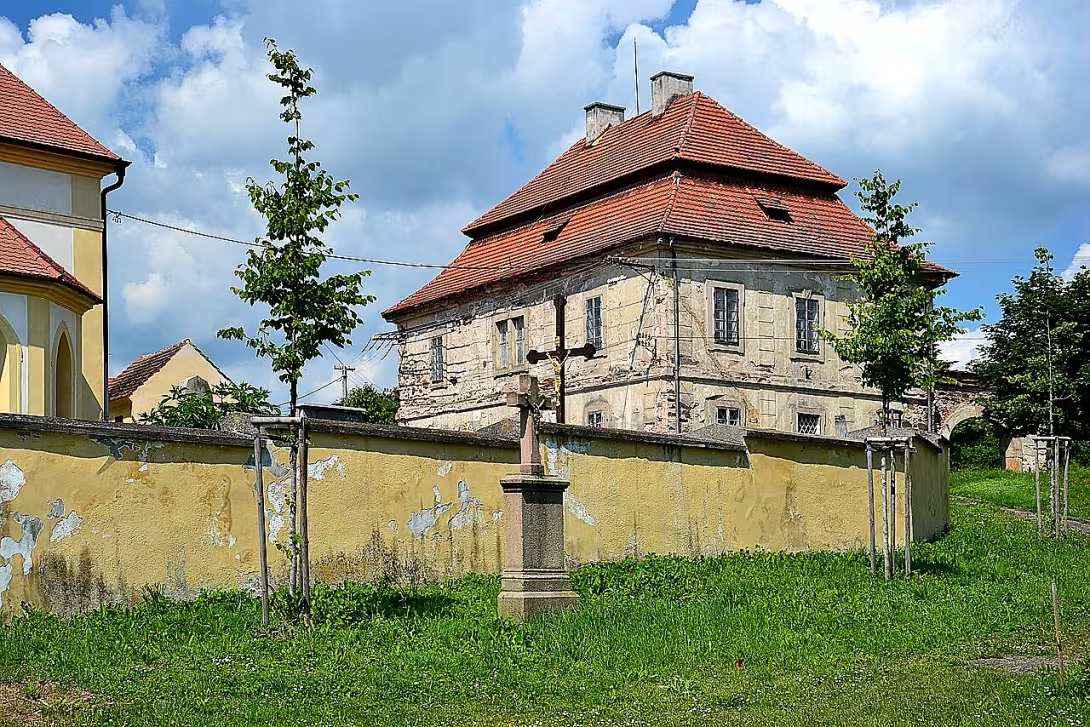
Fara in Žebnice is an exceptionally well preserved example of Baroque rural architecture of the 18th century, situated in the centre of the village. Since 3 May 1958 it has been registered as a cultural monument and has served as a residence of the spiritual administrator at St. Jacob's Church.
The rectory under the monastery of plastics was already in the 15th century. After the Hussite wars, it became a refuge of Catholics in a predominantly tradivistic, later Lutheran territory. In 1530, the area returned under the management of the plastic tankers, which probably prompted the recovery of the rectory. In 1690, for the Abbot Ondrej Trojer, a new far was established, probably in one of the abandoned estates. The current form was created in 1741 under Abbot Celestin Stoy, although it may be a reconstruction of an older building.
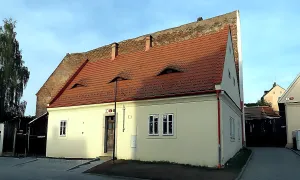
It is a self-standing bunk house with a Mansard roof, originally covered with shingles. The facade is divided by a cordon ledge, separating the ground floor from the first floor, and a profiled crown ledge at the top. The windows with simple sides are enclosed by rustic pilasters, some from the Baroque era. In the vault of one window of the first floor is preserved the abbot sign, the ground-floor windows are protected by metal bars. On the facade, some red chabras are preserved. The rectory included wooden economic buildings and a brick cellar. At the end of the 18th century, in the reconstruction of the neighbouring church, the Far was modernized: windows in the living rooms were doubled, the entrance door was replaced and black kitchen replaced by a stove.
In the interior, there was a two-wing door leading to the stairwell, underneath which is a pair of dry toilets. On the floor there is a kapla room with tiled floor and ceiling decorated with stucco mirrors and a distinctive Fabion, where apparently previously hung ceiling painting. On the first floor there is another room with tiled stove in classical style.
Fara belonged to the monastery of Pláska until 1826. After its cancellation, the building with its surrounding property became owned by Klement W. L. Metternich.
The monument offers a unique view of the Baroque rural parish in the Plasy region. The preserved appearance and architectural details make it an important target for all interested people in history.
Historical milestones
- 1530
- The village Žebnice returns to the hands of the plastic tankers.
- 1690
- Setting up a new rectory for Abbot Ondrej Trojer.
- 1741
- Construction of a new rectory under the leadership of Abbot Celestin Stoy.
- 1826
- The property of the rectory passes under Clementa W. L. Metternich.
- 1958
- The rectory is declared a cultural monument.
Architectural development
The building is baroque with a Mansard roof, originally covered with shingles. At the end of the 18th century the windows were doubled, the doors were changed and the stove was installed. The facade is divided by a cordon and crown ledge with rustic pilasters at the windows.
Historical events
1690: Establishment of a new rectory for Abbot Ondřej Trojer. 1741: Construction of a new parish building under the leadership of Abbot Celestin Stoy. 1826: Transfer of property under Klementa W. L. Metternich.
Owners
Plastic monastery (until 1826), Klement W. L. Metternich (since 1826)
Points of interest
- Fara in Žebnice is an exceptionally well preserved example of Baroque rural architecture of the 18th century, located in the centre of the village. - After the Hussite wars, the rectory became a haven for Catholics in a predominantly attractive, later Lutheran territory. - In the vault of one window on the first floor is preserved the abbot sign, while the ground-floor windows are protected by metal bars. - On the floor there is a kapla room with tiled floor and ceiling decorated with stucco mirrors and a distinctive Fabion. - After the abolition of the Plastic monastery in 1826, the building with its surrounding property became owned by Klement W. L. Metternich.
Guide
Show guide text
This text was created by artificial intelligence and has not been editorially reviewed. It may contain inaccuracies.
Welcome to the center of the village Žebnice! You stand before the historical parish, which is not only an architectural pearl, but also a witness to this country's rich past. In front of you is a self-standing storey building with a distinctive mansard roof. This rectory is an exceptionally preserved example of the Baroque rural architecture of the 18th century and lies like a jewel in the middle of the village.
Let's dive into the history of this fascinating monument. In 1530, the municipality of Žebnice returned under control of the plastic tankers, which was a significant milestone in its development. However, the actual establishment of the rectory took place in 1690 as Abbot Ondřej Trojer, who established it as an important religious institution. But it wasn't the end of her bond with history. In 1741, the parish building was built under the leadership of Abbot Celestin Stoy, who turned it into a real pearl of baroque architecture.
Look up on the facade and enjoy the beauty of baroque lines. Note the vault in the windows, especially one window on the first floor, which hides the preserved character of Abbot Celestine Stoy. This detail is not only an ornament, but a testimony of the abbot's personal contribution to the creation of this building.
Fara in Žebnice also has an interesting historical connection with key personalities. Ondřej Trojer, which founded the farms here, and Celestin Stoy, under whose leadership the parish building was built, are important figures in the creation of this monument. In 1826 the property of the rectory went under Klementa W. L. Metternich, which reflects another chapter of her historical bond.
The interesting thing is that after the Hussite wars, the rectory became a haven for Catholics in a predominantly tradivistic and later Lutheran environment. This role of the rectory as a protective local sanctuary gives its history depth and emotional weight.
Now that you have fallen in love with this monument, wait for further discoveries. Let's go around the building and explore the surrounding area, which is full of other historical stories and beauty.
Thank you for your visit to this important monument. We hope that you feel at home here and that you will remember the Žebnice parish with a joyful surprise and newly discovered knowledge. Let this historic pilgrim introduce you to the other attractions of the village!
Tips for visitors
For the best experience we recommend a visit on bright days, when the sun will highlight the baroque details and the Mansard roof of the building. Morning or late afternoon hours are best suited for photography, when light is softer and better underlined by the shapes of architecture.
The road to Žebnice is possible by car and public transport. Please check the current transport connections and parking possibilities in the village via internet search engines or the carrier's website.
We recommend taking comfortable clothes and shoes suitable for walking around. If you arrive with the children, it is good to have your own refreshments and drinks ready for you during the tour.
As part of a short walk around you can also visit the Church of St. Jacob the Greater, located near the monument.
Businesses nearby
Do you run a restaurant, accommodation, shop, museum, rental, wellness or other visitor service near this monument? Show yourself directly to the people heading to it — this is how they will see you in the app and on the web:
Events nearby
Zdroj akcí: otevřená data měst a obcí ČR (Národní katalog otevřených dat) a kalendář akcí Národního památkového ústavu.
Nearby
Kostel svatého Jakuba Většího.
Accommodation nearby
Trips and activities nearby
Guided tours, tickets and activities nearby from GetYourGuide
Affiliate link: if you buy from the partner, we may receive a commission. The price for you does not change.
Search tours and activities →Themed route
1. Church of St. Jacob the Greater (Type: Temple). Look at this historic building and its exterior. 2. The inner part of the church (Type: Space inside the building). Here you can see the quiet environment and inner appearance of the building. 3. fara (Žebnice) (Type: Spiritual residence). This building complements the overall view of the local religious heritage.
Seasonal recommendations
In the spring, the surroundings of the rectory in Žebnice awaken to life. Light green leaves of trees and blooming grass create a fresh background for this historic building. We recommend visiting the place in the morning when the light is fine and the air is clean. Due to the variable weather, it is advisable to choose layered clothes and comfortable shoes.
The summer season brings a full shadow of thick crowns of trees and intense colors of nature. The atmosphere is warm and the space is open. To avoid the biggest groups of visitors and the heat of the afternoon, we recommend arriving first thing in the morning. Don't forget light summer clothes and plenty of fluid.
In autumn, the landscape around the monument turns into golden and red tones, which gives the place a melancholy touch. Fogs in the valley highlight the mystery of historical architecture. The best time to visit is in the afternoon when the sun hits a sharp angle. The practical recommendation is humidity resistant shoes and lighter jacket.
In winter, the rectory acts calmly and moderately, especially if the building is surrounded by snow. The contrast of the white landscape and the walls of the building creates a unique visual impression. During this period visitors are the least likely, but it is necessary to count on a shorter opening time. Very warm clothes, hats and gloves are essential.
Visualizations and artistic views


The visualisations are generated by artificial intelligence and serve as inspiration.
Photos from the area
Real photos taken near the monument


Zdroj a licence jsou uvedeny u každého snímku.
Tips from visitors
No tips yet. Be the first!
Log in and add your tip.
Sources and literature
Photos: Petr Kinšt / CC BY-SA 3.0 — Wikimedia Commons. The author and licence also appear when you hover over the image.
Faktickým podkladem tohoto textu byl článek na Wikipedii, jehož autory jsou přispěvatelé Wikipedie. Článek je dostupný pod licencí CC BY-SA 4.0.
Location on the map


Příběhy a pověsti
Legendy, pověsti a příběhy spjaté s touto památkou
Fotografie návštěvníků
Zatím žádné fotografie. Buďte první, kdo přidá fotografii z návštěvy!
Log in a přidejte svou fotografii nebo hodnoťte.
Za ověřenou návštěvu v aplikaci získáte víc bodů — poznáme podle GPS, že jste na místě.
Reviews and comments