






Fuchsův statek Homestead
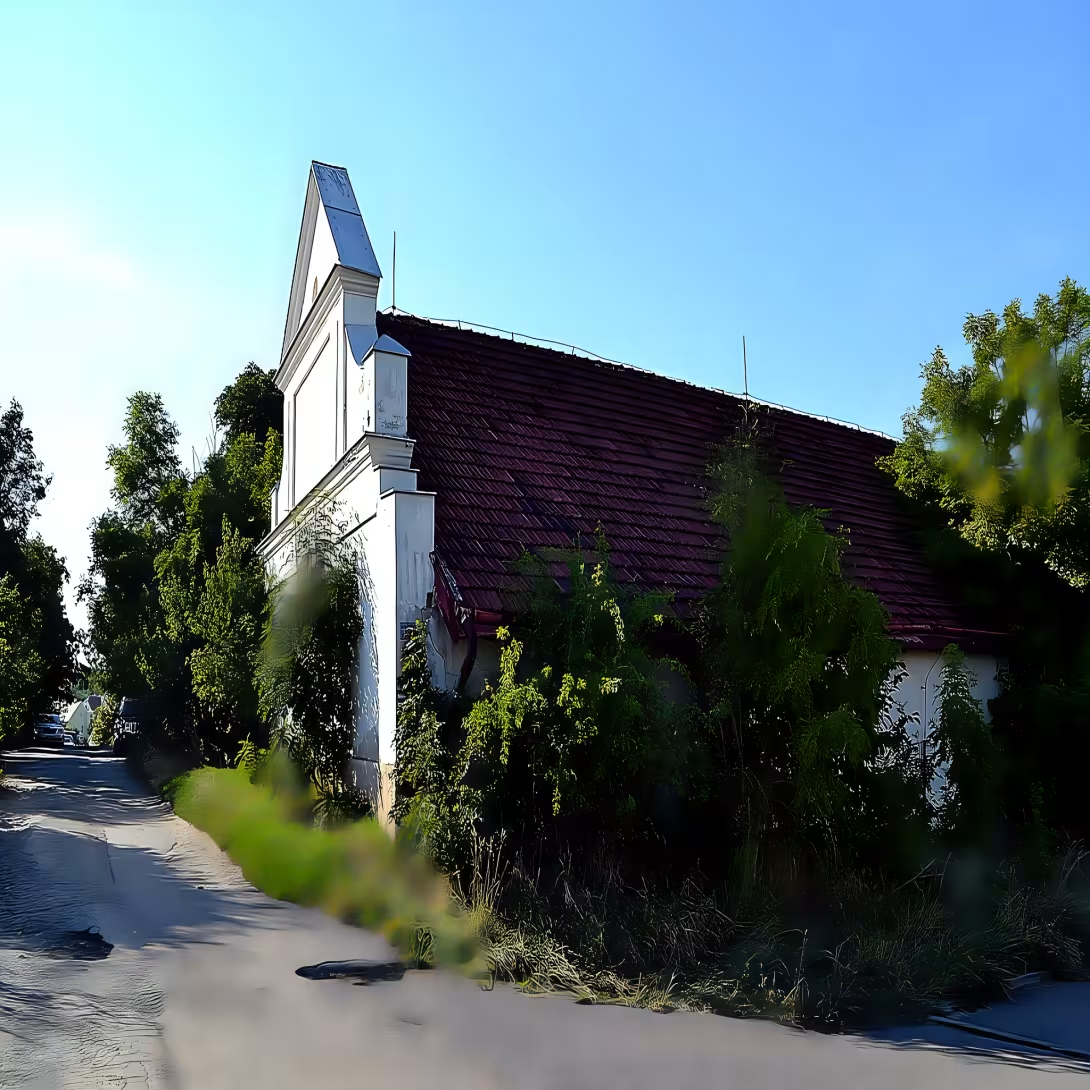
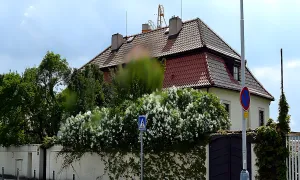
Fuchsův statek, located in Starodvorská street in the historical part of the village Lysolaje, is a Baroque estate protected as a cultural monument of the Czech Republic. This monument has a rich history dating back to the 17th century, when it was known as the Roden Court. Over the years he went through several owners and underwent various reconstructions, especially under Jiří Josef Birl, who radically turned him into a country house with a castle. Today, Fuchsův statek is an important historical monument that attracts visitors' attention with its architecture and past.
The first mention of the court comes from the Berní roula of 1654, when it was referred to as the Rodenovský court. It belonged to the Chancellor of Prince Liechtenstein, the knight James Roden of Hyrcenov, who bought it as abandoned after the 30 years of war. After his death without offspring, the court went to the high office and was then sold to Jan Kaspar Proy from Kaiselberg and Findenstein in 1679. This new owner restored it, but already before 1681 he replaced it with Ludmila Lažanská for a yard in Bohemia. Another owner was the townsman Jiří Josef Birl, who in 1718 turned the court radically into a country house with an summer castle.
The architecture of Fuchs farm is characteristic of the Baroque period. According to the 1725 description, the estate was enclosed with a new wall and had an entrance gate, from which two ornamental gardens with buxuses and prints were located, with four stone statues. Economic buildings such as barn, wine-growing press, ratin with vaulted kitchen and chamber, a band-aid for horse swimming, a well and stables were located on the perimeter of the yard. There was a chapel in the house.
The ownership of Fuchs' estate has often changed over the years. After Jiří Josef Birl, who ran here until 1746, the owners quickly took turns and around the middle of the 18th century the vineyard was carried out as abandoned. Since 1809 it was bought by Matěj Fuchs and its descendants ran it until the middle of the 19th century.
Fuchsův statek is today an important cultural monument that attracts visitors to their attention by its history and architecture. Its rich past and preserved elements of Baroque style make it an interesting goal for all who are interested in the heritage of the Czech Republic. Visiting this place offers an opportunity not only to see beautiful architecture, but also to learn about the history and development of rural settlements in Bohemia.
Fuchsův statek is a reminder of the rich history and culture of our region. Its preservation and protection are important for understanding the past and maintaining the cultural heritage for future generations. Visiting this place is not only a beautiful experience, but also an opportunity for a deeper understanding of the history and architecture of our state.
Historical milestones
- 1654
- First mention of the Berlin Rule Court.
- 1679
- Court sold to Jan Kaspar Proy from Kaiselberg and Findenstein.
- 1718
- Jiří Josef Birl has converted the yard into a country house with a castle.
Architectural development
According to the 1725 description, the estate was enclosed with a new wall and had an entrance gate, ornamental gardens, sculptures, farm buildings like a barn, wine bar press, a raffle room with vaulted kitchen and chamber. There was a chapel in the house.
Historical events
- 1654
- First mention of the Berlin Rule Court.
- 1679
- Court sold to Jan Kaspar Proy from Kaiselberg and Findenstein.
- 1718
- Jiří Josef Birl has converted the yard into a country house with a castle.
Owners
- 1654
- 1679
- before 1681
- 1718
- 1809
Points of interest
- Fuchsův statek is a Baroque estate protected as a cultural monument of the Czech Republic. - This monument has a rich history dating back to the 17th century, when it was known as the Roden Court. - Over the years he passed several owners and underwent various reconstructions, especially under Jiří Josef Birl, who radically transformed him into a country house with a castle. - The architecture of Fuchs farm is characteristic of baroque times and included a enclosed wall, entrance gate, two ornamental gardens with buxuses and prints and four stone sculptures. - The first mention of the court comes from the Berní roula from 1654, when it was referred to as the Rodenovský court.
Guide
Show guide text
This text was created by artificial intelligence and has not been editorially reviewed. It may contain inaccuracies.
Welcome to the Lysolai. You're standing right in front of a place that carries the incredible weight of centuries and a silent story that took place right here on this street in Starodvorska. Before your eyes is Fuchsův statek, the historical economic court, which today represents one of the most precious cultural monuments of the Czech Republic. Feel this atmosphere, feel the calm that prevails here, and try to imagine what this place looked like when this area was much more wild and life here was closely linked to the rhythm of the earth and nature.
Let's go deeper into the past together to understand what you're actually seeing. To find the roots of this place, we must return to the mid-seventeenth century. The first written trail leading us to this court dates back to 1654, when it was first recorded in the historical inventory known as the Berní roula. It's fascinating to think that while the world was changing around, this space lasted. At the time, however, it was not yet called Fuchsův statek. Did you know that this area was originally known as the Roden Court? This name immediately refers to its oldest roots and to the lineage that once lived here.
Now pay attention to how this space has changed over time and how it has become a representative residence from the simple agricultural background. The history of this place isn't just a linear chain of years, but it's a story about ambition, a change in social status, and a constant transformation of reality. In 1679 there was a major twist when the court was sold to Jan Kaspar Proy from Kaiselberg and Findenstein. This transfer of ownership was one of many that shaped the fate of this place.
If you look at the architecture of the buildings that surround you now, notice their baroque character. While time is changing relentlessly, this style is still visible and gives the complex its unmistakable face. The key moment for today's appearance of the monument was the transformation that Jiří Josef Birl launched in 1718. Before him there was a practical, economic court, but Birl had a much broader vision. He decided to radically rebuild it and turn it into a real country house. Note how the agricultural estate functions are interconnected with the elegance of housing for higher social layers. One of the most important elements that was created at the time and which added a noble dimension to the whole area was this year's argument. This idea of creating a place to relax and represent right at the heart of the economic court is a typical feature of the effort to combine utility and beauty.
Each part of this compound is accompanied by the names of the people who left their trail. It's like walking between the shadows of the past. We can name James Roden of Hyrcenov, whose name is linked to the beginnings of this place. Then came other owners like Jan Kaspar Proy, or Michal Lhoták ze Lhoty. Ludmila Lažanská, a character whose presence here adds another layer of humanity and social importance, has appeared in the history of this place. And of course we must not forget Jiří Josef Birl, whose visionary reconstruction in the eighteenth century created today's Baroque form, which you are now observing. Finally, as the name itself suggests, Matěj Fuchs worked here, whose name became a permanent legacy of this place for future generations.
The interesting thing that can make you stop and think about it is the constant transformation of the identity of this place. How does it happen that a place that began as a simple Roden court grew up in a baroque mansion with a castle and eventually became a protected cultural monument known as Fuchsův statek? This transformation from pure utility space into a representative residence and then into a monument to our act reflects the very development of our society and our relationship with architecture and tradition. It's a fascinating process where an ordinary house becomes a monument that makes us think about what's left of us.
But now I will not hold you back. I suggest you continue your tour and be carried away by the atmosphere of this historic area. Look at the more detailed parts of the buildings, see the space and try to imagine what life here looked like hundreds of years ago, when people from the Roden, Proy or Fuchs families moved on these roads. Feel every wall and every corner this Baroque complex offers you to explore. Thank you for choosing to visit this history and devote your time to understanding this important place. We wish you a pleasant continuation in discovering the beauty and mystery of Lysolál.
Tips for visitors
For the best experience we recommend a visit in spring or summer months, when the surroundings of the estate are the most lively and historical architecture works most authentic.
The place can be reached by car or through public transport; Please check the current timetable and connection in advance in the search engine.
For comfortable movement around the historic farm yard we recommend to wear comfortable shoes. For families with children, the tour is particularly interesting thanks to the possibility of observing the historical rural character of the building.
Natural light is best proven for photography during late afternoon, which will highlight the details and texture of the historical state of the monument.
Businesses nearby
Do you run a restaurant, accommodation, shop, museum, rental, wellness or other visitor service near this monument? Show yourself directly to the people heading to it — this is how they will see you in the app and on the web:
Events nearby

Zdroj akcí: otevřená data měst a obcí ČR (Národní katalog otevřených dat) a kalendář akcí Národního památkového ústavu.
Nearby
🏰 Historic sites (1673)
- Tomb unknown doctors 0.8 km
- Rudolf 1.0 km
- ruin Baba 1.4 km
- Trolleybus Transport Memorial on Hanspaulka 1.5 km
- _ 1.5 km
- Location of accident 1975 1.7 km web
- unknown hero and Nadia of Fáborská 1.7 km
- Viktor Lederer 1.8 km
- Irma Lederreva 1.8 km
- Miloš Lederer 1.8 km
- Pavel Lederer 1.8 km
- General Elijah 1.9 km
- Jan Vaniš 1.9 km
- Petr Fetr 1.9 km
- Jaromir Kapalin 2.2 km
- MVDr. 2.2 km
- Houtyš 2.2 km
- Vlasta Burian 2.3 km
- Radegast 2.3 km
- monument to Jiří Sedmíkovi 2.3 km
🍽️ Restaurants and dining (5335)
- U Capsules 0.2 km
- Sunflower 0.2 km web
- Café Library 0.5 km Kamýcká 1218
- U Valentí 0.6 km
- Circular Club 0.6 km
- Buffet Caffeteria TF 0.6 km
- Restaurant G - Academic Club 0.6 km
- AULA. Caffe 0.7 km web
- Club C 0.7 km web
- Many Good Food FAPPZ 0.7 km
- U Refrigerator 0.7 km web
- Green Chilli Continental Restaurant 0.8 km + 420 603 895 398
- Pizza Suchdol 0.8 km web
- Mensa 0.8 km web
- Farma 0.8 km web
- Klub Jih 0.8 km
- Buffet PEF 0.8 km
- Buffet Tractor 0.8 km
- Burger & Coffee Time 1.0 km
- Kebab Ibrahim 1.1 km
🏨 Accommodation (801)
- Carl Inn 0.9 km Sister1167 / 1
- Milada 1.0 km web
- Hotel Galaxie 1.4 km + 420 246 077 111 web
- Penzion Patanka 1.6 km Pate 200 / 4 + 420 602 151 558 web
- Clinic on Hanspaulka 1.6 km
- Libushe 1.8 km
- Pension Hanspaulka 1.9 km ZA Hanspaulkou 877 / 9 + 420 721 905 510 web
- Hotel International 2.1 km Koulov 15 + 420 296 537 111 web
- Vila Kozlovka 2.3 km
- Silenzio 2.5 km
- Bubeneč railway 2.7 km web
- Masaryk Railway 2.7 km Thákurova 1 web
- Dejvice Apartments 2.9 km Glink 14
- Vila Edita 2.9 km Glinkova 6
- Blue Stodola 2.9 km + 420 220 406 444 web
- Vienna House Diplomat Prague 2.9 km European 15 + 420 296 559 111 web
- Residence Jana 3.0 km
- Hotel Meda of Museum Kampa 3.1 km National Defence 825 / 33 + 420603373242 web
- Hotel DAP 3.1 km Winning square 4 + 420 973 211 444 web
- HC Star Praha 3.2 km = = sync, corrected by elderman = = @ elder _ man
🚲 Rentals and sport (514)
- Athletic stadium and football field CZU 0.8 km
- Pool CZU 0.8 km
- ALEA Divers, PADI 5star Center Diving 1.0 km + 420602522355 web
- Magnum Praha 1.3 km + 420 233322466 web
- Koloshop. cz 1.3 km
- Cyklo Adam 1.4 km International 1231 / 8
- Dukla Praha, Juliska 1.7 km
- Cycloservice Richard Eger 1.9 km
- Institute of Physical Education and Sport Czech Technical University 1.9 km
- Sports complex Hanspaulka 2.1 km + 420 724 069 956 web
- Multi-purpose sports grounds 2.1 km web
- Sportopia 2.5 km
- Atombike 2.7 km European 34
- Bikestar 2.8 km web
- Kolovna 2.8 km Povltavská 5 / 74 + 420 778069302 web
- Bowling Blue Stodola 2.9 km
- Bike Gallery 3.0 km Kladenská 19
- Fitness Rounds 3.0 km National Defence 35
- Stromovka: Railway bridge 3.0 km web
- Cordeus 3.1 km Na Long Ian 11
🥾 Hiking and nature (463)
- Miracle well 0.5 km
- lawn and gazebo behind the FAPPZ building 0.7 km
- Bezv. theatrical 0.9 km
- View of the Housle 1.2 km
- Baba 1.4 km
- Community Gardens 1.7 km
- Earth pyramids 2.0 km
- fossils 2.0 km
- Model Railway 2.0 km
- Tram T6 2.0 km
- Na Skalce 2.1 km
- jeleni 2.1 km
- Nordic les 2.1 km
- tahry 2.1 km
- ibis 2.1 km
- levharti 2.1 km
- losi 2.1 km
- Psoun 2.1 km
- boat 2.2 km
- Gabrielka 2.2 km
Accommodation nearby
Trips and activities nearby
Guided tours, tickets and activities nearby from GetYourGuide
Affiliate link: if you buy from the partner, we may receive a commission. The price for you does not change.
Search tours and activities →Themed route
Thematic cruise route from the village Lysolaje
1.Fuchsův statek (residence) * Type: * Historical estate * Why is it worth visiting: * Fuchsův statek is an architectural pearl in the village Lysolaje, offering a view of the rich history and culture of the region. It is an ideal place for those who are interested in the history of rural settlements and their development.
2. Local Market * Type: * Traditional market * Why is it worth a visit: * After exploring the farms you can visit the local marketplace where regional products and specialties are sold. It's a great way to get to know local gastronomy and support small producers.
3. Church of St. John the Baptist * Type: * Religious memorial * Why is it worth visiting: * This church is not only the spiritual centre of the village, but also an architectural interest with a rich history. Its interior and artistic features attract visitors from all over the region.
4. Local Museum * Type: * Historical Museum * Why is it worth a visit: * The museum offers exhibits that illuminate the history and culture of the village Lysolaje. It's an ideal place for those who want a deeper understanding of the local heritage.
5. Garden park near the farmhouses * Type: * Garden with historical plants * Why is it worth a visit: * Park is a beautiful haven for relaxation and a view of the old plant species that were once common in the region. It is an ideal place for a moment of peace after visiting other attractions.
This route offers a comprehensive view of the history and culture of the municipality Lysolaje, each of its points having its unique value.
Seasonal recommendations
Spring: In the spring Fuchsův statek in Lysolaj offers visitors a pleasant atmosphere where life appears after freezing winter days. Green meadows and flowering bushes wrap the farmhouse in a fine fan of new growth. Sun rays illuminate historical buildings, which is the perfect time for photographs without the threat of hanging clouds. When visiting in this period he recommends clothes by temperature - light but ready for cold wind. The best time to visit is in the morning or in the evening, when you avoid crowds and enjoy quiet moments in nature.
Summer: In the summer Fuchsův statek offers visitors a warm and lively atmosphere. Nature is in its golden shade, creating an ideal background for walking around farms. Sun rays illuminate architecture and make the local environment more attractive. Summer is the most popular time to visit, so it is recommended to come earlier in the day to avoid long fronts. Clothes should be light and functional with sun protection. Don't forget to bring a drink, because temperatures can be high.
Autumn: Autumn brings Fuchs a melancholy and peaceful atmosphere. November colors paint the surrounding forests, an ideal time for lovers of photography and poetry. The sunny afternoons are warm and pleasant, but the evenings are quickly shaded and the cooler wind is starting to feel. When visiting he recommends clothing according to conditions - light for sunny days, but warmer at cold evenings. The best way to visit the farm is to avoid crowds and enjoy quiet moments.
Winter: Winter visit to Fuchs farm offers a unique atmosphere. The buildings are covered in snow, which creates a romantic and mysterious impression. The sunny days bring bright light, which illuminates the architecture of states, while the freezing evenings are shaded soon. Opening hours are shorter and visitors should be prepared for cold conditions - warm clothes, wind and rain protection are necessary. The best time to visit is in the morning or in the evening, when you avoid crowds and can also use short visits in quiet moments.
Visualizations and artistic views

The visualisations are generated by artificial intelligence and serve as inspiration.
Photos from the area
Real photos taken near the monument


Zdroj a licence jsou uvedeny u každého snímku.
Tips from visitors
No tips yet. Be the first!
Log in and add your tip.
Sources and literature
Fotografie: Sefjo / CC BY-SA 3.0, rozlišení zvýšeno umělou inteligencí — Wikimedia Commons. The author and licence also appear when you hover over the image.
Faktickým podkladem tohoto textu byl článek na Wikipedii, jehož autory jsou přispěvatelé Wikipedie. Článek je dostupný pod licencí CC BY-SA 4.0.
Location on the map
Příběhy a pověsti
Legendy, pověsti a příběhy spjaté s touto památkou
Fotografie návštěvníků
Zatím žádné fotografie. Buďte první, kdo přidá fotografii z návštěvy!
Přihlaste se a přidejte svou fotografii nebo hodnoťte.
Za ověřenou návštěvu v aplikaci získáte víc bodů — poznáme podle GPS, že jste na místě.
Reviews and comments