



Gloriet na Jánské výši ve Všenorech Gazebo
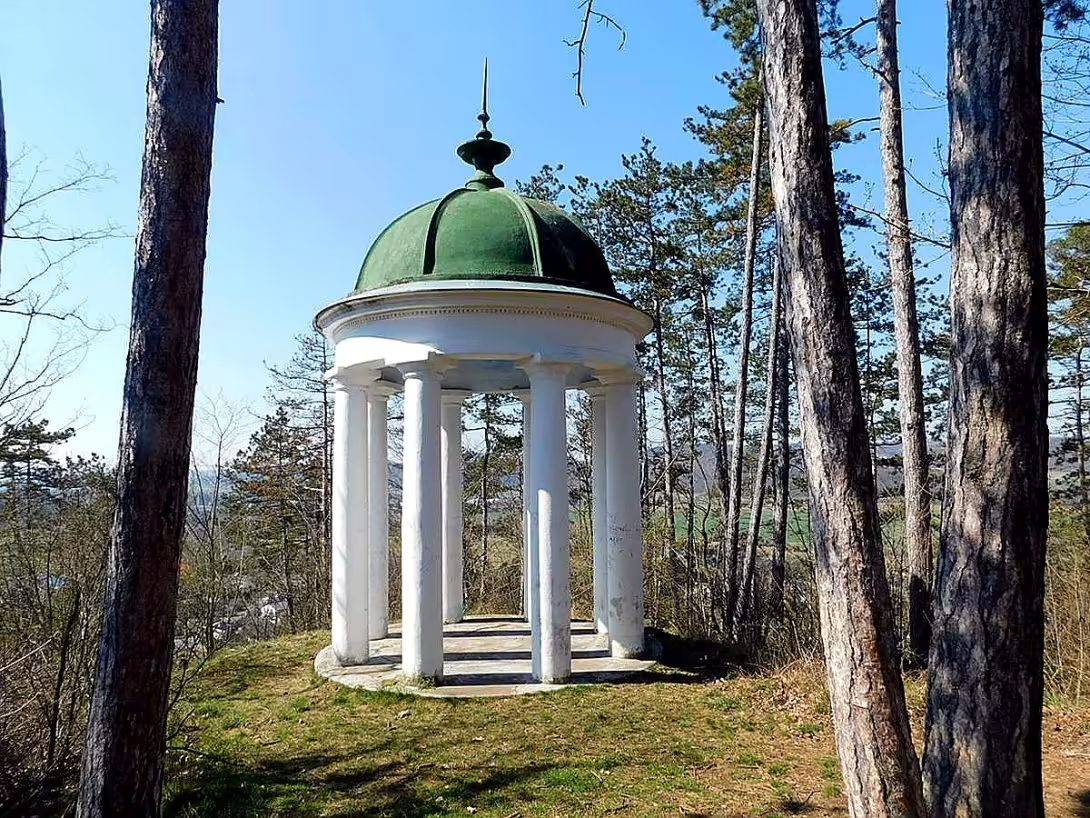
Gloriet na Jánské výši ve Všenorech is a small historical sightseeing building from 1885, which serves as an aesthetic dominant landscape. This antiquated gazebo is located at an altitude of 259 metres and represents an important proof of 19th century garden architecture in Berounka Valley.
In 1885, the building was built by the owner of the village estate Jan Nolč. The creation of the building falls into the period when interest in landscape architecture and romantic sightseeing points grew in the Czech countries. This trend was closely linked to the flourishing of historical styles and the consolidation of national identity. The gazebo was sensitively planted in a landscape above the valley of the river, where at that time large vineyards were decomposed.
Architecturally, the glomeret is conceived as an open circular gazebo without internal walls, based on ancient inspiration. It consists of eight smooth columns with no heels, ended at the top with simple Doric headers. These columns carry a half roof. The whole building serves as a decorative sightseeing and relaxation place.
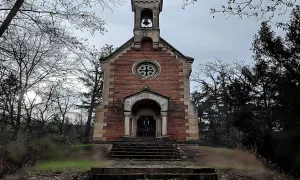
The first owner was Jan Nolč, after whose death in 1888 the administration of the estate switched to his family. In 1889, the widow Františka Nolčová had a New Romanesque cemetery chapel built near the gloriet, across the valley. During the 20th and 21st centuries the building underwent several repairs, namely in 1993, 2009 and last in 2024.
The year 2024 was an important milestone for the preservation of the monument, when it was possible to avert the intention to set up a landfill in the immediate vicinity. This successful step led to an overall adjustment of the surrounding area, thus ensuring additional protection and aesthetic value of the site.
Today the gloriet is an accessible goal that offers visitors the opportunity to relax and view the surroundings. As a historical dominant of the ubiquitous estate, it represents a valuable example of small architecture, the preservation of which is important for maintaining the nature of the landscape. Visiting this place allows you to look into the aesthetic sensations of the late 19th century and appreciate the care that is currently devoted to the monument.
Then and now
Drag the slider to compare how the landmark may have looked when it was built with the view today.
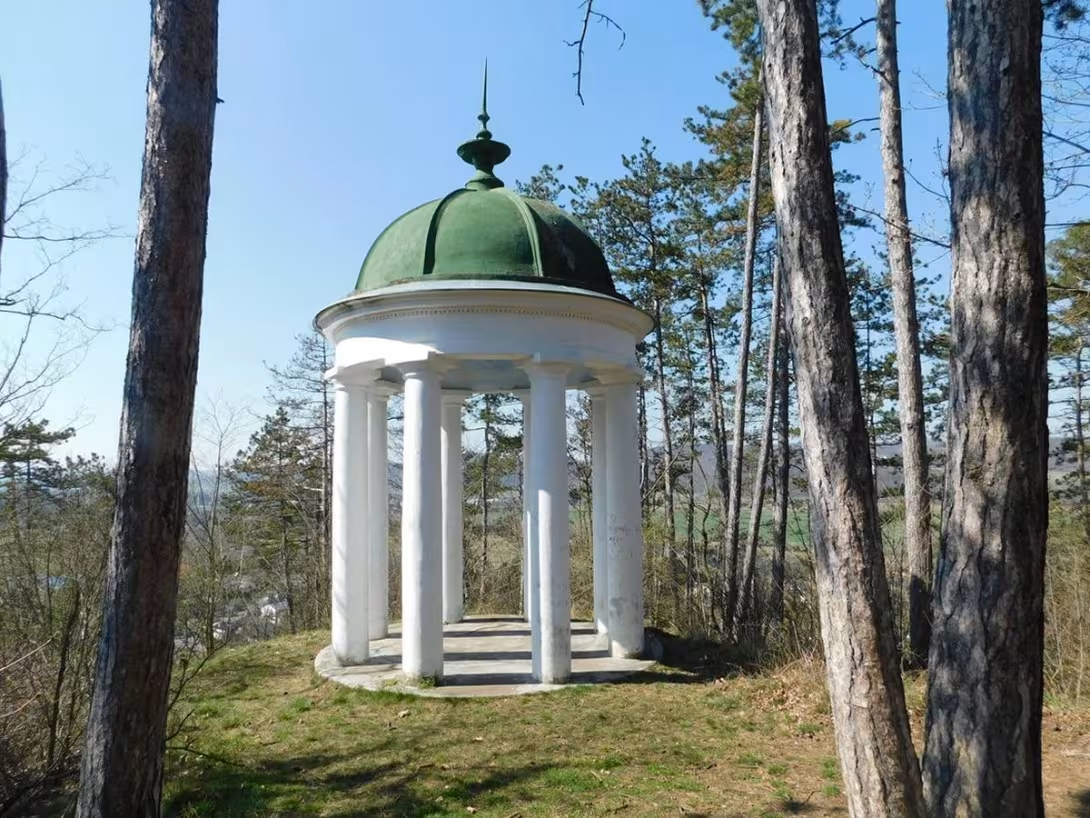

The historical appearance on the left is an AI-generated visualisation and serves as inspiration only.
Historical milestones
- 1885
- Construction of the gloriet by the owner of the village estate Jan Nolč.
- 1889
- Construction of the New Romanesque cemetery chapel of the Nolče family opposite the gloriet.
- 2024
- The total modification of the area of the gloriet after a diversion of the intention to set up a landfill site.
Architectural development
The construction is designed as an open circular gazebo without internal walls. Architectural based on ancient inspiration using the Doric Order. During the 20th and 21st centuries the building underwent several repairs, namely in 1993, 2009 and 2024.
Historical events
1885: Construction of the gloriet Jan Nolčem. 1889: Completion of the New Romanesque cemetery chapel of the family of Nolče. 2024: Successful protection of the site against landfill and subsequent modification of the surrounding area.
Owners
Jan Nolč (1885-1888), followed by the Nolčova family.
Points of interest
- The construction was built in 1885 as an aesthetic dominant landscape and is evidence of the 19th century garden architecture. - The object was built by the owner of the Observer Manor Jan Nolč. - Architecturally, it is an open circular gazebo without internal walls, which consists of eight smooth columns with Dorian warheads carrying a half roof. - In 1889, the widow Františka Nolčová had a New Romanesque cemetery chapel built near the building. - In 2024, the intention to set up a landfill in the immediate vicinity of the landfill was averted, resulting in a subsequent modification of the surrounding area.
Guide
Show guide text
This text was created by artificial intelligence and has not been editorially reviewed. It may contain inaccuracies.
Welcome here, to the Jansen level in Všenory. Stop for a moment, take a breath, and let your gaze slowly move on to the building that stands right in front of you. You are standing in front of a small but very elegant summer castle known to local and visitors under the name Gloriet. It is a place where human desire for beauty and order is combined with the natural grandeur of the surrounding countryside. The first impression this building is likely to give you is a sense of ease and openness. It's a space that doesn't make you come in to separate you from the world, but it encourages you to look away from it.
Let us now look together at how this building was created and who was its creator. Let's move back more than a hundred and thirty years in time, to 1885. At the time, it belonged to Mr. Jan Nolč. He was the man who decided that this high rise, the Yansk High, deserved his dominance. Jan Nolč didn't just want to build an ordinary shelter, but he wanted something that looked like an aesthetic jewel in the landscape. In the nineteenth century, it was very popular to go back to patterns from ancient history, and therefore this castle was brought out in ancient style. The aim was to create a place of rest and prospects that would complement the vast vineyards that had spread out in the valley of the Berounka River at that time. Imagine how the owner of the estate sat here in the late summer afternoon, watching his vineyards and seeing the calm of the natural landscape.
Now pay attention to the architecture itself, which is right in front of you. If you look at the floor plan of the building, you'll notice it's perfectly circular. This shape symbolizes unity and infinity, which is very typical of buildings inspired by the ancient period. Now look at the columns. The entire castle is carried by eight smooth columns. Note that these columns have no grooves or decorative grooves, they are absolutely smooth, which gives the construction a clean and strict look. If you look up, you'll see the top of the columns, the so-called warheads. These are Doric warheads, which is the simplest and oldest order of ancient columns. They are stealth, but it is in this simplicity that their strength and elegance lie. These eight columns together carry a half roof that closes the whole building and gives it the form of a noble gazebo. It's fascinating that the building has no inner walls. It's an open space that serves as a frame for the image of the surrounding nature.
When you stand under the roof of the castle, feel the atmosphere of this place. It's a place connected to the Nolch family. Jan Nolč and his wife Františka Nolčová probably spent their free time here. But life is not only about rest and beauty, it's about remembering those who have already left. If you turn now and look across from this year's castle, you will see another significant structure. In 1889, only four years after the construction of the Gloriet, the cemetery chapel of the Nolče family was built here. It's done in a New Romanesque style. It's very symbolic that these two buildings are facing each other. On the one hand, we have a castle, which represents the joy of life, relaxation and admiration for nature, and on the other side of the chapel, which reminds of the finality of human existence and respect for the ancestors. This axis between a place of joy and a place of sadness forms a deep emotional dimension of the entire complex at Janska level.
You may now be wondering if this place has undergone any changes in recent years. The history of this place is not only about beauty, but also about fighting to preserve it. A few years ago, a very disturbing thought emerged. In this beautiful neighborhood, near the historic castle, a landfill was considered. Imagine the contrast to how there could be a pile of trash near these ancient columns and the family chapel. Fortunately, however, this intention has been averted. As a result, a general modification of the Gloria area could be carried out in 2024. What you see around you today is the result of trying to get this castle back to its original role as an aesthetic dominant landscape. It's proof that people still value the 19th century garden architecture and want to protect it for future generations.
Now try to imagine what this landscape looked like over a century ago. Where you see trees and meadows today, there were a series of wine games. The scent of ripe grape wine mixed with fresh air rising from Berounka Valley. Gloriet was not just a construction, it was a scenic point from which the owner of the estate could control his land and enjoy the very act of observation. It's fascinating how one small building can define the whole character of the hill and turn a common view into a place with history and soul.
Now I encourage you to enter the space under the dome, lean on one of the Dorian columns and simply remain silent. Listen to the wind in the trees and look towards the valley. Feel how the history of the Nolče family combines with the architectural taste of past times and with today's peace of nature. This small gazebo is like a time capsule that brings us back to a time when things were made in the landscape with regard to beauty and harmony.
I hope you enjoyed this short trip to the history of Všenor and Jansky above. Gloriet may be small, but he has a great story about ambition, love of art and courage to protect what is valuable. Now you can continue to explore the surroundings, visit the mentioned family chapel or just walk the surrounding roads and look for more clues of the past in this beautiful landscape. Thank you for your attention and I wish you a pleasant rest of the day spent in the arms of nature and history. Goodbye.
Tips for visitors
The best time to visit is during the late afternoon when the sun falls below and illuminates the ancient columns with warm light, creating ideal conditions for photography. Avoid weekends at noon when the place gets busier.
You can walk to the monument from the village Všenory. For precise connection by public transport, use the connection search engine to guide you to the stop in Všenory.
Take plenty of water and snacks with you, because there are no refreshments at the building itself. For photographers I recommend a wide-angle lens that captures the entire circular structure with eight columns in the context of the surrounding landscape.
In the vicinity you can visit the picturesque river Berounku, which offers quiet places to relax, or see the New Romanesque cemetery chapel of the Nolče family, which is architecturally very interesting.
For families with children the trip is suitable as a light nature walk. The path to the view is not very demanding, but I recommend fixed shoes because the terrain can be uneven in the woods.
Frequently asked questions
Can the monument be visited?
This is a structure in a public space that can usually be seen from outside free of charge. We have not verified that this particular one is freely accessible.
Where is the monument?
Location: Všenory, Středočeský kraj. The map on this page shows the exact spot.
Why is the monument protected?
It is listed in the Central List of Cultural Monuments of the Czech Republic as a cultural monument (register no. 1000024329).
Businesses nearby
Do you run a restaurant, accommodation, shop, museum, rental, wellness or other visitor service near this monument? Show yourself directly to the people heading to it — this is how they will see you in the app and on the web:
Events nearby

Zdroj akcí: otevřená data měst a obcí ČR (Národní katalog otevřených dat) a kalendář akcí Národního památkového ústavu.
Nearby
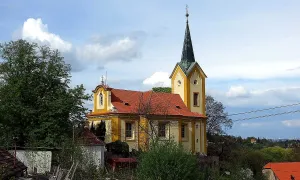
Řeka Berounka, novorománská hřbitovní kaple rodiny Nolčů, obec Všenory.
Accommodation nearby
Trips and activities nearby
Guided tours, tickets and activities nearby from GetYourGuide
Affiliate link: if you buy from the partner, we may receive a commission. The price for you does not change.
Search tours and activities →Themed route
1. Municipality of Všenory, village. A place where you can start your journey. 2. Berounka River, water flow. Walk along the shore offers a pleasant peace. 3. New Romanesque Cemetery Chapel of the Nolch family, Chapel. This building is worth visiting for its architectural appearance. 4. Gloriet na Jánské výši ve Všenorech, this year's castle. The main destination of the trip, which offers a beautiful view.
Seasonal recommendations
Spring: In the spring period, Gloriet illuminates at the Janka level with sunlight, which projects the pink and green colors of nature around. Flowers are beginning to bloom, which gives the summer castle a lively atmosphere full of hope. Visitors can expect a slight crowd load because it is before the main summer period when people start travelling outside. It is recommended to wear light clothes with the possibility to add a layer to colder days and the trip can be planned in the afternoon when the sun is frowned upon.
Summer: In summer, Gloriet is transformed into a shining place with rich vegetation and blooming flower palette. Sunshine gives the summer castle a lively color, but it can also be too hot, especially at noon. This period is most popular and visitors can meet with a large crowd. It is advisable to visit the castle early in the morning when the temperature is more pleasant, and not forget the protective eyes and sufficient hydration.
Autumn: The autumn atmosphere around Gloriet takes on quiet beauty with leaves in colour shades. Sun rays become softer and the climate is usually more pleasant than summer, making this time ideal for visiting. The crowd load decreases compared to the summer period, making it possible to enjoy a lighter environment. It is recommended to wear laminated clothing and bring a sun curtain if you plan a trip at the end of the day.
Winter: In winter, Gloriet gains a soft romantic mood with a pale shining sun and a snow umbrella that covers the landscape. The temperatures are cold and the opening times of the monument can be shortened, so it is important to inform yourself before visiting. The crowd load is minimal, allowing a peaceful walk. It is necessary to wear warm clothes and suitable footwear goods, especially if you plan a trip on cooler days.
Visualizations and artistic views


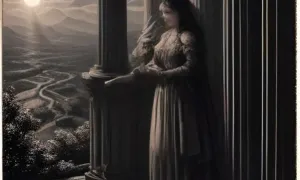
The visualisations are generated by artificial intelligence and serve as inspiration.
Photos from the area
Real photos taken near the monument


Zdroj a licence jsou uvedeny u každého snímku.
Tips from visitors
No tips yet. Be the first!
Log in and add your tip.
Sources and literature
Photos: Noe / CC0 — Wikimedia Commons. The author and licence also appear when you hover over the image.
Faktickým podkladem tohoto textu byl článek na Wikipedii, jehož autory jsou přispěvatelé Wikipedie. Článek je dostupný pod licencí CC BY-SA 4.0.
Location on the map




Příběhy a pověsti
Legendy, pověsti a příběhy spjaté s touto památkou
Fotografie návštěvníků
Zatím žádné fotografie. Buďte první, kdo přidá fotografii z návštěvy!
Log in a přidejte svou fotografii nebo hodnoťte.
Za ověřenou návštěvu v aplikaci získáte víc bodů — poznáme podle GPS, že jste na místě.
Reviews and comments