



holešovický přístav Water structure
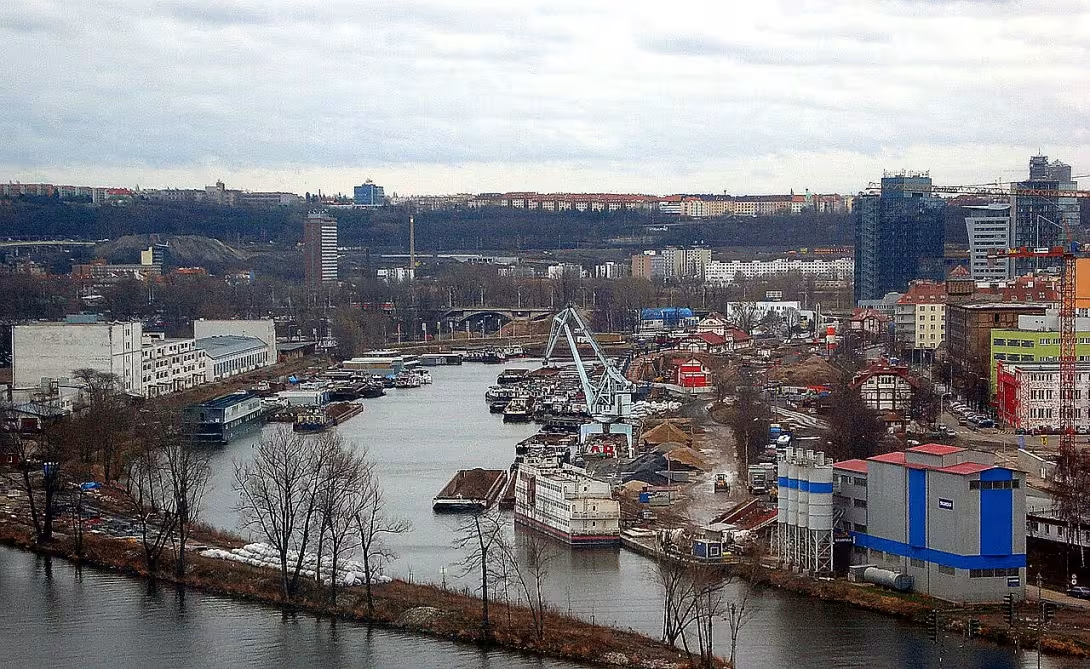
Holešovická port in Prague is an artificially excavated water work from the period of history. It served as a strategic hub for water and rail transport. The building has been protected as a cultural monument since 2002. It is currently undergoing conversion to residential and administrative use.
The creation of the port is linked to the intensive industrialization of Prague at the end of the 19th century, when it was necessary to modernise trade routes. The construction was carried out by Lanna in two stages. From 1892 to 1895 it was created primarily as a port of protection and winter. From 1896 to 1910 the modifications followed for his transformation to a commercial port.
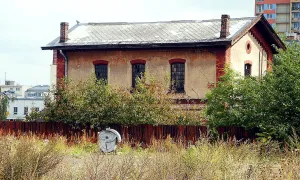
From the point of view of technical parameters it is an extensive complex with an artificially excavated swimming pool of 750 metres long, 100 metres wide and 4,8 metres deep. A total of 513 900 m ³ of soil was extracted during construction. The most architecturally important buildings from 1906, most of which are high to one floor. Their facades are richly chipped and combine red reed masonry with cream plaster. The later objects in the complex dates back to 1927 and 1936.
A key element of the infrastructure was the ranking station from 1906. It was connected from the north and south side by a train to Drum Station. In 1926, as a result of the translation of the Vltava trough in Manin, the port scythe narrowed down. In the newer period, namely 2003, two Lighthouse Vltava Waterfront Towers high-rise buildings were built at the port at the Libeňská Bridge.
In the 1990s, the port stopped serving shipping. In 2005 the tracks of the marshalling and freight stations were removed. The Prague Marina project is currently under way, which plans to build the premises of apartments and shops. The transport service on working days is provided by the Midibus line 156 with the stop in the Port. In 2016, Prague 7 considered building a bridge connecting Holešovice with the port scythe.
The Holesovický port represents a unique witness to the industrial development of the capital and the interconnection of waterways and railways. It is a place where the historical architecture of industrialization meets modern urbanization. Visiting this area offers insight into the technical heritage of Prague.
Then and now
Drag the slider to compare how the landmark may have looked when it was built with the view today.
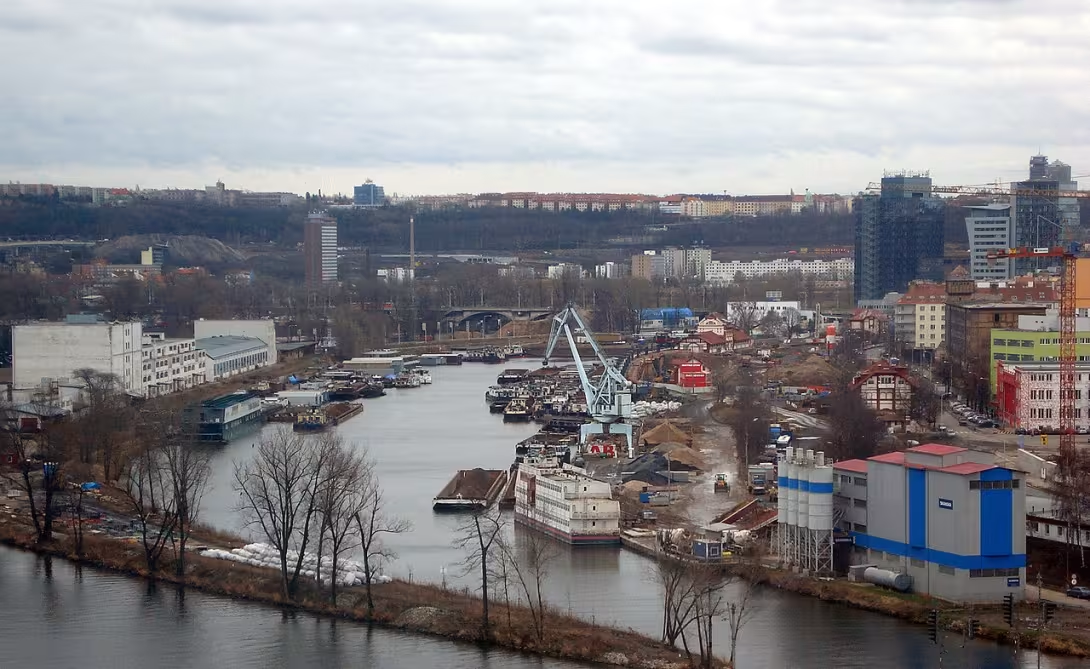
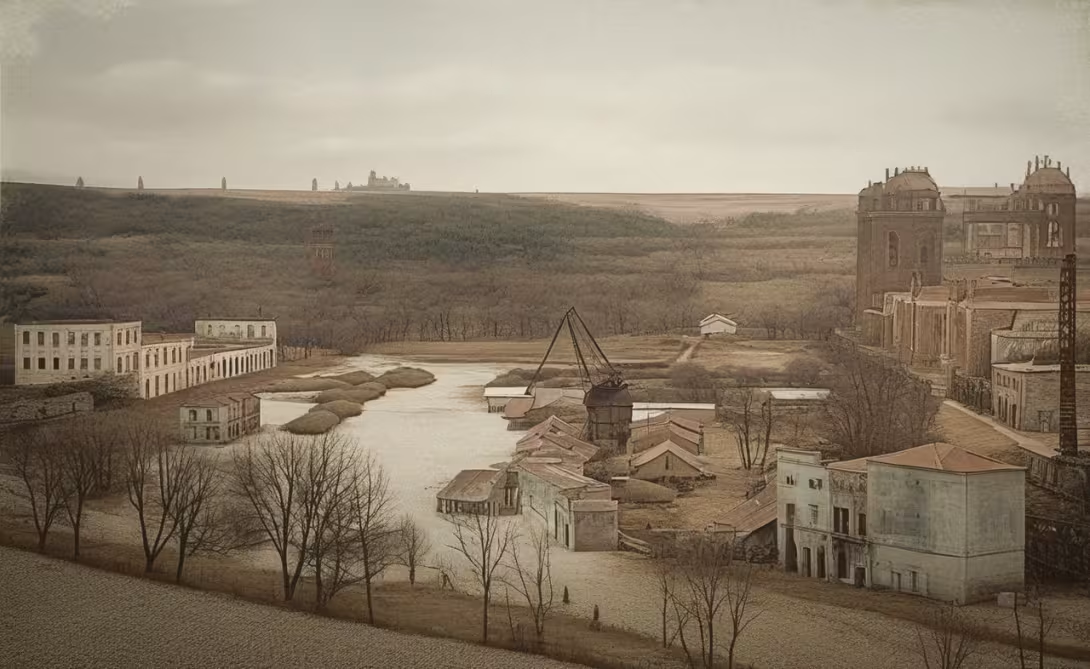
The historical appearance on the left is an AI-generated visualisation and serves as inspiration only.
Historical milestones
- 1892
- start construction of the protection and winter port
- 1896
- start of adjustments to the commercial port
- 1906
- construction of a sorting station and most buildings
- 2002
- the beginning of protection as a cultural monument
Architectural development
The port was excavated artificially with extraction of over 500,000 m ³ soil. The 1906 buildings show a red brick wall and a creamy plaster with richly chipped facades. In later years, objects from 1927 and 1936 were added.
Historical events
1892-1910 construction and development of the port, 2002 publication cultural monument, 2005 removal of the tracks of the sorting station.
Points of interest
- The artificial swimming pool is 750 metres long, 100 metres wide and 4.8 metres deep. During the construction, 513 900 meters of cubic soil were extracted. - The construction was carried out by Lanna in two stages between 1892 and 1910. - The 1906 buildings have rich red masonry facades and cream plaster. Since 2002, the building has been protected as a cultural monument. - In 1926, the port moss was narrowed due to the translation of the Vltava trough in Manin.
Guide
Show guide text
This text was created by artificial intelligence and has not been editorially reviewed. It may contain inaccuracies.
Welcome to Holešovice. You are standing in front of one of the most interesting water works in Prague, which is Holešovický port. Now, if you look around you, you will see the space that was created by man to serve water transport and trade. In front of you is a large water complex that still radiates the atmosphere of an old industrial centre with its size and location. Feel this space as a gateway to the past, where water, railways and the business interests of large enterprises met.
Let us now look together at how this place was created and why it is standing here. This whole area was not the result of a natural riverbed, but was artificially excavated. The company Lanna played a major role in its construction, which started this colossal project in 1892. At that first stage, the port was designed primarily as a protection and winter port. So imagine a place where the ships could safely outlast the hardest winter months, when the river level was changing or the voyage was dangerous.
Over time, however, the needs of the city and the merchants have changed. Already in 1896, adjustments were made to make this safe haven a fully-fledged trading port. The goal was to create an effective hub for the transport of goods from ships to land and further inland. This process of construction and expansion lasted several decades, namely between 1892 and 1910, when Lanna gradually completed its work.
Now pay attention to the buildings that surround the water surface. If you look at the 1906 buildings, notice their appearance. They are characterized by their richly fragmented execution. Follow the combination of colours and materials where it dominates the red masonry with a cream plaster. It is this contrast that creates the typical appearance of the time and gives the whole area some nobility, even if it was primarily useful buildings. Note the details on the facade that show the care with which these structures were lifted. In addition, in 1906 a ranking station was built, which underlines the importance of this place as a logistics centre where various modes of transport were combined.
When we think about the people who worked here, we have to realise that even though we do not know today the specific names of the architects who drew these plans, behind every stone and every metre of the earth, thousands of hours of hard work for the workers and precise planning of the Lanna engineers. It was a place full of noise, the movement of goods and the constant rush. Imagine the atmosphere here a century ago, when they were moored here, they were hitting the bottom and the air was carrying the sound of cargo loading.
And now I'm going to transfer you to something that might surprise you. Let's think about the dimensions of what you see. This artificially excavated pool is not just a small tank. Its length is seven hundred and fifty metres and its width is one hundred meters. The depth is four whole eight-tenth of a meter. In order to create this huge space, the builders had to export an incredible amount of soil from this place. Exactly five hundred and thirteen thousand nine hundred meters of cubic clay and sand were taken away to create space for water and ships. It's a fascinating idea when you realize how much material must have been moved at a time when modern machines were not used today.
This site with its unique infrastructure deserved recognition even in later times. Since 2002 the entire building has been protected as a cultural monument. This means that the state has recognised its historical and architectural value and decided that it must be preserved for future generations. It is proof that even industrial architecture can have its beauty and meaning beyond mere usefulness.
At present, however, the Holešovická port is changing again. It is undergoing a conversion process, which means that it is gradually becoming a space for residential functions and administrative offices. It is the natural development of a city that tries to return an old, unused area to life in a new form without destroying its history.
Now, if you look around again, try putting all these pieces together. You see not only water and masonry, but a reminder of the ambitions of the end of the nineteenth century, the courage of Lanna and the transformation of Prague into a modern metropolis. Feel the contrast between the calm of the times and the dynamics of the old trading port.
Thank you for coming with me to this fascinating place. I hope you're interested in the story of Holešovice Harbor and that you've noticed the details that would escape at a normal glance. I now invite you to further explore the area. Walk slowly through the shores, take a closer look at the facades of the buildings and be inspired by the atmosphere of this unique water work. I wish you a pleasant continued trip to Prague and a pleasant day.
Tips for visitors
The best time to visit is late autumn or early spring when trees are around the water works without leaves and there is a better view of the construction of the complex. Transport to Holešovice is possible by car and public connections; Check the specific routes and connections in the maps.
Take suitable shoes for a walk, which can also handle unprepared terrain because it is a space in reconstruction. We also recommend changing in case you get dirty near the water.
For the best photos choose the time shortly before sunset, when the low light will highlight the industrial character of the port. The most interesting shots are taken from the edges of the complex, where you can see the extent of the excavated space.
It is interesting for families with children to monitor the water and explore the surrounding architecture, but due to the ongoing repairs, caution should be exercised with children.
Frequently asked questions
Can the monument be visited?
This is a structure in a public space that can usually be seen from outside free of charge. We have not verified that this particular one is freely accessible. According to the heritage register restoration is under way, so access may be restricted.
Where is the monument?
Location: Holešovice. The map on this page shows the exact spot.
Why is the monument protected?
It is listed in the Central List of Cultural Monuments of the Czech Republic as a cultural monument (register no. 1938149231).
Businesses nearby
Do you run a restaurant, accommodation, shop, museum, rental, wellness or other visitor service near this monument? Show yourself directly to the people heading to it — this is how they will see you in the app and on the web:
Events nearby

Zdroj akcí: otevřená data měst a obcí ČR (Národní katalog otevřených dat) a kalendář akcí Národního památkového ústavu.
Nearby
V blízkosti se nachází Libeňský most, nádraží Bubny a Vltava.
Accommodation nearby
Trips and activities nearby
Guided tours, tickets and activities nearby from GetYourGuide
Affiliate link: if you buy from the partner, we may receive a commission. The price for you does not change.
Search tours and activities →Themed route
Here is the design of the cruise route:
1. Drum station (transport node) - A convenient beginning of the journey where you can start your walk. 2. Liberian bridge (construction work) - An architecturally interesting connection across the river, which offers a nice view. 3. Vltava (river) - The natural artery of the city that follows you on the way to the finish line. 4. Holešovický port (water work) - The main destination of the trip, where you can admire water structures and surroundings.
Seasonal recommendations
In spring the surroundings of the water works awaken to life and the landscape around the Holešovice green. The air is fresh and light soft, which is pleasant for viewing architecture. We recommend moisture-resistant shoes, because at this time the terrain around the water can be wet. It's best to visit the place in the morning.
In the summer months it dominates areas of strong sun and hot air. The water surface creates a specific cooling microclimate, which causes a refreshing impression. It is advisable to choose light, breathable clothes and not forget the protection of the head. Due to intense heat, the perfect time is shortly before sunset.
Autumn brings colorful leaves and frequent fog around the harbor, giving the place a mysterious atmosphere. The lighting is golden and less sharp. It's practical to carry a waterproof coat or a lighter jacket because it's windy by the water. We recommend a walk in the afternoon when the colors of nature are the most distinctive.
Zimą is a space of Holešovice overtaken by silence and the landscape is often covered with snow or frost. The atmosphere is sharp and minimalist, which highlights the shapes of the reconstructed work. Hot clothes, thermo-pads and solid winter shoes are essential. The best is a short visit at noon when the most daylight is.
Visualizations and artistic views


The visualisations are generated by artificial intelligence and serve as inspiration.
Photos from the area
Real photos taken near the monument

Zdroj a licence jsou uvedeny u každého snímku.
Tips from visitors
No tips yet. Be the first!
Log in and add your tip.
Sources and literature
Photos: Martin Pauer (Power) / Public domain — Wikimedia Commons. The author and licence also appear when you hover over the image.
Faktickým podkladem tohoto textu byl článek na Wikipedii, jehož autory jsou přispěvatelé Wikipedie. Článek je dostupný pod licencí CC BY-SA 4.0.
Location on the map



Příběhy a pověsti
Legendy, pověsti a příběhy spjaté s touto památkou

Fotografie návštěvníků
Zatím žádné fotografie. Buďte první, kdo přidá fotografii z návštěvy!
Log in a přidejte svou fotografii nebo hodnoťte.
Za ověřenou návštěvu v aplikaci získáte víc bodů — poznáme podle GPS, že jste na místě.
Reviews and comments