



Hotel Juliš Hotel building
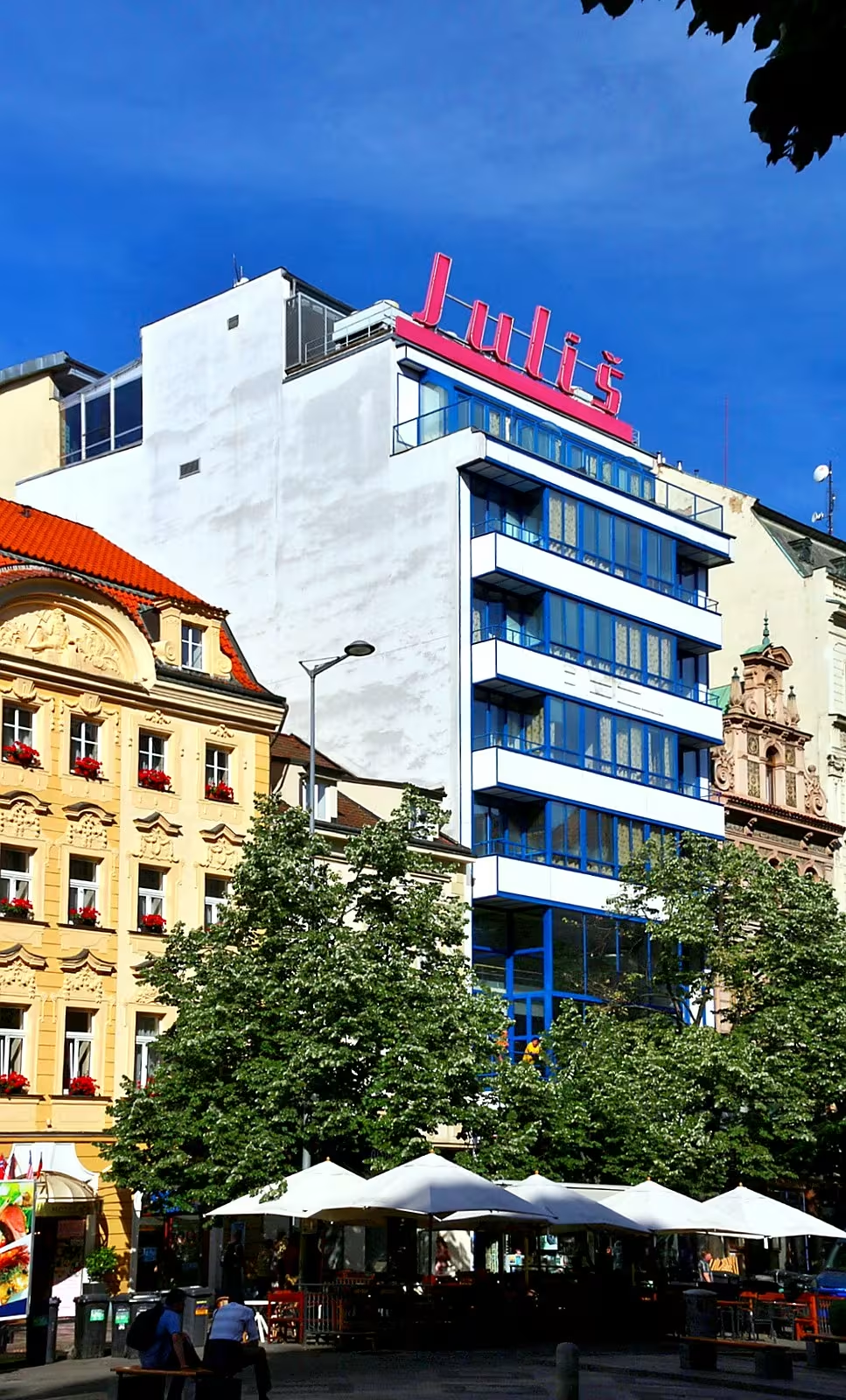
Hotel Juliš is a functionalist hotel located on Wenceslas Square in Prague's New Town. The main object from 1931- 1932 excels with steel construction and avant-garde design. This monument is an important example of the interwar modernization of the Prague Centre.
The house of Jakub Krejčí stood on a narrow medieval plot at least since 1378. Around 1725, the building was rebuilt in Baroque style and named according to the home sign at the painting of the Virgin Mary. In 1788 Josef Gabriel Behrns bought the house. Around 1900, the violinist Bohumil Lantner was based on the ground floor, and the famous Gustav Jäger Confectioner in the surrounding area and later Peter's Art Nouveau House by Jan Kotěra.
In 1917 the pie maker Karel Juliš and his wife Katusha purchased the building. In 1919, the Magistrate rejected the original proposal for demolition because of historical value. Therefore the architect Pavel Janák in 1922-1925 built only a court extension to the Franciscan garden in late cubism. With the progressive modernization of Wenceslas Square, Juliš was approved for demolition in 1929. In 1927-1933 Karel Juliš built an 8-story hotel.
The main building from 1931- 1932 is the work of functionalism. It stands on a steel skeleton with metal and glass components on it. The distinctive red-yellow colour of the facade and avant-garde interior was designed by painter and designer František Kysela.
After World War II, Major Miloš Knorr lived in the hotel together with Major René Černým. In 1948 the building was nationalized and renamed the hotel Tatran. Since 3 May 1958 the building has been protected as a cultural monument of the Czech Republic. As part of the restitution in 1991, the hotel returned to the Juliš family, but sold it because of the bad financial situation. The current owner is Eltima Property Company, whose parent company is Austrian developer S IMMO.
In the basement of the building there was a Paris cinema (originally Biograf Juliš) which was created in 1926 and since 1930 was sound. The hall will accommodate 400 spectators, but the cinema definitely disappeared during reconstruction in the years 1998- 2003. In July 2017, there was a scaffolding fire at the hotel. He may have requested an evacuation, but he didn't damage the building itself.
The building underwent extensive reconstruction between 1998 and 2003. Some original features were deleted, including marble tiles, door linings and furniture. The building used to have a sports goods store and since 2020 there is the largest amusement park with virtual reality in the Czech Republic.
Hotel Juliš presents a unique combination of cubism and functionalism in the heart of Prague. This monument is an important point for anyone interested in the architecture of the first republic and its influence on the form of a modern city.
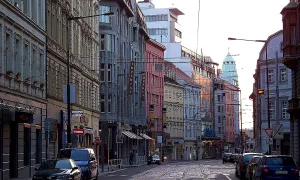
Then and now
Drag the slider to compare how the landmark may have looked when it was built with the view today.
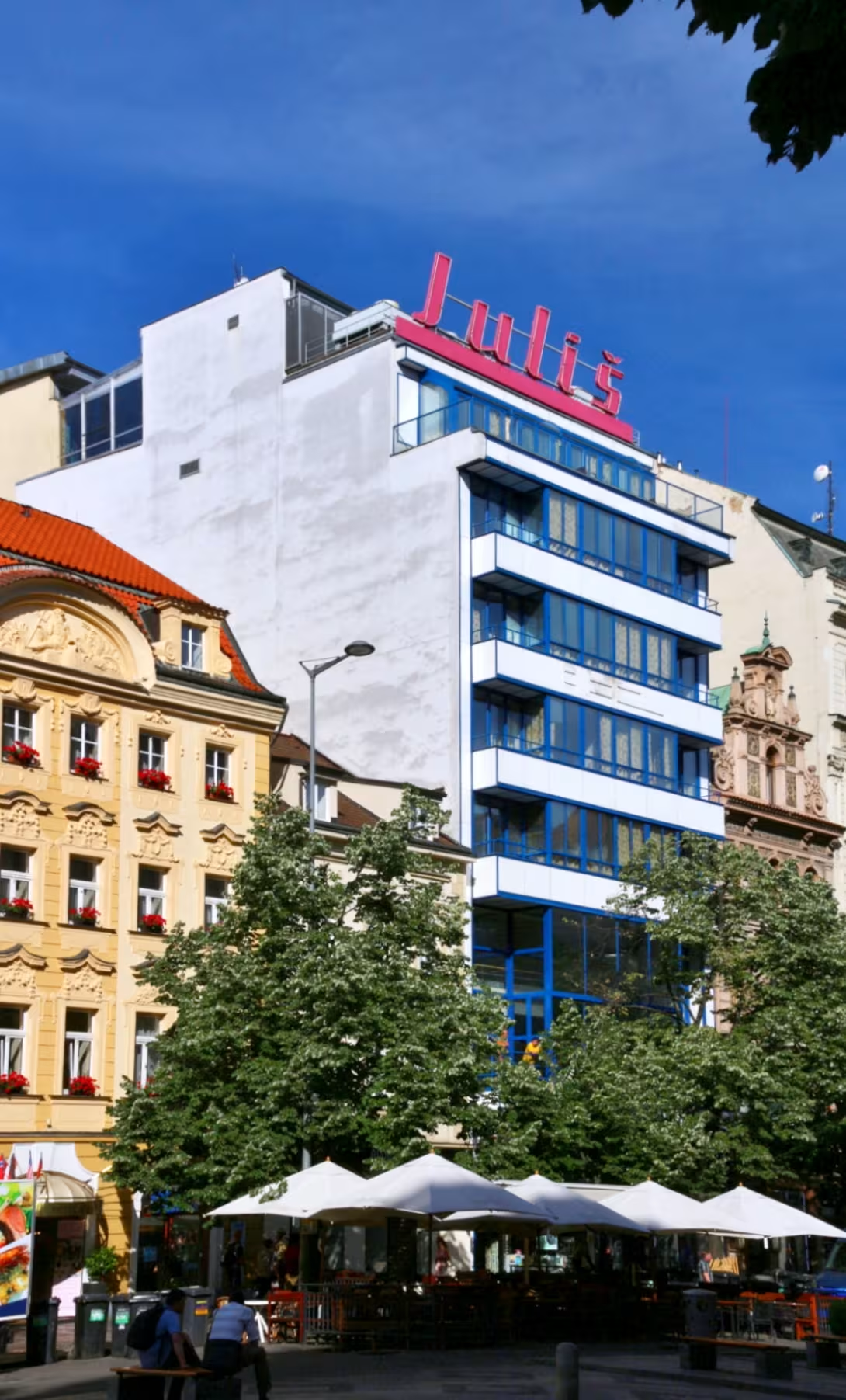

The historical appearance on the left is an AI-generated visualisation and serves as inspiration only.
Historical milestones
- 1922
- Opening of the yard extension to the Franciscan Garden
- 1931
- Start construction of the hotel's main functionalist building
- 1948
- Nationalization of the hotel and change of name to Hotel Tatran
- 1958
- The hotel was declared a cultural monument
Architectural development
In 1922-1925, the court wing was created in late cubism. The main building from 1931- 1932 uses a steel skeleton with steel and glass components in the style of functionalism. The facade and interior were designed by painter František Soda with distinctive red-yellow colour.
Historical events
1948: Nationalization and renaming to the Tatran Hotel. 1958: Registration of cultural monuments. 1998- 2003: Extensive reconstruction of the building.
Owners
Karel and Katusha Juliš (since 1917), State (nationalized after 1948), family of Juliš (restitution 1991), Eltima Property Company (current)
Points of interest
- The main building from 1931- 1932 stands on a steel skeleton and excels with avant-garde design. - The house of Jakub Krejčí has been at the hotel since 1378 at least. - The facade in red-yellow colours and interior was designed by painter and designer František Kysela. - There was a Paris cinema in the basement, which since 1930 has been sound and has captured 400 spectators. - Since 2020 there is the largest theme park with virtual reality in the Czech Republic.
Guide
Show guide text
This text was created by artificial intelligence and has not been editorially reviewed. It may contain inaccuracies.
Welcome to the heart of Prague, one of the most important places in the city, Wenceslas Square. You're standing right where history meets modernity, where the sounds of the past mingle with the constant movement of the present world. Before your eyes is a building that carries the incredible strength and courage of its time. It's Hotel Juliš. But before we go into a deep investigation into what you see, let you enjoy the atmosphere of this place for a while. Feel the movement around you, feel the energy of this square, and then look again at this building, which was so self-confident in it.
This building is not just an ordinary house for accommodation. It's a symbol of transformation, a symbol of transition from old world to new age. Now, if you look at the main part of it, you'll see eight floors that go up to the sky. This building was built between 1931 and 1932 and its creation was closely linked to the ambitions of a man named Karel Juliš. He was an important pastry chef, a man who knew how to create something sweet and beautiful, and he wanted to create something in this place that would celebrate modern life.
Now let's think about what happened here earlier. Before these modern walls were raised here, this place belonged to a completely different time. Since 1378, when Prague was still a medieval town, the house of Jakub Krejčí stood here. Imagine the huge difference. Instead of stone and wooden houses from the time of kings and knights, there is now a steel miracle. This change is fascinating. It's like an old book opened up and someone wrote a completely new revolutionary story on her website.
Now pay attention to the architecture itself, because that is where the greatest mystery and strength of this place lies. Look at the structure. You may not see it at first sight, but this whole building is built on something absolutely extraordinary. It's built on a steel skeleton. That was a completely revolutionary way of building at the time. Instead of relying only on the thickness of its walls to stick together, the building uses an internal skeleton made of steel, which gives it strength and allows for looser shapes. It makes the building so light and so adamant. It is a pure example of functionalism, a direction that says that the shape of things must follow its usefulness and purpose.
The architect of this entire work was Pavel Janák, one of the greatest creators of his time. His vision was clear - creating something avant-garde, something that would look like the future. And if you look at the facade now, notice the colors. It's not the colors you'd see anywhere at the time. The red-yellow shades that dominate here are not random. These colors and the whole appearance of the interior space were designed by painter and artist František Kysela. He was the one who breathed life into the building through color and detail. Thanks to him, the building is not just a cold living machine, but an art piece that communicates with the world through its colors.
If you look a little bit next to the main building, you can see another part of the whole. It's a courtyard wing that was built a little earlier. Notice his different character. While the main building is purely functionalist, this wing bears the features of cubism. It's a fascinating combination of two different styles in one place, as if the building was telling the story of how art gradually changed and evolved.
But there have been other chapters in the history of this place, less glorious or just different. In 1948, the hotel's fate changed. He was nationalized and his name changed to the Tatran Hotel. Although the name has changed, its substance and its importance as a cultural treasure have been preserved. And even in 1958, this building was officially declared a cultural monument, which confirms how important it is to our heritage.
But now I want to tell you one thing that may surprise you. If you look under your feet, into the basement, into the lowest parts of the building, you have to imagine a completely different world. At the time when guests were staying in the upper floors and enjoying modern comfort, something completely different was happening down below. The Paris cinema worked there. Since 1930, people have been meeting here to watch the latest films. Imagine the atmosphere - the dark halls, the projector light and the people who for a moment broke away from the reality of the outside world and immersed themselves in stories on a silver screen. This space beneath your feet was the heart of entertainment and culture for many people.
Now, if you look at this whole building, try to realize how much this place is an ally of different people. Architects like Janák, artists like Acid, owners like Karel Juliš and thousands of people who just walked around, slept or watched movies. All these tracks are still present here.
Now that you know the secret of the steel skeleton, about the colors proposed by Acid and the underground cinema, I suggest you look again at the building, but this time with a new look. Feel the harmony between steel and paint, between the old 14th century house and this modern icon.
Thank you for joining us on this short journey through time. We hope that this view of Hotel Juliš helped you better understand its beauty and meaning. Now continue with your exploration of Prague, explore further corners of this beautiful city and do not be surprised by what other history has prepared. We wish you a beautiful rest of the day and enjoy every moment you spend in this town. Goodbye.
Tips for visitors
The best time to visit the hotel is in the spring or autumn season when the weather is pleasant and fewer people gather in Wenceslas Square. This time of year also offers a beautiful atmosphere for walking around the sights.
It is advisable to use public transport, such as buses or metro, to reach the Hotel Jules.
When planning a tour, remember the light suit, especially in winter. If you are interested in photographing the building, we recommend bringing a high-quality camera and possibly a monopod for stabilization.
The best places for the photo of the Hotel Juliš are especially in the afternoon when the sun lights the facade from the side. Photography from Franciscan or Wenceslas Square offers interesting perspectives.
You can visit the Franciscan Garden in the vicinity of the Hotel Jules, where you can walk and relax. It is also an interesting house for families with children, which offers historical and cultural information.
Frequently asked questions
Can the monument be visited?
The building is in use (offices, a school, shops and the like). The interior is generally accessible only during operating hours and tours are not usually offered; we have not verified the details. You can see the exterior from the street.
Where is the monument?
Location: Nové Město, Hlavní město Praha. The map on this page shows the exact spot.
Why is the monument protected?
It is listed in the Central List of Cultural Monuments of the Czech Republic as a cultural monument (register no. 1000152009).
Businesses nearby
Do you run a restaurant, accommodation, shop, museum, rental, wellness or other visitor service near this monument? Show yourself directly to the people heading to it — this is how they will see you in the app and on the web:
Events nearby

Zdroj akcí: otevřená data měst a obcí ČR (Národní katalog otevřených dat) a kalendář akcí Národního památkového ústavu.
Nearby
Václavské náměstí, Františkánská zahrada, Peterkův dům
Accommodation nearby
Trips and activities nearby
Guided tours, tickets and activities nearby from GetYourGuide
Affiliate link: if you buy from the partner, we may receive a commission. The price for you does not change.
Search tours and activities →Themed route
1. Wenceslas Square - historical square - central heart of the village, where the architecture of the 19th century meets cafes and street artists. Distance to the next point about 300 m.
2. Franciscan Garden - a city garden - a quiet oasis with flowery bushes and old statues, ideal for a short walk and rest. Distance to the next point about 200 m.
3. Peter's house - family house - preserved example of local folk architecture, the indoor window shows traditional crafts and decorations. Distance to the next point about 150 m.
4. Hotel Juliš - accommodation - a comfortable hotel overlooking the historic centre, offers a restaurant with regional cuisine and possibility of sleeping all day. Distance from the previous point about 100 m.
Seasonal recommendations
In the spring, it smells of the awakening of nature in New Town and the air smells of the first flowers. The light is soft and pleasant, which gives the building of the Hotel Juliš a fresh look. We recommend visiting the place in the morning when it is calmer. Choose the clothes layered because spring weather is very variable.
The summer season brings intense sun and a noisy, joyous atmosphere in the streets. The building in bright light looks very representative and the surroundings are green. Due to the large number of visitors in the main season, come as early as possible in the morning. Don't forget light, breathable clothes and sun protection.
In autumn, the city is covered in golden colors and morning fog creates a mysterious mood. The atmosphere is calmer and more relaxed. The ideal time to visit is this afternoon when the sun gently hits the facade. Due to frequent collisions, we recommend waterproof shoes and a lighter jacket.
In winter, the monument is cosy, especially if snow covers it and warm lights are lit in the windows. In Advent time, there is a sense of holiday expectations around here. The best time is the late afternoon, when the evening lighting of the building stands out.
Visualizations and artistic views


The visualisations are generated by artificial intelligence and serve as inspiration.
Photos from the area
Real photos taken near the monument

Zdroj a licence jsou uvedeny u každého snímku.
Tips from visitors
No tips yet. Be the first!
Log in and add your tip.
Sources and literature
Photos: VitVit / CC BY-SA 4.0 — Wikimedia Commons. The author and licence also appear when you hover over the image.
Faktickým podkladem tohoto textu byl článek na Wikipedii, jehož autory jsou přispěvatelé Wikipedie. Článek je dostupný pod licencí CC BY-SA 4.0.
Location on the map
More monuments – Nové Město
Show all in the municipality


Příběhy a pověsti
Legendy, pověsti a příběhy spjaté s touto památkou
Fotografie návštěvníků
Zatím žádné fotografie. Buďte první, kdo přidá fotografii z návštěvy!
Log in a přidejte svou fotografii nebo hodnoťte.
Za ověřenou návštěvu v aplikaci získáte víc bodů — poznáme podle GPS, že jste na místě.
Reviews and comments