



Hrobka Haugviců Building
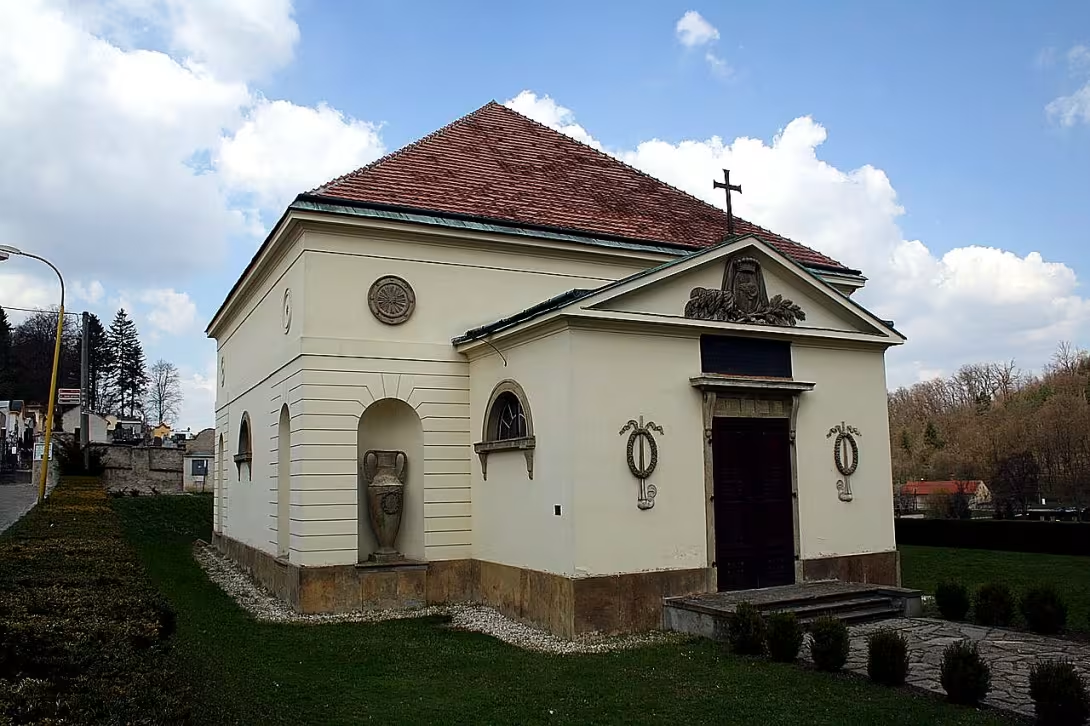
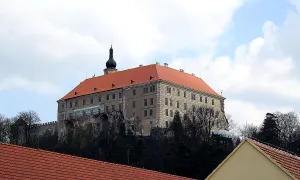
Hrobka Haugviců in Náměště nad Záslavou is an empir family tomb of the count family, which was established in 1822-1825. The building is an important example of classical architecture in the region and is registered as a cultural monument.
The history of the Haugvice family funerals, which lived on the town estate in 1752- 1945, has undergone several changes. Bedřich Vilém z Haugvic, who acquired the estate in 1752, had members of the family initially buried in the tomb under the dean's church of St. John the Baptist. Later, in 1761- 1763, he built a Capuchin monastery with his own tomb. The remains were transferred to it after 1768. In 1784, however, the monastery was abolished by Emperor Josef II, which led to the transfer of the remains to the church of St. Peter and Paul in Jinošov. The original monastery building became a fabric factory in 1795.
The present building was built in response to the transfer of the town cemetery to Vítěslav Nezval in 1805. Jindřich Vilém Haugvic had a new family tomb built in its vicinity, to which the remains of Jinošov were subsequently transferred.
The tomb was performed in 1822-1825 according to the design of the significant Viennese architect Josef Kornhäusel. It is a square object with dimensions 15.17 m x 15.17 m with a right-angle hallway. Empire style is strongly inspired by Greek and Roman antiques. The facade is broken down by rustic, shingles, nobodies and lunette windows. It's decorated with sober, septurnal motives.
The interior contains marble sculptures from the workshop of Viennese sculptor Josef Klieber. In the opposite window windows, there are two figures of pietes, which represent the allegory of Grief and Parting. The Ancient influence is evident on the classical shape of hands and arms, mascara of clothing and olive wreaths.
In modern history, the tomb underwent a roof repair in 1994, supported by Karl Antonín hrabě Haugwitz. In June 1995 he held a feast for members of the genus Austria, Germany and Canada. Shortly before, on June 4, 1995, the Count suddenly died of a heart attack. He was buried in the same year in a family tomb alongside his ancestors. In 2024, the reconstruction of the outdoor stone mobile is planned.
The tomb is now part of the cultural promenade of the city. Access to its premises is possible by telephone with the local information centre. Reservation must be made in advance for several days.
The monument represents a valuable document of noble history and a high level of Classicist architecture. Her visit offers insight into the aesthetics of the Empire and the fates of the genus, which fundamentally influenced the cultural development of Náměště nad Oslavou.
Then and now
Drag the slider to compare how the landmark may have looked when it was built with the view today.
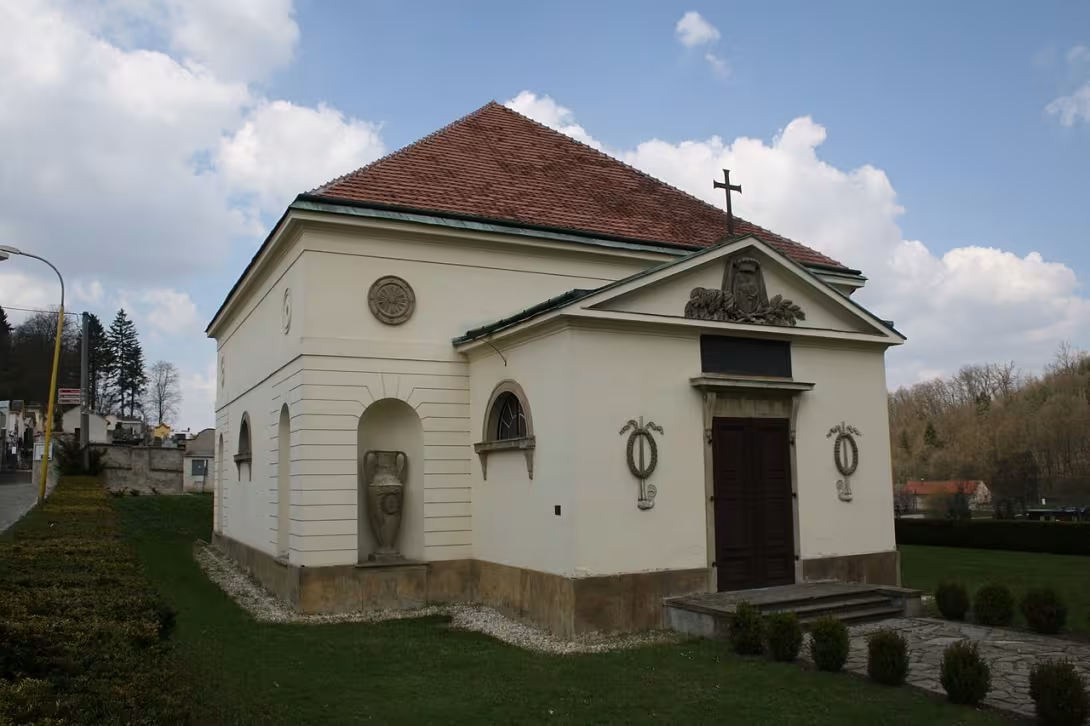
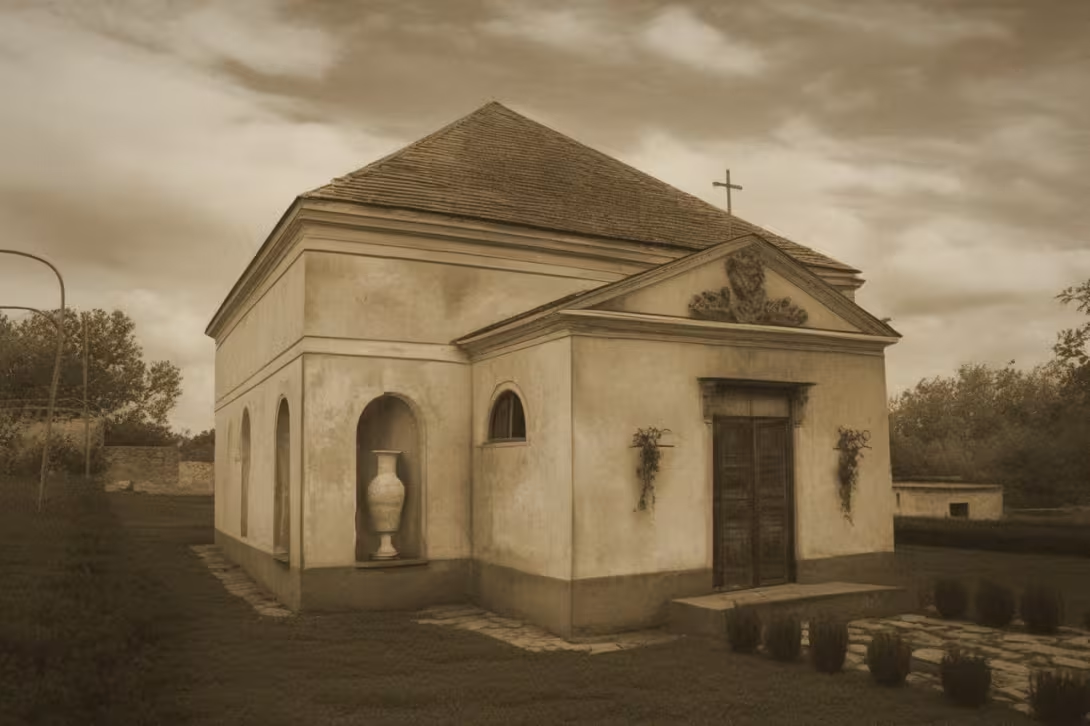
The historical appearance on the left is an AI-generated visualisation and serves as inspiration only.
Historical milestones
- 1825
- Completion of the construction of the current family tomb.
- 1994
- Repairing the building roof.
- 1995
- The burial of Karl Antonín, Count Haugwitz, into the family tomb.
Architectural development
The construction is carried out in empirical style with a facade divided by armour, rustic and lunette windows. The interior contains marble statues of Josef Klieber's work. In 2024, the reconstruction of the outdoor stone mobile is planned.
Historical events
1761-1763 construction of the first family tomb near the Capuchin monastery; 1822-1825 construction of the current tomb; 1994 roof repair with the financial support of Karl Antonín Count Haugwitz.
Owners
House Haugvice (on the manor in Náměště 1752-1945)
Points of interest
- The family tomb was created in 1822-1825 according to the design of Viennese architect Josef Kornhäusel. - The building is a square object inspired by Greek and Roman antiques with facade decorated with sober grave motifs. - The interior includes marble sculptures from the workshop Josef Klieber and two statue of pietes representing Sour and Parting. - Before the present tomb was built, members of the family were buried in the tomb under the church, in the cappuccino pit or in Jinosov. - In 1995 Karl Antonín hrabě Haugwitz was buried in the tomb, which previously financially supported the roof repair.
Guide
Show guide text
This text was created by artificial intelligence and has not been editorially reviewed. It may contain inaccuracies.
Welcome to the Town of Celebration. Right now, you're facing one of the very quiet and dignified places in this city. In front of you is the family tomb of the Haugvice. If you look at her for the first time, you might be interested in her calm strength and sobriety. It is a place that was created for eternal rest, and it is this sense of peace that radiates from it. Stop for a moment, take a breath and let the atmosphere of this historic space surround you, which today is an important part of the city's cultural promenade.
Now let's look at how this building came into being and why it actually stands here. The tomb was built in the first decade of the nineteenth century, namely between eight hundred twenty-two and eight hundred twenty-five. At that time, it was a tribute to the ancestors and a symbol of the status of the mighty Earl of Haugvice. They wanted to have a place where their family ties would survive death. The project was taken up by the Vienna builder Josef Kornhäusel, who put his experience and taste into the work. The result is an object that was ahead of its time and still seems very elegant.
Now pay attention to the architecture itself. Look carefully at the overall design of the construction. Note that the tomb has a square plan, which gives it a sense of stability and balance. In front of the main part is a rectangular hall, which serves as a transition from the outside world to a space of silence. The whole style of the construction is inspired by Greek and Roman antiques, which was at that time a very popular direction which highlighted the purity of lines and harmony. If you look at the facade, notice the sober decorative elements. These are the so-called grave motives that inconspicuously resemble the passing of life and the inevitable of the end, but at the same time make the building a real work of art.
When we think about the people associated with this place, we remember names like Bedřich Vilém z Haugvic or Jindřich Vilém Haugvic. It was these men of the earths who made up the history of this family and their fates are stored in these walls. It's interesting to see how time has stopped in this tomb, but at the same time how construction works with it. Even after many decades, the site remains relevant. An example is the year one thousand nine hundred ninety-five when Karl Antonín hrabě Haugwitz was buried in the family tomb. This shows us that this tomb is not just a museum piece from the past, but it still serves as a final resting place for family members.
Now I'm going to allow you to capture something that you can't see from the outside at first sight, but that creates the soul of this place. Although the exterior makes the building very sober, its inner space hides real treasures. In the interior there are marble sculptures that came from the workshop Josef Klieber. Imagine the subtle details of marble that create contrast in the silence of the tomb to the cold stone. In addition, there are two figures of pietech, which represent sadness and deep pain, which is a very powerful symbolic element in the secular architecture. It's fascinating how in one building, strict ancient geometry from the outside connects to a deep emotional expression inside.
For the tomb to look as you see it today, it must have gone through time and care. In the year one thousand nine hundred ninety-four the roof was repaired, which was essential for maintaining the entire building before the weather. Thanks to such interventions, the tomb is now recognised as a cultural monument, which means that the state and the city recognise its irreplaceable value for our history and culture.
Now, if you look at this building again, think of it as a bridge between centuries. From Viennese architect Kornhäusel to Count Haugvice to today's visitors who come here to seek peace and inspiration. It's a place where art, faith and family tradition meet.
Let's close this stop slowly. I hope you've found a moment to think and that architecture and stories connected with the Haugvice tomb have attracted you. This place is just one of the many jewels Náměšť nad Oslavou has to offer. I invite you now to explore the city's cultural promenade, where you will have other interesting sights and stories. We wish you a pleasant continued walk and a beautiful day spent in our city. Goodbye.
Tips for visitors
The best time to visit is late spring or autumn, when the surrounding greenery and the colour of leaves beautifully complement the appearance of the building. Transportation to Náměště nad Záslavou is possible by car and public connections; Check the current options in the search engine.
To visit we recommend you take comfortable shoes suitable for walking along the cemetery paths and in colder months warm clothes because the space around the tomb can be windy.
For the best photos we recommend to come in the morning or late afternoon lights that highlight details of the Empire style and Greek-Roman elements of the facade. The most interesting views offer the surroundings of the building itself.
During the visit, it is worth checking out the area where the castle Náměšť nad Oslavou, the church of St. John the Baptist and the cemetery on the street Vítíslav Nezvala is located.
Families with children can use the path to the tomb as a guide to the history of noble families and architecture, and we recommend children to observe the details of the facade.
Frequently asked questions
Can the monument be visited?
The building is in use (offices, a school, shops and the like). The interior is generally accessible only during operating hours and tours are not usually offered; we have not verified the details. You can see the exterior from the street.
Where is the monument?
Location: Náměšť nad Oslavou. The map on this page shows the exact spot.
Why is the monument protected?
It is listed in the Central List of Cultural Monuments of the Czech Republic as a cultural monument (register no. 1000148187).
Businesses nearby
Do you run a restaurant, accommodation, shop, museum, rental, wellness or other visitor service near this monument? Show yourself directly to the people heading to it — this is how they will see you in the app and on the web:
Events nearby
Zdroj akcí: otevřená data měst a obcí ČR (Národní katalog otevřených dat) a kalendář akcí Národního památkového ústavu.
Nearby
Zámek Náměšť nad Oslavou, kostel svatého Jana Křtitele, hřbitov na ulici Vítězslava Nezvala.
Accommodation nearby
Themed route
Here is the design of the thematic route:
1. Castle Náměšť nad Oslavou (building) - The walk begins at this magnificent mansion, which represents the dominance of the whole town. 2. Church of St. John the Baptist (Temple) - Next is a visit to this spiritual sanctuary with a rich history. 3. The cemetery on the street of Evřislav Nezvala (stebnice) - Moving to a local burial ground where there's peace and respect for the deceased. 4. Hrobka Haugviců (memorial) - The highlight of the journey is this family tomb that fascinates its architecture and significance.
Seasonal recommendations
In the spring, the surroundings of the tomb awaken to life and the young green is accompanied by fresh air. For a walk is ideal morning when the sun gently illuminates the details of the construction. We recommend shoes suitable for wet grass and light jacket.
In the summer months the landscape is dominated by green and bright, sharp light, which highlights the shapes of the monument. It is best to visit the place in the early morning or late evening to avoid heat. Don't forget the cap and plenty of water.
Autumn brings a golden colour of leaves to the tomb and a foggy, mysterious atmosphere. The outside tour is the best in the afternoon with soft light. It is suitable for layered clothing and fixed footwear until the sun is up.
Zimą is a place of quiet and raw, which underlines the nature of the tomb space. The most striking is the view on a freezing, bright day when the freezing air cleans the horizon. Hot gloves, hats and non-slippery sole are essential.
Visualizations and artistic views


The visualisations are generated by artificial intelligence and serve as inspiration.
Photos from the area
Real photos taken near the monument


Zdroj a licence jsou uvedeny u každého snímku.
Tips from visitors
No tips yet. Be the first!
Log in and add your tip.
Sources and literature
Photos: Jiří Sedláček - Frettie / CC BY-SA 3.0 — Wikimedia Commons. The author and licence also appear when you hover over the image.
Faktickým podkladem tohoto textu byl článek na Wikipedii, jehož autory jsou přispěvatelé Wikipedie. Článek je dostupný pod licencí CC BY-SA 4.0.
Location on the map

Příběhy a pověsti
Legendy, pověsti a příběhy spjaté s touto památkou
Fotografie návštěvníků
Zatím žádné fotografie. Buďte první, kdo přidá fotografii z návštěvy!
Log in a přidejte svou fotografii nebo hodnoťte.
Za ověřenou návštěvu v aplikaci získáte víc bodů — poznáme podle GPS, že jste na místě.
Reviews and comments