



jezuitská kolej v Jihlavě Building complex
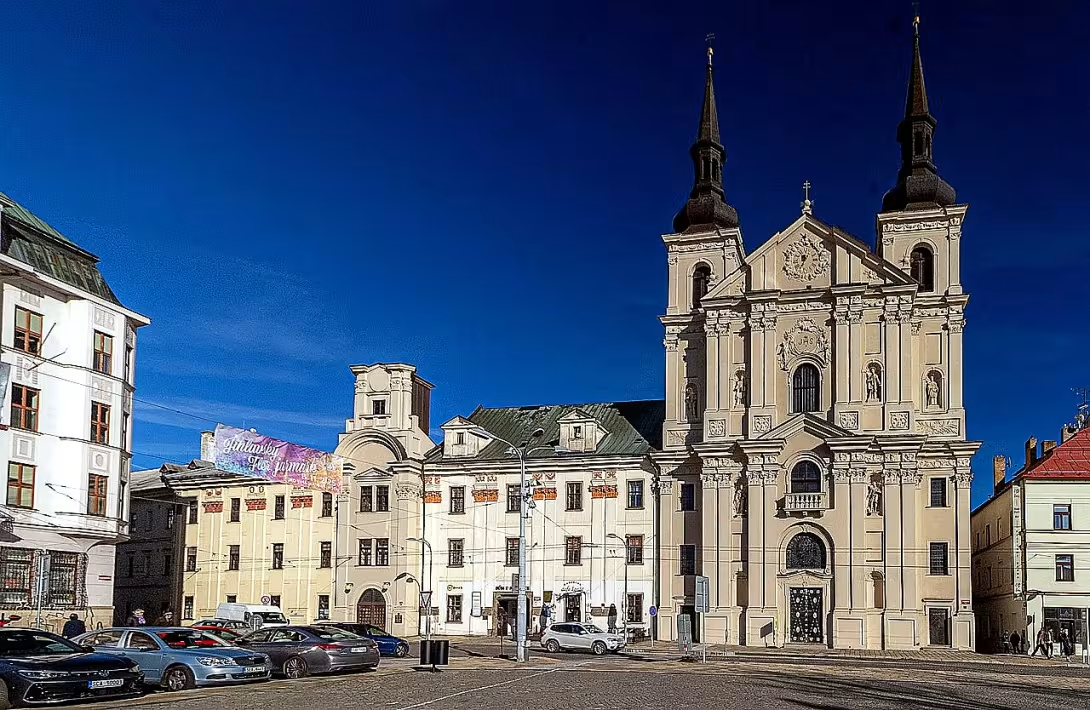
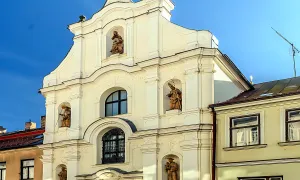
Jesuit College in Jihlava is a Baroque complex of buildings on the northeast side of Masaryk Square, which today serves as a municipal library. This monument-protected complex includes a college building and a gymnasium. It was created at the turn of the 17th and 18th centuries as a key tool of reCatholicization after the Battle of White Mountain and forms an important element of the historic city centre.
The establishment of the Jesuit foundation is closely linked to the political situation after 1620, when the Habsburg administration sought to consolidate the Catholic faith in mostly Lutheran music. The first attempt to operate the Jesuits in 1618 was not successful, but in 1623 a foundation for establishing the track was established. The city council subsequently provided 23 confiscated townhouses in the square. The construction itself, led by the Italian builder Jacob Brascha, began after the plague epidemic in 1625 or 1626. The important supporters of the project were Imperial General Michael Adolf z Althannu with wives or Colonel Rombald XIII of Collalto.
The architectural ensemble is built in a Baroque style. The oldest part is the college building, while the gymnasium, completed in 1727, represents the youngest element of the complex. Over the centuries, the building has undergone a number of modifications that reflected the changing needs of users, from school purposes to administrative and security applications.
The property history of the object is varied. The Jesuit Order worked here from 1624 until its abolition in 1773. From 1781 to 1784 the premises were used briefly by Dominicans from a neighbouring monastery. In later periods, the building served as an archive, a school for women's professions, a boarding school or the headquarters of the Regional Headquarters of the National Security Corps, which left the premises in 1960. Since 1961, the State District Archive has been here almost four decades.
Major events in history include the ceremonial start-up of the track in the presence of the provincial of Řehora Rumer and the presence of Superior Jiří Plaché-Ferus. The interesting thing is that from the premises direct access to the extensive system of the Jihlava catacombs. During World War II, the building was temporarily located in the city library, to which the building returned after extensive reconstruction in 2003.
Today, the monument after reconstruction is again used as an urban library and is open to the public. The visit offers the opportunity to look into the history of the recatholicism effort in the Czech countries and to see the premises that have performed many different social functions over the centuries. The building represents valuable evidence of Baroque architecture and changes to the Jihlava Centre.
Then and now
Drag the slider to compare how the landmark may have looked when it was built with the view today.
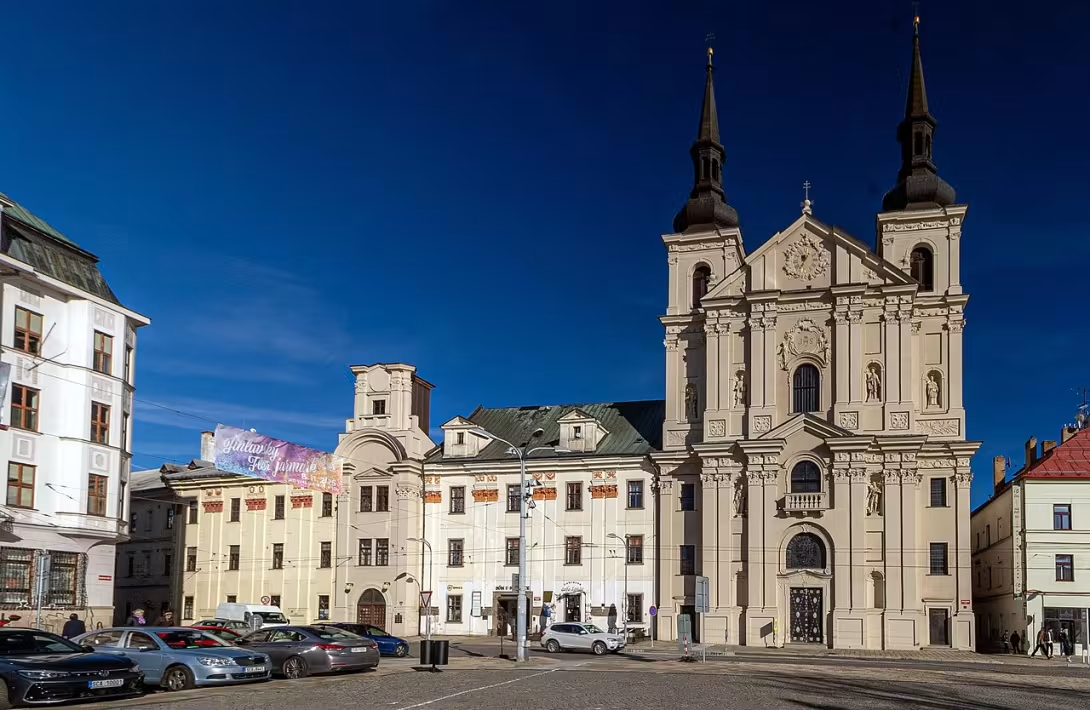

The historical appearance on the left is an AI-generated visualisation and serves as inspiration only.
Historical milestones
- 1624
- The foundation of Jesuit Funding and the acquisition of townspeople's houses for the construction of the track.
- 1625
- Laying the foundations of the track building after the plague epidemic has passed.
- 1727
- The opening ceremony of the Jesuit Gymnasium building.
- 2003
- The ceremonial opening of reconstructed premises for the needs of the city library.
Architectural development
The construction took place since 1625 under the direction of Italian builder Jacob Brasch on site 23 of confiscated townhouses. The youngest part of the Baroque ensemble is the Gymnasium building completed in 1727. Over the centuries, the object has undergone a number of adaptations for the needs of archives, education and security forces.
Historical events
The foundation of the Jesuit Funding in 1624, the start of the construction of the track in 1625, the opening of the Jesuit Gymnasium in 1727, the opening of the city library after reconstruction in 2003.
Owners
Jesuit Order (1624-1773), Dominicans (1781-1784), Government Administration (archive, SNB), City of Jihlava.
Points of interest
The area was built on the site of twenty-three confiscated townhouses provided by the city council. - The construction was led by Italian builder Jacopo Brascha and began after the plague epidemic in the years 16-25 or 16-25-26. - From the premises of the building leads direct access to the extensive system of the underground corridors of Jihlava. - The building in the past served as an archive, a school for women's professions, a boarding school or the headquarters of the Regional Headquarters of the National Security Corps. - During World War II, the building was temporarily located in the city library, to which the building returned after reconstruction in the year two thousand and three.
Guide
Show guide text
This text was created by artificial intelligence and has not been editorially reviewed. It may contain inaccuracies.
Welcome to the historic heart of Jihlava. Right now, listening to these words, you are in a place that is an absolutely indispensable part of the history of this city. You are standing right in front of the monumental total Jesuit tracks, which with its size and presence is very serious, dignified and up to slightly strict. Look around you at Masaryk Square. This building, which is right before your eyes, forms the northeast edge of this vast space, and its shadow touches the history of the many generations that lived here. Feel the strange atmosphere of peace and stability floating here, even if the world of a modern, fast city can move around you. This object is not just an ordinary building, it's a complex that carries deep traces of faith, learning, and the enormous human effort that took place here hundreds of years ago.
Now let's go back deep into the past together to understand why this space looks just like this and why it's so important here. To really understand the importance of this construction, we need to look at the period when the whole of Europe and the spirit of this region have changed. After the decisive battle on White Mountain, there was a time when states were trying to restore and strengthen Catholic faith. These efforts, called reCatholisation, had a very specific and tangible form in Jihlava. In the year sixteen hundred and twenty-four, events began to unfold, which defined this space forever. The Jesuit foundation was founded here, and the townspeople had to retreat to build on a whole new foundation. The city provided twenty-three of its houses to create the foundations for this new, spiritual and educational center.
But it was a very difficult and unpredictable time. Shortly after the foundation, the city had to deal with a very severe plague epidemic. This disease stopped many things, brought sadness and stopped ordinary life, but not stopped efforts to rebuild and build. It was only when the danger of the plague finally went away that it was possible to start cutting down and laying the foundations for the building of the track. This happened in 1625. Imagine the work at that time, the uncertainty, but also the great hope that people were facing for future success. The whole construction process lasted for decades and gradually became one of the most important building units in the region.
Now pay attention to the architecture that is right in front of your eyes. This whole area is not just one separate building, but a complex and thoughtful complex, which consists of a college building, a gymnasium and is directly connected to the nearby church of St. Ignatius. Note how these parts complement each other and form one whole. This whole project was led by an important Italian builder whose name is Jacopo Brascha. It was by his hand that the construction was conducted in a baroque style, which is so typical of its era and which is intended to express nobility, strength and order. Although there is an urban library in these premises today, you can still perceive the baroque dignity that Brascha has designed. It was in seventeen hundred and twenty-seven that another important moment took place when it was the gymnasium that was an integral part of this whole.
The history of this place is also closely linked to the great personalities that have influenced the fate of the whole countries. In the construction and subsequent operation of this place, the people whose names belong to the most important. We can name here Emperor Ferdinand II, whose decision was shaped by the world at the time and by the religious order. Other significant figures such as Jiří Plachý-Ferus, Michael Adolf z Althannu or Řehoř Rumer appear over the years. Each of these personalities has left an invisible but deep mark in the history of this place. These names are not just dry data, but represent human stories and decisions that have shaped life in this complex for many years.
Now, if you look at the whole building and its dimensions, you might think of one interesting thing that gives this place a special mystery. The whole complex is located in a place where 23 townhouses used to stand. These houses were taken by the city council to make room for Jesuit college. But that's not all you'll find in this place. What may be the greatest mystery you can imagine looking at these walls is what lies deep beneath your feet. There is a direct entry from the premises of this building into a large underground corridor system. These corridors form an invisible network that connects different parts of the city and which over the centuries are told different stories. It's as if another, hidden, mysterious heart of the city was beating under this peaceful and noble space.
Today, however, this place is completely different from in the baroque times or when Jesuit learning worked here. It served various purposes after long years, but in the year two thousand and three there was a great and modern change. The premises were thoroughly renovated and ceremonially opened for the needs of the city library. What was once home to students and spiritual people is now home to readers, students and anyone seeking peace, silence and knowledge. It is in this library that history meets with the present every moment.
So now we invite you to enter and explore these premises yourself. Walk the streets that once served the Jesuits and let the silence of the library consume you. Maybe when you look at shelves full of books, you'll see a reflection of the old days and feel a connection with the people who were here before you. Thank you for spending this moment with us and for being interested in the history of this important place. We wish you a pleasant further tours of Jihlava.
Tips for visitors
For a visit, choose the morning hours in the working week, where there is a quieter atmosphere in the rooms and the natural light better highlights the Baroque details of the library interior. You avoid larger groups of tourists.
The historical center of Jihlava is comfortably accessible by public transport, which builds within walking distance of the square.
During the tour of the interior we recommend to carry comfortable shoes and warmer clothes, because it is colder in historic stone buildings. Use the morning sun-penetrating windows to take pictures, which light up the bookshelves beautifully; Keep the tripod in storage.
In the immediate vicinity you can visit the neighboring church of St. Ignatius, explore the Jihlava Catacombs or take a walk along the vast Masaryk Square. There is also a Dominican monastery nearby, which complements the historical nature of this part of the city.
For families with children, the visit is suitable as part of a sightseeing tour of the city. We recommend prior verification of the accessibility of the space for prams, as historical buildings may have limited wheelchair access.
Frequently asked questions
Can the monument be visited?
The building is in use (offices, a school, shops and the like). The interior is generally accessible only during operating hours and tours are not usually offered; we have not verified the details. You can see the exterior from the street.
Where is the monument?
Location: Jihlava, Kraj Vysočina. The map on this page shows the exact spot.
Why is the monument protected?
It is listed in the Central List of Cultural Monuments of the Czech Republic as a cultural monument (register no. 1000127597).
Businesses nearby
Do you run a restaurant, accommodation, shop, museum, rental, wellness or other visitor service near this monument? Show yourself directly to the people heading to it — this is how they will see you in the app and on the web:
Nearby
Kostel svatého Ignáce, Masarykovo náměstí, jihlavské katakomby, dominikánský klášter.
Accommodation nearby
Trips and activities nearby
Guided tours, tickets and activities nearby from GetYourGuide
Affiliate link: if you buy from the partner, we may receive a commission. The price for you does not change.
Search tours and activities →Themed route
1. Masaryk Square (city square) - The central point of the city with historical development. It serves as an ideal starting point for the entire route.
2. Jihlava catacombs (underground corridors) - Mysterious nets space beneath the surface. They offer fascinating insight into ancient times.
3. Dominican monastery (monastery complex) - A place of peace and spiritual silence. It represents an important monument to religious architecture.
4. Jesuit College (educational construction and library) - The main destination of a trip with a unique library. It's the center of history and science.
5. Church of St. Ignatius (Temple) - Magnificent building right by the track. It fascinates itself with its size and inner space.
Seasonal recommendations
Flowers in the surroundings are beginning to bloom, which adds a colorful and lively touch to the atmosphere. It is recommended to wear comfortable shoes for walking on a flowering lawn and light clothes that provide protection from sunlight.
Summer: Summer is the college of Jihlava most visited by tourists. The sun lights up for long hours, allowing you to explore the interior and library in detail. The humid air can sometimes be unpleasant, so it's good to bring a roll-over. The best time to visit is in the morning or in the evening to avoid the noon heat and crowd. Early arrival is crucial in order to give sufficient attention to the dorm without unnecessary waiting.
Autumn: In autumn the track becomes a place with melancholy atmosphere. Leaves falling into the flower garden add a colour element and the sunlight is less intense, creating fine shadows in the building interior. Clothes turn to warmer layers because the cooler air is starting to feel.
Winter: Winter college visit offers a calm atmosphere because many people prefer warmer activities. The sunlight is weak and the interiors become slightly darker, creating a unique mood. Hot clothes and shoes are necessary for comfort during a visit in cold weather, which ensures that you can enjoy the historic interior without inconvenience.
Visualizations and artistic views


The visualisations are generated by artificial intelligence and serve as inspiration.
Photos from the area
Real photos taken near the monument


Zdroj a licence jsou uvedeny u každého snímku.
Tips from visitors
No tips yet. Be the first!
Log in and add your tip.
Sources and literature
Photos: VitVit / CC BY-SA 4.0 — Wikimedia Commons. The author and licence also appear when you hover over the image.
Faktickým podkladem tohoto textu byl článek na Wikipedii, jehož autory jsou přispěvatelé Wikipedie. Článek je dostupný pod licencí CC BY-SA 4.0.
Location on the map


Příběhy a pověsti
Legendy, pověsti a příběhy spjaté s touto památkou

Fotografie návštěvníků
Zatím žádné fotografie. Buďte první, kdo přidá fotografii z návštěvy!
Log in a přidejte svou fotografii nebo hodnoťte.
Za ověřenou návštěvu v aplikaci získáte víc bodů — poznáme podle GPS, že jste na místě.
Reviews and comments