






Jiráskův most Bridge
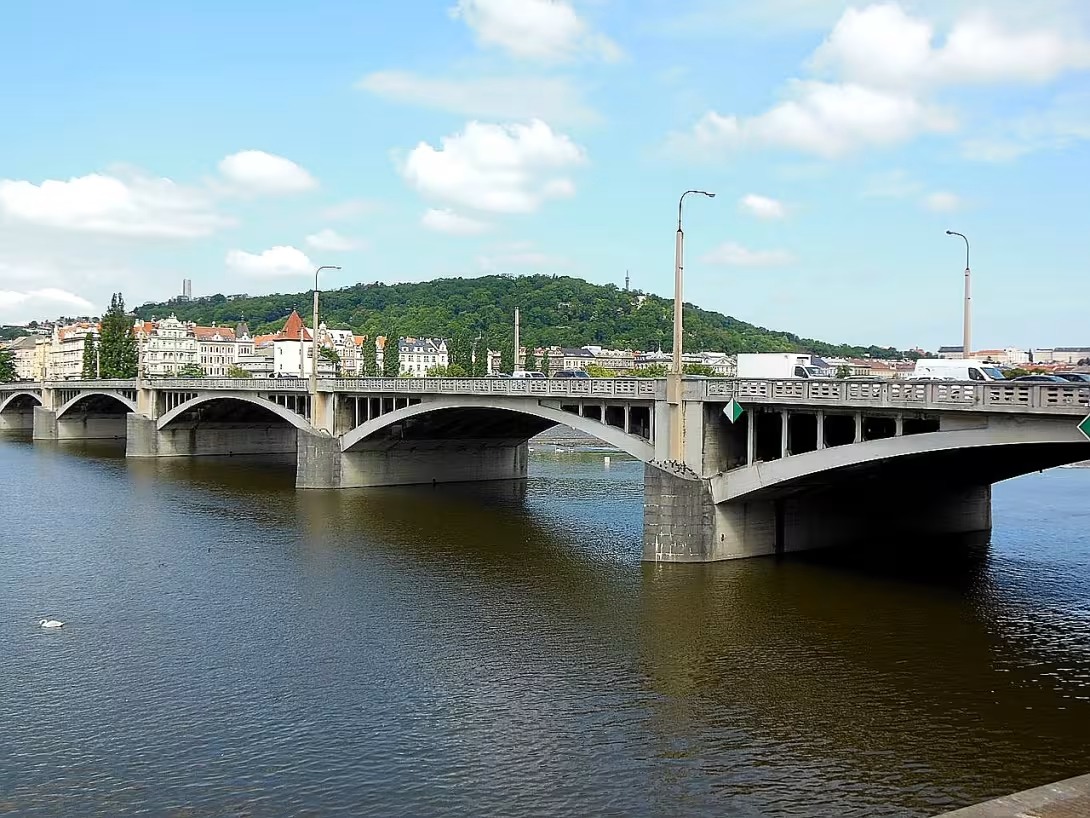
Jiráskův most connects right-hand Nové Město with left-hand Smíchov. The construction started in 1929 according to the design of architect Vlastislav Hofman and engineer František Mencla. The material was chosen by a reinforced concrete - five mantle pillars, each four feet wide, is covered with granite blocks. The bridge is 310.6 metres long and 21 metres wide. It consists of six arches with a range of 45 to 51 meters. The outside surfaces are covered with a plaster made of artificial stone, concrete railing and lighting masts have a terraced surface.
The bridge was put into operation in two stages. First, in 1931, its central section with tram rails was operational, then on 18 October 1933 the rest. The tracks eventually proved unnecessary and were removed. After the bridge, there was a single Prague trolleybus track connecting the two Vltava shores.
The building was defended by the baroque pavilion on the Smíchov side allegedly from Kilián Ignác Dientzenhofer. Originally, it was decided to move 110 metres upstream of the river, but eventually it was demolished because the insurance company was unable to guarantee the risk of a successful transfer. In the historical plans, the bridge was originally intended to appear in a completely different place - between Mysálek Street and Janáček waterfront.
The building hides military secrets. In two pillars, seamless pipes were placed for possible destruction of the bridge of charges. During World War II, German soldiers conked them up for fear that the Czech resistance would blow him up.
The bridge name changed over the years. Between 1940 and 1945 Dientzenhofer's bridge was named in honor of the Baroque architect, since 1945 the name Jiráskův most has returned. In 2012, historian Petr Vilgus initiated a discussion about the renaming of the Václav Havel Bridge, who lived and worked here for many years.
Today, the bridge management is divided between three urban areas: MK Praha 5 manages the western half, MH Praha 1 northeast quarter and MH Praha 2 southeast quarter. In 2019, the railing was replaced. On the Smichov side you can still see the remnants of the waterfront supports - the silent testimony of the original building plans that never took place.
Then and now
Drag the slider to compare how the landmark may have looked when it was built with the view today.
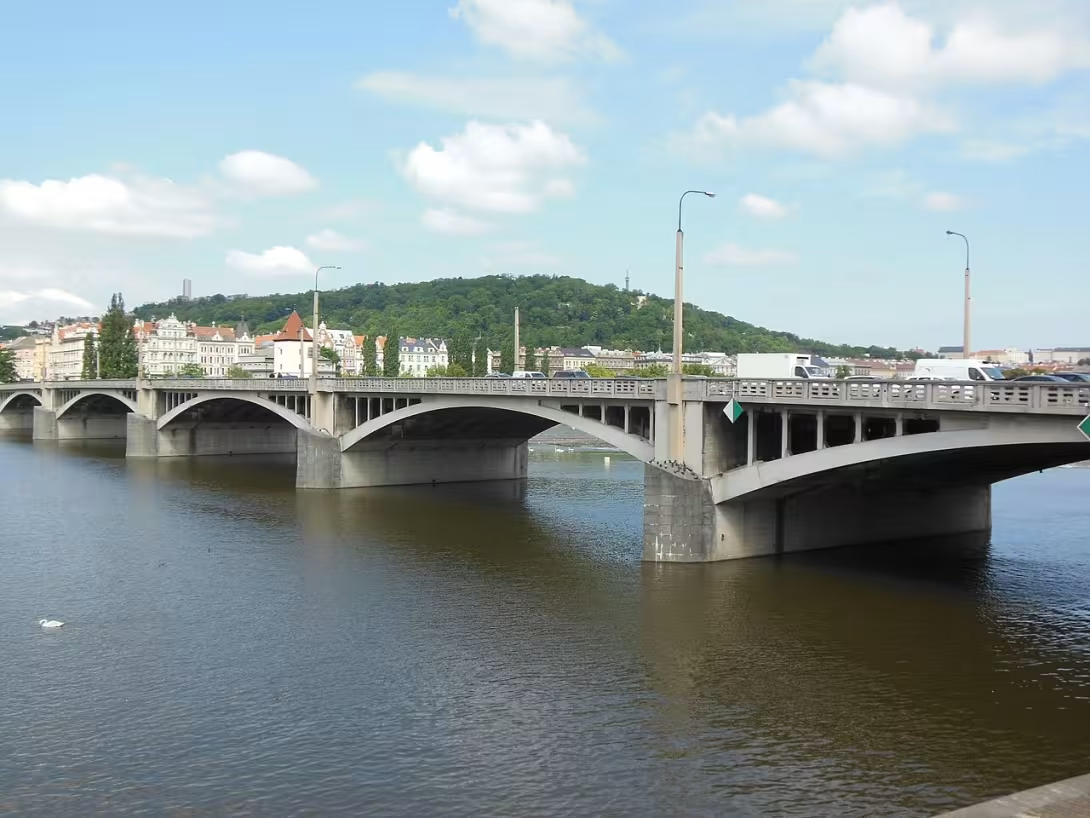

The historical appearance on the left is an AI-generated visualisation and serves as inspiration only.
Historical milestones
- 1929
- Opening of the bridge construction, demolishing the Baroque pavilion on the Smíchov side due to its obstacle status.
- 1931
- Complete the middle part of the bridge with tram tracks which were later removed.
- 1933
- The completion and commissioning of the entire bridge, the bridge was named after the writer Alois Jirásek.
- 1940
- Renaming the bridge to the Dientzenhofer Bridge during the German occupation.
Architectural development
The bridge was built from reinforced concrete with five pillars lined with granite blocks. The outside surfaces are coated with an artificial stone, the railing is concrete with a terraced surface. In 2019, the railings were replaced. The original plans from the time of Austria-Hungary envisaged another location of the bridge which was not implemented.
Historical events
- 1929
- The beginning of the bridge construction according to the project Vlastislav Hofman and František Mencla.
- 1931
- Completion and commissioning of the central bridge with tram tracks.
- 1933
- Completion and commissioning of the entire bridge, removal of tram tracks.
- 1940-1945
- Renaming the bridge to the Dientzenhofer Bridge during the occupation.
Points of interest
- The bridge was built in 1929-1933 and connects Nové Město with the left bank of Smíchov.
- Originally planned in a different place - between Mystery Street and Janáček's waterfront.
- In its pillars were hidden the seamless pipes for possible destruction, which were sealed by the Germans during World War II.
- At the construction site, he defended the baroque pavilion, which was eventually demolished due to the risk of movement.
- The bridge was in operation in two stages - first in 1931 (with tram tracks), then on 18 October 1933.
Guide
This guide is narrated by a synthetic voice generated by artificial intelligence.
Show guide text
This text was created by artificial intelligence and has not been editorially reviewed. It may contain inaccuracies.
Welcome to one of the key points of Prague transport and architecture. Stop for a moment, take a breath and look around you. You are standing in front of the Jirask Bridge, which at this moment serves as a fixed connection between New Town and Smíchov. Feel the massive structure spreading beneath your feet and the Vltava flowing around you. It's a place where there's a daily rush with a silent testimony to history. If you look ahead, you will see a monumental structure that dominates the landscape with its simplicity and stability. It is a bridge which is not only a transport route, but a symbol of a certain era, when Praha was modernising and looking for its new-looking face.
Now let's go back in time together to understand how this building came into being. Imagine the Prague end of the twentieth decade of the last century. It is the year nine hundred twenty-nine and that is when the construction of this bridge begins. It was a time of great ambition and expansion of the first republic, when the city expanded and required a more effective connection between its shores. Two talented architects, Vlastislav Hofman and František Mencl took over the project. Their task was not only to build a crossing across the river, but to create a functional element of Prague's transport infrastructure that could withstand a time test. The construction lasted four years and was completed in the year nine hundred thirty-three. At that time it was a modern technological performance that was intended to help the development of Smíchov and its better connection with the city centre.
Now pay attention to the architecture itself, which is right before your eyes. If you look at the overall form of the bridge, you'll notice it's a reinforced concrete arc bridge. It was this material that was the peak of modern building twa. Note the six regular arc fields that rely with rhythmic precision on the pillars of the river. The entire length of the bridge is over three hundred ten meters, namely three hundred ten and six tenths of a meter, and its width is twenty-one meters. It's a space designed for movement, for the flow of people and vehicles. If you look at the surface of the bridge, you might imagine how the trams used to ring. Yes, the original project also included tram tracks, which were actually in the middle of the bridge in nine hundred thirty years. Later, however, they were removed to change the transport organisation, but the trail of them remains in the history of the bridge. So look at these clean concrete lines and see how this structure unifies both sides of the Vltava.
Speaking of this place, we can't ignore the personalities associated with it. The bridge bears the name Aloise Jiráska, an important Czech writer who helped shape the national identity in his work. It was named in the year one thousand nine hundred thirty-three, the moment it was put into service. The name Jiráska on the bridge symbolized in mutually the connection with modern architecture of pride and cultural awareness of the young Czechoslovak state. However, history is full of twists and this bridge is a clear proof of that. Let's move ten years ahead into the dark period of the German occupation. In the year nine hundred and forty, the bridge was forced to change its name. It became Dientzenhofer Bridge, named after the famous builder Kilian Ignác Dientzenhofer. This change was not just a formal one, it was an attempt by the occupying power to rewrite the local identity and replace it with another meaning. But after the liberation, the bridge returned to its original name, and so today it reminds Alois Jirásek again.
Now, I want to take you to some interesting things that are not visible at first sight, but that give this place a special mystery. Did you know that Jiráskův most in this form and in this place was not the only option from the beginning? It was originally planned to stand in a completely different place, specifically between Mystery Street and Janáček's waterfront. But fate and urban needs decided differently, and the bridge ended here, where you admire it today. The next story is tied to the smiling side. In order for the bridge to arise in the year nine hundred twenty-nine, there had to be a sacrifice. A beautiful Baroque pavilion must have been demolished because its location was in the way of the planned bridge route. It is a reminder that progress often requires the deletion of traces of the past.
But the most fascinating is the secret hidden deep in the bridge pillars. Imagine that at the time of construction, seamless pipes were built into the structure of the pillars. Why? They were ready for possible bridge destruction. In the event of an enemy attack or the need to quickly destroy the bridge to prevent the enemy from advancing, these pipes were intended to be used to locate the charges. It was cruel to prevent a time of uncertainty. However, during World War II, the Germans reached these pipes. In order to prevent the bridge from being destroyed by Czech resistance, the pipes were simply concreted. In this way, these dangerous elements have become part of the body of the bridge itself, where they remain hidden today, invisible to anyone crossing the bridge.
If you look again now, you will see Jiráskův most with different eyes. It's not just a piece of concrete and steel, but a layered story about the ambitions of the first republic, the pain of occupation and the silent secrets buried in the pillars. It is a bridge that connects not only two parts of Prague, but also two periods.
Now you have nothing left but to explore this fascinating space with your own motion. I suggest you slowly cross the bridge towards Smíchov, follow the stream of river beneath you and perceive the rhythm of the city that surrounds you. Note how the perspective on Prague Castle and the surrounding waterfront changes, how you move along these six arches. I hope this short trip to history has helped you feel the spirit of this place more. I wish you a pleasant continued walk around our beautiful city. Goodbye.
Tips for visitors
{'paragraph': 'The best time to visit the Jirásek Bridge is during the morning hours when the bridge is minimal and you can easily see its architectural details. The ideal is also the late afternoon when the sun shines from the side and creates interesting shadows on the arches of the bridge. During the summer months avoid the noon hours when the bridge is often busy.'}
{'paragraph': 'Parking near the bridge is possible but it is recommended to use public transport. The location is well accessible by trams and buses that stop nearby. If you arrive by car, look for parking near Jiráskov Square or Smíchov waterfront. Always check current parking options in the map search engine.'}
{'paragraph': 'When visiting a bridge, wear comfortable shoes because the path along the bridge is quite long and part of the sidewalk is reinforced. It is also convenient to take a map or navigation so that you can easily navigate around. In the summer months bring plenty of water and sun protection because there are not many shadows on the bridge.'}
{'paragraph': 'Photography on the Jirásek Bridge is a great way to capture its beauty. The best places for pictures are the arches of the bridge and the views of the Vltava from both sides. It is recommended to photograph in the morning or afternoon light, when shadows are softer and colours are more vivid. Interesting footage can also be obtained from Jirásek Square, from where the bridge is well seen.'}
{'paragraph': 'Several interesting places are worth visiting around the bridge. Opposite the bridge lies Jirásek Square, which is an ideal place to relax and observe the surroundings. On the left bank of the Vltava is the Smíchov waterfront, where you can walk by foot and enjoy the view of the bridge. The žofin cemetery, located about a mile south-east, is a quiet place with a rich history and interesting graves of important personalities.'}
{'paragraph': 'For families with children, visiting the Jirásek Bridge is a great opportunity for active spending time. Children can see the bridge and its construction, which is also interesting for younger visitors. In the vicinity of the bridge it is possible to play in Jiráskov Square or to see Zofín cemetery, where there is also a children's playground and a quiet area for rest. It is also recommended to visit nearby parks where children can run and play.'}
Frequently asked questions
Is Jiráskův most open to the public?
Yes, Jiráskův most is open to the public. The entrance is free.
How do I get to the place by car / public transport?
By car you can reach the bridge via Nové Město or Smíchov. The public transport line No. 4 or 6 can be reached at Jiráskovo Square stop.
How much is the entrance fee and is it paid on the spot?
No admission fee, the bridge is open to the public.
Is the tour suitable for children and seniors?
Yes, Jiráskův most is suitable for visiting families with children and seniors. There are several viable parts of the bridge that are suitable for families with children.
How long does the tour take?
A bridge tour usually takes 15-30 minutes.
What are the opening times and booking is required?
The bridge is open all year round, the opening hours are not fixed. Reservation is not necessary.
What's interesting in the immediate vicinity?
In the immediate surroundings you will find Nové Město with its historical development, including Jirásek Square, where the statue of Czech writer Alois Jirásek is located. The neighborhood of Smíchov with its shops and restaurants is also nearby.
For kids
Imagine going back 93 years and finding yourself in a place where Jiráskův most stands in Prague today. Local people have called this location "Candlestick cliffs" and lived here since the Middle Ages. They were fishermen who caught fish in Vltava and sold them on the market.
It's like time stopped when the first bridge showed up. It was a 1350 wooden bridge connecting two quarters of the city. But the bridge gradually disassembled and people had to look for a new way to enter the city across the river.
Businesses nearby
Events nearby

Zdroj akcí: otevřená data měst a obcí ČR (Národní katalog otevřených dat) a kalendář akcí Národního památkového ústavu.
Nearby
{'memories': [{\ 'Nazen': 'Jirásek Square', 'type': 'square', 'distance': 'exactly opposite the bridge'}, ('nazen': 'Smíchov embankment', 'type': 'waterfront', 'distance': 'on the left bank of the Vltava'}, 'nazen': 'island', 'detachment': 'exactly opposite the bridge on the right bank'}, 'furthest': 'furthest': [{'nazeva': 'type', 'island', 'type' type ':' island ',' distant ':' exactly opposite the bridge on the right bank '}],' prikrady ': [{' nazov ':'
Accommodation nearby
Trips and activities nearby
Guided tours, tickets and activities nearby from GetYourGuide
Affiliate link: if you buy from the partner, we may receive a commission. The price for you does not change.
Search tours and activities →Themed route
Thematic cruise route to New Town and the surrounding area with visit to Jirásek Bridge
1.Jiráskův most The bridge named after writer A. Jirásek is a unique combination of modern architecture and historical context. Its glass construction and lighting create a picturesque evening atmosphere in Vltava. It is worth visiting for his aesthetics as well as as as an entrance gate to Jirásek Square.
2. Jirásek Square Right across from the bridge there is a square with historic houses and living urban life. There is also a memorial in memory of A. Jirásek and the possibility of sitting in cafes overlooking Vltava. It is an ideal place for a short rest before the next part of the trip.
3. Smíchov waterfront On the left bank of Vltava stretches a picturesque waterfront with a promenade and bathing possibilities in the summer months. It's a great place to walk along the river, where modern architecture and nature mingle. Here you can also see the shipping and view of Jiráskův most from a different angle.
4. Žofin Cemetery About a kilometer to the southeast of the centre is located a quiet Zofín cemetery, which is one of the oldest and most important in Prague. Many prominent figures are buried here, such as Karel Čapek, a writer. For lovers of history and architecture, the cemetery offers a rich collection of tombstones and monuments.
5. Children's Island Just opposite the Jirásek Bridge on the right bank is located the Children's Island, an ideal place for a family cruise. There are children's playground, cycling trails and picnic areas. It's a great place to relax and spend an active time in nature.
Seasonal recommendations
Spring In the spring months, Jiráskův most will turn into a picturesque place where historical architecture with flowering nature intersects. The light of the sun, which is reflected from stone arches and water levels, creates fine shadows and gives the memory a romantic touch. Around the bridge, trees and bushes begin to bloom, while the first visitors who enjoy walking around New Town appear on the shore. The atmosphere is quiet but lively - ideal for shooting or short sitting on benches. It is recommended to visit in March or April when there are fewer people than in the summer months. The clothes are suitable layered because the weather can be variable - from sunny days to cold rainy wounds. The best time is early morning or late afternoon when the light is soft and the crowds have not yet grown.
Summer In summer months, Jiráskův most becomes one of the most visited places in Prague, where busy urban life meets quiet water scenery. Sun rays create a light and shadow game on stone structures, while the water under the bridge attracts you to rest. The surrounding area is lively - tourists, cyclists and local citizens are around, and in the main summer months (July, August) the surrounding area of the bridge can be densely occupied. It is recommended to come early in the morning to avoid the biggest crowds, or to choose the evening hours when heat retreats and the bridge gains a more mysterious atmosphere. Clothes should be light, but with sun protection - hat, sunglasses and light sweater for the evening. It is also appropriate to take a bottle of water, because in summer days there may be little shade around the bridge.
Autumn Autumn brings a rich variety of colours to the surroundings of the Jirásek Bridge - golden and red tree leaves are reflected in the water and create a picturesque background. Cooler air and longer shadows give the monument a nostalgic and calm feel, while the afternoon sun creates warm, soft lighting on the bridge. The area is still relatively quiet in September and October, but in November the first visitors start to appear, enjoying their walks before winter. It is recommended to visit in September or early October when the weather is pleasant and leaves have not yet lost their colour. Clothes should be warm but not too mass - sweater, hooded jackets and waterproof shoes are ideal. The best time is the afternoon when the sun shines enough, but it's not too cold yet.
Winter In the winter months Jiráskův most will turn into a fairy tale scenery, where snowflakes are calmly settled on rocks and the water level gets mirror shine. Freezing air and foggy mornings give the memory a mysterious atmosphere, while the sun rays of the afternoon create beautiful glare on the bridge. In December, during advent time, the surrounding area is often decorated with shining lamps and the Christmas atmosphere amplifies the charm of the place. It is recommended to visit in January or February when there are fewer tourists and snow cover can be the most beautiful. Clothes should be warm and comfortable - warm winter jackets, gloves, caps and waterproof shoes are essential. The best time is the afternoon, when the light is sufficient and the opening times of the monuments still allow a tour. In winter it is also advisable to follow the opening times of the bridge, which may be shortened in some days.
Visualizations and artistic views


The visualisations are generated by artificial intelligence and serve as inspiration.
Photos from the area
Real photos taken near the monument


Zdroj a licence jsou uvedeny u každého snímku.
Tips from visitors
No tips yet. Be the first!
Log in and add your tip.
Sources and literature
Fotografie: PatrikPaprika / CC BY-SA 3.0 — Wikimedia Commons. The author and licence also appear when you hover over the image.
Faktickým podkladem tohoto textu byl článek na Wikipedii, jehož autory jsou přispěvatelé Wikipedie. Článek je dostupný pod licencí CC BY-SA 4.0.
Location on the map
More monuments – Nové Město
Show all in the municipality


Příběhy a pověsti
Legendy, pověsti a příběhy spjaté s touto památkou

Fotografie návštěvníků
Zatím žádné fotografie. Buďte první, kdo přidá fotografii z návštěvy!
Přihlaste se a přidejte svou fotografii nebo hodnoťte.
Za ověřenou návštěvu v aplikaci získáte víc bodů — poznáme podle GPS, že jste na místě.
Reviews and comments