






Kancelářský komplex Šumavská Building complex
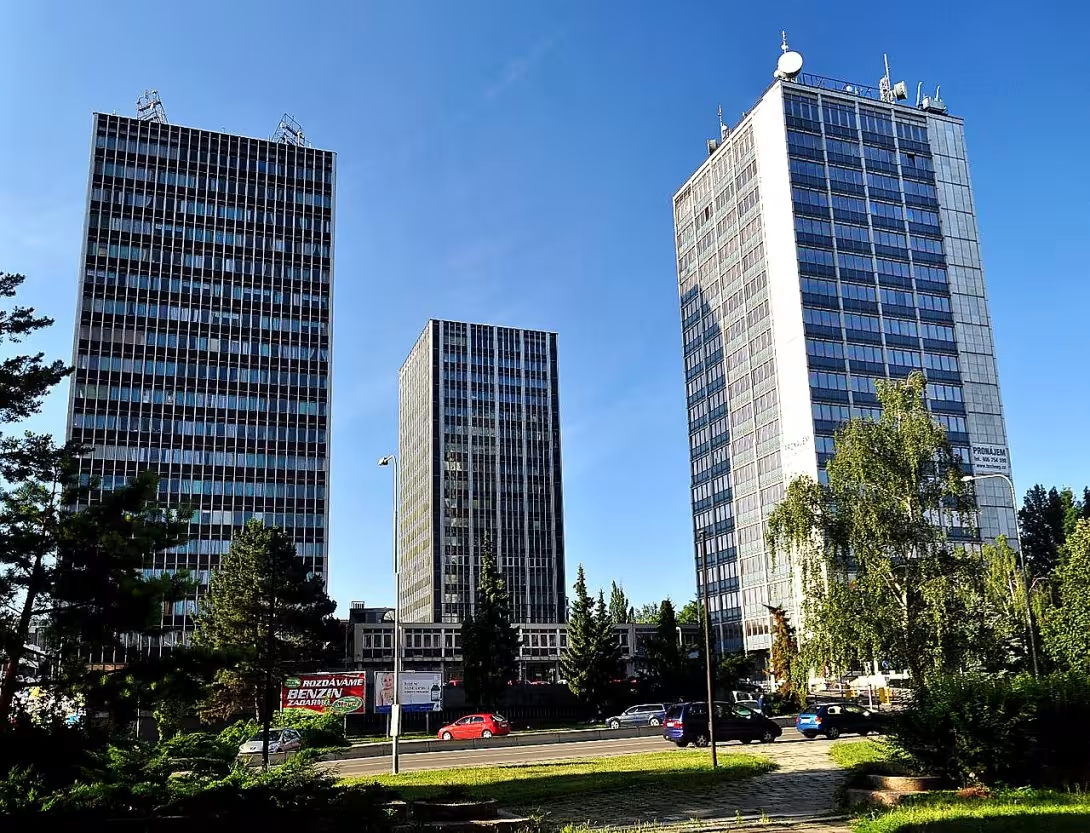
The Kancelářský komplex Šumavská, also known as the Brno Triplets or Šumavská Tower, consists of three high-rise administrative buildings in Brno's Veveří district. Built between 1967 and 1974, this site is a notable example of late modernism and remains one of the city's tallest structures.
Stavoprojekt Brno designed the complex under the leadership of architects Roman Zajíc and Jaroslav Ryška. Work started in 1967 and concluded in 1974. The process began with Building C at Šumavská 35 on the western side, which differed in structure and appearance from the other two towers. Subsequently, Building A (Šumavská 33) to the south and Building B (Šumavská 31) to the east were erected. Once finished, a two-story structure linked all three.
Reaching 66 meters, the towers generally consist of 19 above-ground floors, though Building C has 18; all three include two underground levels. A concrete central core houses the elevators and staircases. Structural frameworks vary: the oldest, Building C, features a steel frame, while the newer Buildings A and B utilize concrete. The original cladding consisted of Boletice panels, a popular material of the era.
Management and ownership of the complex have shifted recently. Integra stavby founded the company Šumavská tower in 2015. In 2019, a 50% stake was sold to ECO Property Invest, a member of the ECO Finance Group.
The complex is associated with several historical curiosities. The nickname "Brno Triplets" was adopted shortly after the 1972 completion of the World Trade Center in New York. Originally, the three towers served different entities: Building A was the seat of Ředitelství silnic a dálnic, Building B hosted the enterprise Agrie, and Building C was occupied by Chepos.
The buildings have undergone significant modernization. From 2015 to 2016, Building C was completely reconstructed, including a new facade, costing 200 million CZK. Between 2017 and 2018, work began on Building B, adding three floors and increasing its height by roughly 10 meters. While Building C features gold vertical stripes, Building B was updated with silver ones. These updates, along with plans to add five floors to Building A, drew criticism from architects and monument experts. Critics, including original architect Roman Zajíc and historian Rostislav Koryčánek, argued that unifying the facades erased the original character. There were also concerns that the added height would alter the skyline by overshadowing landmarks like Špilberk and Petrov.
The complex continues to evolve. Following the 2019 completion of Building B's interior and the opening of a shopping gallery and underground garages near Building C, the owner planned a Building D. This new addition is intended to be the tallest in the complex and will be architecturally distinct from the existing towers.
The Kancelářský komplex Šumavská remains a prominent feature of the Veveří district. It provides a significant look at the evolution of late modernism and the ongoing transformation of Brno's urban landscape.
Historical milestones
- 1967
- Start of the construction process.
- 1974
- Completion of the complex.
- 2015
- Foundation of the Šumavská tower company.
- 2019
- Sale of a 50% stake in Šumavská tower to ECO Property Invest.
Architectural development
The complex was designed by the Stavoprojekt Brno studio. While building C features a steel skeleton, the younger buildings A and B have concrete skeletons. The original cladding consisted of Boletice panels, and recent reconstructions have updated the facades with different color schemes for each tower.
Historical events
- 1967–1974
- Construction of the complex took place.
- 2015–2016
- Building C underwent a complete reconstruction, including a new facade.
- 2017–2018
- Reconstruction of building B began, adding three new floors.
Owners
The company Šumavská tower was founded in 2015 by Integra stavby; in 2019, a 50% stake was sold to ECO Property Invest, which belongs to the ECO Finance Group.
Points of interest
– The complex is known as the Brno Triplets, a nickname adopted shortly after the 1972 completion of the World Trade Center in New York. – The three towers originally served different entities: Building A was the seat of Ředitelství silnic a dálnic, Building B hosted Agrie, and Building C was occupied by Chepos. – Building C features a steel frame, while the newer Buildings A and B utilize concrete. – Modernization added gold vertical stripes to Building C and silver ones to Building B. – Critics argued that unifying the facades erased the original character and could overshadow landmarks l
Guide
Show guide text
This text was created by artificial intelligence and has not been editorially reviewed. It may contain inaccuracies.
Welcome to the Veveří district. As you stand here, take a moment to look up and let your eyes travel the full height of the structures rising before you. You are standing in the presence of a landmark that has defined this part of the Brno skyline for decades. What you see is the Kancelářský komplex Šumavská, a striking trio of high-rise buildings that command attention through their sheer scale and rhythmic design. These three towers, reaching up to sixty-six meters, create a powerful vertical presence in the urban landscape, acting as a monumental gateway to this part of the city.
To truly appreciate these buildings, we must travel back in time to the late 1960s. The story of this complex began in 1967, a period of significant architectural ambition and urban transformation. For seven years, the site was a hive of construction and engineering, as the vision for a modern administrative center began to take physical shape. By 1974, the project reached its completion, marking the arrival of a new era for the Veveří district. This was not just about adding more office space; it was about creating a symbol of progress and administrative efficiency.
As you observe the silhouette of the complex, you are looking at a quintessential example of late modernism. This architectural movement, which flourished during the time of construction, emphasized clean lines, functional geometry, and a sense of monumental scale. Notice how the three towers do not stand in isolation, but are brought together into a cohesive whole. They are linked by a two-story connecting structure that serves as the architectural glue, binding the three distinct vertical elements into a single, unified complex. This design choice creates a fascinating interplay between the massive, soaring heights of the towers and the more grounded, horizontal connection that holds them together.
The creation of such a significant structure required the vision of talented architects. The complex is the work of Roman Zajíc and Jaroslav Ryška, two figures who helped shape the modern face of the city. Their ability to balance the functional requirements of a massive administrative hub with the aesthetic demands of late modernism is evident in the way the towers dominate the space around them without feeling disconnected from their environment. As you look at the facades and the way the buildings interact with the light and the sky, you are seeing the enduring legacy of their design.
The history of the Kancelářský komplex Šumavská is also a story of changing roles and shifting purposes. In its early years, these towers were the nerve centers for vital organizations. Each building had its own distinct identity and responsibility. Building A served as the seat of Ředitelství silnic a dálnic, managing the very arteries of the country's transport network. Building B was the home of Agrie, while Building C completed the trio, providing the necessary space to support the complex's massive administrative functions. These buildings were more than just concrete and steel; they were the places where decisions were made that moved the country forward.
As time progressed, the complex evolved alongside the city. The management and ownership of these towers have seen significant shifts in the modern era. In 2015, the Šumavská tower company was founded to oversee this landmark, and in 2019, a new chapter began when a fifty percent stake in the Šumavská tower was sold to ECO Property Invest. This transition reflects the ongoing life of the buildings, proving that even structures built decades ago can continue to adapt and remain relevant in a changing economic landscape.
Now, I want to share a piece of local lore that gives these buildings their most famous nickname. If you listen to the locals or read about the history of Brno, you might hear them referred to as the Brno Triplets. This is not just a random description; it is a nickname that carries a sense of international connection. Shortly after the completion of the iconic World Trade Center in New York in 1972, the resemblance between those famous towers and our own local trio became a point of fascination. While they are uniquely their own, the comparison to the New York skyline captures the ambition and the global architectural language that was being spoken in Brno during the early seventies. It is a reminder that even here in Veveří, the echoes of global architectural trends can be felt.
As you continue your walk through the area, take one last look at the Kancelářský komplex Šumavská. Consider the decades of history held within those walls, from the first stones laid in 1967 to the modern offices that occupy them today. Whether you see them as a triumph of late modernism, a relic of a specific era, or simply as the Brno Triplets, there is no denying the impact they have on this city. Thank you for joining me on this brief journey through time. Please, continue your exploration of Veveří and enjoy the many other stories waiting to be discovered around every corner.
Tips for visitors
Best Time to Visit: The Kancelářský komplex Šumavská is a year-round destination, but the best time to visit is during spring or autumn when the weather is mild and sunny. This allows for great photography opportunities and comfortable exploration of the complex's surroundings.
Businesses nearby
Do you run a restaurant, accommodation, shop, museum, rental, wellness or other visitor service near this monument? Show yourself directly to the people heading to it — this is how they will see you in the app and on the web:
Events nearby





Zdroj akcí: otevřená data měst a obcí ČR (Národní katalog otevřených dat) a kalendář akcí Národního památkového ústavu.
Nearby
The complex is located in the Veveří district of Brno, near the city center and historical landmarks such as Špilberk Castle and Petrov.
Accommodation nearby
Trips and activities nearby
Guided tours, tickets and activities nearby from GetYourGuide
Affiliate link: if you buy from the partner, we may receive a commission. The price for you does not change.
Search tours and activities →Themed route
1. Špilberk Castle (Historical landmark) – Discover the history of this prominent fortress located near the city center. 2. Petrov (Historical landmark) – Visit this significant landmark to experience its unique atmosphere. 3. Kancelářský komplex Šumavská (Office complex) – Conclude your trip at this modern facility located in the Veveří district.
Seasonal recommendations
Spring brings a sense of renewal to the area around Kancelářský komplex Šumavská. The surrounding nature begins to wake up, offering soft, diffused lighting that is perfect for photography. As the greenery returns to Veveří, the atmosphere feels fresh and energetic. For visitors, it is wise to dress in layers to accommodate the unpredictable spring weather. Since the crowds are generally moderate during this time, a mid-morning visit allows you to enjoy the tranquility before the midday rush.
During the main summer season, the complex is bathed in bright, intense sunlight, highlighting the architectural details of the site. The vegetation is at its lushest, creating a vibrant and lively environment. Because this is the peak period for tourism, crowds can be significant. To make the most of your visit, aim to arrive as early as possible in the morning to beat both the heat and the largest groups of people. Lightweight, breathable clothing and sun protection are essential for a comfortable experience.
Autumn transforms the landscape into a palette of gold and amber, providing a unique and somewhat melancholic atmosphere. The misty mornings and low-angled sunlight create dramatic shadows and a serene mood around Veveří. This is an excellent time for those seeking peace, as the summer rush has subsided. However, the weather can turn chilly quite quickly, so bringing a warm jacket and sturdy walking shoes is highly recommended. Visiting in the late afternoon can yield particularly stunning lighting effects.
In the winter months, the atmosphere becomes quiet and stark, often accompanied by crisp air and a dusting of snow. The shorter days mean that the natural light is limited, creating a cozy yet somber mood. Visitors should be prepared for colder temperatures by wearing heavy coats, scarves, and gloves. It is also important to keep in mind that opening hours may be shorter during this season. Planning your visit for the middle of the day ensures you have enough daylight to fully explore the site.
Visualizations and artistic views

The visualisations are generated by artificial intelligence and serve as inspiration.
Photos from the area
Real photos taken near the monument


Zdroj a licence jsou uvedeny u každého snímku.
Tips from visitors
No tips yet. Be the first!
Log in and add your tip.
Sources and literature
Fotografie: Millenium187 / CC BY-SA 3.0 — Wikimedia Commons. The author and licence also appear when you hover over the image.
Faktickým podkladem tohoto textu byl článek na Wikipedii, jehož autory jsou přispěvatelé Wikipedie. Článek je dostupný pod licencí CC BY-SA 4.0.
Location on the map


Příběhy a pověsti
Legendy, pověsti a příběhy spjaté s touto památkou
Fotografie návštěvníků
Zatím žádné fotografie. Buďte první, kdo přidá fotografii z návštěvy!
Přihlaste se a přidejte svou fotografii nebo hodnoťte.
Za ověřenou návštěvu v aplikaci získáte víc bodů — poznáme podle GPS, že jste na místě.
Reviews and comments