



kašna na Karlově náměstí v Kolíně Fountain
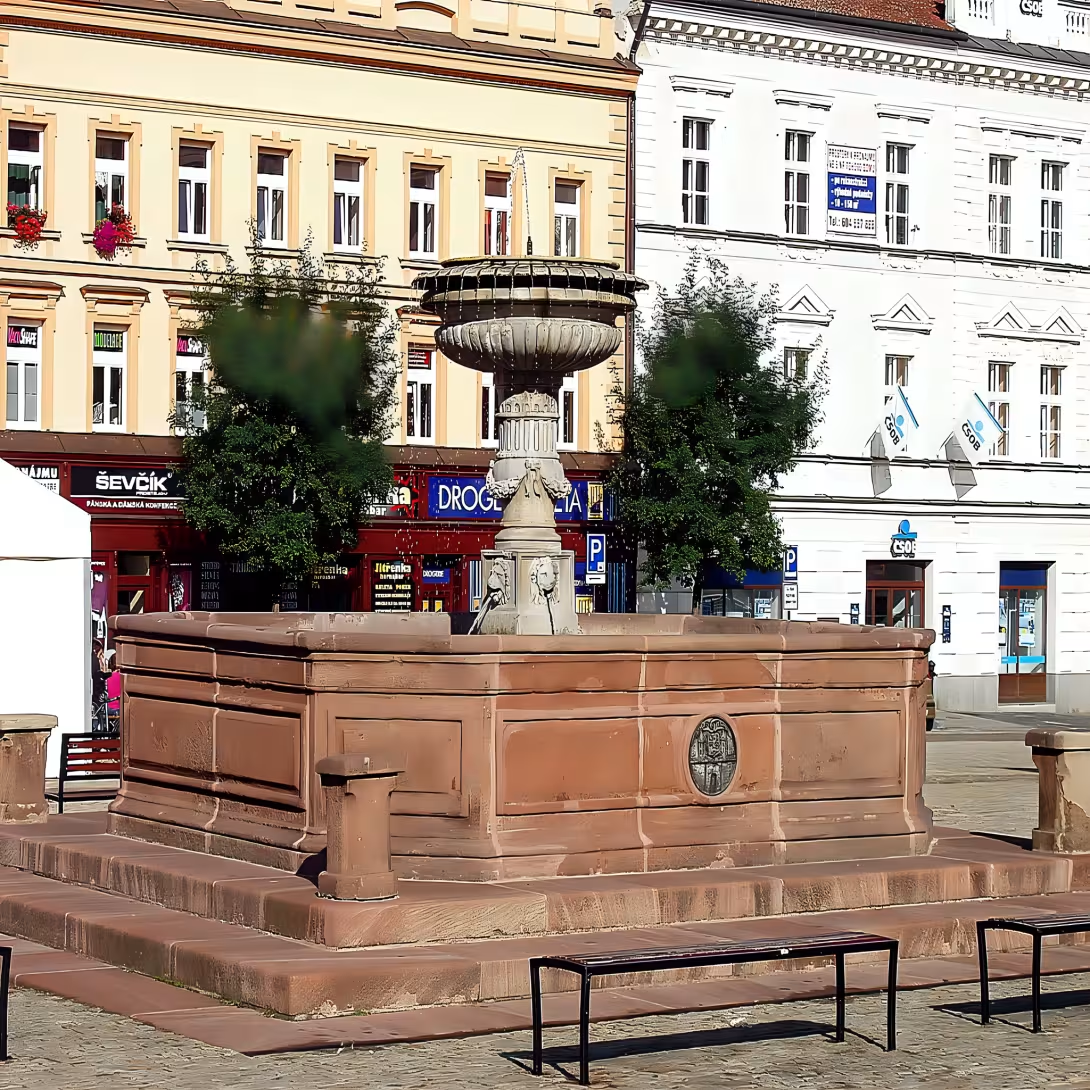
The fountain on Charles Square in Cologne is a baroque water building, the current form of which is based on modifications in the 18th and 19th centuries. The building consists of a square staircase support with corner plates and an octave tank decorated with embossed city features. This monument is protected as a cultural heritage and is part of a city conservation.
The first fountain was built on Cologne Square in 1555. The water flowed into it with wooden drill pipes from the so-called water tower, which the city obtained from King George of Podebrad in 1468. The first urban water pipeline was set up in 1596 due to the declining quality of the lard water. He was supposed to bring water from wells around Radonic and Štítar. In 1780, a Baroque repair was carried out by builder František Tomáš Jedlička. In 1870 a new Neo-Renaissance fountain was built on order of the city council, on which worked the stonemason master František Rajnyš and stonemason Josef Freud. Ten years later, in 1880, the stonemason master Josef Ladislav of Kutna Hora overcame her. The water from the Elbe and the water from the Štítar tap could be brought into one part.
The construction stands on a square platform with three degrees. The original material from the red nutchica sandstone was replaced during repairs between 2005 and 2007 by a copy of the sandstone from the Krakorka quarry near Trutnova. In the corners of the stands there are four stone paws with covered corners and a horizontal plate, which used to be used for the disposal of buckets. The tank itself has an eight-sided plan and its walls are broken by rectangular fillings framed by bars. On the north and south side of these fillings are placed circular targets with relief sign Cologne. Inside the tank, lined with lead sheet, there is a prism plinth decorated with embossed heads of lions. From it grows a richly broken column with horizontal rings and floral curtains, which carries a mussel bowl. The central part of the building is made of ochre sandstone.
The town of Cologne is the owner of the fountain. During the 19th century, the wood pipes were replaced by stoneware and later cast iron pipes; the technical equipment has been continuously modernised. In 1981, parts of the historical wooden pipeline were found in excavation works in the surrounding area, which are today stored in the Regional Museum in Cologne. After a long period of decaying, the fountain underwent repairs between 1989 and 1990, then between 2005 and 2007 under the leadership of the sculptor Vojtěv Adamce and in 2017 under the supervision of the restorer Pavel Kytek. The last overall reconstruction and cleaning, adding missing pieces of plastic decoration, took place in September 2025 under the direction of architect Martin Kulánek.
This monument is an important proof of the historical supply of water and development of urban infrastructure from the 16th century to the present day. The visit to Charles Square offers the opportunity to see this technically and artistically interesting object in the context of the historical centre of Cologne.
Historical milestones
- 1555
- Construction of the first fountain in Cologne Square.
- 1780
- Baroque repair of fountain builder František Tomáš Jedlička.
- 1870
- Construction of the new Neo-Renaissance fountain by the stonewalled masters Rajnyš and Freud.
- 2025
- Finishing the repair and cleaning of the fountain by architect Martin Kuhlánek.
Architectural development
The original Baroque building from the 18th century was replaced in 1870 by a neo-Renaissance construction using stone. During the 19th and 20th centuries the fountain passed through a number of technical modifications, including the replacement of pipes and installation of new equipment. During the reconstruction in the years 2005- 2007, the staircase support was replaced by a copy of the sandstone from Krakorka quarry.
Historical events
1555: construction of the first fountain on the square, 1870: construction of the new neo-renaissance fountain, 1880: congestion of the fountain for two different water sources, 2025: total repair and cleaning of the fountain.
Owners
City of Cologne
Points of interest
- The first fountain was built on Cologne Square in 1555. - In 1880, the fountain was ambushed so that water from the Elbe river could flow into one part and water from the Štítar pipeline. - The stone pavements in the corners of the stringers used to be used to delay the buckets. - During excavation works in 1981, parts of the historic wooden pipeline were found, which are now stored in the museum. - The original material from the red sandstone was replaced during repairs between 2005 and 2007 by a copy of the sandstone from the Krakorka quarry.
Guide
Show guide text
This text was created by artificial intelligence and has not been editorially reviewed. It may contain inaccuracies.
Welcome to the heart of our city. You are standing in Charles Square, in a place that is absolutely crucial to Cologne, in a place where time has stopped and the carousel of urban life is constantly spinning. Before your eyes, there is this beautiful water structure that is so inherent in this square. Before we go into her secret, just look at her for a second. Feel the calm that brings the sound of running water, and watch the light reflected in its surface. This fountain is not just an ordinary element of urban architecture, it is a living witness for many centuries, standing here watching the changing world around it. It is a place where nature meets in the form of water with human art in the form of treated stone.
To fully understand why this building is so important to us, we need to go back deep into the past together. The story of water at this place begins much earlier than you might think. The first fountain in this square was built here in the year fifteen hundred fifty-five. Imagine the Cologne Square back then, much different, but already full of life and human endurance. But time continues to flow and the needs of the city change. The fountain must have grown with the city and changed. In the year seventeen hundred and eighty there was a major repair carried out by František Tomáš Jedlička. It is thanks to his work and vision that the fountain has acquired the baroque form that we still feel in its foundations today. Later, in the year one thousand eight hundred seventy, the city changed again and the fountain went through another transformation. The Kamenice masters František Rajnyš and Josef Freud have created a new form in the Neo-Renaissance style, which has given the square another nobility. And even today, in our time, this monument is constantly nurturing and keeping in beauty. In the year two thousand twenty-five completed its repair and cleaning by architect Martin Kulhánek so that even for future generations it can decorate this square and serve as a meeting place.
Now, please pay attention to the details you have right in front of you. Look at the basic part of the building. Do you see the square support that forms a solid and stable base of the entire structure? In its corners are placed stone pavements. Give them a moment of attention, they have a special weight and stability that makes the whole piece feel unshakeable. Above this subsoil there is an eight-sided tank. It's fascinating to see its shape and how harmonically designed it is. If you approach, you can see the embossed features of the city that are carved into the stone with great care and artistic feeling. These marks remind us of the pride and identity of our city, the symbols that link the past to the present. Now, look higher. There's a pillar in the middle of the tank carrying its mission. And right here is one of the most beautiful and important elements - the plastic decoration of lion heads. These heads, which look as if they should wake up to life at any moment, are a typical feature of baroque work and supply the whole building with a majestic and a little mysterious look.
Every stone here has a story and every hand that worked it left its mark in time. We mean masters like Rajnysh or Freud who, in the nineteenth century, breathed new life and new face into this building. Although shapes and styles changed, the spirit of the place remained the same. In the history of the city, the names of great characters such as Jiří z Poděbrad or Jakub Krčín are confused, and even though their direct path to this particular fountain may not always be connected, they are all part of the great history that takes place in Cologne. They are the people who formed the character of this region. Even modern creators like architect Martin Kulhánek become part of this chain that connects old masters with today's world.
I have another interesting thing for you that may surprise you and help you better understand practical life in the past. Do you know how this fountain was fed? In the year one thousand eight hundred and eighty something very practical and interesting happened. The fountain was ambushed to make it as useful to the city as possible. One part of it was powered by water directly from the Elbe River and the other part used water from the city's water pipeline from Štítar. So it was a little technical monument that linked the natural source of the river to the modern technology of that time. And those stone pavements in the corners you saw a while ago? They weren't just for decoration. In the past, they served people to put off heavy wreaths when they came for water. They were little helpers of the everyday, difficult life of the people. Imagine the people who stood here every day, putting away their vessels and drawing water for their families.
I hope that this brief insight into the past has helped you to better perceive the beauty and importance of this place. The fountain on Charles Square is not just an ordinary water object; It's the heart of the square and the vivid memory of the city that keeps flowing. Now that you know her secret and her history, I invite you to continue your walk around Cologne. Explore the other corners of our city, perceive its atmosphere, look at the facades home and enjoy every moment you spend here. Thank you for your attention and I wish you a wonderful rest of the day to discover our city.
Tips for visitors
To visit the fountain on Charles Square I recommend the morning hours when the square is quieter and the sun pleasantly illuminates the Baroque details of the tank, which is ideal for shooting without disturbing elements. Take the camera with you with the lens for detailed images of reliefs and comfortable shoes, because the historic paving in the square can be uneven. In the immediate vicinity, do not miss a tour of St. Bartholomew's Temple, a visit to the Regional Museum in Cologne or a walk to the nearby Elbe River, all available with a short walk. For families with children, the square is a great place for a short stop in exploring the history of the city, while the open space allows children safe movement under the supervision of parents.
Frequently asked questions
Can the monument be visited?
This is a structure in a public space that can usually be seen from outside free of charge. We have not verified that this particular one is freely accessible.
Where is the monument?
Location: Kolín I, Středočeský kraj. The map on this page shows the exact spot.
Why is the monument protected?
It is listed in the Central List of Cultural Monuments of the Czech Republic as a cultural monument (register no. 1000142069).
Businesses nearby
Do you run a restaurant, accommodation, shop, museum, rental, wellness or other visitor service near this monument? Show yourself directly to the people heading to it — this is how they will see you in the app and on the web:
Nearby
Karlovo náměstí, chrám svatého Bartoloměje, Regionální muzeum v Kolíně, řeka Labe.
Accommodation nearby
Trips and activities nearby
Guided tours, tickets and activities nearby from GetYourGuide
Affiliate link: if you buy from the partner, we may receive a commission. The price for you does not change.
Search tours and activities →Themed route
Thematic cruise route around Charles Square in Cologne
1. The fountain on Charles Square
Type: Historical monument
Why is worth a visit: The fountain is one of the oldest and most famous in the Czech Republic. It is located in the middle of Charles Square where you can look at its beautiful Gothic elements and enjoy a quiet moment.
2. St. Bartholomew's Temple
Type: Religious memorial
Why is it worth visiting: This Gothic temple is the oldest church in Cologne. Its architecture and history attract many visitors who are interested in the spiritual and cultural heritage of the city.
3. Regional Museum in Cologne
Type: Museum exposition
Why is it worth a visit: The Regional Museum offers interesting exhibitions about the history and culture of Cologne. It is an ideal place for those who want to learn more about local traditions and historical topics.
4. River Elbe
Type: Natural water flow
Why is worth a visit: The Elbe River is not only a vital element for Cologne, but also provides beautiful views and opportunities to relax. A walk along her shore will allow you to enjoy a quiet moment in nature.
This route offers a combination of historical, cultural and natural experiences that are easily accessible in the centre of Cologne.
Seasonal recommendations
Spring: The fountain on Charles Square in Cologne offers a stunning view during spring when flowers and trees come to life and the garden around it is full of color. Sun rays illuminating the fountain give the impression of purity and a new beginning. At this time the weather may be variable, so it is advisable to prepare for the occasional rain. Visit the memory in the early hours of the morning or evening to avoid intense sunlight and get a quieter walk.
Summer: In summer, the atmosphere around the fountain on Charles Square is lively and full of energy, when people meet in a friendly environment. The sunlight illuminates the fountain in a strange way, making it an ideal place for photos. In the main summer season it is recommended to come early morning or late evening to avoid the biggest crowds and heat. Remember light clothes and sun protection.
Autumn: The autumn atmosphere around the fountain is calm and quiet when leaves are coloured in vivid colours. The sunny days lighting the fountain bring warm light, which gives the place softness. At this time, the weather is usually mild, but dress well for any colder days. Autumn visit offers a peaceful walk without excessive crowds.
Winter: Winter visit to the fountain is a unique experience, when sunlight is reflected on ice surfaces and creates a magical atmosphere. At this time the weather may be cold and short days require warm clothes such as fur and footwear with thermal insulation material. Visit her in the morning to enjoy the peace and beauty of winter sunshine.
Visualizations and artistic views


The visualisations are generated by artificial intelligence and serve as inspiration.
Photos from the area
Real photos taken near the monument

Zdroj a licence jsou uvedeny u každého snímku.
Tips from visitors
No tips yet. Be the first!
Log in and add your tip.
Sources and literature
Photos: Jstojanov / CC BY-SA 3.0, rozlišení zvýšeno umělou inteligencí — Wikimedia Commons. The author and licence also appear when you hover over the image.
Faktickým podkladem tohoto textu byl článek na Wikipedii, jehož autory jsou přispěvatelé Wikipedie. Článek je dostupný pod licencí CC BY-SA 4.0.
Location on the map
More monuments – Kolín I
Show all in the municipality

Příběhy a pověsti
Legendy, pověsti a příběhy spjaté s touto památkou

Fotografie návštěvníků
Zatím žádné fotografie. Buďte první, kdo přidá fotografii z návštěvy!
Log in a přidejte svou fotografii nebo hodnoťte.
Za ověřenou návštěvu v aplikaci získáte víc bodů — poznáme podle GPS, že jste na místě.
Reviews and comments