



Kašna se sochou svatého Floriána Fountain
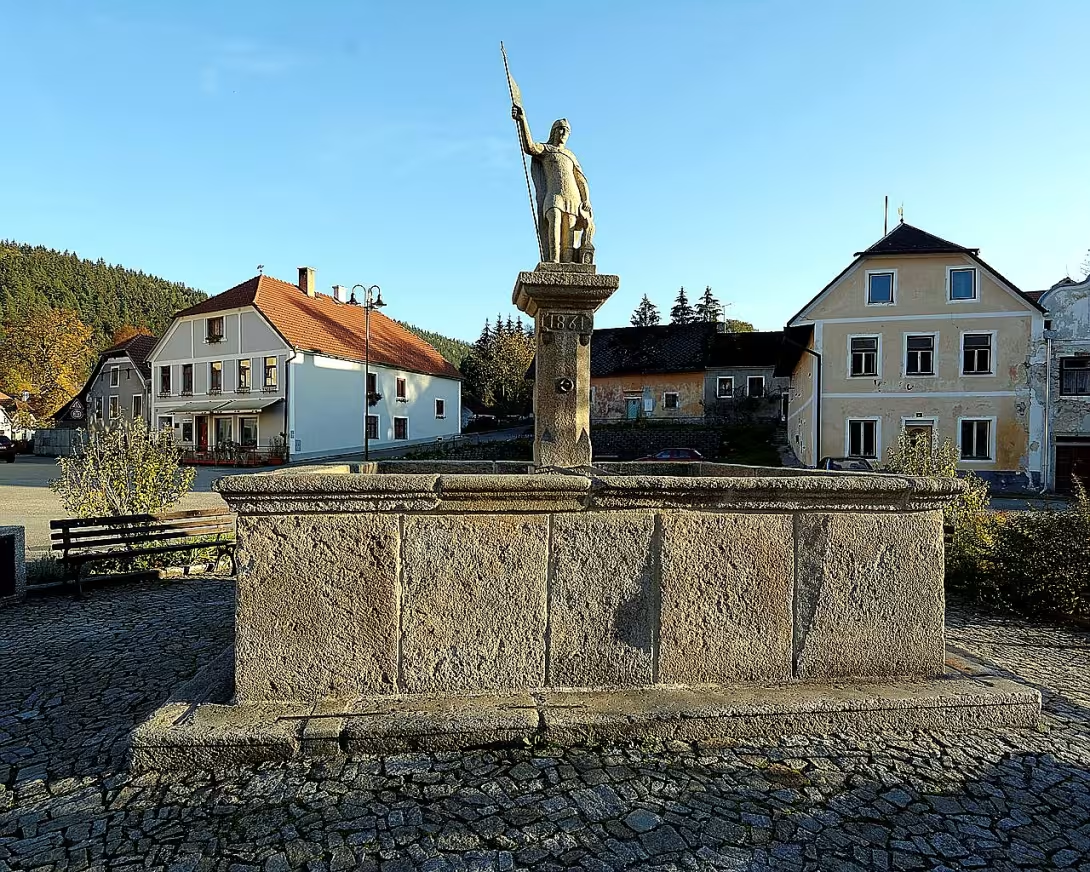
Kašna se sochou svatého Floriána in Rožmberk nad Vltavou is a cultural monument of the Czech Republic. It is located in the middle of the square in the town monument zone. The building dates from 1861 and represents an important element of public space, which illustrates the artisanal level of stonework in the mid-19th century.
The monument was created during the period of national renewal and gradual modernisation of urban infrastructure. In the European context, the effects of the Industrial Revolution were then met, and historizing styles of old traditions were promoted in architecture. The exact circumstances of the creation and the names of the creators are not specified in the sources, but the year 1861 carved into the central column clearly determines the time of creation.
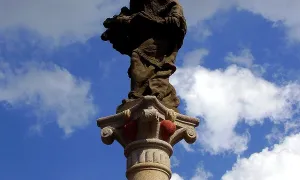
The architectural solution of the fountain corresponds to period historism with emphasis on functional and decorative use of stone. The construction has a square ground plan and is composed of granite plates ended with a profiled ledge. The vein has been selected with respect to local availability. In the middle of the tank is a column with a statue of St. Florian on it.
Saint Florian is depicted in a typical iconographic concept as a fireman who actively controls fire. The choice of this patron refers to protecting the city from devastating fires, which was essential for a dense urban development. At the time, the fountain performed a practical function as an important source of utility water for the inhabitants of the square.
The building is currently protected as a cultural monument and forms the natural center of the monument zone. The castle Rožmberk and the river Vltava are located in the immediate vicinity.
Kašna se sochou svatého Floriána is a valuable document of historical infrastructure and craftsmanship of the 19th century. When visiting Rožmberk nad Vltavou, this object is an invisible element of the square, which is worth paying attention thanks to its historical importance and its preserved architectural design.
Historical milestones
- 1861
- The creation of a stone porridge with a statue of St. Florian in Namesti.
- 1861
- Installation of the statue as protection of the town before the background.
- around 1900
- The practical function of the water source will gradually become obsolete.
- around 2000
- Registration of the object in the list of cultural memories of Ceske Republic.
Architectural development
The fountain was built in 1861, which is evidenced by the year carved directly into the central column. The construction uses local granite material that is typical for this area. The architectural solution corresponds to historical historism with emphasis on functional and decorative use of stone.
Points of interest
- The fountain is a cultural monument of the Czech Republic and is located in the middle of the square in the town monument zone. - The object dates back to 1861, which is carved into a central column. - The construction has a square plan and is composed of granite plates, the granite has been selected because of its local availability. - Saint Florian is depicted as a fireman who controls fire, which was supposed to protect the city from fires. - In the past, the fountain served as an important source of utility water for the inhabitants of the square.
Guide
Show guide text
This text was created by artificial intelligence and has not been editorially reviewed. It may contain inaccuracies.
Welcome to the beautiful city of Rožmberk nad Vltavou. Right now you're standing in the heart of this historic place, right in the middle of the square, which is the artery of the entire city. There is an object before your eyes that is absolutely crucial to this space. It is a fountain that, by its presence, dominates the whole area and forms a natural center around which the life of the locals and visitors revolves. Look at it and feel the atmosphere of this place. This fountain is not just an ordinary element of urban architecture, it is a silent witness for many years who stands here and watches everything that happens around it.
So let's go back to the past together, so that we can better understand why this object is here and why it's in this form. The entire history of this building begins in a thousand eight hundred sixty-one. At that time, the world was much different than today, and cities had their specific risks. One of the greatest fears of the people at that time was the fiery element that could destroy the entire neighborhood within a single moment. This is why this stone fountain was built this year. But its creation was not only determined by aesthetics. It was supposed to be of profound importance for the safety of the entire city. There's a statue of St. Florian on the center column. For the people of the nineteenth century, this holy symbol of protection against devastating fires. The installation of this statue was therefore of spiritual and practical importance - it should bring peace and security to all who live and work here.
Now pay attention to the construction itself and look at the details you have right in front of you. Notice how the fountain is built. It has a square plan, which gives it a sense of stability, strength and balance. The whole structure consists of massive granite plates. If you look at the top of the tank, you will see a profiled stone ledge, which beautifully ends this stone unit and gives it a proper and finished appearance. It's fascinating to see these stone shapes connect. The centre column, which is the main carrier of the entire composition, then appears in the middle of the whole tank. This is where the important statue is placed. If you approach it, you may notice that the year of its creation is carved in the stone, namely the year one thousand eight hundred sixty-one. This is a beautiful and durable proof of the time that has passed since her birth.
If you look at the material from which this entire building is carved, you will see the incredible strength and strength of granite. This stone was not chosen by chance. It's a stone that comes from our nearby surroundings, which means that this fountain is, in some sense, part of the country itself that it stands on. The vein is known for its enormous resistance and its ability to withstand time, rain and wind, which is absolutely essential for such an object. Working with this hard material required great skill and patience from the craftsmen at the time.
Although we do not know the names of the particular architects who designed this project or the names of the people who built this fountain at the time of its creation, we can imagine their efforts. Every cut into stone, every smoothed granite surface was the result of the work of creators who wanted to create something that would last centuries. We're standing here in front of a work that doesn't have one famous author, but has the soul of the whole city. The character of St. Florian you see here is not just an artistic element. It's a symbol of hope. At a time when cities were often threatened by fires, the presence of this saint in the square was like a silent prayer for the safety of all the houses and people in the area.
You might have a question about how this object changed over time. It's a very interesting thing. At the time of its creation, the fountain played a very important practical role. It served as a source of useful water for residents. People came here to pump water for their everyday lives, for their homes and for the needs of the city. However, as the city was supposed to develop and the technology improved, around a thousand and nine hundred years ago, this practical function gradually began to disappear. The fountain stopped being the main source of water and became rather an aesthetic element, the decoration of the square. Yet she maintained her importance. Her value hasn't changed, she's just transformed. From a practical source of water it became a rare cultural monument. Indeed, around the year two thousand this building was officially included in the list of cultural monuments of the Czech Republic, which confirms its high historical and artistic value.
It's fascinating to think about how people's needs change, but how symbols remain the same. Even though people no longer go to this fountain with water containers, its presence still defines this square. It's a point that people go back to, a place where they stop and feel at the heart of the city.
Now that you have known the history and shape of this beautiful fountain, I suggest you continue your walk through the square. Rožmberk nad Vltavou has many other secrets and beautiful corners waiting for you. Let yourself drift through the atmosphere of this historic city and enjoy every moment you spend near it. See other parts of the square, see the architecture of the surrounding buildings and enjoy this time spent exploring. Thank you for spending some time with this monument, and we wish you many wonderful experiences in your next survey of our city. Goodbye.
Tips for visitors
The best time to visit is in the morning or at sunset, when the sun's rays illuminate the details of the statue of St. Florian. In these times the square is quieter and offers an ideal atmosphere for observing the historical centre.
You can easily reach Rožmberk nad Vltavou by car or public transport.
To photograph the statue, select a wide-angle lens to capture the fountain in the context of the surrounding historical development. The best light for images is when you stand up so that the sun shines on the face of the saint, which will highlight its sculpture.
In the immediate surroundings we recommend visiting the castle of Rožmberk, which rises above the city, and walking along the river Vltava. The entire town monument zone offers a pleasant walk in history, which is suitable for all ages.
For families with children, the visit to the square is an ideal stop when traveling around the city. Children can admire the statue of St. Florian while you rest near the fountain. The whole area is well accessible and safe for joint movement with the smallest visitors.
Frequently asked questions
Can the monument be visited?
This is a structure in a public space that can usually be seen from outside free of charge. We have not verified that this particular one is freely accessible.
Where is the monument?
Location: Rožmberk nad Vltavou. The map on this page shows the exact spot.
Why is the monument protected?
It is listed in the Central List of Cultural Monuments of the Czech Republic as a cultural monument (register no. 1000141086).
Businesses nearby
Do you run a restaurant, accommodation, shop, museum, rental, wellness or other visitor service near this monument? Show yourself directly to the people heading to it — this is how they will see you in the app and on the web:
Events nearby
Zdroj akcí: otevřená data měst a obcí ČR (Národní katalog otevřených dat) a kalendář akcí Národního památkového ústavu.
Nearby
Hrad Rožmberk, řeka Vltava, městská památková zóna Rožmberk nad Vltavou.
Accommodation nearby
Trips and activities nearby
Guided tours, tickets and activities nearby from GetYourGuide
Affiliate link: if you buy from the partner, we may receive a commission. The price for you does not change.
Search tours and activities →Themed route
Thematic cruise route from Rožmberk nad Vltavou
1.Kašna se sochou svatého Floriána - Type: Historical landmark - Why is it worth visiting: This fountain is not only a beautiful place to relax, but also symbolizes protection against fires. Her statue of St. Florian resembles the importance of this firework patron.
2. Castle Rožmberk - Type: Historical castle - Why it is worth a visit: The castle is an icon of Czech history and culture, known for its beautiful architecture and views of the river Vltava. It's a place full of stories about the past and legends.
3. River Vltava - Type: Natural landmark - Why is it worth a visit: The river offers a peaceful walk along its shore where you can enjoy pleasant moments in nature and beauty of the region. It is an ideal place for relaxation and refleksia.
4. City Monument Zone Rožmberk nad Vltavou - Type: Historical area - Why is it worth visiting: This zone retains authentic architectural elements of the ancient city. Visit the streets with historic houses and explore their rich past.
5. Arrival to the castle courtyard - Type: Historical courtyard - Why is it worth a visit: The reservoir is an ideal place for understanding the history and importance of the castle. Here are also other interesting elements that complement the overall atmosphere of the place.
This route offers a combination of cultural enrichment and natural experiences in one of the most beautiful places in the Czech Republic.
Seasonal recommendations
Spring: During the spring season Kašna se sochou svatého Floriána in Rožmberk over Vltava will turn into a special place where flowering shrubs and trees celebrate the return of heat. Sun rays reflecting on water add the tone of clarity and renewal to the atmosphere. For a visit it is advisable to choose a day without heavy rains that can cause unexpected irrigation of surrounding areas. Clothes should be adapted to changing weather - there is good help from warm clothes with umbrella. The best time to visit is usually in the early afternoon when I crowd even less.
Summer: During the summer period Kašna se sochou svatého Floriána takes on a special dazzling character under Rožmberk. The sun fills the water and surrounding landscape with a lively color, which contributes to a warm atmosphere ideal for relaxing under the shadow of old trees. This season it is recommended to visit the memory earlier in the day to avoid long fronts of tourists. Hot clothes and sun protection such as hats or shields are crucial for comfortable visiting.
Autumn: In autumn the Kašna se sochou svatého Floriána in Rožmberk obtains Melancholic beauty when leaves pass into golden and red shades. Sunshine days are the perfect time to visit, because autumn clouds can quickly bring rain storms. Clothes should be warm and suitable for changing weather - from warm clothes with umbrella is good help. The best times to visit are usually in the early afternoon, when I crowd even less.
Winter: In winter Kašna se sochou svatého Floriána under Rožmberký nad Vltavou receives a quiet and quiet atmosphere. Ice shapes on the water add magic to the region, especially during cold morning hours, when bright sunlight is the most beautiful. For a visit it is important to have warm clothes and suitable shoes - a tourist center during winter often has shorter operating hours. The best times to visit are in the early afternoon, when the sun is the most beautiful above the landscape and the crowd decreases.
Visualizations and artistic views

The visualisations are generated by artificial intelligence and serve as inspiration.
Photos from the area
Real photos taken near the monument


Zdroj a licence jsou uvedeny u každého snímku.
Tips from visitors
No tips yet. Be the first!
Log in and add your tip.
Sources and literature
Photos: Gampe / CC BY-SA 4.0 — Wikimedia Commons. The author and licence also appear when you hover over the image.
Faktickým podkladem tohoto textu byl článek na Wikipedii, jehož autory jsou přispěvatelé Wikipedie. Článek je dostupný pod licencí CC BY-SA 4.0.
Location on the map
More monuments – Rožmberk nad Vltavou
Show all in the municipality

Příběhy a pověsti
Legendy, pověsti a příběhy spjaté s touto památkou

Fotografie návštěvníků
Zatím žádné fotografie. Buďte první, kdo přidá fotografii z návštěvy!
Log in a přidejte svou fotografii nebo hodnoťte.
Za ověřenou návštěvu v aplikaci získáte víc bodů — poznáme podle GPS, že jste na místě.
Reviews and comments