






klášter augustiniánek na Novém Městě v Praze Monastery
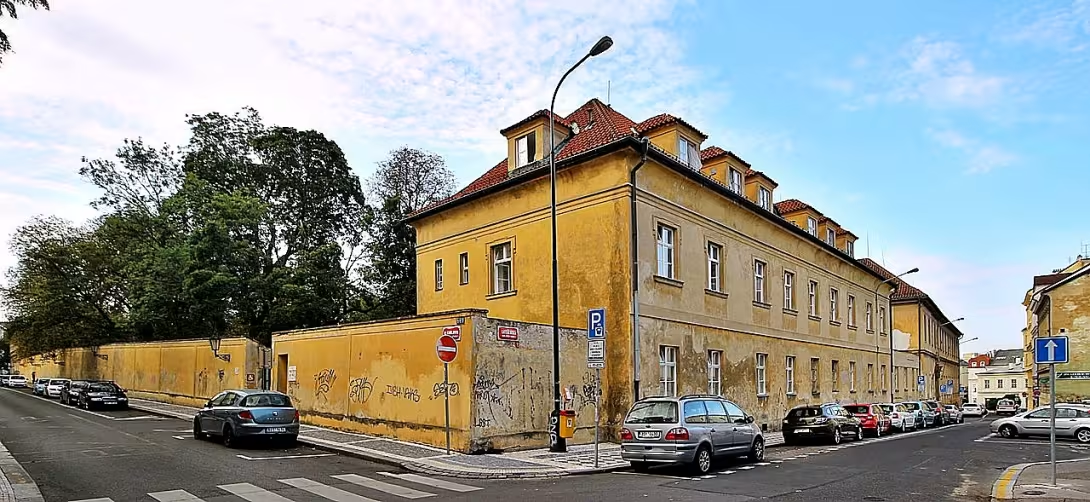
The Augustinian monastery, located in New Town in Prague, is a historical monument with a rich past. This monastery complex, originally Gothic and later baroque, is connected to the Church of St. Catherine of Alexandria. Its importance is not only in the building character but also in the history dating back to the 14th century. Today the site is protected as a monument zone and serves as a place for the Psychiatric Clinic 1st LF UK and VFN.
The founding of the Augustinian monastery dates back to 1355-1367 when Emperor Karel IV. founded it as a result of his victory in the Battle of San Felice in 1332. The monastery was part of a wider effort by Charles IV, who supported the development of art, education and architecture, turning Prague into a Central European cultural centre. After the Hussite fire in 1420, the monastery went through several stages of renewal, with its present baroque shape formed in 1718-1730. The Baroque church was built in 1737-1741 by Kilian Ignác Dientzenhofer replacing the Gothic building with a preserved tower.
The monastery is an architect of Baroque style. The original Gothic complex was restored after the Hussite fire and later rebuilt to Baroque style in 1718-1730. The Baroque church, built according to the design by Kilian Ignác Dientzenhofer, replaced the Gothic building with a preserved eight-sided tower, known as the Prague Minaret. This tower is one of the dominant elements of the urban horizon. In 1844, the new building of the mental institution was built on the premises and in the years 1847-1848 the director's villa was built.
The history of the monastery is recorded by changes to its owners and functions. In 1784, the monastery was abolished as part of the church reforms of Josef II, which led to the building becoming a military educational institution. In 1789 Prague was located in Prague for the care of quiet and calm mental persons, which in 1862 went under the administration of the Prague village. After the closure of the disease in 1929, the site was converted into a Psychiatric Clinic.
Key events that shaped the fate of the monastery include its foundation by Charles IV, the Hussite fire in 1420 and the Baroque reconstruction in 1718-1730. These events affected not only architecture, but also the function of the building over the centuries.
Today the monastery of Augustinian women in New Town is open to the public and serves as a place to relax and visit. The area contains a publicly accessible Kateřín garden, which offers a quiet environment in the middle of the city. The monastery is an important historical and architectural monument area, attracting visitors with its rich history and significant building features.
The monastery of the Augustinian in New Town is therefore not only a monument to the architectural character, but also an important historical place that shows changes in Czech society and culture. His visit offers a view of the rich past and an opportunity for peaceful disconnection in the centre of Prague.
Then and now
Drag the slider to compare how the landmark may have looked when it was built with the view today.
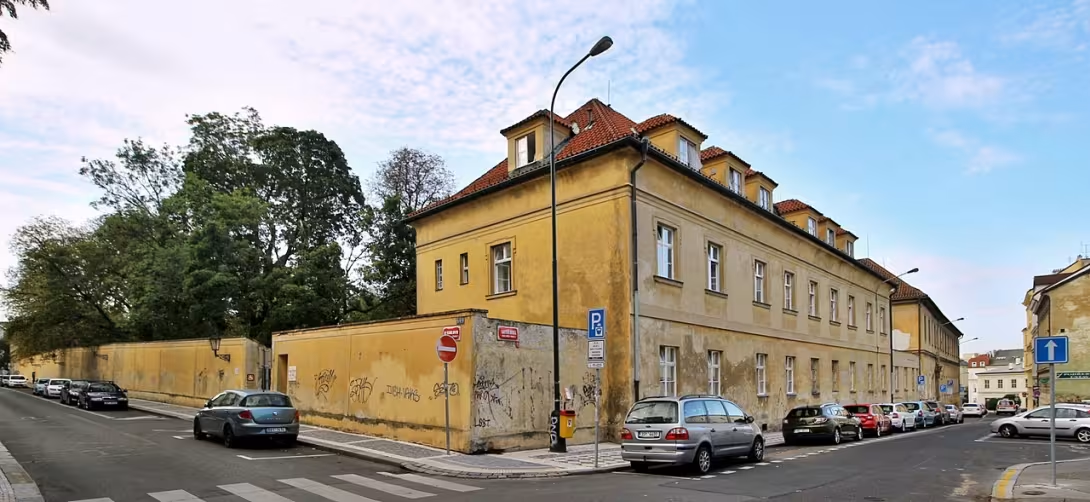
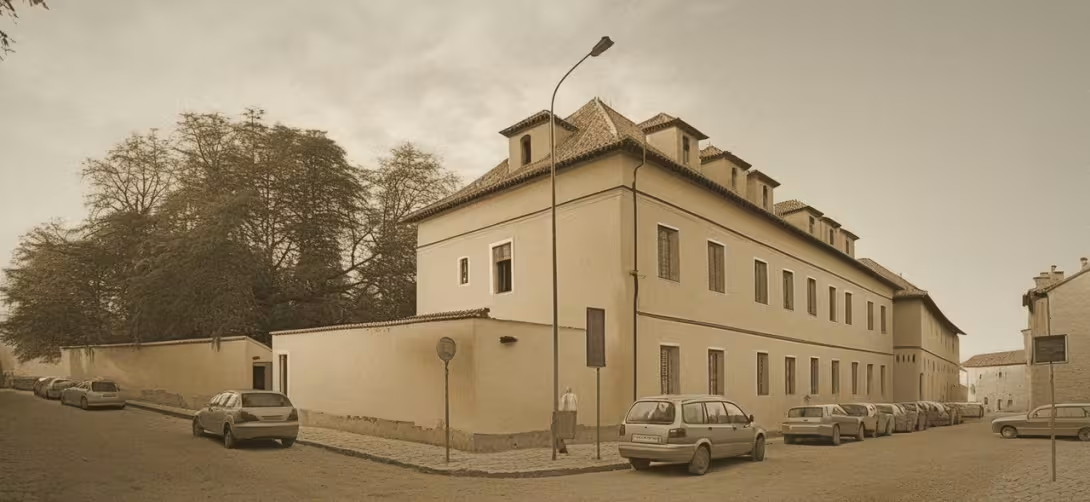
The historical appearance on the left is an AI-generated visualisation and serves as inspiration only.
Historical milestones
- 1355
- The establishment of the monastery by Charles IV.
- 1420
- Hussite burning
- 1784
- Cancellation of the monastery in the framework of the church reforms of Joseph II.
Architectural development
The original Gothic monastery was restored after the Hussite fire and later rebuilt into Baroque style in 1718-1730. The Baroque church was built in 1737-1741 by Kilian Ignác Dientzenhofer replacing the Gothic building with a preserved tower. In 1844, the new building of the mental institution was built on the premises and in the years 1847-1848 the director's villa was built.
Historical events
- 1355-1367
- The establishment of the monastery by Charles IV.
- 1420
- Hussite burning
- 1784
- Cancellation of the monastery in the framework of the church reforms of Joseph II.
Owners
- 1355-1367
- 1784
- 1789-1822
- 1862
- 1929
Points of interest
- It was founded by Emperor Karel IV. in 1355-1367 as a result of victory in the battle of San Felice. - Originally a Gothic complex was rebuilt in 1718-1730 in Baroque style. - There is a tower known as Prague Minaret. - After the cancellation in 1784, the building served as a military educational institution and later a medical facility. Today, the area serves as a Psychiatric Clinic and offers the public a Kateřín Garden.
Guide
This guide is narrated by a synthetic voice generated by artificial intelligence.
Show guide text
This text was created by artificial intelligence and has not been editorially reviewed. It may contain inaccuracies.
Welcome to the heart of Prague's New Town. You're standing in front of one of those places where history can't just be read in textbooks, but you can literally feel it in every stone block and every shadow that throws these ancient walls. Before your eyes, there is a complex of Augustinian monastery, which is a silent witness to the centuries that have taken place here - from the times of powerful emperors to the times of military training. Before you go any further, stop for a moment and feel the atmosphere of this place. There is something in it from the peace of the former spiritual centre, but also from the dynamics of a city that is constantly changing around it.
Let's go back deep into the past together to understand why this place is standing right here. Imagine the fourteenth century, when Praha experienced its greatest boom. Just then, in the years between 1355 and 1367, there laid the foundations of this monastery the sovereign himself, Emperor Karel IV. His decision for this place was not random. It was motivated by his personal triumph, a victory in the battle of San Felice, which he wanted to honor and write into history through the establishment of this spiritual residence for the order of the Augustinian. So the monastery became not only a place of prayer, but also a symbol of the reaper's power and his deep faith.
Note, however, that what you see now is not just one solid style. The history of this place was not linear and calm, but full of dramatic breakthroughs. In 1420, at the time of national riots and religious wars, the monastery was burned by Hussites. This event left deep traces and forced the building to go through several stages of recovery. What you're seeing today is a fascinating mixture of two completely different worlds. The original core of the monastery was deeply Gothic, with its firm and strict structure, but later, during the period of the high baroque, the whole complex was radically rebuilt.
Now pay close attention to the architecture surrounding you. If you look at the overall design of the buildings, you will see the richness and dynamism brought about by the Baroque style. This magnificent transformation took place between 1718 and 1730 and the hands of the greatest builders of their time were printed in his work. You can find the influences of František Maximilian Kanka in these lines and shapes or the Dientzenhofer family championship, namely Kryštof and Kilián Ignác Dientzenhofer. They all contributed to the monastery gaining its present, impressive face. Although architecture was changing, the spirit of the place remained relentless. Feel the baroque elegance trying to tame the original medieval weight of buildings.
And right here, in the middle of this architectural dialogue, is one of the most interesting things that must interest you. Look towards the sky, towards the distinctive vertical that dominates the surroundings. It is an eight-sided tower that brings immediate wonder to Prague. This tower is known as the Prague Minaret. It's a unique element that is unlikely to be of any kind in this city. Its unconventional shape and presence at the heart of the European metropolis give the whole area a mystery and a special character that makes you stop and look up even longer.
But history continues to flow and the monastery had to face political changes that changed the face of the entire empire. In 1784, as part of the extensive church reforms of emperor Joseph II, the monastery order was abolished. Spiritual life is quiet here and the buildings have acquired a completely different, practical and less mystical function. The object became a military educational institution. Imagine the changes - instead of the silent prayers and the whispers of the monks, there were now orders, troop steps and sounds of military training. This era added another layer of history to the complex, which is less poetic than the time of Charles IV. But equally important for understanding how Praha turned into a modern city.
Now, if you're going to walk on, try to connect all these characters and events in your mind. Emperor Charles IV, who sought spiritual support after victory, the Hussy warriors who left ashes, the Baroque masters who sought beauty here, and the soldiers who sought discipline here. All these tracks are here, in these walls, in this space.
Don't just let yourself be taken by looking at one building, but let this whole space consume you. Every corner of this complex has its own story thread. Enjoy this moment of discovery and continue your tour. Praha has many faces, and right here, at the Augustinian monastery, you have just discovered one of the most petrified. I wish you a pleasant journey along these historic paths.
Tips for visitors
The best time to visit the Augustinian monastery is autumn or spring, when the view of the surrounding Prague is particularly impressive and the vegetation of the monastery park offers beautiful colors. This time of year also brings a softer attendance, which allows better exploration of the complex.
Parking in New Town can be quite challenging depending on the time of the day and the day of the week. We recommend the use of public transport, which can be easily connected to the monastery. For those arriving by car, it is advisable to look for parking places near the main square of New Town and then continue on foot.
When visiting the monastery, wear a suitable suit because the interior can be cold. We also recommend a handbag or headphones for listening to audio lines, which is often available in several languages, and an magnifying magnifying magnifying magnifier for a detailed view of works of art.
Photography of the monastery offers many possibilities. The best light is usually in the early morning or late afternoon when the sun is not directly above your head. The interiors of the chapel and the garden of the monastery are particularly impressive.
In the vicinity of the monastery there is a square of the Republic with its historical buildings and an artistic statue. It is an ideal place for a walk or a short rest before another part of your day in Prague.
Frequently asked questions
Is klášter augustiniánek na Novém Městě v Praze open to the public?
Yes, the monastery is open for public visits. The tours are usually possible after the agreed time.
How do I get to the place by car / public transport?
The monastery is well accessible with trams and buses from the city center. Parking in the area is limited, therefore we recommend using public transport.
How much is the entrance fee and is it paid on the spot?
Admission fee is payable on site. The current price list can be found on the official site of the sights.
Is the tour suitable for children and seniors?
Yes, the monastery offers accessible rooms for children and seniors. The tours are designed to be interesting to all visitors.
How long does the tour take?
The tour time may vary, but usually lasts about 1 to 2 hours. You can spend more time exploring interiors and monastery gardens.
What are the opening times and booking is required?
Opening hours may vary depending on the period. We recommend checking the actual opening hours on the official site of the monastery and booking the tour is advisable in advance.
What's interesting in the immediate vicinity?
In the vicinity of the monastery there are several historical and cultural monuments such as Pohořelec or the National Museum. These places are suitable for short trips and offer additional possibilities for exploring Prague.
For kids
Imagine Prague in the 14th century, when it was full of the sounds of cheerful footsteps and loud laughter of people. There, in the middle of New Town, a little chapel began to be built, which was supposed to be home to the religious sisters of the Augustinian. This monastery was like a new growing tree, its roots dug deep into the soil and the tribe rose up to heaven.
Businesses nearby
Events nearby

Zdroj akcí: otevřená data měst a obcí ČR (Národní katalog otevřených dat) a kalendář akcí Národního památkového ústavu.
Nearby
XXXHistorical monuments (1635)
- Museum Antonín Dvořáka 0.0 km Ke Charles 462 / 20 + 420 224 918 013
- Arnešt Lederer 0.1 km
- Robert Vogel 0.1 km
- Marta Lederero 0.1 km
- Ludmila Vogel 0.1 km
- Marie Ann Guth 0.1 km
- Otto Vogel 0.1 km
- Olga TöpfejáxZ4ZX 0.1 km
- Arthur Töpfer 0.1 km
- Oskar Töpfer 0.1 km
- Gertrude Töpfer 0.1 km
- Fany Klominková 0.1 km
- Karel Töpfer 0.1 km
- Max Töpfer 0.1 km
- Armin Gipsz 0.1 km
- Regina Gipszu 0.1 km
- Tree of the soul and nerves in the Kateřín Garden in Praze 0.1 km
- Hrdliček Museum of Man 0.2 km Wine 7 + 420 724 039 933
- Albert Einstein 0.2 km
- Mudr. 0.2 km
Restaurant and catering (5430)
- Caviar 0.1 km Na battlefield 1989 / 8 + 420 608 714 582
- Švejk Guesthouse U Kalicha 0.1 km Na battlefield 12
- Café with Sí 0.1 km Ke Charles 12
- Macu Picchu Restaurant 0.1 km + 420774178181
- Restaurant U Emma Destino 0.2 km Kateřinská 7 + 420 224 918 425
- Rendez Vous 0.2 km
- At the junction "Uterus" 0.2 km
- Miss sophis 0.2 km
- Bistro URO 0.2 km + 420 775 508 533
- LegendA 0.2 km
- U Barley 0.2 km
- Café Purkine 0.2 km Sokolská 31
- Biwon 0.2 km
- Ball lightning 0.2 km + 420 721 420 859
- Honest Taste 0.2 km Leger 33
- Mlynastic pelmene 0.2 km Ječná 522 / 40
- Jin Xin 0.2 km Lip 8
- Everyday rest & wine 0.2 km
- LegendA 0.2 km
- Cukrcafé 0.2 km
Accommodation (815)
- NABO Apartments 0.1 km Na Field 22
- Hostel Advantage 0.1 km Sokolská 11
- Anyday Apartments 0.1 km Sokolská 9
- Hotel City Central de Luxe 0.2 km Sokolská 21 + 420 242 430 003
- Hotel DaVinci Wenceslas Square 0.2 km Sokolská 25
- Hotel Residence Select 0.2 km Sokolská 34 + 420 734 729 646
- Ibis Praha Wenceslas Square 0.2 km Kateřinská 36
- Hotel Saint George 0.2 km Tyršova 2
- Hotel S42 0.2 km Sokolská 42 / 1797
- Sophie's Hostels 0.2 km
- Hotel Brixen 0.2 km Sokolská 44
- Hotel Tivoli 0.2 km Sokolská 1794 / 48 + 420 296 114 401
- Miss Sophie's New Town 0.2 km Melon 3 + 420 210 011 210
- Hostel Centre 0.2 km Sokolská 29
- Miss Sophie's New Town & Wellness 0.2 km Melon 3
- Jecna Holiday Apartments 0.2 km Ječná 32a
- Novotel Praha Wenceslas Square 0.2 km Kateřinská 38
- Hotel Sunrise 0.2 km Ke Charles 19 + 420 222 944114
- Ankorax 0.2 km Kateřinská 42
- Hotel 16 U Saint Kateřiny 0.2 km Katerinská 16 + 420 224 920 636
▶ Rental and Sport (545)
- Ski & Surf 0.4 km
- 11 Teamsports 0.4 km
- Physical unity Sokol Prague 0.4 km Rye 1438 / 42 + 420 221 965 311
- Husky 0.6 km RX669 / 1 + 420 222 220 950
- Free Time Centre Botič 0.7 km
- BEL Sport 0.7 km
- Rossignol 0.8 km + 420 733 626 382
- Sport hall Folimanka 0.8 km
- Festka 0.8 km Jana Masaryk 281 / 28 + 420 775 264 543
- Richmond Cycles 0.8 km American 293 / 12 + 420 777 410 029
- Kola- Skies- Win 0.9 km Vyšehrad 7 + 420 777 307 205
- A3 SPORT 0.9 km + 420 222 240 690
- Oasis City 0.9 km Wenceslas Square 36
- HUDYsport 1.0 km Silesská 8
- Cyclosecs 1.0 km Jaromírova 50
- Harbour Rashínov waterfront 1.0 km
- Hanibal Sport 1.0 km Crown 732 / 16 + 420 222 522 416; + 420 220 920 820
- Sport Servis 1.0 km
- Center Services Pre 1.0 km
- Honzovs 1.0 km + 420 777 493 182
© Tourism and Nature (479)
- Mind Maze 0.3 km
- Čelakov sady 0.6 km
- Čelakov sady 0.6 km
- New Town Hall 0.7 km
- National Museum tower 0.7 km
- Zítka sets 0.9 km
- Dancing House viewpoint 0.9 km
- Stulc sets 1.1 km
- Karlach sets 1.1 km
- Slavín 1.1 km
- Vyšehrad 1.2 km
- Zvon # 9801 1.2 km
- grotta 1.2 km
- Czech Puppet 1.3 km
- Dienzenhofer sets 1.3 km
- Thrill Park 1.4 km
- Na Tape 1.4 km
- Na Tape 1.5 km
- Celetna 1.5 km
- Celetna 1.6 km
Accommodation nearby
Trips and activities nearby
Guided tours, tickets and activities nearby from GetYourGuide
Affiliate link: if you buy from the partner, we may receive a commission. The price for you does not change.
Search tours and activities →Themed route
1. Monastery of Augustinian in New Town in Prague (Memorial) - Explore the architecture and spiritual history of this important monastery complex. 2. Monastic courtyard (Area) - Take a walk around this quiet space and enjoy the atmosphere of the historic inner court. 3. Monastic Exposure (Exhibition) - Know the life of monks and the history of the place through a tour of selected historical artifacts.
Seasonal recommendations
Spring: In spring, the monastery surroundings are awakening to life and gardens near New Town are beginning to bloom. The soft sunlight beautifully highlights the details of historical architecture and creates a calm, optimistic atmosphere. For the visit it is ideal to choose the morning hours when the air is still fresh. We recommend you take lighter layered clothes to prepare you for the variable spring weather.
Summer: The summer season brings intense sun and lively, lively atmosphere to Prague's streets. Due to the main summer season there are the most visitors around the monastery, so it is best to arrive immediately after opening to enjoy peace. Get ready with light summer clothes and don't forget enough fluids. The shady parts of the monastery area offer a pleasant shelter from the heat.
Autumn: Autumn in this part of the city is characterized by golden trees and a slight shade of morning fog, which gives the monument a nostalgic and noble touch. The atmosphere is very quiet and meditative at this time. It is advisable to prepare a warmer sweater or coat because it can be colder in narrow alleys. The ideal time for the tour is clear afternoon hours, when the leaf colours best shine.
Winter: Winter turns the vicinity of the monastery into a quiet and slightly mysterious space with a short day and cold air. In advent time and during freezing days there is a sense of isolation from the urban rush. Due to limited daylight we recommend planning a visit around noon hours. It is necessary to warm winter clothes, including gloves and hats, and count on the fact that during this period the opening time may be shorter.
Visualizations and artistic views


The visualisations are generated by artificial intelligence and serve as inspiration.
Photos from the area
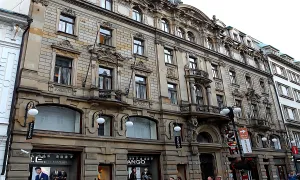
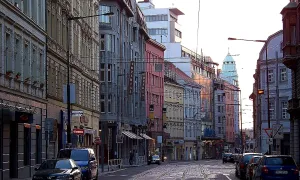
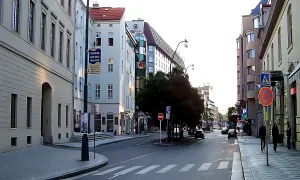
Real photos taken near the monument


Zdroj a licence jsou uvedeny u každého snímku.
Atmosphere of the place
This atmospheric visualisation of the place and period was generated by artificial intelligence. It is not real footage of the location.
Tips from visitors
No tips yet. Be the first!
Log in and add your tip.
Sources and literature
Fotografie: VitVit / CC BY-SA 4.0 — Wikimedia Commons. The author and licence also appear when you hover over the image.
Faktickým podkladem tohoto textu byl článek na Wikipedii, jehož autory jsou přispěvatelé Wikipedie. Článek je dostupný pod licencí CC BY-SA 4.0.
Location on the map
More monuments – Nové Město
Show all in the municipality


Příběhy a pověsti
Legendy, pověsti a příběhy spjaté s touto památkou

Fotografie návštěvníků
Zatím žádné fotografie. Buďte první, kdo přidá fotografii z návštěvy!
Přihlaste se a přidejte svou fotografii nebo hodnoťte.
Za ověřenou návštěvu v aplikaci získáte víc bodů — poznáme podle GPS, že jste na místě.
Reviews and comments