



Klášterní mlýn (Želiv) Water mill
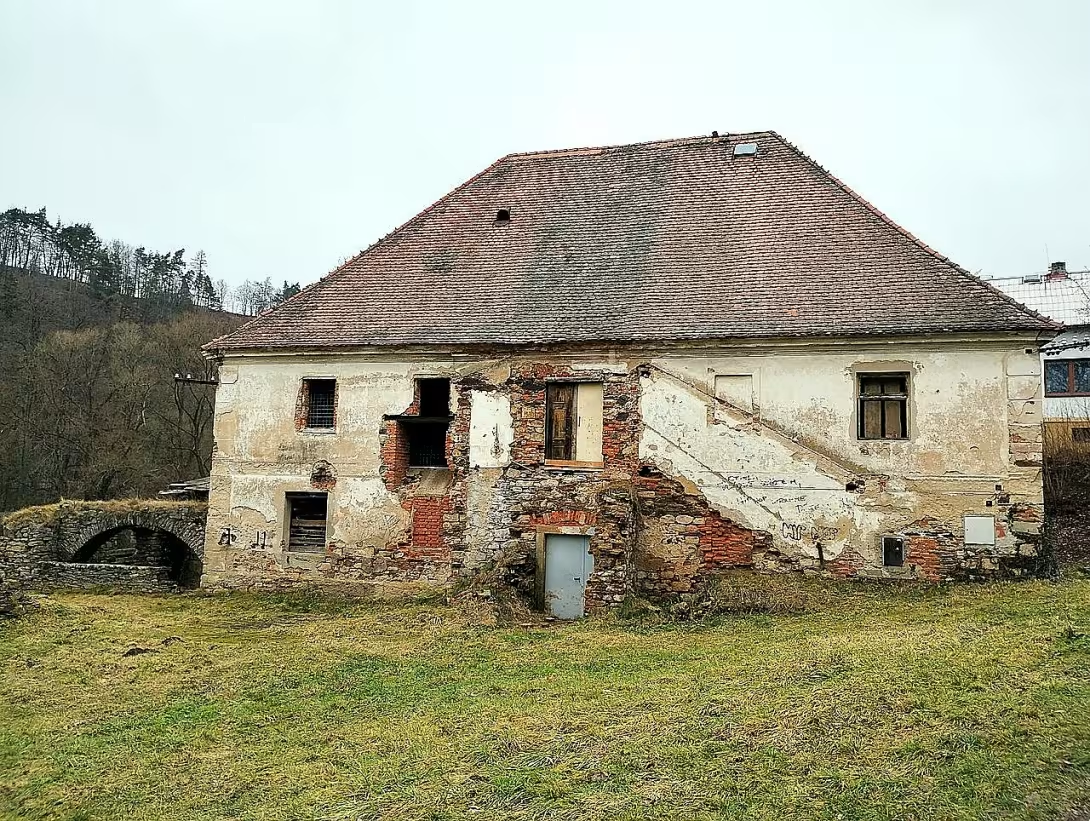
Monastic Mill in Želivi is a historic water mill located north of the local monastery on the river Želivce in Pelhřimov district. The building probably has medieval roots and represents an important technical monument. In the past, it served as a self-sufficient energy source for the monastery's great estate.
Few direct reports of the oldest history of the construction have been preserved, although its medieval origins are assumed. The first written mention dates back to 1680. The monasteries played a crucial role in the economic recovery of the countryside and the management of property at the time when the Czech countries went through the reCatholics and coped with the consequences of the Thirty Years' War. The operation of the mill as part of the monastery facilities fit fully into this system.
Architecturally, it is a single-storey mill building on a rectangular floor plan covered by a steep wavy roof. The facades carry elements of baroque style, particularly visible on modest decoration and corner bosány imitating stone. The original entrance to the building was a covered staircase. On the north side, a half-circle arch of the bridge still clashes over a part of the former drive.
For centuries, the mill has been owned by the Geliv monastery. In 1843 Sommer's topography lists it as a mill equipped with saw and shindle. In the first half of the 20th century, the building underwent a major reconstruction. Between 1939 and 1942, a pair of Francis turbines with wet mammals were installed in an attached turbine house, replacing the original three water wheels with the upper water. This modernization enabled the production of electricity for the needs of the monastery and the large estate. After 1951, when the mill was taken over by the Czechoslovak state goods Pelhřimov, the building was used as a scrap and fodder mill.
Since 1977 the mill has been abandoned and gradually decaying. During the years, the drive and demolition of the farm buildings on the premises took place. Yet key technical elements, such as the saw and both Francis' turbines installed in the mid-20th century, remained preserved.
Monastic Mill in Želivi is a protected real estate cultural monument of the Czech Republic today. Despite the emergency situation, it remains evidence of the historical self-sufficiency of the monastery economy and technical development of the mill industry. Visiting the vicinity of the monastery and the river Želivka offers an opportunity to recognize this monument as part of a wider historical whole.
Historical milestones
- 1680
- First written mention of the mill.
- 1843
- A record of a mill with saw and shindle in Sommer's topography.
- 1939
- The launch of the installation of Francis turbines and the establishment of a power plant.
- 1977
- The completion of the operation and the beginning of the demolition of the mill building.
Architectural development
Originally a medieval building was renovated in the first half of the 20th century. The original water wheels were replaced by a turbine system installed in an attached turbine house. The building shows elements of Baroque architecture, particularly visible on the structure of facades and steep roof.
Historical events
The first written mention dates back to 1680. In the years 1939-1942 there was modernization with the installation of Francis turbines. Since 1977, the object has been abandoned and gradually decaying.
Owners
Želiv monastery, since 1951 Czechoslovak state goods Pelhrimov.
Points of interest
- The building probably has medieval roots and has in the past served as a self-sufficient energy source for the monastery's large estate. - The first written mention of the mill dates back to 1680. - Between 1939 and 1942, two Francis turbines were installed in the built-in turbine house, replacing the original three water wheels with the upper water. - After 1951, when the building was taken over by the Czechoslovak state goods Pelhřimov, the mill served as a scrap mill and a fodder mill. - Since 1977 the mill has been abandoned and gradually decayed, yet key technical elements such as saw and both turbines have been preserved.
Guide
Show guide text
This text was created by artificial intelligence and has not been editorially reviewed. It may contain inaccuracies.
Welcome to the Monastic Mill in Želivi. You are standing in a place where there is a constant noise of water and where history meets the calm of local nature. In front of you is a building that has been a key pillar for the operation of a nearby monastery for centuries. Feel this atmosphere, which is woven through the sound of the river Želivky, which flows just near your feet. This water flow was not only a beautiful background for this place, but above all a tireless source of power, which powered the machines and allowed the life and flowering of the whole monastery estate. Now that you're standing right in front of this historic monument, try to close your eyes for a moment and imagine what sounds this place made at the time of its greatest expansion. Instead of today's peace, there was probably a constant bubbling of water, squeaking of wooden wheels and rhythmic blows of machines.
Now let's go back deep into the past together to understand why this place is so special. Although our historical records show the mill for the first time in writing only in the year one thousand six hundred eighty, experts believe that its roots go much further, perhaps until the Middle Ages. This means that this object has been part of the life of the local community and monastery for centuries. The mill was not just an ordinary building, but a heart of economic background. It was used for many purposes, which were absolutely necessary for those needs. During various periods there was milling of grain, which fed people, and cutting wood, which was the basis for building and heating. This object was a symbol of self-sufficiency and the ability of the monastery to secure its own needs through the force of nature.
Now pay attention to the construction itself, which shows itself to you. Look at its overall form. The building has a clear, rectangular plan that gives it a sense of stability and unwavering. It's a building built to withstand time and constant proximity to water. Above your heads is a steep valb roof, which has a strong slope typical of the architecture of the region and helps drain the water. If you look at the facades of the building now, I'm sure you'll notice an interesting detail. The facades are decorated with brass, which are the highlighted, worked stone blocks that create an interesting rhythm and shadow play on the walls. This element adds some nobility to the mill and shows that the economic building could have been architecturally rich and aesthetically sophisticated. Notice how these stone details collide with the natural texture of the surroundings.
However, this building was not immutable at the time of its existence. Its history is a story of constant adaptation to new challenges and technological progress. In the middle of the nineteenth century, namely around a thousand eight hundred forty-three, the mill was already a very complex operation which included both saw and shingles. This means that people who made wood materials for roofs and buildings have been working around the clock. But the biggest break came much later, between the years one thousand nine hundred thirty-nine and one thousand nine hundred forty-two. There was a fascinating transformation at the time. Two modern Francis turbines were installed in the built-in turbine house. This technological innovation has turned the mill into something much more than just a place for grinding grain. The mill became part of the energy network and began to produce electricity directly for the needs of the monastery. Imagine the revolution when the power of flowing water turned into an invisible force of electricity that illuminated the monastery corridors and powered machines.
Perhaps now you can think of an interesting question concerning the nature of this place. How is it possible that such a small object could be so important? The secret lies in his role as a self-sufficient resource. The monastery mill was not just another building in a row, but it was a key element that allowed the whole monastery estate to function independently from the outside world. This ability to produce energy and food itself in the past has been an enormous advantage and symbol of the power and balance sheet of the local monastery. It's a fascinating idea that this modest object by the river was essentially a small power plant that kept this whole vast complex going.
Unfortunately, with the advent of the modern era and the change of economic ways, the role of the mill gradually changed. In the year one thousand nine hundred seventy, the mill was definitively shut down. Since then, the building has witnessed slow degradation and decay, leaving a certain melancholy trail. Despite the fact that machines are no longer drilling and turbines are no longer moving, the mill still stands as a monumental reminder of human efforts to control the forces of nature and use them for the benefit of the entire community.
Now that you've been through the basic history and architecture of this place, I suggest you continue your walk along the banks of the Želivky River. Feel history intertwined with the present, and watch the landscape change around you. The Monastic Mill will now not only tell you about its walls and roof, but about the whole invisible world of work, energy and tradition that once ruled here. Thank you for spending this moment with us and for stopping by to hear the story of this special place. We wish you a nice continued journey around Želiva.
Tips for visitors
The best time to visit is during the late spring or early autumn, when the surrounding nature of the river Želivky is the most photogenic and the state of the building is not complicated by snow or stormy terrain. Due to the emergency condition of the mill we recommend a visit in daily hours at good visibility.
Due to the emergency state of the monument, move exclusively on marked roads and do not enter enclosed areas. We recommend fixed shoes suitable for field and basic equipment for hiking, as the surroundings of the mill can be wet.
The most suitable morning light for photography is the historical wall of the mill and reflections on the surface of the river Želivka. The best shots can be obtained from the opposite bank, where the overall composition of the mill will stand out in the context of the surrounding landscape.
Family with children we recommend combining tour of the mill exterior with walk to nearby Želiv Monastery or to Trnávka dam tank. The roads in the surroundings are suitable for low-cost family tourism, but at the mill itself ensure the increased safety of children.
Frequently asked questions
Can the monument be visited?
This is a technical monument. Some are open as exhibitions, others are out of use or on private land. We have not verified whether this one is accessible. According to the heritage register the structure is in poor condition – do not enter it and take care nearby.
What are the opening hours and admission?
We have not verified the opening hours or admission. Current information is published by the operator.
Where is the monument?
Location: Želiv, Kraj Vysočina. The map on this page shows the exact spot.
Why is the monument protected?
It is listed in the Central List of Cultural Monuments of the Czech Republic as a cultural monument (register no. 1000125088_0014). It is protected as part of a larger listed ensemble.
Businesses nearby
Do you run a restaurant, accommodation, shop, museum, rental, wellness or other visitor service near this monument? Show yourself directly to the people heading to it — this is how they will see you in the app and on the web:
Nearby
Želiv monastery, river Želivka, dam tank Trnávka.
Accommodation nearby
Themed route
1. Želiv monastery - historical monastery, Gothic and Baroque architecture. It is worth a visit to the impressive church of St. John the Baptist and monastery garden where you can soak up the spiritual atmosphere and admire the preserved frescoes.
2. River Želivka - natural water flow, part of the monastery area. A short walk along the shore offers peaceful views of the water surface and the opportunity to observe local flora and fauna.
3. Klášterní mlýn (Želiv) - historical water mill, main destination trip. You will visit a well-preserved mill bike and exhibition about traditional crop processing, which shows how the monastery used the power of the river.
4. Trunávka dam tank - modern water tank, recreational area. It offers an opportunity to rest by the water, a nice view of the surrounding countryside and the possibility of a short walk along the shoreline.
The route is logically arranged: from the historical Želiv monastery, to the calm river Želiv, to the main destination of the Monastery Mill, and finally to the relaxing dam Trunávka. The approximate distances between each point are 300 m, 500 m, 400 m and 1 km.
Seasonal recommendations
Spring brings to the surroundings Želiv monastery awakening nature, which contrasts with dark walls of the mill. The warm spring light hitting the old stone masonry underlines its texture and historical character. Due to the emergency state of the building, the visit is possible only from the outside, which you will appreciate during this period, because flowering trees and green meadows create a beautiful framework for photography. Practically the spring season is ideal for a quiet tour without large groups of tourists. I recommend wearing layered clothes, as spring weather can be variable and can be cold in the morning. The best time to visit is in the morning when the air is cleaner and light softer.
Summer brings to area Želiva highest attendance, which must be taken into account when planning the trip. The sunlight reveals all the details of the mill facade, but at the same time it can be hot and uncomfortable in the noon hours for longer standing. Therefore, it is best to come as early as possible in the morning, before the main summer crowd is assembled. Clothes should be light and breathable, with plenty of drinking water and sun protection. Since it is an emergency building, it is not possible to enter, so concentrate on the outer surroundings and the monastery area, which in summer is gaining its life thanks to greenery and visitors.
Autumn offers a completely different atmosphere, where coloured leaves and colder air give the scene a melancholy and historical feel. The light is lower and warmer, creating dramatic shadows on the stone walls of the mill. This period is less crowded by tourists, which allows silent contextion and better pictures without disturbing elements. Practical advice includes clothes in cold weather, ideally with waterproof layers, because autumn rains are common. The best time to visit is in the afternoon when the sun drops to the horizon and lighting is the most powerful for photographic images of the historical monument.
Winter brings to Želiva quiet and quiet, often reinforced by snow cover that contrasts with dark stone wall mill. Short days and low sun create specific, cold lighting that emphasizes the hardness and age patina of the building. Due to the emergency condition, the inner space is inaccessible, but the outer area in winter clothing is very atmospheric. I recommend warm clothes, including gloves and hats, and careful walking along possibly slippery paths. The best time to visit is the late morning, when the day is warmer and the light is brightest, while evening cold and darkness quickly start.
Visualizations and artistic views


The visualisations are generated by artificial intelligence and serve as inspiration.
Photos from the area
Real photos taken near the monument


Zdroj a licence jsou uvedeny u každého snímku.
Tips from visitors
No tips yet. Be the first!
Log in and add your tip.
Sources and literature
Photos: JAn Dudík / CC BY 3.0 — Wikimedia Commons. The author and licence also appear when you hover over the image.
Faktickým podkladem tohoto textu byl článek na Wikipedii, jehož autory jsou přispěvatelé Wikipedie. Článek je dostupný pod licencí CC BY-SA 4.0.
Location on the map



Příběhy a pověsti
Legendy, pověsti a příběhy spjaté s touto památkou
Fotografie návštěvníků
Zatím žádné fotografie. Buďte první, kdo přidá fotografii z návštěvy!
Log in a přidejte svou fotografii nebo hodnoťte.
Za ověřenou návštěvu v aplikaci získáte víc bodů — poznáme podle GPS, že jste na místě.
Reviews and comments