



Kostel Nejsvětější Trojice na Novém Městě v Praze Church
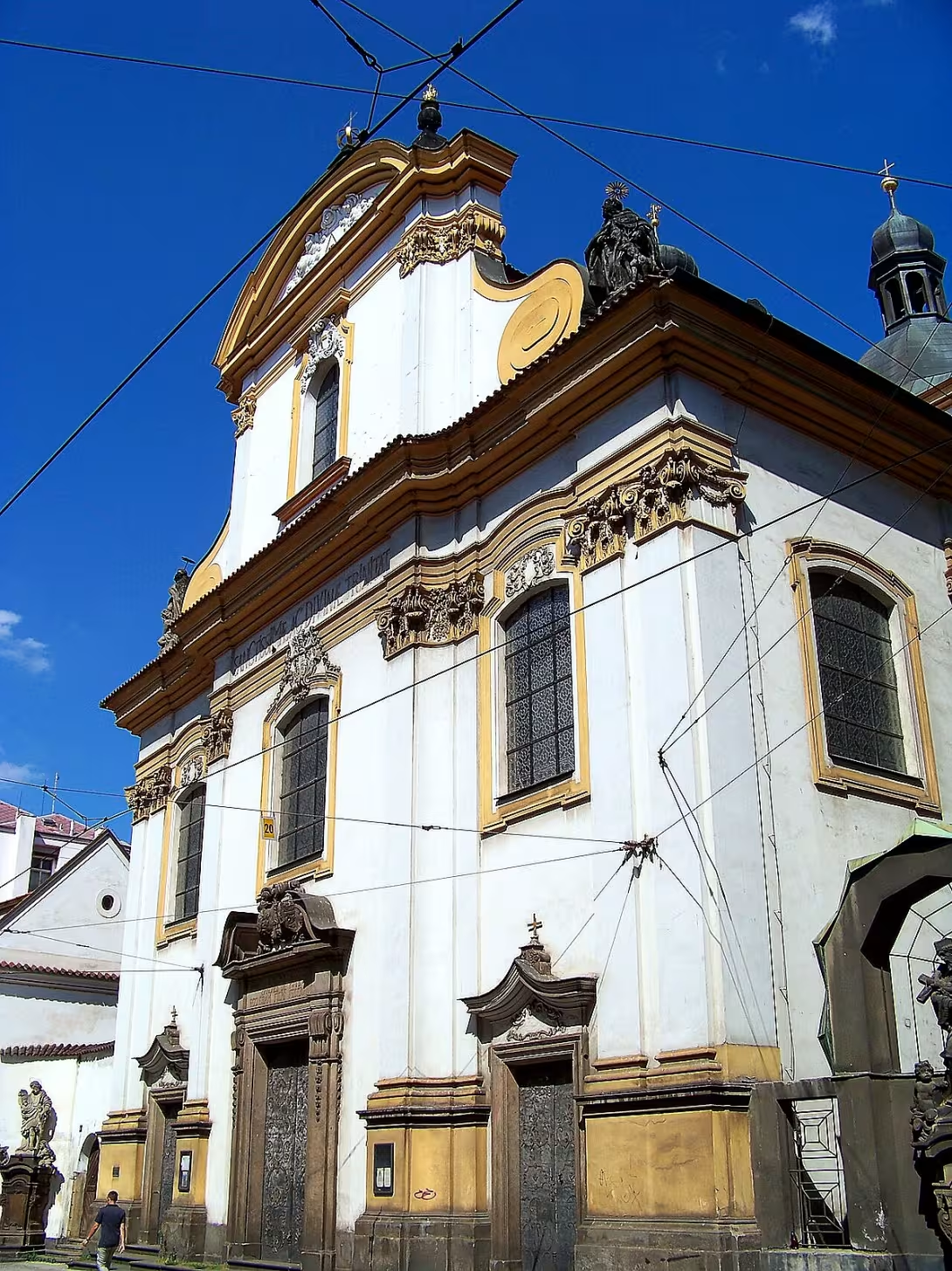
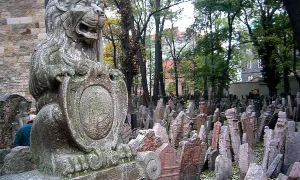
Interesting place with long history. In 1254 a Jewish cemetery was established, and in 1478 it was abolished. Over time, several residential houses were built. In 1708, trinitarians - a order aimed at buying prisoners out of Turkish captivity - bought two houses with Shossov rights. They were already granted permission to establish the Convention by Emperor Leopold I, perhaps three years earlier.
The construction began in 1708 and lasted until 1713. It was led by builders Kryštof Dientzenhofer and Jan Jiří Aichbauer younger according to the project Octavia Broggia. The patron Baron Jan Ignác Putz of Adlersthurn, the highest mincmaster of the Kingdom of Bohemia, financed the construction together with his wife Terezia Klara Freisleben. During the construction there were modifications of the project: the oratory in the boat was launched and the extended priesthood under the tower was added. These changes were decided in 1710. The similarly solved dome also appears at the pilgrimage church of St. Mary in Chlum, where Dientzenhofer also worked, suggesting that changes could have come from one head. The Convention was probably built in 1716.
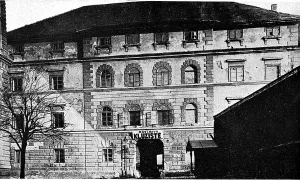
The church is a baroque tripod with a tower. Josef Navre painted parish interiors around 1850, but his paintings were later killed. The facade was restored in 1896 and again in 1991. The parish building was built in 1784 according to Pavel Wiedhoff's plan in early classical style. In 1881 a house was built with an apartment for the bell tower. The former monastery was torn down in 1889.
In 1783, during the reforms of Joseph II, the monastery of trinitarians was abolished and the church closed; The area of the convention has turned into barracks. But the believers have reopened it. In 1784 the parish was transferred here from the repealed church of St. Martin in the wall - along with the Renaissance tin baptiser from 1552 and the Gothic door to the sacristy. The first services took place on the first Advent Sunday of the year 1784, in which it dominated German, including sermon; Since 1785 it has only been Czech.
Today the church is protected as a cultural monument and is located near the Faculty of Education of Charles University. It has been used by the Slovak Greek Greek Community since the end of 2005. The construction remains an interesting witness to the Baroque age and changing character of Prague's New Town.
Then and now
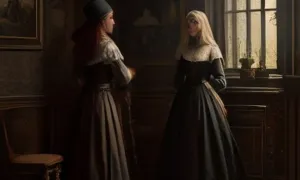
Drag the slider to compare how the landmark may have looked when it was built with the view today.
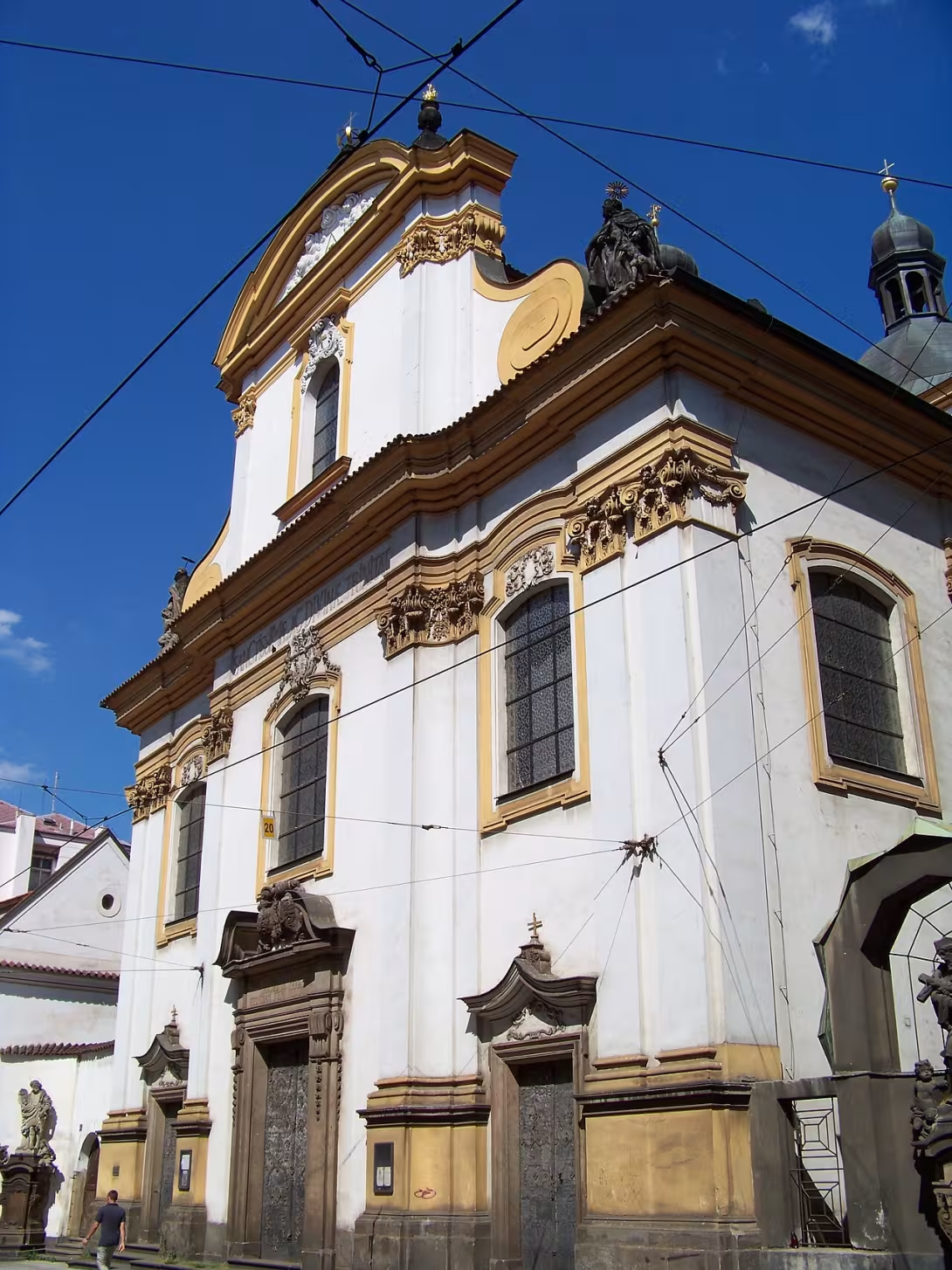
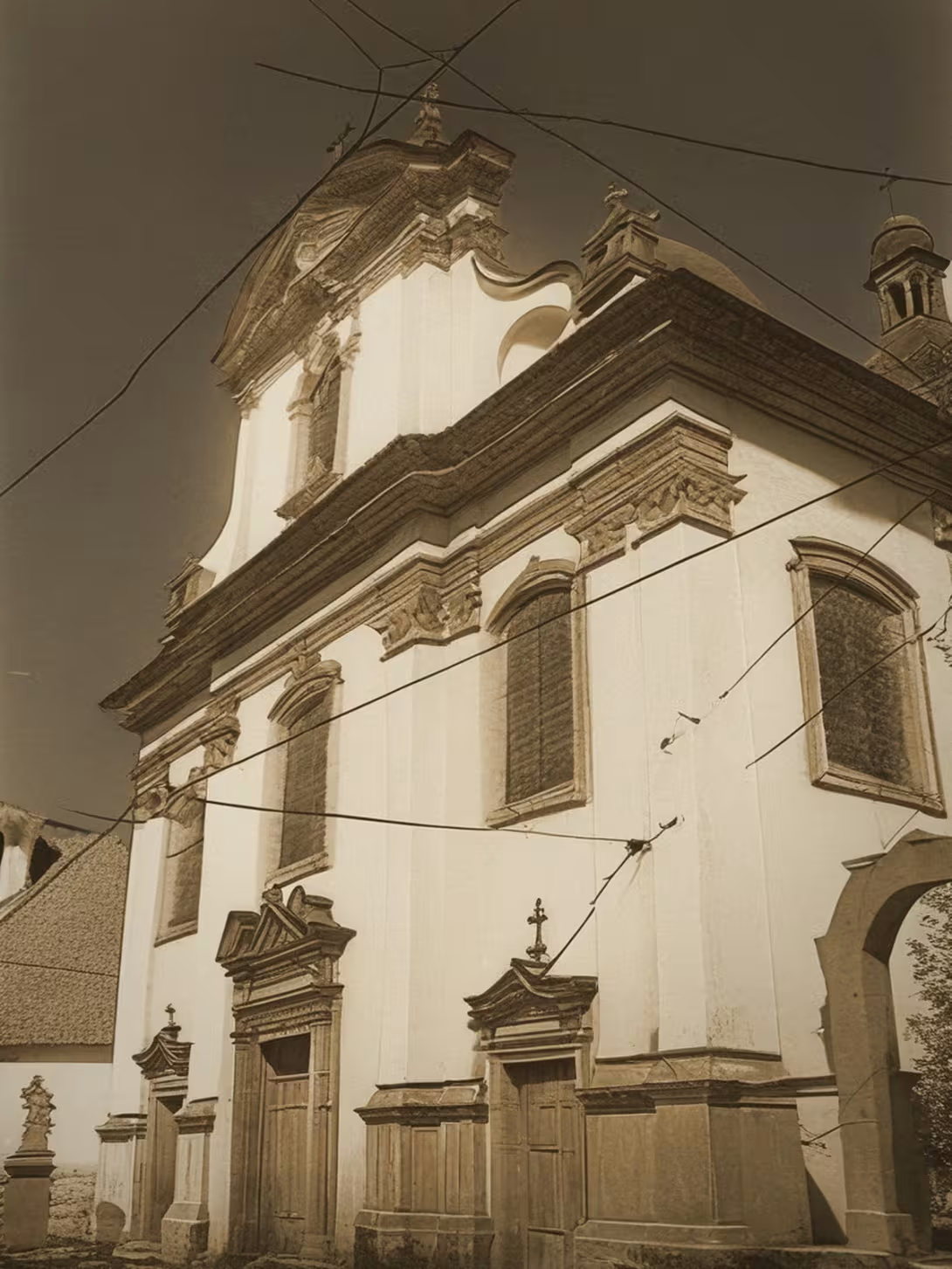
The historical appearance on the left is an AI-generated visualisation and serves as inspiration only.
Historical milestones
- 1254
- Establishment of a Jewish cemetery in place of a future church
- 1708
- Land purchase trinitaries for the construction of monastery and church
- 1713
- Completion of church construction and consecration
- 1783
- Cancellation of monastery and conversion of premises to barracks
- 1784
- Transfer of the parish from St. Martin's church in the wall and start of regular service
- 1889
- The demolition of the monastery building
- 2005
- Allocation of the Church to the Greek Catholic Church
Architectural development
The church was built on the basis of the Octavia Broggia project, but with architectural modifications made by Kryštof Dientzenhofer and Jan Jiří Aichbauer mladší. The original proposal included an oratory in a ship which was later launched. The clenches were changed so that the central space had a dome with a lantern, while the priesthood was supplemented by symmetrical sacristy. The facade was newly modified in 1896 and 1991. The monastery building was torn down in 1889.
Historical events
- 1254
- Establishing a Jewish cemetery at the site of the present church
- 1713
- Completion of the church and monastery of trinitarians
- 1783
- Cancellation of monastery and conversion of premises to barracks
- 2005
- Allocation of the Church to the Greek Catholic Church
Owners
- 1708-1783
- 1784-2005
- since 2005
Points of interest
- The church was built between 1708 and 1713 according to the project of Octavia Broggia, the building was led by Kryštof Dientzenhofer and Jan Jiří Aichbauer mladší.
- The original project was modified in 1710 - the oratory was launched in the ship and added the extended priesthood under the tower.
- The church was originally served by order of trinitarians who were engaged in the redemption of prisoners from Turkish captivity.
- In 1783 the monastery was closed and the church was closed, but the parish was restored already in 1784, and the Renaissance tin baptizer from 1552 was brought here.
- The first service after the reconstruction took place in 1784, the sermon was first German, but since 1785 it has only proved Czech.
Guide
This guide is narrated by a synthetic voice generated by artificial intelligence.
Show guide text
This text was created by artificial intelligence and has not been editorially reviewed. It may contain inaccuracies.
On Spálená street in the New Town in Prague stands a baroque three-aisled church of the Most Holy Trinity with a tower from the year 1713. It was built by the Trinitarians, that is, the Order of the Most Holy Trinity for the redemption of captives. This Catholic order dedicated itself primarily at that time to redeeming Christians from Turkish captivity. The church is protected as a cultural monument and is located in the immediate vicinity of the Faculty of Education of Charles University.
On the site of the church there was a Jewish cemetery from the year 1254. In 1478 it was closed down and the land was divided into plots, so several houses were built there. Two of them were purchased by the Trinitarians in 1708. Three years earlier, Emperor Leopold the First had permitted them to establish a convent. The church and the adjacent convent building facing Lazarská street were built in the years 1708 to 1713 according to the design of Octavio Broggia. The construction was led by Kryštof Dientzenhofer and Jan Jiří Aichbauer the Younger. The entire construction was financed by the highest mintmaster of the Kingdom of Bohemia, Baron Jan Ignác Putz z Adlersthurnu, with his wife.
Contrary to Broggia's proposal, several things changed during construction. The oratories were removed from the aisle and an extended sanctuary was added. Only the central space received a dome with a skylight and symmetrical sacristies were created around the sanctuary. The dome is solved similarly in the pilgrimage church in Chlum, where Kryštof Dientzenhofer also worked. This suggests the assumption that he promoted these changes.
In 1783, the convent was closed as part of the reforms of Emperor Joseph the Second and the convent became a barracks. The faithful, however, achieved the reopening of the church. In 1784, the parish was transferred here from the closed church of sv. Martina ve zdi. From there comes a Renaissance tin baptismal font with the date 1552 and Gothic doors to the sacristy covered with iron bands. The New Town had only four parish churches at that time, whereas the Old Town had eight. The first services of the new parish were held on the first Sunday of Advent in 1784. At first German predominated here and Czech services were held only in the morning mass. From 1785 onwards, sermons were already preached only in Czech.
The building of the former convent was demolished in 1889. The church received a new façade in 1896 and again in 1991. At the end of 2005, the local Roman Catholic parish was closed down and the church was given into the use of Slovak Greek Catholics.
Frequently asked questions
Can the monument be visited?
Religious buildings are usually open mainly during services; at other times a visit is normally arranged with the parish or the operator. We have not verified specific times.
Where is the monument?
Location: Praha, Hlavní město Praha. The map on this page shows the exact spot.
Why is the monument protected?
It is listed in the Central List of Cultural Monuments of the Czech Republic as a cultural monument. It is protected as part of a larger listed ensemble.
For kids
Imagine going back 313 years, until Prague's New Town was still a young town. At that time, there was the Church of the Holy Trinity, which today is protected as a cultural monument.
How did it look here? Who lived here? What happened here? The city was full of craft shops and shops. People lived in homes with high roofs and slender towers. The church held mass and religious rituals.
Businesses nearby
Do you run a restaurant, accommodation, shop, museum, rental, wellness or other visitor service near this monument? Show yourself directly to the people heading to it — this is how they will see you in the app and on the web:
Events nearby

Zdroj akcí: otevřená data měst a obcí ČR (Národní katalog otevřených dat) a kalendář akcí Národního památkového ústavu.
Nearby
Faculty of Education at Charles University
Accommodation nearby
Trips and activities nearby
Guided tours, tickets and activities nearby from GetYourGuide
Affiliate link: if you buy from the partner, we may receive a commission. The price for you does not change.
Search tours and activities →Themed route
Thematic cruise route: Baroque and educational trails of New Town
1. Church of the Holy Trinity * Type: * Sacral monument, Baroque architecture. * Why visit? * A unique example of Prague Baroque with rich decoration, built in the place of the former Jewish cemetery. His history is closely linked to the fates of New Town and the transformation of his urban face.
2. St. Martin's Church in the Wall * Type: * Gothic church, historical parish building. * Why visit? * Originally there was a church of parishes for the New Town before it was replaced by the Church of the Holy Trinity in the 17th century. Interesting is its name referring to medieval buildings and city walls.
3. Faculty of Education of Charles University * Type: * Academic building, historical university monument. * Why visit? * It is located in the immediate vicinity of the church and is an example of the adaptation of baroque and classical buildings to educational purposes. Facades and interiors reflect the long tradition of Prague education.
4. Lazarus Street * Type: * Historical street, connected with monastery life. * Why visit? * Named after the former Lazaret, later associated with the monastery and the town building. The street offers an authentic Prague atmosphere with houses of various epoch, including baroque and classical.
5. Burned Street * Type: * Historical communication, named after a tragic fire. * Why visit? * One of the oldest streets of New Town, named after the Great Fire in 1541. Today it is a quiet street with preserved historical houses, which complements the atmosphere of the Baroque centre.
Seasonal recommendations
Spring During the spring, when Praha wakes from winter sleep, the Church of the Holy Trinity in New Town offers a unique atmosphere of calm and bloom. The sun rays penetrate through the stained glass and create a color game on the stone walls, while the surrounding parks and gardens begin to dress in green shades. The soft light of the morning clock is also specific, which highlights the details of Baroque architecture and creates fine shadows on the facade. Practically it is advisable to visit the church early in the morning, when the attendance is low and can be easily viewed both the interior and the surrounding cemetery. It is recommended that clothing suitable for variable weather - light layers that allow to adapt to temperature fluctuations, and comfortable shoes for walking on stone paths. In this period is also an ideal time for photography, when the church and its surroundings appear in full glory.
Summer The main summer season brings to the surrounding church The most holy Trinity live atmosphere, where visitors gather not only inside, but also on the surrounding terraces and in the park. The warm sunlight emphasizes the golden details of statues and frescoes, while the shadows of trees create pleasant cooling. The evening lighting is also specific, which in the summer months starts soon after sunset and gives the church a mysterious atmosphere. Practically, it is best to come in the morning, when the church is still cold and full of crowds, or in the late afternoon, when the attendance decreases. Light, breathable clothes, sunglasses and hat are recommended to minimise overheating. Due to the high traffic, it is advisable to carry enough water and possibly small backpacks for small objects.
Autumn Autumn brings to the church area The Holy Trinity, a rich palette of colors, where tree leaves turn into shades of red, orange and yellow, which contradict stone architecture. Cooler air and short days create a calm and contemplative atmosphere, ideal for walking and meditation. A soft, scattered light is also specific, which emphasizes the details of statues and vitrates without sharp shadows. It is practically advisable to visit the church in the morning when the light is the most beautiful and the traffic is lower than in the afternoon. It is recommended that warmer clothes, which protect against the cold wind, and comfortable shoes, since in this period there are often rainy days. Due to the lower temperature, it is also nice to enjoy a quiet atmosphere in the church without a summer crowd.
Winter In the winter months, the Church of the Holy Trinity in New Town offers a unique atmosphere, where the snow cover and frost are reflected in its Baroque architecture and create a mysterious, almore fairy tale set. Freezing air environment and short days provide the interior of the church with a special calm and contextual touch, while outdoor lighting highlights the details of the facade. Specific is also limited daylight, which forces visitors to concentrate on a detailed examination of the interior. Practically, it is best to visit the church in the afternoon when there is enough light out and the attendance is lower than in the pre-Christmas period. It is recommended to warm, layered clothes that protect against cold, and comfortable shoes with anti-slip soles because the roads can be frozen. Due to shorter days, it is also advisable to carry a small flashlight lamp to facilitate orientation in the interior.
Visualizations and artistic views


The visualisations are generated by artificial intelligence and serve as inspiration.
Photos from the area
Real photos taken near the monument


Zdroj a licence jsou uvedeny u každého snímku.
Tips from visitors
No tips yet. Be the first!
Log in and add your tip.
Sources and literature
Photos: ŠJů (cs:ŠJů) / CC BY-SA 3.0 — Wikimedia Commons. The author and licence also appear when you hover over the image.
Faktickým podkladem tohoto textu byl článek na Wikipedii, jehož autory jsou přispěvatelé Wikipedie. Článek je dostupný pod licencí CC BY-SA 4.0.
Location on the map
Příběhy a pověsti
Legendy, pověsti a příběhy spjaté s touto památkou
Fotografie návštěvníků
Zatím žádné fotografie. Buďte první, kdo přidá fotografii z návštěvy!
Log in a přidejte svou fotografii nebo hodnoťte.
Za ověřenou návštěvu v aplikaci získáte víc bodů — poznáme podle GPS, že jste na místě.
Reviews and comments