



Kostel Nejsvětější Trojice (Střekov) Church
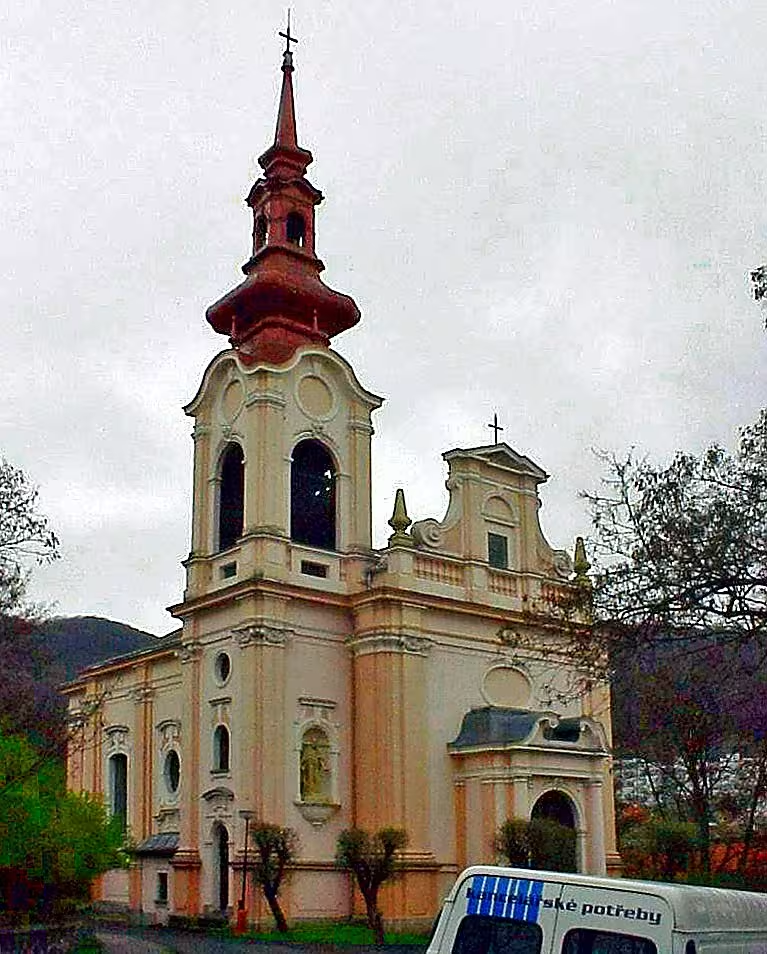
The Church of the Holy Trinity is located in Ústí nad Labem-Střekov above Zukov Street, in a cleft between it and Jesenin Street. It is a neo-Baroque parish building whose history is closely related to the rise of industry in this part of the Czech Republic. The project was developed by Teplice architect Max von Loos and the construction was carried out in the early 20th century by the owner of the Georg Schicht plant, the then largest European fat processing company. He carried his seat here in the early 1980s and triggered the turbulent development of surrounding communities.
The base stone was laid on 19 May 1901 and the construction lasted two years. The church was ceremonially consecrated on July 1, 1903. In the tower they placed a religious bell that came here as a gift of the city of Ústí nad Labem - it came from the church of St. Materno, which was demolished in 1896. The church was to serve the growing village of Novosedlice-Kramoly, which soon became important as an industrial satellite settlement. All the local units have gradually united under the name Střekov (since 1922), the village became the most populous village of the then Czechoslovakia and in 1936 it was promoted to the city.
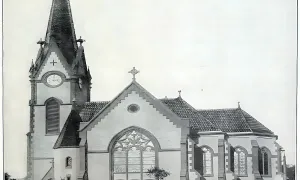
Architecturally, it is a single-boat construction with a rectangular presbyter removed with a triangular apsid oriented north. The ship covers a rolling vault and the tower is adjacent to the southwest corner of the building. The rich external plastic decoration made of artificial stone consisted of statues and ornaments, which, over the years, were very badly resistant to aggressive industrial air. The great statue of Christ, which once dominated the main entrance portal, completely fell apart. The interior equipment remained a loyal style of the time of origin, with neo-Baroque furniture and decoration.
During World War II, the church survived the bombing without further damage, but the following years brought about its gradual decline. It wasn't until the end of the 1990s that a bigger recovery took place. Today, they perform an important parochial function for the Prague part Ústí nad Labem and adjacent municipalities. Since the late 1980s, it has been partially covered by a panel house from the centre of the city, yet the Holy Trinity has been a witness to lush industrial development, which has changed the form of the whole site for over a century.
Then and now
Drag the slider to compare how the landmark may have looked when it was built with the view today.
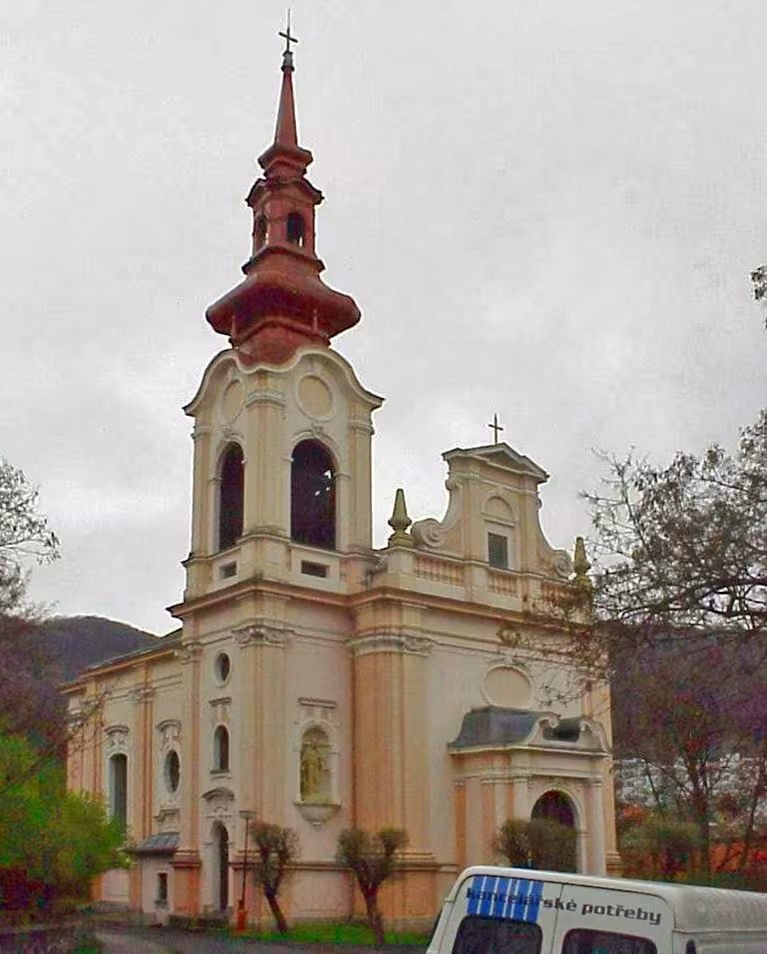

The historical appearance on the left is an AI-generated visualisation and serves as inspiration only.
Historical milestones
- 1901
- The laying of the foundation stone of the Church of the Holy Trinity, funded by industrialist George Schicht for the growing industrial area.
- 1903
- The ordination of the church on July 1st, when the bell was hung from the dismantled church of St. Matherna in Ústí nad Labem.
- 1922
- Merging the municipalities of Novosedlice, Kramoly and Střekov under the name Střekov, leading to the establishment of a separate Catholic parish.
- 1939
- Connecting Střekova to Ústí nad Labem, thus becoming part of the city.
Architectural development
The church was built in 1901-1903 in a neo-Baroque style according to the design of architect Max von Loosa. The single-boat building with a vaulted vault and a triangular apsid has an adjacent tower on the southwest corner. The external decoration of the artificial stone was largely damaged by chemical air. The interior device corresponds to the original style.
Historical events
1901 - laying of the church base stone
1903 - consecration of the church after two years of construction
1922 - the merger of the municipalities Novosedlice, Kramoly and Střekov under one name
End of the 20th century - extensive repair after long-term decay
Points of interest
- The church was built in the early 20th century as a parish building for the growing industrial settlement of Novosedlice-Kramola.
- His project was developed by architect Max von Loos and the construction was financed by the owner of the Georg Schicht plant, who carried his seat here in the 1880s.
- The church tower hosts a bell donated from the city of Ústí nad Labem, originally from the church of St. Materno demolished in 1896.
- The building was festively consecrated on 1 July 1903 after two years of construction, whose foundation stone was laid on 19 May 1901.
- External plastic decoration, including a large statue of Christ above the main entrance, was damaged by aggressive industrial air.
Guide
This guide is narrated by a synthetic voice generated by artificial intelligence.
Show guide text
This text was created by artificial intelligence and has not been editorially reviewed. It may contain inaccuracies.
The Church of the Holy Trinity is a Roman Catholic parish church in the Střekov district of Ústí. This neo-baroque building stands above Žuková Street, in the gap between it and Jeseninová Street. Since the late eighties of the twentieth century, it has been obscured from the view of the city center by a panel building.
Its creation is connected with industry. At the beginning of the eighties of the nineteenth century, the company Georg Schicht moved its headquarters to the border of Novosedlice, Kramoly and Střekov, close to the railway station of the Austrian Northwestern Railway. Its fat processing factory was the largest in Europe at that time. The surrounding villages grew rapidly because of it and soon required their own independent Catholic parish.
The church was intended for the merged municipality of Novosedlice-Kramoly. It was built between 1901 and 1903 with the support of the factory owner. The cornerstone was laid on May nineteenth, nineteen hundred and one, and the consecration took place on July first, nineteen hundred and three. The neo-baroque design was drawn up by Max von Loos, an architect from Teplice. The city of Ústí nad Labem donated to the tower a bell from the local Church of Saint Maternus, which had been demolished in eighteen ninety-six.
From nineteen twenty-two onwards, all three municipalities shared the common name Střekov. They thus became the most populous village of that time Czechoslovakia. In nineteen thirty-six Střekov was elevated to the status of a city and on January first, nineteen thirty-nine it was incorporated into Ústí nad Labem.
The church survived the bombing at the end of the Second World War without major damage. After the war, however, it gradually fell into serious disrepair. It underwent major renovation only at the end of the nineties of the twentieth century. Today it serves as a parish church for the right bank part of the city and for the adjacent villages.
It is a single-nave building with a barrel vault. The nave is followed by a rectangular recessed presbytery, terminated by a three-sided apse and oriented towards the north. The tower adjoins the southwestern corner of the nave. The external decoration, including sculptures, was made of artificial stone. This has very poor resistance to aggressive air in the vicinity of chemical production. This is why a large statue of Christ that stood above the main entrance portal has completely disintegrated. The interior furnishings date from the time of construction and are likewise neo-baroque.
Tips for visitors
The best time to visit the Church of the Holy Trinity is during the morning hours when the inner spaces are lit with a favorable light and there is a quieter atmosphere. The ideal is to visit the church before noon when the outdoor light is mild and suitable for photography. If you want to enjoy the church in peace, avoid weekends and holidays when the place is often visited by larger groups.
It is recommended to arrive by car because public transport to Střekova is not very common.
When visiting the church, wear comfortable clothes and shoes because the interior can be cold and the floor is often covered with tiles. Children can bring a little toy or a book to entertain themselves during their visit. If you are planning to photograph, remember to take a high-quality camera or smartphone with a good camera because the church interior offers beautiful architectural details.
The best places for photography are mainly the inner spaces of the church, especially the presbytery and the main ship. The best light is in the morning or in the afternoon, when the rays of the sun create pleasant shadows and illuminate details. External photographs are possible from around Zhukov Street, where the church is well visible. Always avoid photography during services to avoid disturbing the peace.
Around the church it is worth visiting Zhukov Street, which forms the cleft between it and Jesen Street. This street is typical of the industrial atmosphere Střekova and offers the possibility of walking around historically important places.
For families with children, a visit to the Church of the Holy Trinity is particularly interesting because of its historical importance and architecture. Children can look at small details such as statues or stained glass and learn about the history of the place. It is possible to find quiet places to sit and relax around the church where children can have fun. It is also recommended to use the proximity of Zhukov Street for a short walk and exploring the surrounding area.
Frequently asked questions
Can the monument be visited?
Religious buildings are usually open mainly during services; at other times a visit is normally arranged with the parish or the operator. We have not verified specific times.
Where is the monument?
Location: Střekov, Ústecký kraj. The map on this page shows the exact spot.
For kids
Imagine going back 1025 years to the past. Střekov, a small town on the mouth of the Elbe River, was still young and rapidly expanding. The Church of the Holy Trinity stood in the heart of the city and was its most important monument.
Is that what the world looked like? People lived in small houses of stone and wood, merchants sold their goods on the markets. The city was full of life, craftsmen and artists. And then there was the church - the tallest building in town, like it climbed up to heaven.
Businesses nearby
Do you run a restaurant, accommodation, shop, museum, rental, wellness or other visitor service near this monument? Show yourself directly to the people heading to it — this is how they will see you in the app and on the web:
Events nearby
Zdroj akcí: otevřená data měst a obcí ČR (Národní katalog otevřených dat) a kalendář akcí Národního památkového ústavu.
Nearby
- The streets on which the church stands form a cleft between her and Jesen Street.
- The proximity of the railway station contributed to the development of the industrial area and the subsequent formation of the church.
- It covers the church when viewed from the city centre, which is typical of urban transformation of the area.
Accommodation nearby
Trips and activities nearby
Guided tours, tickets and activities nearby from GetYourGuide
Affiliate link: if you buy from the partner, we may receive a commission. The price for you does not change.
Search tours and activities →Themed route
Thematic cruise route around the Church of the Holy Trinity in Střekov
1. Church of the Holy Trinity Baroque church from the 18th century, built thanks to the development of industry around the railway line. Its architecture and historical importance make it dominant in the village.
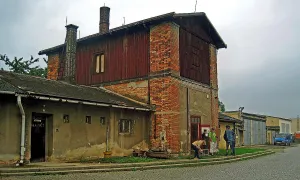
2. Railway line Austrian Northwest Railways About 200 meters from the church. Visiting the local historical railway station (remnants) or walking along the track will show how the railway affected the formation of the church and the whole city.
3. Zhukov Street The cleft between her and Jesenin Street is a unique urban landmark. A walk down the street will reveal how the history of industrial development and the current development are projected here.
4. Panel House from the late 1980s Direct view of the church from the center of the village. The contrast between the ancient church and the modern building illustrates the transformation of the city in the 20th century.
Seasonal recommendations
Spring Spring at Střekov offers a unique atmosphere where the Church of the Holy Trinity is projected into a green landscape and the sun's rays illuminate its stone details. Light days and fine shadows on the facade create a contrast with the dark vaults of the interior, which thus appears to be both mysterious and refreshing. Nature around the monument blooming trees and fields creates pleasant harmony, while the air is still cold, but without winter dust. In this period, the visit is ideal for those who want to escape the crowds because tourists are even less numerous than in the summer months. Light clothes with layering are recommended - it may be cold in the morning, but warm up quickly after noon. The best time to visit is early morning or afternoon when the sun does not blind and the monument shines in a calm light.
Summer Summer brings to Střekova lively atmosphere, when the Church of the Holy Trinity becomes the center of interest of many visitors. Hot days and long light clocks illuminate the memory with golden light, which emphasizes detailed sculpting work on portals and windows. Nature around it is dry and green, with high grass and sunspots on the ground that lure you to rest. In the main summer season, however, larger crowds need to be counted, especially in the morning. It is recommended to come as soon as possible after opening or in the evening when the heat is less uncomfortable and the traffic is decreasing. Light, airy clothes and hat protect from the sun while comfortable shoes help walk around the surrounding sides.
Autumn Autumn Střekov is magical with its golden and red lighting, when in the morning the sun illuminates the Church of the Holy Trinity from one side, while shadows on the other side create dramatic contrast. Nature turns around into a colour palette, leaves on trees turn into yellow and orange shades, while the air is cold and clean. The atmosphere is calm because tourists are already less numerous than in the summer, but the monument still attracts lovers of nature and history. It is suitable to dress with layers - light jackets or sweaters that protect against cold wind. The best time to visit is in the morning when light is soft and nature still full of life before winter.
Winter Winter Střekov offers a quiet and peaceful atmosphere where the Church of the Holy Trinity appears to be dark and mystical in the white light of snow. Short days and low sun light up a memory from one side, while shadows stretch long on the ground, creating a mysterious mood. Nature around is covered with a white blanket that gives the landscape peace and quiet. In advent time the visit is even more pleasant because the atmosphere is Christmas and quiet. Hot clothing is recommended as temperatures often fall below freezing. The best time to visit is in the afternoon when the light is still sufficient and the monument shines in a quiet light.
Visualizations and artistic views


The visualisations are generated by artificial intelligence and serve as inspiration.
Photos from the area
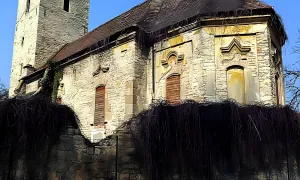
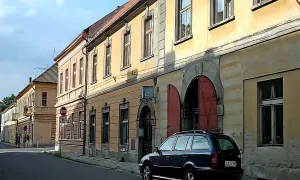
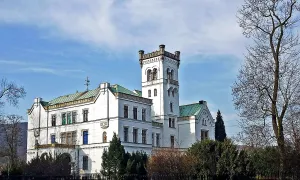
Real photos taken near the monument

Zdroj a licence jsou uvedeny u každého snímku.
Atmosphere of the place
This atmospheric visualisation of the place and period was generated by artificial intelligence. It is not real footage of the location.
Tips from visitors
No tips yet. Be the first!
Log in and add your tip.
Sources and literature
Photos: Lukas Sova / Public domain — Wikimedia Commons. The author and licence also appear when you hover over the image.
Faktickým podkladem tohoto textu byl článek na Wikipedii, jehož autory jsou přispěvatelé Wikipedie. Článek je dostupný pod licencí CC BY-SA 4.0.
Location on the map
Příběhy a pověsti
Legendy, pověsti a příběhy spjaté s touto památkou
Fotografie návštěvníků
Zatím žádné fotografie. Buďte první, kdo přidá fotografii z návštěvy!
Log in a přidejte svou fotografii nebo hodnoťte.
Za ověřenou návštěvu v aplikaci získáte víc bodů — poznáme podle GPS, že jste na místě.
Reviews and comments