



kostel Proměnění Páně Church
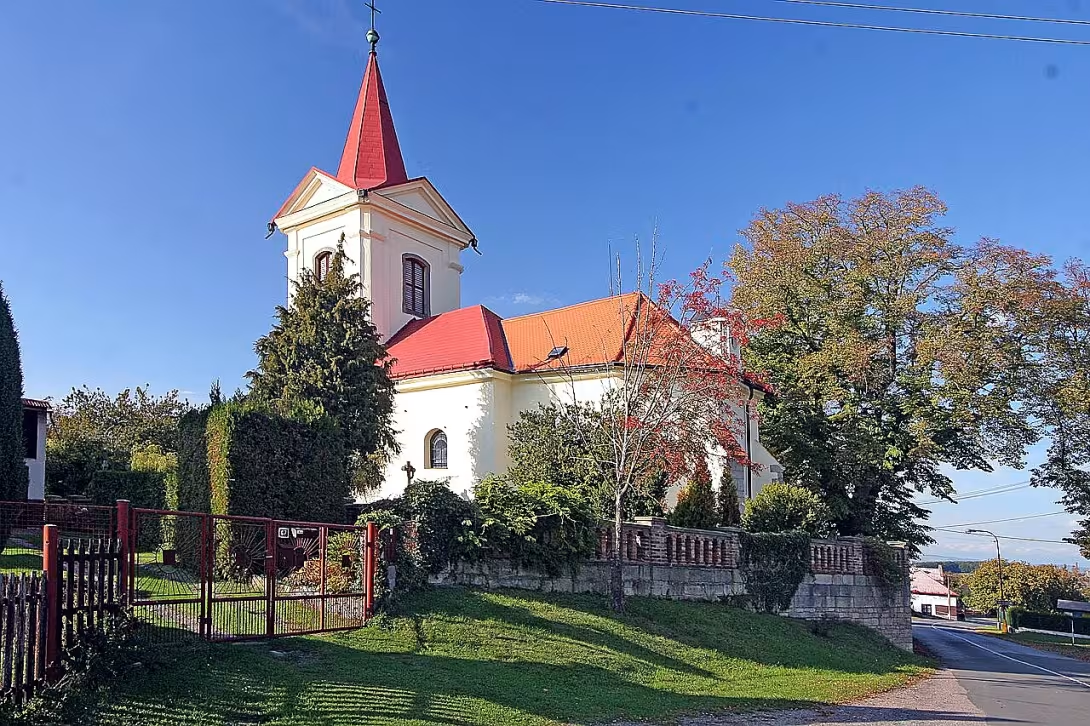
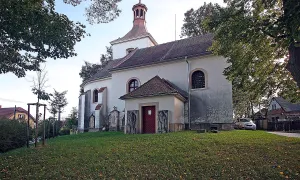
The Church of the Transformation of the Lord in Chlum near Výstar is an important baroque one-boat building with polygonal presbytery. His history dates back to the 14th century. The building is closely associated with events of the Prussian-Austrian War in 1866 and is today a protected cultural monument, which is part of the educational path of the Central battlefield Chlum.
The first written mention of the shrine dates back to 1384, where a smaller building could have stood in its place earlier. In the 16th century, for the ownership of the House of Bořek of Dohalice, the building underwent reconstruction. In the 17th century she lost her parish status and became a filial church falling under Všestary. In the 18th century, the Dobřenský family from Dobřenice, Karel Ferdinand Dobřenský z Dobřenic and later his widow Elizabeth, deserved the development of the monument.
The construction has a rectangular plan and polygonal presbytery with gothic elements. In the middle of the 18th century, the original wooden tower replaced the walled tower. In 1824 the ceiling of the ship collapsed, which subsequently replaced the current reed structure. The interior is decorated with a late Renaissance triple-wing closing sheet serving as the main altar. In the northern side altar there is a picture of the crucified from 1872 by the painter Josef Kolář. The southern side altar is complemented by a statue of St. Isidor, which she had set up in 1744 by Alžběta Dobřenská z Dobřenic. The only preserved bell from 1541 was made by Václav Farář from Hradec Králové.
During the battle at Hradec Kralove on July 3, 1866, the church served as a Lazaret. The doctors used the main altar menza for field operations. The building was badly damaged by the fight and still the cannons and grenades remained in its walls. After the peace was concluded, the church visited the Emperor František Josef I., who devoted funds to his renovation. In December 1868, a strong storm destroyed the upper part of the tower that penetrated the vault of the presbytery; The repairs ended in 1870. In 1876, the Crown Prince Rudolf saw the memory.
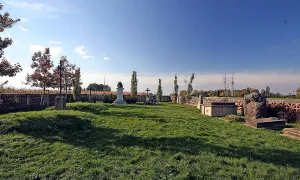
In the surrounding cemetery, officers who were killed in the battle of 1866 rest. There is a joint grave of Prussian officers marked with granite boulder, the grave of Austrian Major Ferdinand Graf Grünne under the high granite cross and the sandstone tombstone of General Ferdinand Poschacher von Poschach.
Since 1964, the church has been protected as a cultural monument. In recent years it has undergone extensive repairs involving the reconstruction of the facade of the tower, ship, presbytery and sacristy, restoration of the pulpit and repair of the organ. Today, the building is accessible as a stop of the educational path of the Central battlefield Chlum. Visiting this place offers the opportunity to become acquainted with the history of Baroque architecture as well as with tragic events that have fundamentally affected the region in the 19th century.
Historical milestones
- 1384
- First written mention of the church.
- 1866
- The church served as a Lazaret during the battle at Hradec Králové.
- 1868
- The collapse of the upper part of the tower during the storm.
- 1964
- Statements of the church for a cultural monument.
Architectural development
The original Gothic foundation was rebuilt in the 16th century and in the middle of the 18th century it was baroque, including the construction of a wall tower instead of the original wooden one. In 1824, the ship's collapsed ceiling was replaced by a reed structure. There have been extensive repairs of facade, interior and technical equipment in recent years.
Historical events
The first written mention of the church dates back to 1384. During the battle at Hradec Kralove in 1866, the church was used as a Lazaret and suffered considerable damage. In 1868, the upper part of the tower was destroyed during a strong storm.
Owners
House of Bořky from Dohalice (16th century), family of Dobřenský from Dobřenice (18th century).
Points of interest
- The church is a baroque one-ship building whose history dates back to the 14th century. - During the battle of 18 hundred and sixty-six, the church served as a Lazaret, and doctors used the main altar for operations. - In the church wall there are still cannon balls and grenades from the time of war. - The only preserved bell dates back to 1540 and was made by Václav Farář from Hradec Kralove. - Emperor Franz Joseph First spent money after visiting the church to repair it.
Guide
Show guide text
This text was created by artificial intelligence and has not been editorially reviewed. It may contain inaccuracies.
Welcome to the Church of the Lord's Transformation in Hlum at the All Star. Stop for a moment, get some fresh air, and just look at this proud building that's been guarding the surrounding countryside for hundreds of years. You are standing in front of a building that carries layers of many centuries, from a quiet medieval place of prayer to dramatic events of great war conflicts. The first impression that radiates from it is peace and stability, but if you look closely, you will find that every stone of this temple has its own story.
Let's go back in time together to get this building to start talking. The history of this place dates back to the past, back to the 14th century. The first written mention of the church dates back to a thousand three hundred eighty-four. At that time, it was not the temple you see today, but probably a modest medieval sanctuary. Imagine people coming to this small sanctuary in that time of time looking for comfort and spiritual guidance. Over time, however, the needs of the community grew and the church had to change. In the 16th and thereafter in the eighteenth century he underwent major reconstructions. It was at that time that he acquired his present Baroque form.
Now pay attention to the architecture itself before you. The church is built as a baroque one-ship building. This means that the inner space consists of one main ship, which leads the view directly to the main altar. If you look at the back of the church, you'll see a polygonal presbytery, which is the end part where the altar is located and where the liturgy itself takes place. Note also the wall tower that was added during later reconstruction. The tower is a symbol of stability, although its journey was not entirely peaceful. In a thousand and eight hundred and sixty-eight, at a time when the landscape was recovering from the war wounds, a strong storm hit the area. It was so devastating, it caused the top of the tower to collapse. What you see today is the result of subsequent repairs and care for this space.
However, this church is not only about architecture and data, but mainly about the people who were associated with it. In his history, there are names of prominent personalities who have left a mark in our history. Among them was Bořek Hamza ze Zabědovic, a figure associated with chivalry and nobility. Later they identified with the church Karel Ferdinand Dobřenský z Dobřenic and Alžběta Dobřenská z Dobřenic. Imagine these people, in the silence of these walls, seeking peace or promoting the development of the parish. Václav Farář also worked here in connection with spiritual leadership, who took care of a flock of his believers here.
But the most fascinating period is the mid-nineteenth century. Let's transfer to the year one thousand eight hundred sixty-six. At that time there were events of the Prussian-Austrian war, specifically in connection with the battle at Hradec Králové. In such moments, holy spaces often turn into places of suffering and hope. Church Transformation In this brief period, the Lord stopped being a house of prayer and became a hospital for wounded soldiers.
Try to imagine. The silence of the church was replaced by full wounded men, the smell of medicine and the urgent voice of doctors. Something has happened here that is very unusual in terms of religion and history. The doctors used the main altar as an operating table at the time. Where the holy community and prayers were usually held, there was now a fight for the lives of soldiers. It was a place where faith in divine help met with human knowledge and surgical precision. There were probably also important representatives of the then power, such as Emperor Franz Joseph first or Rudolf Habsbursko-Lotrinský, who followed the course of the conflict as part of the military command.
And now we come to the part that may interest you most. If you look very carefully at the masonry of the church, you can find here a quiet but tangible testimony of that time. I remember that in the church wall there are still cannon balls and grenades from the time of the war. These are the real gunshots that were soiled in the stone as a reminder of how close death was and how devastating the nineteenth-century weapons were. It's a fascinating contrast when you see the beauty of a baroque style and next to it a sharp metal object that was originally meant to destroy everything around it. These balls are like halted moments of history, which today tell us about the horrors of war and how the church has become a safe haven for those who have been injured.
This monument is so valuable that in the year one thousand nine hundred sixty-four it was officially declared a cultural monument. This means that the state recognised its irreplaceable value not only for the local population but for the entire society. It is a place where medieval modesty, Baroque elegance and the tragedy of modern war conflicts are combined.
Now, when you look around, feel the atmosphere of this place. It's a space that survived the storm and war. He survived changes in regimes and generations. You're standing in front of a construction that teaches us that even in the darkest moments, like the one in the year one thousand eight hundred sixty-six, there may be room for help and kindness.
I ask you to go around the building in peace. Look at the details of the walls, look for the above-mentioned fireballs, and think about how many people have gone through them in the last 600 years. Feel the silence that rules today and imagine the contrasts that have taken place here. Whether you're interested in architecture or dramatic stories about the Lazaret and the Army, I hope this short trip to history has helped you better understand the meaning of the Church of the Transformation of the Lord.
Thank you for your attention and I wish you a pleasant continuation in discovering the beauty of our region. Goodbye and goodbye.
Tips for visitors
To visit, choose a sunny day from spring to autumn when Baroque architecture stands out in natural light and the surrounding landscape is ideal for walking. Take with you fixed shoes to move in the field and a bottle of water, as there may not always be open refreshments in the immediate vicinity. The best time for photographers is during a gold watch, when light highlights details of polygonal presbytery and historical masonry. In the vicinity we recommend to visit the educational trail of the Chlum Central battlefield and the fine military cemetery, which are also suitable for families with children as a light educational walk in history.
Frequently asked questions
Can the monument be visited?
Religious buildings are usually open mainly during services; at other times a visit is normally arranged with the parish or the operator. We have not verified specific times.
Where is the monument?
Location: Všestary, Královéhradecký kraj. The map on this page shows the exact spot.
Why is the monument protected?
It is listed in the Central List of Cultural Monuments of the Czech Republic as a cultural monument (register no. 1000130378).
Businesses nearby
Do you run a restaurant, accommodation, shop, museum, rental, wellness or other visitor service near this monument? Show yourself directly to the people heading to it — this is how they will see you in the app and on the web:
Events nearby


Zdroj akcí: otevřená data měst a obcí ČR (Národní katalog otevřených dat) a kalendář akcí Národního památkového ústavu.
Nearby
Naučná stezka Centrálního bojiště Chlum, vojenský hřbitov, obec Všestary.
Accommodation nearby
Themed route
1. Municipality of Všestary, type: village. The journey begins in this quiet settlement, which forms the basis for the whole trip. 2. Church of the Transformation of the Lord, type: church. The main destination of your route, which offers both spiritual and aesthetic experience. 3. Military cemetery, type: monument. Instead of silent reminiscing of historical events in the vicinity. 4. Educational path of the Central battlefield Chlum, type: path. A walk along a route that will guide you through the history of the local battlefield.
Seasonal recommendations
Spring: In the spring season kostel Proměnění Páně is revived by flowers and leaves that green the surrounding forests and field landscapes. The sunny days bring a warm atmosphere that is ideal for long walks around the sights. During spring it is recommended to visit the church in the early afternoon when the place is still quiet and there are no large crowds of tourists. Clothes should be adapted to the changing weather - bring both a warm jacket and a light skirt.
Summer: Summer in Výstary offers long sunny days and ideal conditions for visiting the Church of the Transformation of the Lord. The woods around them are green, which creates a beautiful background for photography. In the main summer season it is recommended to visit the memory early in the morning or in the evening to avoid large crowds. Clothes should be light and light - do not underestimate the sun's protective cream, because the sun can be intense in summer.
Autumn: In the autumn period the surroundings of the church are growing. The sunny days are still warm, but the evenings are cooling fast. The atmosphere is calm and pleasant, which makes autumn an ideal time to visit. It is recommended to visit the memory at noon when the sun is still in the sky to enjoy the warmth and light. Clothes should be variable - bring with you both a warm jacket for cooler evenings and a light skirt for sunny days.
Winter: Winter visit to the Church of the Transformation of the Lord is a special experience. The landscape around it turns into a white snow blanket, creating a romantic and peaceful environment. The opening time of the monument is limited to a shorter period, so make sure you visit the church during working hours. When visiting in winter we recommend wearing warm clothes - fur and thick shoes are necessary for comfort when walking on snow. In addition, it is advisable to visit the memory in the early afternoon, when the sun warms the surroundings until late evening.
Visualizations and artistic views


The visualisations are generated by artificial intelligence and serve as inspiration.
Photos from the area
Real photos taken near the monument


Zdroj a licence jsou uvedeny u každého snímku.
Tips from visitors
No tips yet. Be the first!
Log in and add your tip.
Sources and literature
Photos: Petr1888 / CC BY-SA 3.0 — Wikimedia Commons. The author and licence also appear when you hover over the image.
Faktickým podkladem tohoto textu byl článek na Wikipedii, jehož autory jsou přispěvatelé Wikipedie. Článek je dostupný pod licencí CC BY-SA 4.0.
Location on the map

Příběhy a pověsti
Legendy, pověsti a příběhy spjaté s touto památkou
Fotografie návštěvníků
Zatím žádné fotografie. Buďte první, kdo přidá fotografii z návštěvy!
Log in a přidejte svou fotografii nebo hodnoťte.
Za ověřenou návštěvu v aplikaci získáte víc bodů — poznáme podle GPS, že jste na místě.
Reviews and comments