



Kostel svaté Alžběty Durynské (Praha) Church
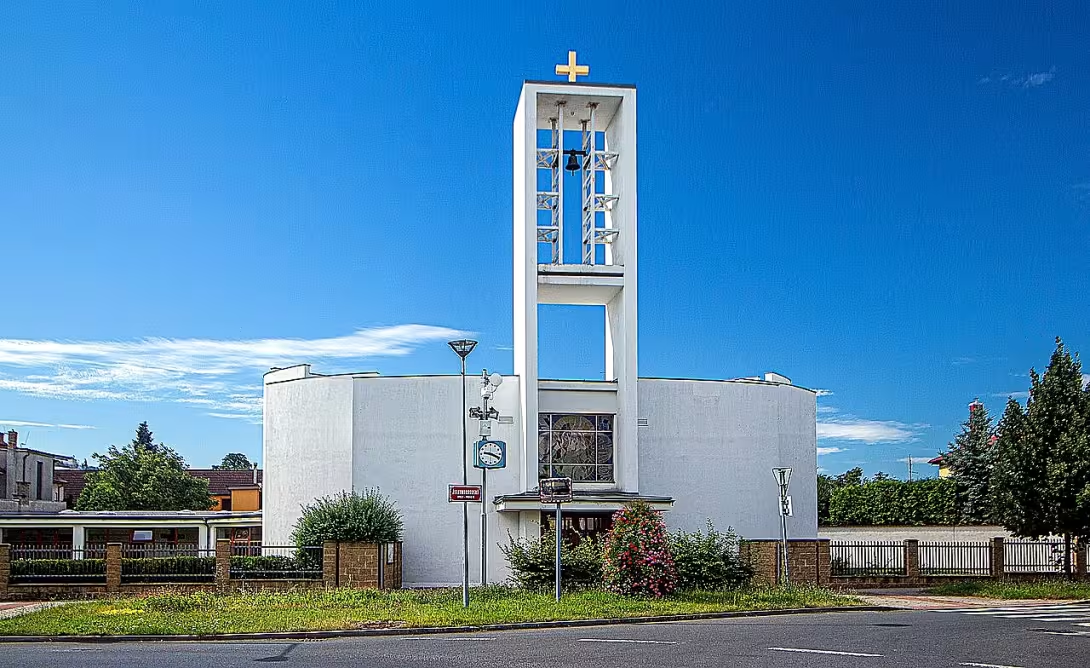
The Church of Saint Elizabeth of Thuringia is located in Prague 19 - Kbels, on the corner of the streets of Vrchlabská and Železnobrodská (Vrchlabská no. 42 / 41), close to the source of the Vinoří creek. It is a modern parish temple, which represents an interesting example of the sacral architecture of the 21st century.
But the history of the place is much deeper. The villages of Kbela have been documented since 1130, when Prince Spoleslav I. donated them to the Vysehrad chapter. For centuries afterwards, however, the locals did not have their own church - the Kbels belonged to the vineyard parish under the leadership of the Church of the Elevation of the Holy Cross. The situation didn't change until the 20th century. After World War I, a more modern location developed from the agricultural community, supported by the creation of a local airport - the first ever in the territory of Prague and the whole of Bohemia.
The growing population created an urgent need for its own shrine. In 1931, Dr. Frantisek Nosek purchased the building site in Kbels and had the chapel built here. It was consecrated on 28 October 1932 by the Grand Master of the Knight Order of Cruisers, Dr Josef Vlasák, and dedicated to St. Elizabeth of Hungary. Over time, Kbels institutionalized spiritually - since 27 January 1997, they have become officially quasi-parish.
Plans for the construction of a more modern church were made before World War II, but their implementation was moved far into the future. The new church of Saint Elizabeth of Thuringia was eventually built in 2001- 2003 according to the design of architect Bernard d'Ambrose. The architect was inspired by the charitable activities of St. Elizabeth and reflected this inspiration in an unusual form of construction. D'Ambrose printed the church with a silhouette of bread, from which part is cut and distributed - a gesture that symbolizes Elizabeth's donation activity and thus becomes an architectural expression of charity and solidarity.
The consecration of the new temple took place on 13 June 2004 and was carried out by Cardinal Miloslav Vlk. Today, the church serves as a parish centre in Kbels and also represents an interesting example of how modern architecture can express deep spiritual values - in this case the charitable tradition of its patron, which reminds itself of the shape of the building itself.
Historical milestones
- 1130
- The first written mention of the Kbels, when the village is donated to the Vyšehrad chapter by Prince Soběslav I., but without its own church.
- 1931
- Purchase of land for the construction of the chapel by Dr. František Noskem.
- 2001
- The beginning of the construction of a new church on the site of an older chapel.
- 2004
- The consecration of the new church of Saint Elizabeth of Thuryn.
Architectural development
The original chapel from 1932 was a simple building that served the local community until the 21st century. The new church from 2001- 2003 was designed in modern style with a distinctive symbolism of a loaf of bread. Modern materials and design solutions corresponding to current architectural trends were used. The building respects the original chapel as a historical basis, but it differs significantly from it in form and function.
Historical events
- 1932
- The consecration of the original chapel of St. Elizabeth of Hungary, built on the land purchased by Dr. František Nosek.
- 1997
- The establishment of the Quasi-Parish Kbela, which prepared the ground for the construction of a new church.
- 2004
- The consecration of the new church by Cardinal Miloslav Wolf after completion in 2003.
Points of interest
- The church of Saint Elizabeth of Thuringia was built in the years 2001-2003 as a modern parish temple.
- His architecture is inspired by the charitable activities of Saint Elizabeth and reminds him of the shape of a loaf of bread from which part is cut and distributed.
- He was ordained on June 13, 2004 by Cardinal Miloslav Wolf.
The chapel was built in 1932 and dedicated to St. Elizabeth of Hungary.
Guide
This guide is narrated by a synthetic voice generated by artificial intelligence.
Show guide text
This text was created by artificial intelligence and has not been editorially reviewed. It may contain inaccuracies.
The Church of Saint Elizabeth of Thuringia in Prague's Kbely is a Roman Catholic parish church. It was built between 2001 and 2003 in modern style. It stands at the corner of Vrchlabská and Železnobrodská streets, not far from the source of the Vinořský stream.
Kbely is an old village. It is mentioned as early as 1130, when Prince Soběslav the First donated it to the Vyšehrad chapter. However, the village did not have its own church for a long time. The village belonged to the Vinořská parish at the Church of the Exaltation of the Holy Cross.
Change came after the First World War. At that time, what was still a farming village outside Prague began to grow, partly thanks to Kbely airfield. It was the first airport in Prague and on Czech territory. With new residents came the need for a sanctuary. In 1931, Doctor František Nosek purchased a building plot in Kbely and had a chapel built there. It was consecrated on October 28, 1932 by Joseph Vlasák, Grand Master of the Order of the Cruciferous Knights, and dedicated to Saint Elizabeth of Hungary.
Plans for an actual church were discussed before the Second World War, but it was not built until much later. From January 27, 1997, Kbely became a quasi-parish. The new church was built on the site of the older chapel between 2001 and 2003. It was consecrated by Cardinal Miloslav Vlk on June 13, 2004.
The conceptual design was prepared by architect Bernardo d'Ambrose. He drew inspiration from the charitable work of Saint Elizabeth. The church was therefore given the shape of a loaf of bread, with part of it cut off and distributed.
Tips for visitors
The best time to visit the church of Saint Elizabeth of Thuringia is during the morning hours, ideally on Saturday or Sunday when there is a quieter atmosphere and you can enjoy the service. The sunny morning also provides a pleasant light for shooting indoor spaces, especially window windows, which are a unique part of the interior. In summer it is advisable to avoid hot afternoon hours when the presence of visitors in the church may be higher and the temperatures in the interior may be unpleasantly high.
Parking around the church can be found in several places. It is recommended to use public transport, which is well developed in Prague. The location is also available by car, but it is recommended to find a parking lot nearby where there are plenty of places. It is always good to check the availability of parking spaces and public transport options before visiting.
When visiting the church, take on comfortable clothes and shoes, as there is often a paving with inequalities in the interior. Further prepare your laptop or mobile device if you want to record information about the history of the church or see official materials. Take a macro lens for photography, which allows you to capture details of stained glass and other architectural details.
Photography in the church is permitted, but care must be taken to respect other visitors and not touch walls or equipment. The best places for photography are windows with stained windows and interior elements such as altars and pulpit. For quality images is ideal natural light, which penetrates through stained glass during morning or afternoon hours. In the interior it is advisable to avoid flashing lightning that may disturb other visitors.
In the vicinity of the church is worth visiting the Church of the Elevation of the Holy Cross in Vinoří, which is approximately two kilometres away. This church offers an interesting history and is connected with local traditions. Near the church also stems from the Vinořská potok, which is an important element of the local landscape and offers an opportunity for a short walk in nature. For families with children it is advisable to use nearby green areas and walks along the surrounding roads.
For families with children, a visit to St. Elizabeth Thuryn's church is an interesting opportunity to get acquainted with religious architecture and history. Children can be intrigued by the modern architecture of the church, which resembles a loaf of bread, and also by vitrates that tell biblical stories. It is recommended to use the opportunity to explain the importance of individual elements of the church and its symbolism. In the vicinity of the church it is possible to find even small walking routes that can be fun and educational for children.
Frequently asked questions
Is Kostel svaté Alžběty Durynské (Praha) open to the public?
Yes, the church is open to visitors. The best time to visit the church is during working days from 9:00 to 17:00 and on weekends from 10:00 to 18:00.
How do I get to the place by car / public transport?
The Church of Saint Elizabeth of Thuringia is located in Prague-Kbels, which are available by bus line 211 or 207 from the centre of Prague. Parking is possible on the surrounding parking areas.
How much is the entrance fee and is it paid on the spot?
Payment is made directly at the entrance to the church.
Is the tour suitable for children and seniors?
Yes, the church is accessible to all ages. Special tours are available for families with children, which can be arranged in advance.
How long does the tour take?
The church tour takes approximately 30 minutes. If you want more information about the church or its history, you can arrange with the guide.
What are the opening times and booking is required?
The Church of Saint Elizabeth of Thuringia is open from Monday to Friday from 9:00 to 17:00 and on weekends from 10:00 to 18:00. Reservation is not necessary, but it is good to arrange it in advance for groups over 10 people.
What's interesting in the immediate vicinity?
In the immediate vicinity of the church there is a park Kbelí where you can make a pleasant walk. There are also restaurants and shops near the church.
For kids
Imagine going back to the past, until Prague was not as big and rich as it is today. If you go back to that time, you'll find yourself in a small village called Kbely. The village was surrounded by forests and fields where people lived from agriculture and animal farming.
At that time there was a beautiful church of St. Elizabeth Durynsky, which was the centre of the village. People used to come here for services and holidays, and they used to meet in it at the council and at the assembly. The church was also a haven for locals who sought protection from danger.
Businesses nearby
Do you run a restaurant, accommodation, shop, museum, rental, wellness or other visitor service near this monument? Show yourself directly to the people heading to it — this is how they will see you in the app and on the web:
Events nearby


Zdroj akcí: otevřená data měst a obcí ČR (Národní katalog otevřených dat) a kalendář akcí Národního památkového ústavu.
Nearby
- The original parish church, which Kbely belonged to until the 20th century.
- Natural flow with a spring near the church, important for the local landscape.
- An important transport artery connecting Prague to the surrounding area.
Accommodation nearby
Trips and activities nearby
Guided tours, tickets and activities nearby from GetYourGuide
Affiliate link: if you buy from the partner, we may receive a commission. The price for you does not change.
Search tours and activities →Themed route
Thematic cruise route: The path to the sacral heritage and nature of St. Elizabeth of Thuringia * * * *
1. Church of Saint Elizabeth of Thuringian * Sacral monument * - A unique church from the 19th century, dedicated to the Thuringian priestess, connecting Gothic and neo-gothic elements. Its peaceful architecture and historical importance in the context of the Prague parish are worthy of attention.
2. Church of the Elevation of the Holy Cross (Vinoor) * Parish Church * - The original centre of spiritual life for Kbels, now picturesque baroque-classical building with rich history. Suitable for comparing sacral styles in the area.
3. Wine stream * Natural flow * - A picturesque water spring with surroundings that gives the landscape peace and authenticity. Ideal for a short walk and rest between sightseeing visits.
4. Prague district road I / 10 * Traffic artery * - Although there is a road, it offers the possibility to observe local urban planning and historical links between municipalities. Suitable for a short section of walking path overlooking the surrounding countryside.
* The route combines spiritual and natural elements in the immediate vicinity of St. Elizabeth of Thuringia. *
Seasonal recommendations
Spring In the spring months, the church of Saint Elizabeth of Thuringia is dressed in light, which penetrates through the stained glass and creates on the stone walls a game of color reflections. Nature around it, especially in the vicinity of the Little Party, begins to bloom - the trees are blooming and the air is saturated with the scent of spring herbs. The atmosphere is calm, but alive, as visitors seek escape from the urban rush. It is recommended to visit early in the morning when the church is still almost empty and the light is softer. Clothes should be easy, but with the possibility to cover up - spring weather is variable, and in the interior with stone walls can be cold. Avoid the afternoon hours when groups of tourists come here.
Summer In the summer months the church shines in full force, as the sun rays fall directly on its facade and create sharp shadows in the interior. The surrounding area is green and full of life, but also noisy - especially in the high summer season, when foreign tourists come here. The atmosphere is energetic, sometimes even busy, especially in the afternoon. It is recommended to arrive before nine in the morning, when the church is still calm and the heat still tolerable. Clothes should be light, but considering the fall in indoor temperatures - the church is a few degrees colder than outside. In the summer months they also tend to be longer opening times, but in hot days it is worth visiting even in late afternoon hours when the crowds get smaller.
Autumn Autumn brings to the church of Saint Elizabeth Thuryn golden shades, which are projected through stained glass and create a quiet, meditative atmosphere in the interior. The surrounding area is colorful, but the air is already colder and sometimes moist, as is reflected on the stone walls of the church. The atmosphere is calm, almost introspective, as tourists return from summer trips and look for a place to rest. It is recommended to visit the church in the morning when the light is still pleasant and the crowds minimal. Clothes should be warm but not too massive - in the interior the temperature is maintained at a pleasant level, but outside can be already cold. In November, in the time of St. Catherine, the church is visited by more believers, which can affect the atmosphere.
Winter The winter season brings a mysterious atmosphere to the church of St. Elizabeth of Thuryn, where light spreads only through small windows and creates a quiet, almost mystical environment in the interior. The surrounding area is covered with snow, which gives the church a fabulous look, and the air is clean and cold. The atmosphere is quiet, sometimes sacred, because winter moons bring a period of peace and reflection. It is recommended to visit the church in the morning when the light is still sufficient and the crowds minimal. Clothes should be warm and laminated - it is cold outside, but the interior keeps a nice temperature. In advent time there are longer services and the church is visited by more believers, which can affect opening times. Avoid late afternoon hours when the light becomes weak and the church can be even more mysterious but even less accessible.
Visualizations and artistic views


The visualisations are generated by artificial intelligence and serve as inspiration.
Photos from the area
Real photos taken near the monument


Zdroj a licence jsou uvedeny u každého snímku.
Atmosphere of the place
This atmospheric visualisation of the place and period was generated by artificial intelligence. It is not real footage of the location.
Tips from visitors
No tips yet. Be the first!
Log in and add your tip.
Sources and literature
Photos: VitVit / CC BY-SA 4.0 — Wikimedia Commons. The author and licence also appear when you hover over the image.
Faktickým podkladem tohoto textu byl článek na Wikipedii, jehož autory jsou přispěvatelé Wikipedie. Článek je dostupný pod licencí CC BY-SA 4.0.
Location on the map

Příběhy a pověsti
Legendy, pověsti a příběhy spjaté s touto památkou
Fotografie návštěvníků
Zatím žádné fotografie. Buďte první, kdo přidá fotografii z návštěvy!
Log in a přidejte svou fotografii nebo hodnoťte.
Za ověřenou návštěvu v aplikaci získáte víc bodů — poznáme podle GPS, že jste na místě.
Reviews and comments