






Kostel svaté Máří Magdaleny v Krásné Lípě Church
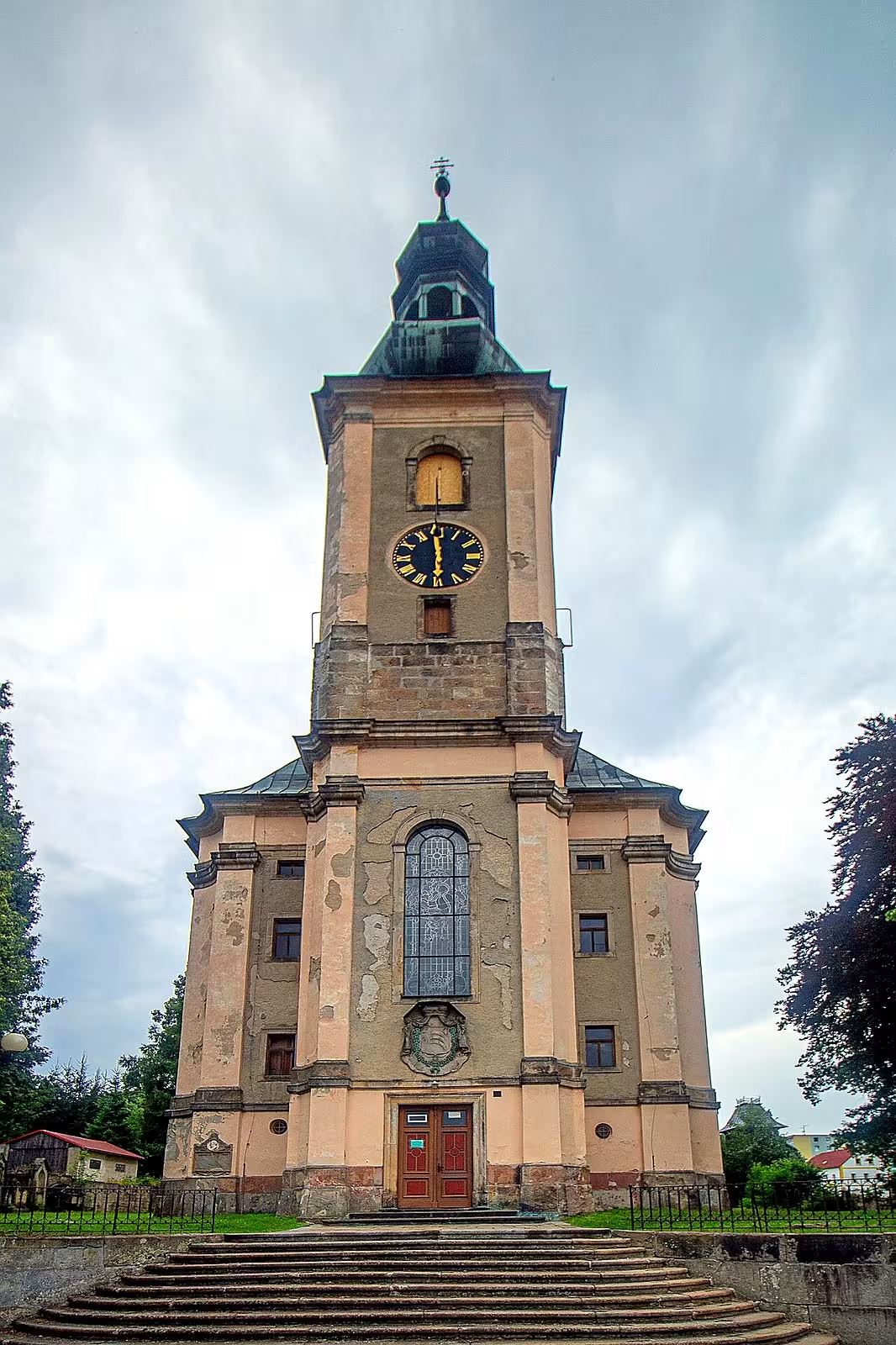
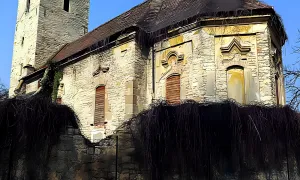
The Church of St. Mary Magdalena in the centre of Krásná Lípa presents the highest example of Baroque in northern Bohemia. The dominant tower with bevelled edges and magical architectural details from the Midsecond Century makes it one of the region's most important sacral structures. It is situated in the middle of the cemetery above Køíinická Square, which has a developed area around it with its own parish building and cemetery chapel.
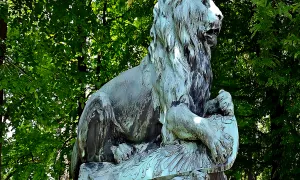
In the place of the older church, which stood here from 1332-1368, a new temple in the spirit of the Baroque was established at the turn of the 18th century. The construction lasted from 1754 to 1758 according to the plans of Ústí architect Jakub Schwarz and was led by P. Hoffmann z Lipové. The distinctive tower was added later, in 1777. A monumental staircase with statues and a large cross carved from one piece of stone, leading from the square to the church, was created as part of the composition between 1816 and 1818. This solution created a fascinating urban link between the city and the temple.
The building is oriented in an unusual way - the presbytery is headed north to open the front of the church above the spacious square. It is a single-boat construction with a tripod ending with presbyterium and lateral chapels. Both sides of the presbyteria have rectangular sacristy with oratons on the floor. The facade is thoroughly divided by pilasters, rectangular portals and windows with a semicircle, its sides are concave-gassed. Inside, two-story empores appear, and the vaults on the empores rest on pillars with rich ornamental decoration. Presbyterium has a value of the vault with lunettes and the end is glazed radially.
The interior has preserved its rich equipment from the 18th and 19th centuries. The main altar from 1808 is classical with Dominik Kindermann. The side altar of the Virgin Mary from 1815 has a picture of the Madonna from Josef Fkřerich from 1856, the second side altar of St. Joseph from 1821 adorns the painting from Franz Tkadlik. The Rococo pulpit from 1765 with beautiful ornamental decoration and the relief of Last Supper is particularly remarkable. On empores hang a crucifix from 1773 and pictures of the Annunciation from the first half of the 19th century. Attention is also due to the authentic marble statue of a sleeping boy signed by "Ferdinand Pettrich F. Romae 1820.".
The cemetery around the church retains rare tombstones - Rococo stone slabs from 1792 and 1794 with rich ornamental and classical tombstones from the end of the 18th and first half of the 19th century. The most famous is Veronica Römisch's grave with sculptures from the Dresden court sculptor Franz Pettrich (1770-1844). There is an iron cross from 1818 on the staircase, which is probably the author of Ferdinand Pettrich (1798-1872). Near it is established in 1857-1859 so-called Cross Hill with stops of the cross road and two chaples.
Today's church has been part of the urban life of Beautiful Lips for more than two centuries. His tower, which far from being seen, remains a symbol of города and his heart is a baroque architecture with classical elements, which has retained the quality and beauty of its decoration up to now.
Then and now
Drag the slider to compare how the landmark may have looked when it was built with the view today.
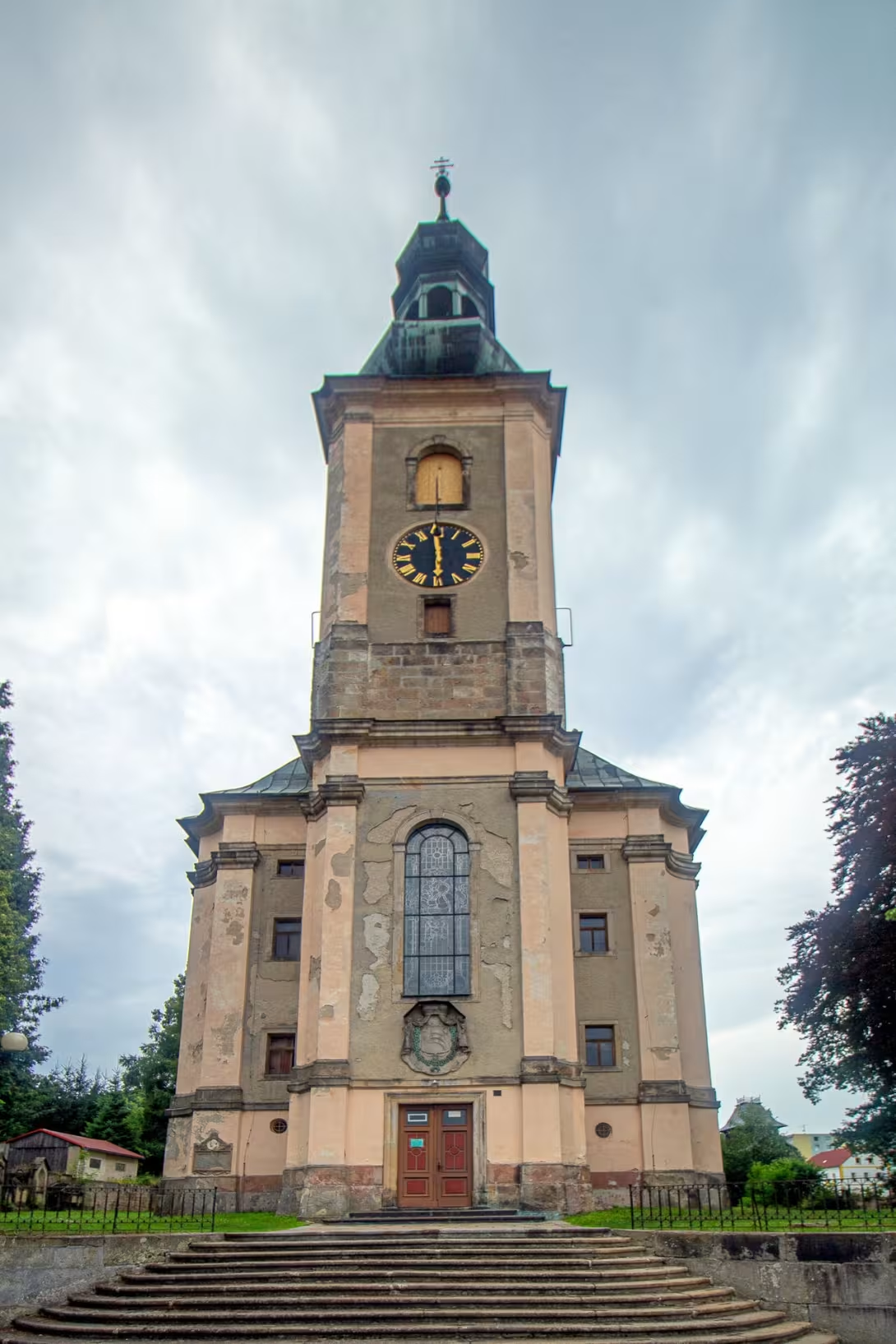
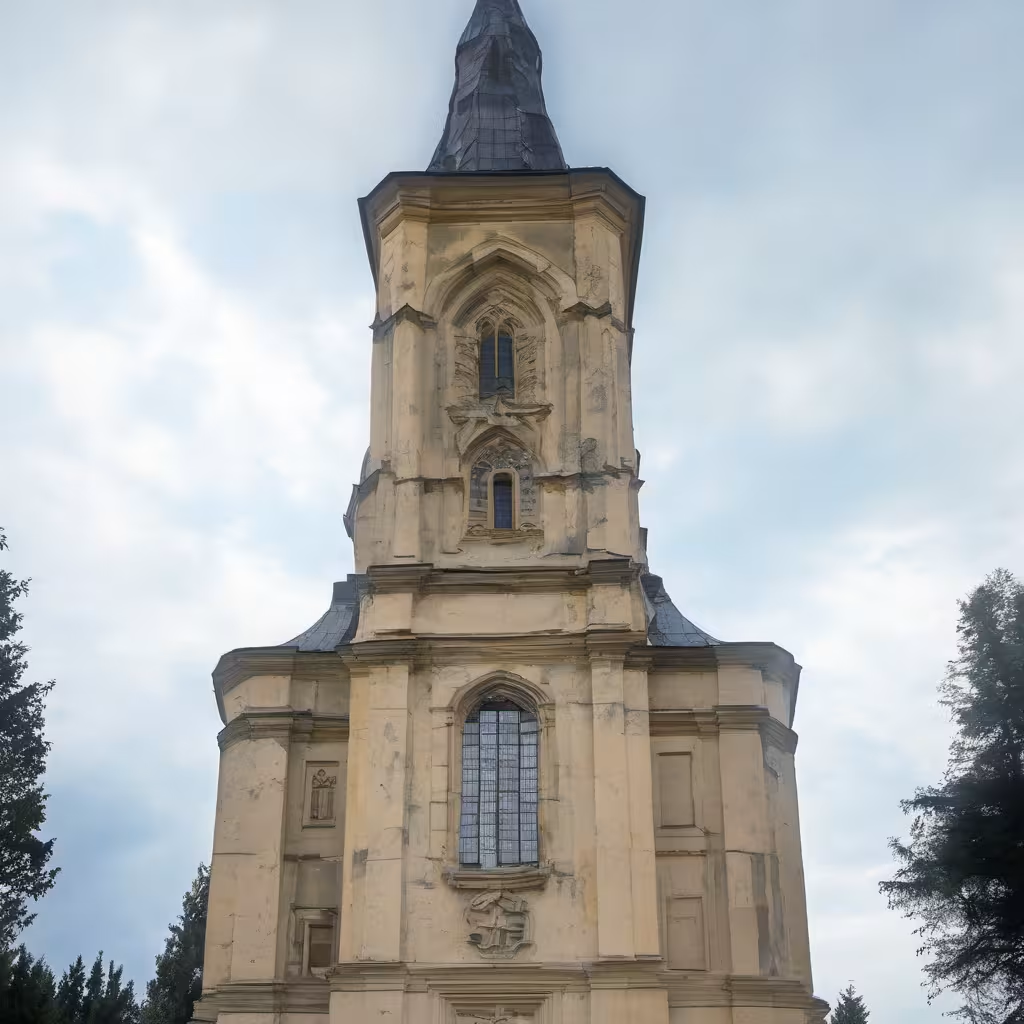
The historical appearance on the left is an AI-generated visualisation and serves as inspiration only.
Historical milestones
- 1332-1368
- The establishment of the first church in Beautiful Lípa, probably Gothic
- 1754
- Opening of the contemporary Baroque church according to the plans of Jakub Schwarz
- 1777
- Church tower status
- 1816-1818
- Building a monumental staircase with a stone cross from Ferdinand Pettrich
- 1966
- Registration of church in the list of cultural monuments
Architectural development
The church was built in 1754- 1758 in the place of an older Gothic church. The tower was built in 1777. In 1816-1818 a monumental staircase was built with a stone cross from Ferdinand Pettrich. The interior is equipped with Baroque and classical elements from the 18th to 19th century, including altars, pulpit and stained glass. The facades are divided by pilasters and semi-circular windows, the facade ends with a tower with bevelled edges.
Historical events
The establishment of the first church in Králová Lípa in the years 1332-1368 (supported by archaeological evidence but without details)
Opening of the contemporary Baroque church in 1754 according to the plans of Jakub Schwarz
Position of monumental staircase with stone cross from one piece of stone in 1816-1818
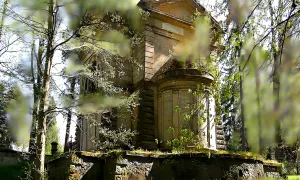
Construction of the Cemetery Chapel of Resurrection of Christ in the years 1844-1846
Owners
The sequence of owners with years if available, otherwise zero.
Points of interest
- The church of St. Mary Magdalena is a top example of Baroque architecture in northern Bohemia with a distinctive tower added only in 1777.
- The building was built on the site of an older church from 1332-1368, the new temple was built at the turn of the 18th century according to the plans of architect Jakub Schwarz.
- The church is oriented in an unusual way - the presbytery is headed north to open the facade above Kříinický Square.
Guide
This guide is narrated by a synthetic voice generated by artificial intelligence.
Show guide text
This text was created by artificial intelligence and has not been editorially reviewed. It may contain inaccuracies.
Welcome to Beautiful Lips. You have just stopped in the heart of this city, at Křinický Square, and right now one of the most important views of the entire area is being opened to you. You're standing right in front of the church of St. Mary Magdalena. Feel the atmosphere surrounding you. This building is not just an ordinary builder, it is a real dominance that, with its size and presence, controls the entire space around you. Look at her massive body and try to realize how strongly this temple fits into the overall character of the square. It's a place where history, architecture and the everyday life of the city meet.
But in order to really understand what you're seeing right now, we need to go back to the past with your eyes. The place you're standing right now has been sanctified by God for centuries. Already between the years 33 and 32 and 33 and 60 and the first church, which was probably gothic. Even though this original building had long since died, its spirit and sanctity of this place were preserved. But the real transformation that you see today came only during the period of the high baroque. In seventy-four, the construction of the present temple, which you admire today, began. The main architect who answered for this magnificent vision and its implementation was Jakub Schwarzer. It was his work that laid the foundations for the baroque majesty who is now standing right in front of you.
Now try to look at the architecture of the church itself and pay attention to the details that address you. Note that this is a one-piece construction that ends with a tributary with a presbytery and lateral caples. It's very interesting to see how this temple is oriented. While most of the old churches are trying to orient to the east, this church is oriented towards the north, while its main facade rises directly above the square and addresses everyone who moves here. Look up now, to the tall tower that rises to heaven. It was only built in seventy-seven and still represents the most striking point by which people in the neighborhood are oriented. If you look towards the temple, you can also see the monumental staircase. This was built in the years between 81 and 80, according to Ferdinand Pettrich's design and is decorated with a stone cross. This whole building is the real peak of Baroque architecture in the region of northern Bohemia.
The history of this place is constantly intertwined by the names of prominent personalities who left their mark. In addition to architect Jakub Schwarz and Father Hoffmann of Lip, who shaped the appearance of the temple, there are traces of other figures. We can mention here, for example, Dominik Kindermann, Josef Fkřerich or Franz Skallik. Each of these names is part of the wider story of this place and its bloom. Even Ferdinand Pettrich, who designed this monumental staircase, left its unmistakable trail in this space, which gives the entire entrance to the church an unmistakable character. Although the names of individual people may seem distant, it is their work and decision that has made it possible for you to look at such a fascinating memory today.
You might find one interesting thing that gives this place a special depth. The church you see has not always been as completed as you see it today. The distinctive tower, which you now see as a self-evident part of the whole, was only added much later, in seventy-seven. Before, the view of this temple was quite different and its silhouette was much lower. It is this additional building of the tower that has given him the contemporary nobility and strength that you are seeing right now. It's like the building is still evolving over time looking for its perfect shape.
We now invite you to further explore the area. The church is surrounded by a cemetery, where you can see the cemetery chapel, and in its vicinity there is also a parish. We recommend you to walk around, perceive architecture from different angles and absorb the atmosphere of this historic space. We hope that you enjoyed this short trip through the history of Beautiful Lips and that this view of the Baroque peak of northern Bohemia will inspire you for a long time. Thank you for your visit and we will help you to enjoy the rest of the day while exploring your surroundings.
Tips for visitors
{'paragraph': 'The best time to visit the church of St. Mary Magdalena is during the morning hours of the week when the place is quieter and you can see the interior without crowds. The Baroque architecture and the light falling through the window windows then works best in sunny weather. In summer it is advisable to visit the church also during evening services, which often offer a unique atmosphere.'}
{'paragraph': 'Parking in the vicinity of the church is possible in public parking lots in the centre of the beautiful Lípa. The location is also accessible by public transport; the current connection can be found in the traffic search engine. It is recommended to come on foot because the Křinický Square, where the church stands, is nicely decorated and offers pleasant walks.'}
{'paragraph': 'When visiting, wear comfortable clothes and shoes because the church and its surroundings offer several stairs and uneven terrain. In winter it is advisable to dress warmer because the church has no heating. Do not miss a little guide or city map to help you navigate around.'}
{'paragraph': 'Photography of the interior of the church is permitted, but taking into account the sensitive elements and artistic values of the monument, avoid strong lighting and flash. The best places for photos are side chapel and presbytery with favourable light from window openings. The exterior of the church is ideal for sunset shots.'}
{'paragraph': 'In the vicinity of the church, it is worth visiting the Cemetery Chapel of the Resurrection of Christ, which, despite its extinct form, is an interesting example of Empire architecture. Near is the area of the Cross Hill, which offers quiet walks and the possibility of relaxing in nature. It is advisable for families with children to visit nearby parks and playgrounds in the city centre.'}
{'paragraph': 'For families with children, a visit to the church is interesting thanks to the possibility of getting acquainted with historical elements and hearing stories associated with the place. Children can see small statues and interior decoration, which is often fascinating for them. In the vicinity of the church it is also possible to find small cafes where children can relax and enjoy sweets.'}
For kids
Imagine going back to a time when there were no machines, computers, or cell phones in the world. It was a different era, another civilization. But at that time also here, in the beautiful village of Krásná Lípa, there was a church of St. Mary Magdalena.
What did the part of Europe look like in the 16th century? People lived mainly in villages and cities where construction materials were used as wood, stone and bricks to build houses and churches. The church of St. Mary Magdalena stood in the middle of the village, in a high place from where it was seen far into the surroundings.
Businesses nearby
Do you run a restaurant, accommodation, shop, museum, rental, wellness or other visitor service near this monument? Show yourself directly to the people heading to it — this is how they will see you in the app and on the web:
Nearby
- empir
- The Empire Chapel disappeared during the normalization period, originally with a pillar port and a semi-circular ending facade.
- The area with the chapel of God's grave and Calvary, located near the church.
- Late Baroque
- Late Baroque rectangular storey building with a mansard roof, located in the church area.
Accommodation nearby
Themed route
Thematic cruise route: Baroque and Empire way of faith in Beautiful Lípa
1. Church of St. Mary Magdalena * Type: * Baroque Church * Why visit? * Unique sacral building with rich decoration, associated with the legend of the miraculous revelation of the Virgin Mary. Interior with Empire elements and valuable altars attracts lovers of history and architecture.
2. Cemetery Chapel of the Resurrection of Christ * Type: * Empire Chapel (extinct) Why visit? Despite the demise of the 20th century, it is worth visiting its original location at the cemetery. The chapel was a model of classical elegance with semi-circular facade and columns - an ideal place for a photo of historical monuments.
3. Cross Hill (Cross Way Area) * Type: * Calvary with Chaples of God's Grave * Why visit? * Near the church is a picturesque area with chaples that resemble biblical events. The location offers a peaceful walk and views of the surrounding countryside, ideal for meditation or photography.
* The route is designed as circular, with distances between points not exceeding 1 km. It is recommended to start at the church and continue towards the cemetery chapel, then to the Cross Hill. *
Seasonal recommendations
Spring Krásná Lípa offers a unique atmosphere in the spring months where the church of St. Mary Magdalena is surrounded by flowering trees and young greenery. Sun rays penetrate through the stained glass, creating a game of light and shadow on the stone walls, which gives the interior of the church mysterious lightness. The surrounding area is still quiet, without summer crowds, and the visit becomes intimate. It is recommended to come early in the morning when the air is fresh and the church is still undiscovered by tourists. The clothes are suitable according to variable weather - light jackets, sunglasses and umbrella, because spring rain can come unexpectedly. The right time is from April to May, when nature blooms and temperatures move around pleasant 10- 15 ° C.
Summer In the summer months, the church of St. Mary Magdalena becomes a centre of living atmosphere, where visitors come not only for its historical value, but also for surrounding nature. The sun illuminates the facade of the church so that it seems to be surrounded by a golden veil, while inside there is a pleasant semi-shade. In the main summer season (July-August), however, it is necessary to count on higher attendance, especially in the afternoon. It is recommended to arrive early in the morning or late in the afternoon to avoid crowds. Light, breathable clothes, sun hat and plenty of water are suitable because temperatures often exceed 25 ° C. It is also convenient to use the shade of surrounding trees while walking around the city.
Autumn Autumn brings golden leaves and a calm, nostalgic atmosphere to Beautiful Lips, which is reflected in the interior of the church. The sun rising through the stained glass creates warm copper reflections on the stones, while the outside light gradually weakens. In September and October, the church is often visited less, allowing quiet tours. Clothes are recommended according to colder weather - warm sweaters, jackets and comfortable shoes because temperatures fall and rainy days are no exception. The right time is the afternoon when the light is softer and the church is even more mysterious. In November, especially in advent time, several groups of visitors may appear, but overall the environment remains quiet.
Winter The winter visit of the church of St. Mary Magdalena is like an entrance to another world - the snow cover turns the surrounding landscape into a fairy tale scenery, while inside the church there is warmth and silence. The sunlight, which penetrates through the stained glass, creates colour reflections on the snow, which provide the interior with a magical touch. However, in the winter months (please February), shorter opening times must be foreseen, often only in the morning. It is recommended that warm, laminated clothing, gloves and solid footwear, as temperatures often fall below freezing. The best time is the afternoon when the light is softer and the church looks even more cosy. Several groups of visitors may appear at advent time, but overall the atmosphere remains calm and calm.
Visualizations and artistic views


The visualisations are generated by artificial intelligence and serve as inspiration.
Photos from the area
Real photos taken near the monument

Zdroj a licence jsou uvedeny u každého snímku.
Atmosphere of the place
This atmospheric visualisation of the place and period was generated by artificial intelligence. It is not real footage of the location.
Tips from visitors
No tips yet. Be the first!
Log in and add your tip.
Sources and literature
Fotografie: VitVit / CC BY-SA 4.0 — Wikimedia Commons. The author and licence also appear when you hover over the image.
Faktickým podkladem tohoto textu byl článek na Wikipedii, jehož autory jsou přispěvatelé Wikipedie. Článek je dostupný pod licencí CC BY-SA 4.0.
Location on the map


Příběhy a pověsti
Legendy, pověsti a příběhy spjaté s touto památkou
Fotografie návštěvníků
Zatím žádné fotografie. Buďte první, kdo přidá fotografii z návštěvy!
Přihlaste se a přidejte svou fotografii nebo hodnoťte.
Za ověřenou návštěvu v aplikaci získáte víc bodů — poznáme podle GPS, že jste na místě.
Reviews and comments