



Kostel svatého Bartoloměje (Mladošovice) Church
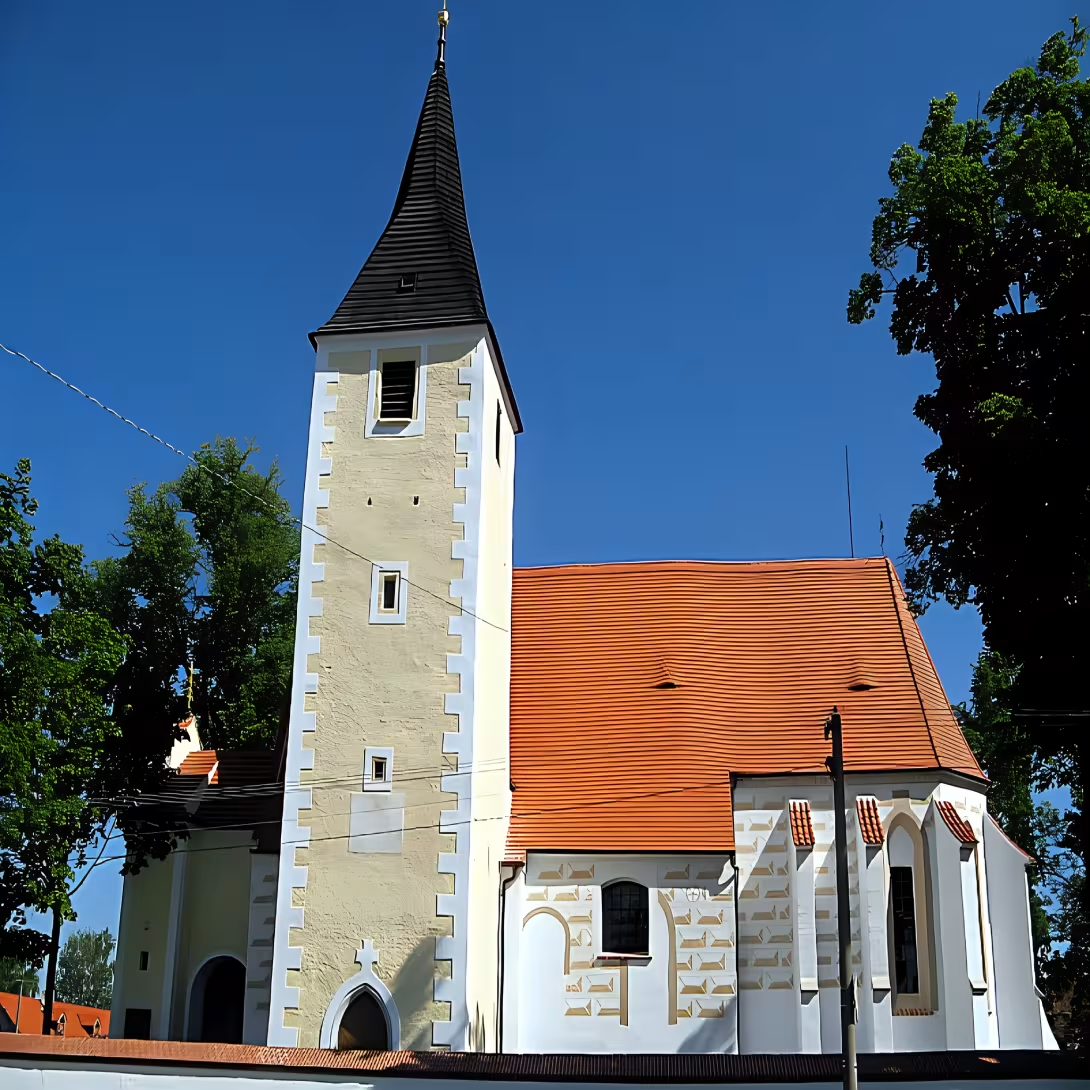
The Church of Saint Bartholomew in Mladošovice is a remarkable historical monument situated at the village center near the municipal office. It lies within the České Budějovice district in Jihočeský kraj. Originally built in the 14th century, this Gothic church has undergone significant architectural transformations over time, including Renaissance and Baroque renovations that have contributed to its unique character. Notably, it features a distinctive Renaissance façade adorned with sgraffito work, making it an exceptional example of religious architecture from this period.
The first documented mention of the Church dates back to 1367 when Augustinian monks from Třeboň conducted a census. At that time, the church was linked to the Třeboň monastery and served as a parish church for Mladošovice. By 1499, a late Gothic tower designed by master Tomáš was added, enhancing its architectural complexity. The Renaissance period brought further changes; in 1576, a unique façade featuring sgraffito work was completed under the commission of Vilém z Rožmberka. This façade includes motifs such as psalms and waves, with a five-petaled rose engraved alongside the year 1576, commemorating Rožmberk's influence.
Architecturally, the church began in the Gothic style but evolved through subsequent renovations. The late Gothic tower added by master Tomáš is one of its defining features. The Renaissance façade, completed in 1576, stands out for its use of sgraffito—a decorative technique more commonly found on secular buildings—making it a unique element in religious architecture. In the 18th century, parts of the church were remodeled in the Baroque style, which included modifications to windows and roofing. The original Gothic windows were either bricked up or plastered over, and the timber roof of the tower was replaced with a shingle roof.
Throughout its history, the Church has seen various changes in ownership and administration, particularly influenced by notable figures such as Vilém z Rožmberka. Its connection to the Třeboň monastery during the 14th century highlights its ecclesiastical significance. By the late 16th century, the influence of Antonius Ericer, who worked on the nearby Třeboň Castle, extended to this church as well.
Today, the Church stands as a protected historical monument since 1958 and underwent extensive restoration in 2010. This included restoring its unique Renaissance façade, ensuring that visitors can appreciate its architectural beauty and historical significance. The church's exterior retains elements from its Gothic origins, such as the external support system around the presbytery with stepped buttresses capped by gables. Inside, the contrast between the preserved Gothic style in the presbytery, tower, and sacristy, and the Baroque renovations in the nave, offers a fascinating glimpse into its layered history.
Visitors to Mladošovice can explore this architectural gem, which reflects the historical transitions of Bohemia and serves as a testament to the artistic and cultural influences that shaped it. The Church of Saint Bartholomew is a must-visit for those interested in Gothic, Renaissance, and Baroque architecture, offering unique insight into the region's rich heritage.
Then and now
Drag the slider to compare how the landmark may have looked when it was built with the view today.
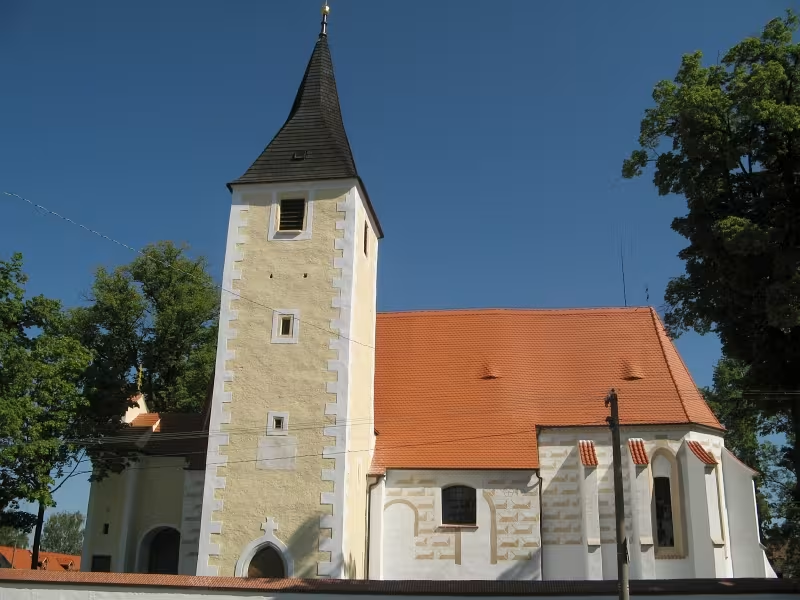

The historical appearance on the left is an AI-generated visualisation and serves as inspiration only.
Historical milestones
- 1367
- First documented mention during a census by Augustinian monks.
- 1499
- Addition of a late Gothic tower designed by master Tomáš.
- 1576
- Completion of the Renaissance façade with sgraffito work commissioned by Vilém z Rožmberka.
Architectural development
The Church of Saint Bartholomew began as a Gothic structure and later incorporated Renaissance and Baroque elements. A late Gothic tower was added in 1499, followed by a unique Renaissance façade with sgraffito work in 1576. In the 18th century, parts of the church were remodeled in the Baroque style, including changes to windows and roofing.
Historical events
1367: First documented mention when Augustinian monks from Třeboň conducted a census, linking the church to the Třeboň monastery.
1499: A late Gothic tower was added to the church, designed by master Tomáš.
1576: The Renaissance façade with sgraffito work was completed, featuring motifs commissioned by Vilém z Rožmberka.
Points of interest
- The Church of Saint Bartholomew is unique for its use of sgraffito on the façade, a decorative technique more commonly associated with secular buildings rather than religious ones.
- Originally linked to the Třeboň monastery in the 14th century, the church served as a parish church and was influenced by Augustinian monks from Třeboň during its early history.
- The distinctive five-petaled rose engraved on the façade alongside the year 1576 commemorates Vilém z Rožmberka's influence and is an emblematic feature of the Renaissance period renovations.
- Master Tomáš, credited with designing the late Gothic tower added in 1499, contributed significantly to the church’s architectural complexity during its evolution from a simple Gothic structure.
- The church underwent extensive restoration in 2010, which included preserving its unique Renaissance façade adorned with psalms and wave motifs, ensuring that visitors can appreciate its historical significance.
Guide
This guide is narrated by a synthetic voice generated by artificial intelligence.
Show guide text
This text was created by artificial intelligence and has not been editorially reviewed. It may contain inaccuracies.
The Church of Saint Bartholomew stands in the very center of Mladošovice on the Českobudějovicko region, not far from the municipal office. It dates from the 14th century and was built in the Gothic style. Later it underwent Renaissance and Baroque reconstruction.
The first written mention dates from 1367. At that time the village became the property of the Třeboň monastery and Augustinian monks from Třeboň carried out a census of the inhabitants there. It was already a parish church at that time. In 1499, a Late Gothic tower was added to it, apparently designed by master Tomáš.
The most precious feature is the Renaissance façade from 1576 with sgraffito in the form of small writings and waves. The year before, work had been completed on the Třeboň castle for William of Rožmberk, which was led by Antonio Ericer. The builders then moved to this very place. The Rožmberks are commemorated by a five-petaled rose carved into the façade together with the date 1576. Sgraffito commonly appears on burgher houses and castles, but on a church it is an exception. It can only be compared with the Church of the Holy Trinity in Hamr u Veselí nad Lužnicí.
In the 18th century the church was partially rebuilt in the Baroque style and the Gothic windows were either bricked up or modified into rectangular shapes. In 1767 a pyramidal roof replaced the tile roof of the tower. At that time journeyman Wít Kold also carved his name into a roof beam along with the date. In 1785 the church was extended with a façade and a passage and choir. At the turn of the 19th and 20th centuries large segmental windows were added on the northern side, reminiscent of agricultural buildings of that time. The church has been listed as a historical monument since 1958. In 2010 it underwent extensive reconstruction and its Renaissance façade was also restored.
The Gothic origin is mainly revealed by the eastern side. Around the presbytery, stepped buttresses with roof covers have been preserved. Four originally pointed windows are now rectangular, but thanks to the preserved embrasures their former shape is still apparent. On the southern side there is a bricked-up rose window in the shape of a three-lobed arch and also a tower with a portal in the shape of a pointed arch. The sacristy window has a pointed tracery called "nun." The western portal is Baroque.
Inside it is a single-nave church. The presbytery, tower and sacristy remain Gothic. The end of the presbytery is covered by a fan vault. Its ribs rest on corbels in the form of human and animal heads, and one of them holds two trefoils in its mouth. On the southern side of the presbytery is a sedilia with three pointed arches. A Gothic triumphal arch leads into the nave, with a wall decorated with frescoes. The nave is Baroque, vaulted with a barrel vault and has white walls.
Tips for visitors
The best time to visit the Church of Saint Bartholomew in Mladošovice is during late spring or early autumn, when the weather is pleasant for exploring its architectural details and surrounding landscapes. These seasons offer mild temperatures and beautiful natural scenery, enhancing your experience as you admire the church's Gothic, Renaissance, and Baroque elements.
For those preferring not to drive, local buses serve the area, making it easy to reach the church from surrounding towns. Always check current routes and schedules in advance to plan your visit smoothly.
When visiting the Church of Saint Bartholomew, consider bringing comfortable walking shoes as you may explore both the interior and exterior areas. A camera is recommended for capturing the intricate architectural details and serene environment. Additionally, carrying a light jacket or sweater can be useful due to varying temperatures inside the church compared to outdoors.
Photography enthusiasts will find several spots around the Church of Saint Bartholomew ideal for capturing its beauty. The best lighting conditions are typically during early morning or late afternoon when the sunlight softly illuminates the structure, highlighting its architectural features. Inside, natural light filtering through stained glass windows creates stunning visual effects.
For families with children visiting the church, there is much to see and enjoy nearby within a 30-minute drive. The surrounding area offers opportunities for outdoor activities such as walking trails or exploring local parks, providing a well-rounded day out. These attractions are perfect for keeping younger visitors entertained while also appreciating the historical significance of the site.
Frequently asked questions
Can the monument be visited?
Religious buildings are usually open mainly during services; at other times a visit is normally arranged with the parish or the operator. We have not verified specific times.
Where is the monument?
Location: Mladošovice, Jihočeský kraj. The map on this page shows the exact spot.
Why is the monument protected?
It is listed in the Central List of Cultural Monuments of the Czech Republic as a cultural monument (register no. 37940/3-251).
Businesses nearby
Do you run a restaurant, accommodation, shop, museum, rental, wellness or other visitor service near this monument? Show yourself directly to the people heading to it — this is how they will see you in the app and on the web:
Accommodation nearby
Themed route
Tematická výletní trasa: Kostel svatého Bartoloměje (Mladošovice)
1. Kostel svatého Bartoloměje (Mladošovice) - Typ: Náboženská památka - Proč stojí za návštěvu: Tento barokní kostel je architektonickou perli obce Mladošovice, části Petrovic. Jeho bohaté historie a významná stavba z roku 1750 nabízejí cenný pohled na náboženské tradice a umělecké styly regionu. Navštívte kostel pro jeho krásné interiér a klid, který poskytuje.
2. Obec Petrovice - Typ: Historické centrum - Proč stojí za návštěvu: Prozkoumejte historické centrum Petrovic pro jeho tradiční českou architekturu a klidný venkovský charakter. Obec nabízí pohled na život v Jihočeském kraji, s malebnými uličkami a autentičtějším způsobem života.
3. Petrovické vinice - Typ: Přírodní a kulturní památka - Proč stojí za návštěvu: Tato oblast je známá svými historicky významnými vinicemi, které jsou součástí regionálního dědictví. Navštívte pro pohled na rozlehlé zahrady a pochopení důležitosti vinobraní v této oblasti. Je to ideální místo k prozkoumání přírody a užití času s klidnými procházkami mezi révovými řadami.
4. Nádvoří kostela svatého Bartoloměje - Typ: Kulturní areál - Proč stojí za návštěvu: Po prohlídce kostela si vychutnejte klid na jeho nádvoří. Toto místo nabízí mírné prostředí k odpočinku a reflektování, s možností užít si panoramatický pohled na okolní krajinu. Je to ideální místo pro relaxaci po prozkoumání kostela.
Tato trasa nabízí kombinaci náboženského dědictví, historických zážitků a přírodních krás Jihočeského kraje, což vytváří vyrovnaný den plný objevování.
Seasonal recommendations
Spring: Visiting the Church of St. Bartholomew during spring offers a unique experience as nature awakens around Mladošovice. The church is enveloped in vibrant colors with blooming flowers and lush greenery, creating an idyllic setting that enhances its historical charm. The gentle warmth and longer daylight hours make it an ideal time for leisurely exploration. Visitors should dress comfortably to enjoy the mild weather but consider bringing a light jacket for cooler mornings or evenings. Although crowds are generally manageable, arriving early in the day can provide a more peaceful visit.
Summer: Summer is a popular season for visiting the Church of St. Bartholomew due to its pleasant climate and extended daylight hours. The church's surroundings come alive with lush landscapes and vibrant flora, providing a picturesque backdrop that complements its historical architecture. This period often attracts more visitors, especially during peak tourist times, so it’s advisable to arrive early in the day to avoid crowds. Lightweight clothing is recommended for comfort, along with sun protection such as hats or sunglasses. The warm weather makes it perfect for exploring outdoor areas and nearby attractions.
Autumn: Autumn brings a spectacular display of colors to the Church of St. Bartholomew as the foliage transforms into shades of red, orange, and gold. This season offers a serene atmosphere with fewer visitors compared to summer, allowing for a more intimate experience of the church’s historical beauty. The cooler temperatures are ideal for comfortable exploration without the need for heavy clothing; however, it's wise to bring a warm layer as evenings can become quite chilly. The soft autumn light enhances the architectural details and creates a magical ambiance around Mladošovice.
Winter: Winter transforms the Church of St. Bartholomew into a serene and enchanting destination with its snow-covered surroundings creating a picturesque scene. Visitors should dress warmly in layers, including hats, gloves, and insulated footwear, to comfortably enjoy the site. While winter may deter some tourists, leading to fewer crowds, the quiet atmosphere provides an opportunity to appreciate the church's architecture without distractions. The soft lighting during this season adds a unique charm to the historical structure.
Visualizations and artistic views


The visualisations are generated by artificial intelligence and serve as inspiration.
Photos from the area
Real photos taken near the monument

Zdroj a licence jsou uvedeny u každého snímku.
Atmosphere of the place
This atmospheric visualisation of the place and period was generated by artificial intelligence. It is not real footage of the location.
Tips from visitors
No tips yet. Be the first!
Log in and add your tip.
Sources and literature
Photos: Sovicka169 / CC BY-SA 3.0, rozlišení zvýšeno umělou inteligencí — Wikimedia Commons. The author and licence also appear when you hover over the image.
Faktickým podkladem tohoto textu byl článek na Wikipedii, jehož autory jsou přispěvatelé Wikipedie. Článek je dostupný pod licencí CC BY-SA 4.0.




Příběhy a pověsti
Legendy, pověsti a příběhy spjaté s touto památkou
Fotografie návštěvníků
Zatím žádné fotografie. Buďte první, kdo přidá fotografii z návštěvy!
Log in a přidejte svou fotografii nebo hodnoťte.
Za ověřenou návštěvu v aplikaci získáte víc bodů — poznáme podle GPS, že jste na místě.
Reviews and comments