



Kostel svatého Erharda Church
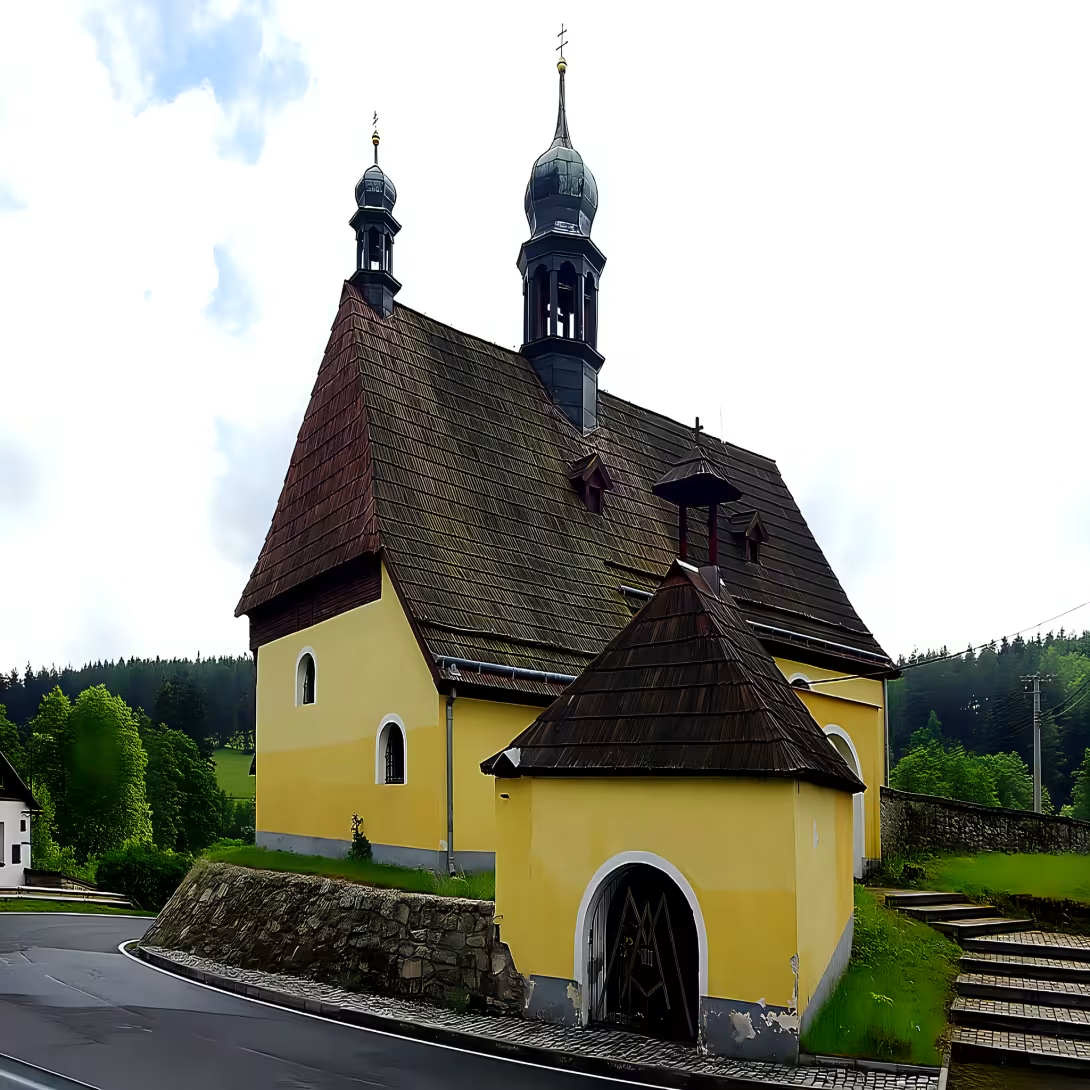
Kostel svatého Erharda belongs to the oldest churches in the region. The exact time of its creation is difficult to date, but it is expected to come from the mid-13th century. Historical sources are questionable on the subject - the older German Fatherscience from 1898 even mentioned the 12th century and attributed its foundation to a member of the Unruher family. However, this claim is based only on an undated document and, given that the Unruhers did not settle in Loketsk until the beginning of the 15th century, it is probably a mistake. The church's actual preserved records have been testifying since 1356, and the plebany has been mentioned since 1352.
Originally there was a larger chapel, which went through successive reconstructions. Significant construction work took place in 1555, when a boat was added to the original building and a rectangular presbytery was encapsulated. The Baroque style of the church can be expected from the first half of the 18th century when it was equipped with a Baroque inventory and was also built by the adjacent Baroque chapel of the Olivet Mountains.
In 1627 the church survived a significant change - the parish church was assigned to Jindřichovice and the building in Tatrovice thus gained the status of the family church. As a result, mass was only served on Sundays and major holidays, while the parish house remained empty and later the local school was located there. According to the preserved parish chronicle, the inhabitants of Tatrovic have been having trouble occupying the parish for a long time. It was only in 1782 that the parish was re-established and larger repairs were made on the occasion of the new consecration of the church. At the same time, the town of Loket, as a mansion, took over the church's patronage. More extensive repairs followed in 1872, a year later the altar was newly decorated. In 1925 electricity was introduced during the reconstruction of the roof and the removal of the interior into the church.
After the end of World War II, the German population was moved away, the village Tatrovice almost completely disappeared and the church gradually collapsed. The church did not have a major restoration until 2004 to 2005, when the total reconstruction was carried out including the repair of the shingles roof and reconstruction of the interior.
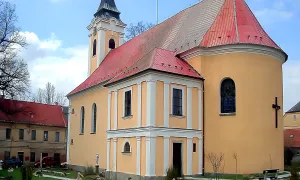
It is an architecturally oriented church of early Gothic style. In the sacristy there are two fields of cross crest vaults. The ship has a flat ceiling and was originally equipped with wooden cartridges. The three-arm wooden circle is carried by carved columns. The interesting thing is that the church lacks support pillars. The roof dominance is the sanctus tower with baroque onion beating and a two-arm cross on top, supplemented by a smaller tower above the presbytery. A square hall with a shingles covered roof is located in front of the western front.
Interior equipment reflects the wealth of baroque decoration. In the presbytery dominates the main portal altar from the middle of the 18th century, originally decorated with the statue of St. Erhard. Side statues represent St. John Nepomuk and St. John the Baptist. From the period around 1700 comes the baroque bench and stone baptist from 1701. Also valuable are the statues of St. Anne and Virgin Mary with Jesus from the first half of the 18th century and the statue of St. Vendelin from the end of this century. The art treasure is also the oil painting of the Cross Way from the same period and the image of the Coronation of the Virgin Mary around 1780. The original organ of the church was first mentioned in 1762.
Since 1963, the church of St. Erhard, the adjacent Olivet Chapel, God's torment, and the gate of the wall have been protected as a cultural monument. As a filial church it testifies to the rich medieval and modern history of the region and represents a valuable example of local sacral architecture with layers of Gothic and Baroque elements.
Then and now
Drag the slider to compare how the landmark may have looked when it was built with the view today.
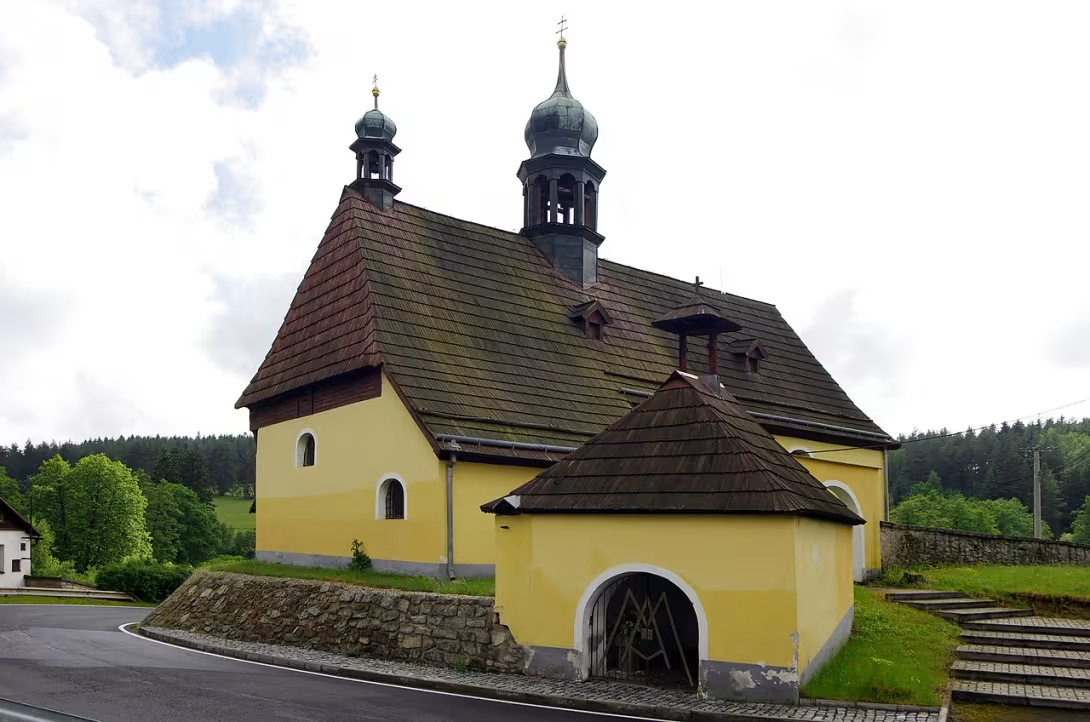
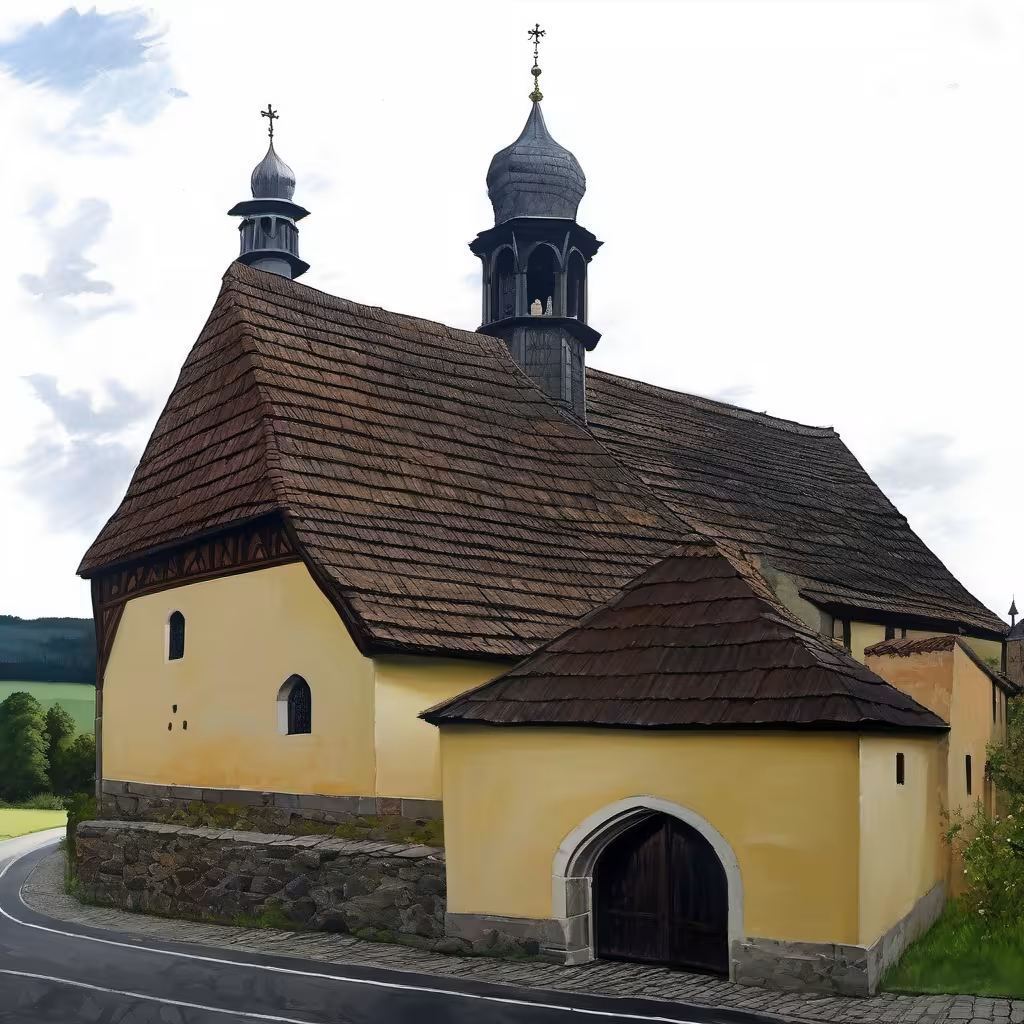
The historical appearance on the left is an AI-generated visualisation and serves as inspiration only.
Historical milestones
- 1356
- First written mention of the church as plebania.
- 1555
- Renaissance extension of the church to the ship and enclose the presbytery.
- 1782
- Repair of the church and rectory during the new consecration, when the church was again occupied by the vicar.
- 2004-2005
- Total reconstruction of the church after long-term neglect.
Architectural development
The original Gothic chapel was extended in 1555 by a boat and an arched presbytery. In the first half of the 18th century, the church underwent Baroque reconstruction, including the replacement of the interior and the addition of the Olivet Chapel. The ship is flat-ceiling with wooden crust, presbytery has a cross vault. The roof is covered with shingles with baroque sanctus tower and smaller lid over the presbytery.
Historical events
In 1356 the church was first documented in writing as plebania.
In 1627 he became a filial church after the assignment of the parish of Henry.
In 1782 extensive repairs of the church and rectory were carried out during the new consecration.
In the years 2004-2005 the church was completely renovated after its long-term decay.
Points of interest
- Kostel svatého Erharda is one of the oldest in the region, with the expected creation of the mid-13th century.
- Originally it was built as a larger chapel which underwent gradual reconstruction, for example in 1555, when the boat was built and the presbytery was sealed.
- In 1627, he lost the status of the parish church and became a filial church, serving mass only on Sundays and holidays.
- In 1782 the parish was restored and extensive repairs were carried out at the new church.
The church lacks support pillars, which is an architectural oddity.
Guide
This guide is narrated by a synthetic voice generated by artificial intelligence.
Show guide text
This text was created by artificial intelligence and has not been editorially reviewed. It may contain inaccuracies.
The Church of Saint Erhard in Tatrovice in the Sokolov region is among the oldest churches in the region. Today it is a filial church, but in the past it was a parish church. Since nineteen sixty-three, the entire area has been protected as a cultural monument, including the Olivet Chapel, the Wayside Crosses and the gate in the boundary wall.
The church probably dates from the middle of the thirteenth century. German local history from eighteen ninety-eight did mention the twelfth century and named a member of the Unruher family as the builder. However, they did not settle in the Loket region until the beginning of the fifteenth century, so this information is incorrect. In thirteen fifty-two, a parish is mentioned in Tatrovice, and the church itself is documented in thirteen fifty-six.
Originally it was probably a larger chapel. In fifteen fifty-five, a nave was added to it and a rectangular presbytery was vaulted. The Baroque renovation probably dates from the first half of the eighteenth century. At that time, the church received Baroque furnishings and the Olivet Mount Chapel was also created.
In sixteen twenty-seven, the parish was transferred to Jindřichovice and the Tatrovice church became filial. Mass was held here only on Sundays and feast days. A small local school later moved into the empty rectory. The priest did not return to Tatrovice until seventeen eighty-two. The city of Loket then took over the patronage and the church was consecrated again after repairs. Further repairs followed in eighteen seventy-two. In nineteen twenty-five, electricity was brought to the church.
After the Second World War and the expulsion of the German population, the village almost disappeared and the church fell into decay. It underwent complete reconstruction only in two thousand four and two thousand five. The shingle roof, interior, the area around the church and the southern staircase were repaired.
The church is single-naved and has no buttresses. On the roof rises a sanctus turret with a Baroque onion dome and a two-armed cross, a second smaller turret stands above the presbytery. In front of the western façade is a vestibule with a shingle roof. On the southern wall hangs a wooden crucifix with a painted carved figure of Christ, which is also covered by a shingle roof.
The nave has a flat ceiling, in the sacristy a cross-ribbed vault has been preserved. The wooden gallery is supported by carved columns. The main Baroque altar is from the middle of the eighteenth century. Among the valuable furnishings worth mentioning is a stone baptismal font from seventeen hundred and one, Baroque pews from around seventeen hundred, and a statue of Saint Anne from the first half of the eighteenth century. From the end of the same century come a statue of Saint Wendelin and an oil painting of the Stations of the Cross. The organ is first mentioned in the church in seventeen sixty-two.
Tips for visitors
Best time to visit The church of St. Erhard in Tatrovice is autumn, when the surrounding forests are coloured and provide a beautiful background for photography. Sunny afternoons offer ideal light to capture the details of Gothic architecture.
When visiting, bring your purse and clothes suitable for autumn weather. If you are planning to photograph, also bring a stable tripod for better results.
For families with children, the church is an interesting opportunity to visit because it offers historical information and beautiful architecture. You can also see the surrounding forests and natural environment, which can be fun for children.
Frequently asked questions
Can the monument be visited?
Religious buildings are usually open mainly during services; at other times a visit is normally arranged with the parish or the operator. We have not verified specific times.
Where is the monument?
Location: Tatrovice, Karlovarský kraj. The map on this page shows the exact spot.
Why is the monument protected?
It is listed in the Central List of Cultural Monuments of the Czech Republic as a cultural monument (register no. 37366/4-718).
For kids
About 678 years ago, a building began in the small village of Tatrovice, which would become a great and legendary church of St. Erhard! It was like kids playing in playcities with all kinds of buildings. But this church was really big and real.
At that time, there were people who took care of their village and wanted a place to pray. So they started to build this beautiful church in the style of goth, which is known to have tall columns and windows like mirrors with the most beautiful stained windows. The church was built around 1348 and became the centre of the village.
Businesses nearby
Do you run a restaurant, accommodation, shop, museum, rental, wellness or other visitor service near this monument? Show yourself directly to the people heading to it — this is how they will see you in the app and on the web:
Nearby
- Baroque chapel from the first half of the 18th century, part of a protected church area.
- Located in the church area, part of a protected cultural monument.
- A wall with a gate, part of a protected area.
- Near-lying historic town with castle Loket, which in the past was the center of the Loket estate.
Accommodation nearby
Trips and activities nearby
Guided tours, tickets and activities nearby from GetYourGuide
Affiliate link: if you buy from the partner, we may receive a commission. The price for you does not change.
Search tours and activities →Themed route
Thematic cruise route from Tatrovic
1. Kostel svatého Erharda (church) Start your journey at the church of St. Erhard, which is not only the main destination of your trip, but also one of the most important architectural monuments of the village Tatrovice. Its history dates back to the Middle Ages, giving it a unique atmosphere and beauty. The church is not only a spiritual centre of the local community, but also a witness to the rich history of the area.
2. Olive Chapel (Chapel) The Baroque Olivet Chapel from the first half of the 18th century is located approximately half a kilometer from the church, which is part of the protected area of St. Erhard's Church. The chapel is a beautiful example of Baroque architecture and its location in green gives peace and harmony. It is a place where you can enjoy a quiet moment and appreciate the historical value of this monument.
3. The Torture of God There is also God's torture on the premises of St. Erhard's Church, which is part of this protected cultural monument area. This statue represents an important element of the religious and artistic history of the region. Its detailed decoration and symbolism offer an interesting view of the past and traditions of the local population.
4. Garden wall with gate (wall) When browsing the protected area of St. Erhard's Church, notice also the wall with the gate, which adds historical and architectural importance to the complex. This wall is an example of medieval defensive structures and its construction was crucial for protecting the church and surrounding buildings.
This route offers visitors the opportunity to immerse themselves in the history and architecture of the village Tatrovice, each of the points visited has its unique value and beauty.
Seasonal recommendations
Spring In the spring months, the church of St. Erhard is surrounded by green robes - the surrounding forests and meadows are awakened to life, while the rays of the sun penetrate through glass stained glass windows and create a game of colored reflections on the stone walls. The specific is also a soft, scattered light that gives the interior of the church a calm, meditative atmosphere, as if time had slowed down here. At this time, the monument is often visited by families with children enjoying flowery surroundings, but also by photo lovers who capture the contrast of old stone walls with flowering trees. Practical advice: it is recommended to visit the church early in the morning or in the afternoon when there are fewer tourists. The clothes are suitable layered - spring weather is variable, and even when the sun welcomes, evenings can be cold. The tour can be combined with a walk in the surrounding fields, where primrose and convalines bloom in May.
Summer In the summer months, especially in July and August, the church of St. Erhard offers a unique combination of historical atmosphere and lively outdoor scenes. The warm sunlight illuminates the church tower and highlights its Gothic details, while the shadows falling on the facade create a dramatic contrast. There is a quiet rural idyla in the surrounding area - leaf and bird singing complements the silence of the church, which in the main summer season is visited by locals rather than tourists. Practical advice: Due to higher temperatures it is advisable to visit the memory early in the morning, before noon, when the sun does not bake too strongly. Light, breathable clothes and plenty of water are recommended, as there are not always food stands available in the area. For those who want to explore the wider surroundings, it is advisable to take shoes suitable for the terrain, as some paths lead through the forest or the field roads.
Autumn Autumn brings a unique colour to the surroundings of St. Erhard's Church - the forests dress up in shades of yellow, orange and red, while the cold, bright light creates deep, saturated colors on the stained glass of the church. The interior of the church then offers a cosy atmosphere where cooler air and the silence of the forest provide a visit to a feeling of peace and reflection. At this time the monument is often sought by photographers who capture the contrast of old stone walls with autumn leaves, but also lovers of peaceful walks. Practical advice: Due to lower temperatures, warmer clothing is suitable, especially in October and November, when evenings can be cold. It is recommended to visit the church in the afternoon when the light is the most beautiful, but at the same time there are fewer visitors than in the main tourist season. For those who go for a walk, it is advisable to take an umbrella - autumn weather can be unstable.
Winter The winter visit to St. Erhard's Church brings a unique atmosphere - the white snow cover and the cold, bright light creates a mysterious, almost fairytale background. The church tower rises above the snowy landscape, while the interior has warmth and quiet, which is even more intense at this time due to the absence of tourist crowds. In advent time, the church then offers a special charm - candles and Christmas decorations (if they are located) add space to the feeling of holidays. Practical advice: Hot, laminated clothing, including warm shoes and gloves, is suitable in winter, as temperatures may fall below freezing. For those who choose to visit in winter, it is ideal to choose a sunny day when the snow landscape is best reflected in church windows.
Visualizations and artistic views


The visualisations are generated by artificial intelligence and serve as inspiration.
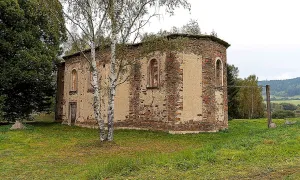
Photos from the area
Real photos taken near the monument


Zdroj a licence jsou uvedeny u každého snímku.
Tips from visitors
No tips yet. Be the first!
Log in and add your tip.
Sources and literature
Photos: Lubor Ferenc / CC BY-SA 4.0, rozlišení zvýšeno umělou inteligencí — Wikimedia Commons. The author and licence also appear when you hover over the image.
Faktickým podkladem tohoto textu byl článek na Wikipedii, jehož autory jsou přispěvatelé Wikipedie. Článek je dostupný pod licencí CC BY-SA 4.0.
Location on the map
Příběhy a pověsti
Legendy, pověsti a příběhy spjaté s touto památkou
Fotografie návštěvníků
Zatím žádné fotografie. Buďte první, kdo přidá fotografii z návštěvy!
Log in a přidejte svou fotografii nebo hodnoťte.
Za ověřenou návštěvu v aplikaci získáte víc bodů — poznáme podle GPS, že jste na místě.
Reviews and comments