



Kostel svatého Havla (Radouň) Church
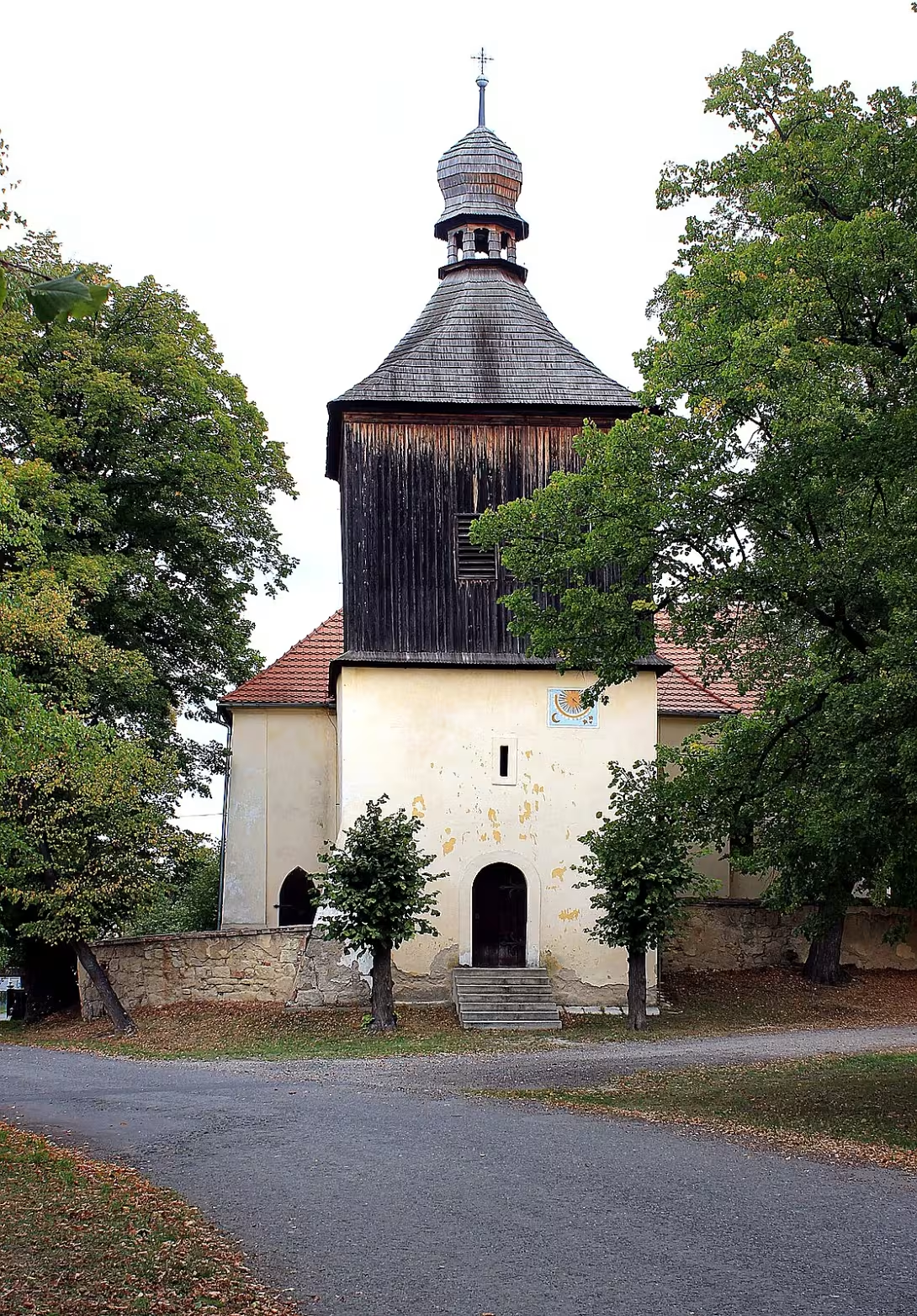
St. Havel's Church is a Gothic sacral building built on a village in the centre of Radouni. Thanks to its facade and especially the powerful prism tower on the south side, which is completed by wooden superstructure, the construction in the landscape is completely unmistakable. Since 1966, it has been protected as a cultural monument.
The church was founded a year ago 1260, which ranks among the older buildings in Bohemia. Although it underwent a major reconstruction in the 16th century, it managed to preserve its original Gothic character. For a long time he served as a parish church, at least until 1640. The interesting fact is that until the 30-year war, even non-Catholics prayed here. In 1939, an archaeological survey was carried out in the church, in which the remains of the masters of Harasov were found, which were then newly and formally stored. The general repair of the church, which was passed between 1998 and 2000, prepared it for a new millennium.
The construction has a clearly structured plan: a central longitudinal ship with a triangular presbytery on one side and a rectangular sacristy on the north side. The presbytery is supplemented with massive backrest and opens with thick windows typical of goth. Especially interesting is the small circular window in the northeast wall of the presbytery, which gives the construction a detailed variety. The presbytery is glazed with a gothic cross arch with ribs of a semi-circular profile. On the contrary, the ship and the sacristy kept a simple flat ceiling. The tower that enters the church is a glass-plated crest vault. The crust rests on three pillar arcades. The entrance portal is broken, with flat profiling.
The richness of the church also manifests itself in its inner facilities. The main altar dates back to the second half of the seventeenth century, and with its portal shape and Boltz ornament radiates baroque majesty. It carries a picture of St. Havel from 1836 by A. Bayer. The side altar dedicated to St. Philomena is partly older - it dates back to around 1600 - and was later modified in rococo style. A small-leaf acanth site falls into the late seventeenth century. Among the oldest elements of the church can probably count the grave board with date 1399.
In the cemetery surrounding the church stands a small six-sided morgue of baroque style, which complements the character of the place. Today he manages the philistine church of the Roman Catholic parish Řepin, whose pages provide information about his spiritual administrators.
Then and now
Drag the slider to compare how the landmark may have looked when it was built with the view today.
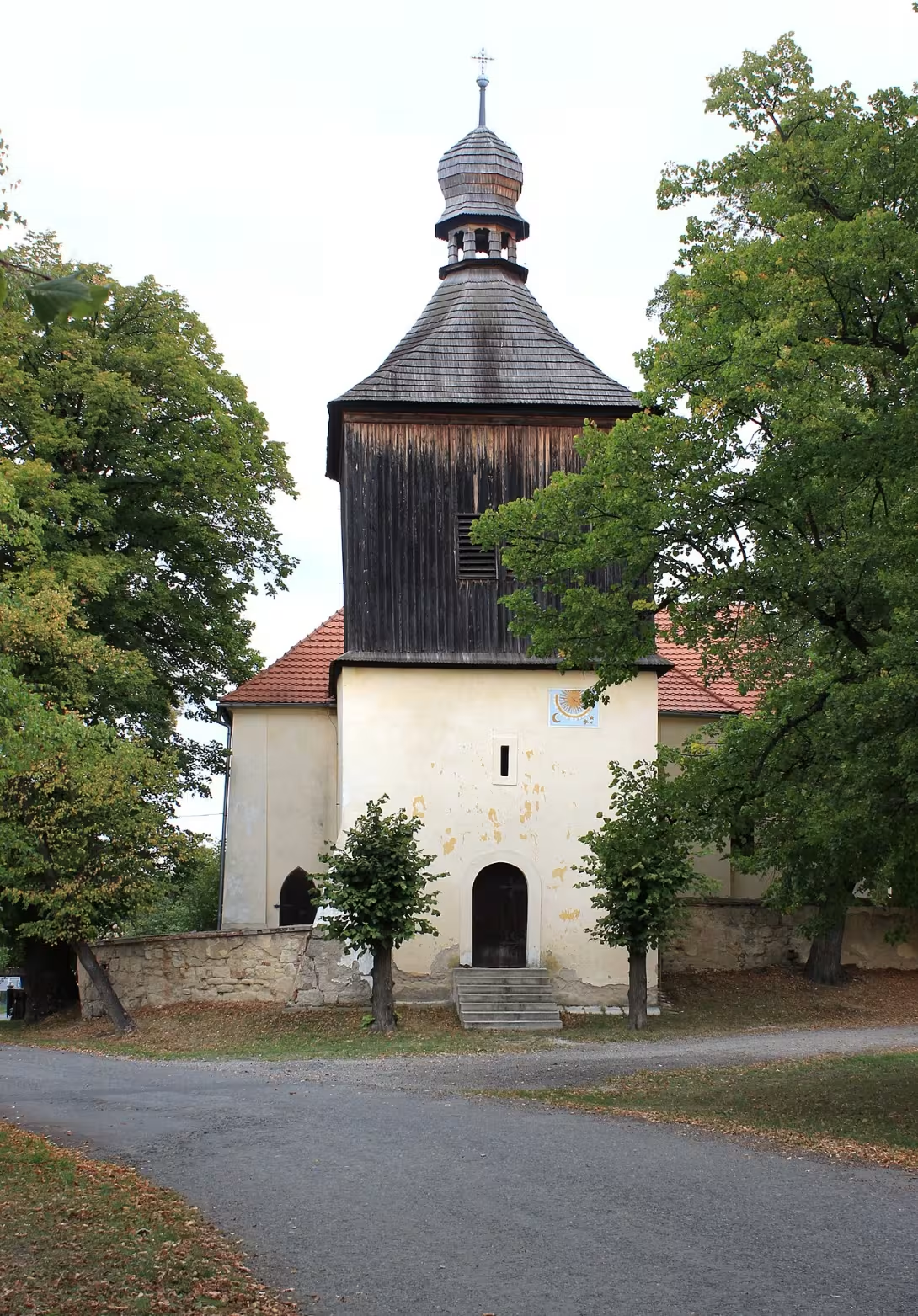
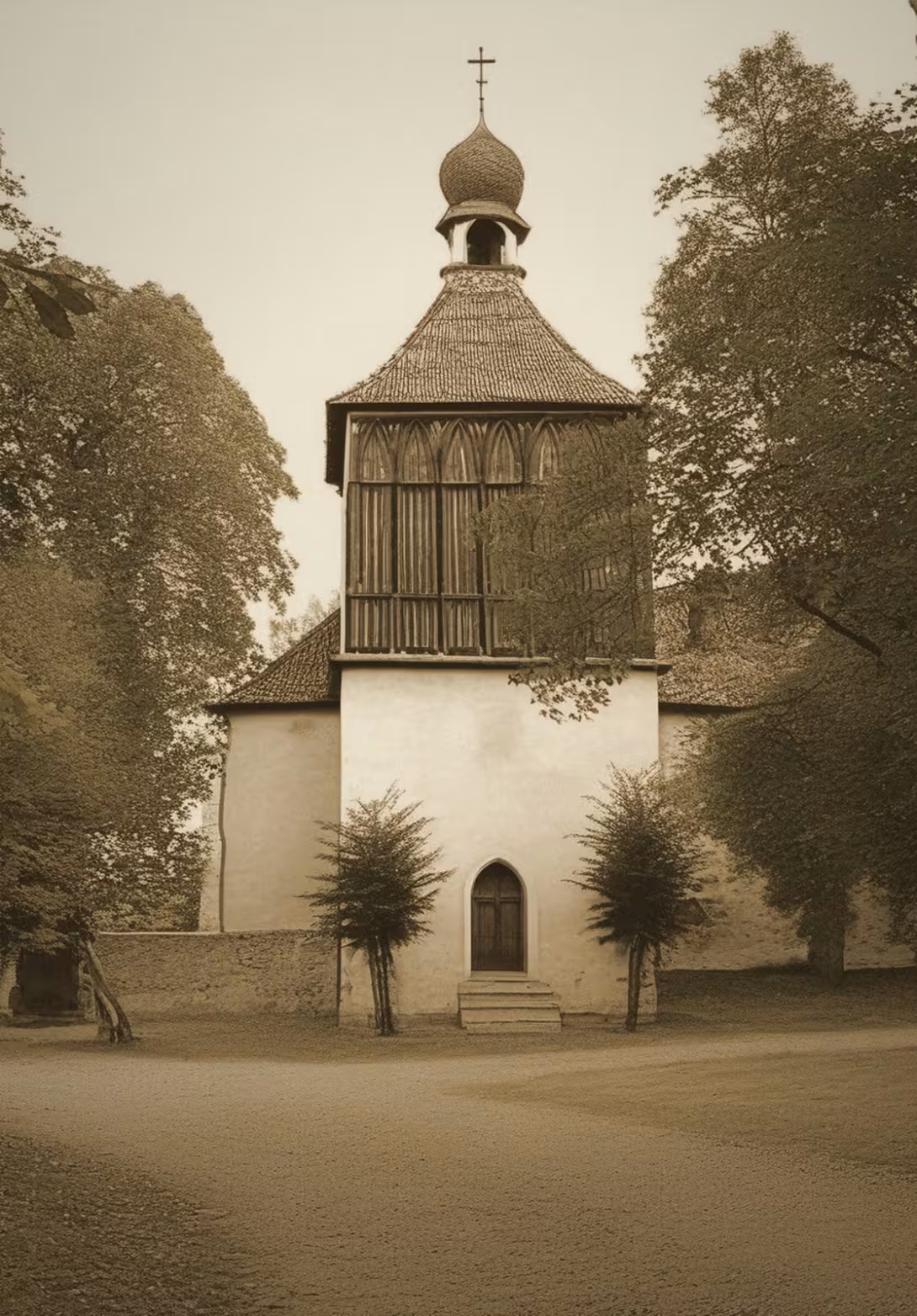
The historical appearance on the left is an AI-generated visualisation and serves as inspiration only.
Historical milestones
- before 1260
- Establishing St. Havel's Church as a parish church
- 1640
- Church stops being parochial and becomes filial
- 1939
- Archaeological survey, found and newly stored remains of the masters of Harasov
- 1966
- The church is declared a cultural monument
- 1998-2000
- General repair of the church
Architectural development
The original Gothic building from the 13th century has a single boat with polygonal presbytery and rectangular sacristy. A tower with a formatted floor and tent roof with lantern is a typical element of late Gothic sacral architecture. In the 16th century the church underwent reconstruction, which preserved Gothic elements, but added baroque elements in the interior such as altars and pulpit. The ship and the sacristy have a flat ceiling, while the presbytery is glassed by a cross vault with ribs of a semi-circular profile.
Historical events
The church was founded before 1260 and served as a parish until 1640. In 1939, an archaeological survey was carried out, where the remains of the masters of Harasova were found and newly stored. General repair of the church took place in the years 1998- 2000.
Points of interest
- The Church of St. Havel is one of the oldest sacral buildings in the territory of Bohemia, since it was established already a year ago 1260.
Until the Thirty Years' War, non-Catholics were praying next to Catholics.
- In 1939, the remains of the masters of Harasov were found and newly stored in an archaeological survey.
The church underwent a general repair between 1998 and 2000.
- The oldest preserved part of the church is a tombstone dated 1399.
Guide
This guide is narrated by a synthetic voice generated by artificial intelligence.
Show guide text
This text was created by artificial intelligence and has not been editorially reviewed. It may contain inaccuracies.
The Church of Saint Havel in Radouni is a Gothic structure that stands in the town square in the middle of the village. It is a Roman Catholic cemetery and subsidiary church. You can easily recognize it by its tower with a wooden superstructure. Since 1966 it has been protected as a cultural monument.
The church was founded already before 1260. In the sixteenth century it underwent reconstruction, but it retained its Gothic character. Until 1640 it served as a parish church. Until the Thirty Years' War it served non-Catholics. In 1939 an archaeological survey was carried out there. During it, the remains of the Lords of Harasov were found, which were then newly laid to rest. A general renovation of the church took place between 1998 and 2000.
The building has a longitudinal nave and a three-sided presbytery. On its northern side is a rectangular sacristy. On the southern side stands a massive prismatic tower, which is topped by precisely that wooden superstructure. The presbytery is supported on the outside by buttresses. The presbytery and nave have pointed windows, that is windows ending in a broken arch. In the northeastern wall of the presbytery's end there is also a small round window.
Inside, the presbytery is vaulted with a ribbed vault. Its ribs have a semicircular profile. The nave and sacristy have flat ceilings. The space under the tower is covered by a ribbed vault with a herringbone pattern. The gallery rests on three pillar arcades. Entry to the church is from the vestibule through a broken, flatly profiled portal.
The main altar is a portal altar and dates from the second half of the 17th century. It is decorated with bolt ornament. It has a painting of Saint Havel from 1836, painted by the painter Bayer. The side altar is dedicated to Saint Philomena. It partly dates from around 1600 and bears stubbed ornament. It was later modified in Rococo style and received a Rococo painting of this saint. The pulpit decorated with fine-leaved acanthus is from the end of the 17th century. In the church there is also a tombstone on which there is apparently a date of 1399.
The church is surrounded by a cemetery. A small hexagonal Baroque mortuary stands on it.
Frequently asked questions
Can the monument be visited?
Religious buildings are usually open mainly during services; at other times a visit is normally arranged with the parish or the operator. We have not verified specific times.
Where is the monument?
Location: Radouň, Středočeský kraj. The map on this page shows the exact spot.
Why is the monument protected?
It is listed in the Central List of Cultural Monuments of the Czech Republic as a cultural monument (register no. 47204/2-1438).
For kids
Imagine going back to the past, when the Czech countries were full of medieval chateaux and churches. And it is the church of St. Havel that stands in the village of Radouň.
How did it look here? Who lived here? What happened here? Imagine you're a little knight with a sword and shield who came to Radouna for a pilgrimage. You should spend the night at the church and have to go to the next town in the morning. Who knows what happened that night? Maybe someone secretly gave you directions, or someone showed you a secret stairwell.
Businesses nearby
Do you run a restaurant, accommodation, shop, museum, rental, wellness or other visitor service near this monument? Show yourself directly to the people heading to it — this is how they will see you in the app and on the web:
Nearby
The church is surrounded by a cemetery with a Baroque morgue and a terrace wall. In the vicinity (up to 5 km) is located the village of Řepin, where is the Roman Catholic parish to which the church in Radouni belongs. The natural landscape is typical for Central Bohemia with field eels and forest trees.
Accommodation nearby
Themed route
Thematic cruise route: Baroque and sacral monuments around St. Havel's Church
1.Kostel svatého Havla (Radouň) Main destination of the route, Gothic-Baroque church from the 14th century with later modifications. The interior preserved valuable Baroque decorations, organ and historical tombstones. The facade and surrounding area of the church offers a quiet environment for walking.
2. The cemetery at St. Havel's church An ancient cemetery with a Baroque morgue and a terrace wall, typical of the sacral architecture of the 18th century. The mortuary served as a protection against weather effects and is still well preserved. The surrounding tombstones reveal the history of local families.
3. Roman Catholic parish in Řepin The parish church in the neighbouring village of Řepin (approximately 3 km from Radouna) is the centre of the spiritual life of the region. The parish office offers information on the history of St. Havel's church and its relationship to the Greek parish, including archive documents.
* The route is focused exclusively on the specified locations in the surroundings and respects their interconnections. *
Seasonal recommendations
Spring In spring, St. Havel's church in Radouni awakens to life in a breathtaking contrast between the silver flowers of spring trees and the dark walls of stone buildings. The light of the sun, which is reflected from wet grass and young leaves, creates on the facade of the church a game of shadows that gives the monument a mysterious atmosphere. The air is saturated with the fragrance of blossoming apples and freshly chopped grass, while birds sing in the surroundings. The ideal time for a visit is early May, when nature flourishes, but the crowds are even less than in the summer months. It is recommended to dress suitable for variable weather - light jackets, sunglasses and comfortable shoes for possible rain. The best is to visit the church early in the morning when light falls into the interior through the stained glass and creates magical effects.
Summer In the summer months, Radouň will turn into a live scenery where St. Havel's Church stands as a peaceful escape from heat and excitement. The sun illuminates its facade at noon, while in the shade of trees and the interior there is pleasant cooling. The surrounding area is green and full of life - meadows bloom, bees buzz and the air is light. In the main summer season, however, more attendance is needed, especially on weekends. It is recommended to arrive early in the morning or late in the afternoon to avoid crowds. Clothes should be easy, but with the possibility of covering the shoulders when entering the church. Take water and sun protection to visit, as the shade around the monument is not always sufficient.
Autumn Autumn brings golden colors to Radouna and a calm atmosphere where St. Havel's Church looks like a fairy tale. The sun, which boils down to the horizon, paints its towers into copper and orange tones, while the interior reflects from the warm colors of the stained glass. The forests around the village turn into a sea of red and yellow leaves that roar at every wind. At this time, the visit is quieter, but the weather is usually volatile - rainy days change in sunny days. It's recommended warmer clothes than you might think, and waterproof shoes. The best time is the afternoon when the light is softer and the church radiates a special nostalgic beauty. In Advent time, the visit can be supplemented by Christmas decorations that add to the holiday atmosphere.
Winter Winter Radouň is a fairy-tale view - St. Havel's church rises between snow and ice, its towers are lost in fog or reflected in frozen sludges. The sun, which is very short in winter, creates silver glitter on the stones of the church, while the interior is warm and calm. The surroundings are quiet, nature is resting and the air is clear. It is recommended that warm but comfortable clothes - thermal layers, gloves and caps, so that the visit is not unnecessarily strenuous. The best time is the afternoon when the light is reflected from snow and the church looks like an adventure book. In winter there is also an ideal time for photography, when the landscape is the most beautiful.
Visualizations and artistic views


The visualisations are generated by artificial intelligence and serve as inspiration.
Photos from the area
Real photos taken near the monument


Zdroj a licence jsou uvedeny u každého snímku.
Atmosphere of the place
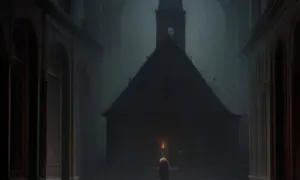
This atmospheric visualisation of the place and period was generated by artificial intelligence. It is not real footage of the location.
Tips from visitors
No tips yet. Be the first!
Log in and add your tip.
Sources and literature
Photos: This file is available under Creative Commons BY-SA license. Basically: You can use this picture for any purpose, provid / CC BY-SA 4.0 — Wikimedia Commons. The author and licence also appear when you hover over the image.
Faktickým podkladem tohoto textu byl článek na Wikipedii, jehož autory jsou přispěvatelé Wikipedie. Článek je dostupný pod licencí CC BY-SA 4.0.
Location on the map





Příběhy a pověsti
Legendy, pověsti a příběhy spjaté s touto památkou
Fotografie návštěvníků
Zatím žádné fotografie. Buďte první, kdo přidá fotografii z návštěvy!
Log in a přidejte svou fotografii nebo hodnoťte.
Za ověřenou návštěvu v aplikaci získáte víc bodů — poznáme podle GPS, že jste na místě.
Reviews and comments