



Kostel svatého Martina (Markvartice) Church
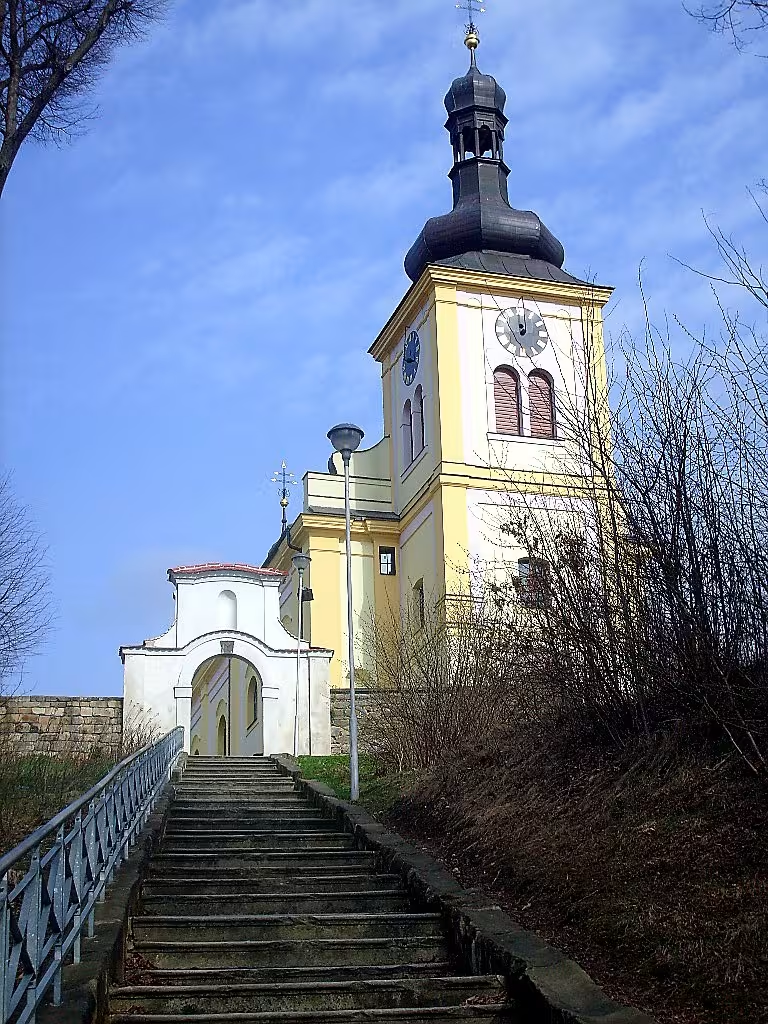
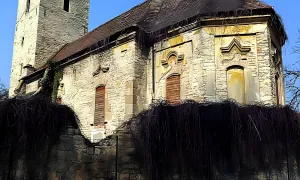
On the platform between Markvarticemi and Veselý there is a church dedicated to St. Martin, protected as a cultural monument of the Czech Republic. For the fourteenth century, it has been marked by a reference in writing, but the original appearance and dimensions remain unknown.
Today's appearance is the work of Baroque reconstruction, which they carried out between 1701 and 1703 according to the design by P. Versa. The most stable support for the construction was provided by the Archbishop of Salzburg, Jan Ernest Thun-Hohenstein, who also ordained it in 1704. The church served for worship until 1966.
In the decades to come, there was a gradual break-up. A rich inventory - paintings, altars, equipment - was taken after 1960 to areas around Nitra without any closer recording. The rest of the furniture and equipment ended up in the debris pit. The cliffs collapsed, the roof disappeared, a circle surrounding the ship from three sides dissolved in debris. Local communist leadership tried several times to demolize: in 1989 the church was to disappear from the map. The velvet revolution protected the construction - the demolition area remained without consequences.
A completely abandoned building with bare perimeter walls was waiting for rescue. In 2003, it eventually joined. The gradual restoration lasted 14 years: wall strengthening, roof construction of the tower (2006), roofing of the church itself. The Ministry of Culture of the Czech Republic, the municipality of Markvartice, Moravian and Czech parishes, the Czech-German fund of the future and the German bishopric and archbishop shared the financial burden. Local volunteers also supported the work. An additional CZK 5,275 million (1998-2014) was invested under the Architectural Heritage Programme.
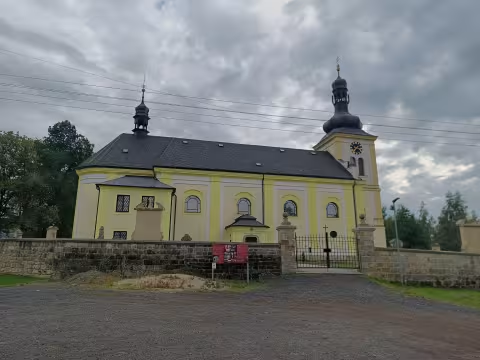
The church is a one-ship building with a rectangular presbytery ended with rounded corners. To the north side lies the storey annex of sacristy and oratory. The tower with onion fighting, pilasters and Lizzy frames grows before the west front. It is supplemented by volutous wing walls and needles. In the north corner of the tower is a Baroque statue of the guardian angel. The side facades are decorated by pilasters and elevated semi-circular windows. The hall has bevelled corners and a Mansard roof.
The interior, before it was destroyed, praised the presbyterium with a vaulted vault and a long ship covered by a compressed vaults. It was covered by stucco triangles. In stucco frames, frescoes from the nineteenth century were spread out, representing the Assumption of the Virgin Mary, Sacrifice in the temple and Mary's return to Jerusalem. Five belts were assembled for pilasters with washers. The original three-arm circle consisted of stone pillars with windows.
The reconstruction was formally completed in September 2017. On 23 September he consecrated the renewed construction of the Salzburg Emeritus Archbishop Mons. Alois Kothgassner in the presence of the lithomeric bishop Jan Baxter and dozens of Czech and German priests. After more than 50 years of disintegration and horrors in the second half of the twentieth century, the church serves the faithful again - and all who are interested in the story of Czech independence.
Then and now
Drag the slider to compare how the landmark may have looked when it was built with the view today.
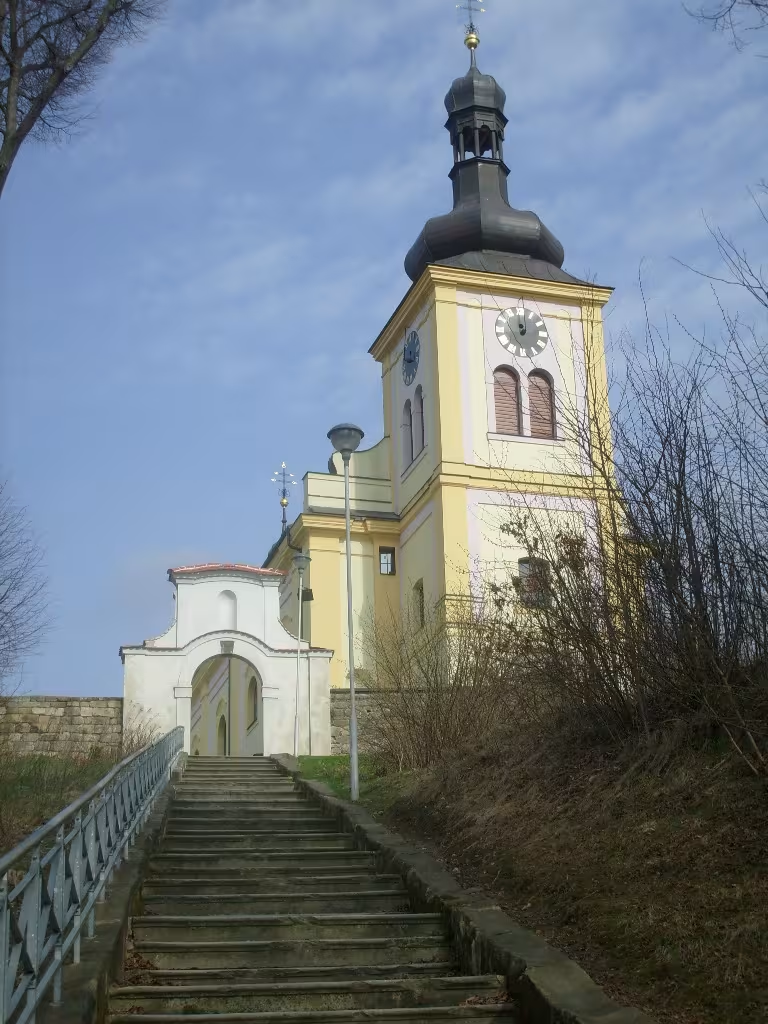
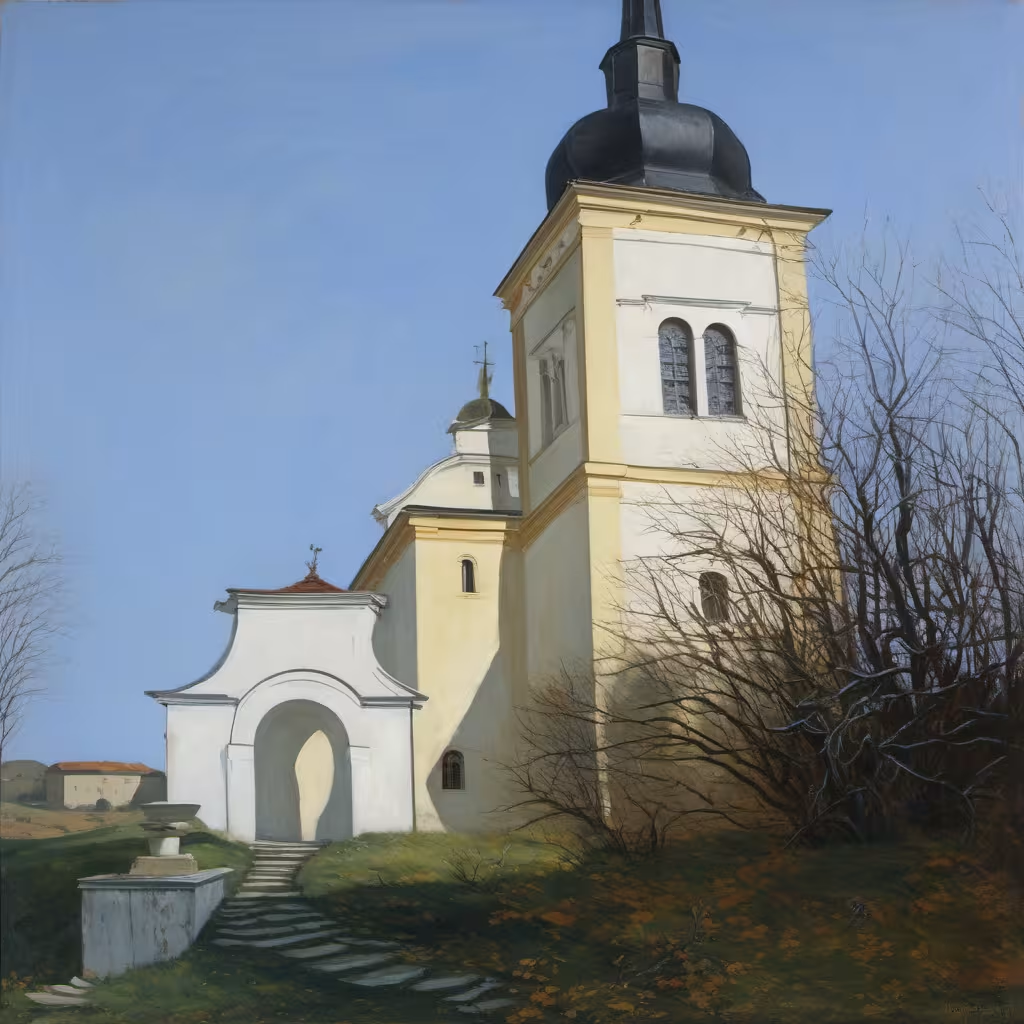
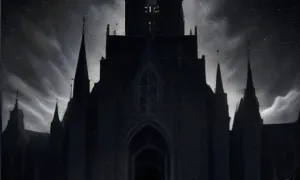
The historical appearance on the left is an AI-generated visualisation and serves as inspiration only.
Historical milestones
- 14th Century
- The first written mention of the church in Marquartice, but the original appearance and size are unknown.
- 1701-1703
- Construction of the present Baroque church according to the design of architect P. Versa.
- 1704
- The consecration of the Church of Salzburg by Archbishop Jan Ernst Thun-Hohenstein.
- 1966
- End of religious use of the church, followed by devastation and destruction of the interior.
- 2003-2017
- Difficult reconstruction of the church, including restoration of the roof and interior.
- 2017
- The ceremonial reconsecration of the church after reconstruction.
Architectural development
The church was built as a one-ship building with presbytery and sacristy in Baroque style. The interior was dominated by a rolled vault with lunettes and stucco decoration, including 19th century frescoes. After the devastation, the original layout was reconstructed, including the restoration of the vault and facade decoration. The materials include Lizard Frames, Pilasters and an onion pit tower.
Historical events
The consecration of the church in 1704 by the Archbishop of Salzburg, John Ernst Thun-Hohenstein.
Destruction of the interior and destruction of the building after 1960, including removal of equipment to the vicinity of Nitra.
The basic repairs and reconstruction of the roof took place in 2003- 2006, the overall reconstruction was completed in 2017.
The ceremonial reconsecration of the church on 23 September 2017 by the Archbishop of Salzburg Mons. Alois Kothgasser.
Owners
Farnost Markvartice, municipality Markvartice
Points of interest
- St. Martin's Church in Markvartice has been mentioned in the papers since the 14th century, but the original appearance and dimensions remain unknown.
- The Baroque reconstruction of the church took place between 1701 and 1703 according to the design by P. Versa, the Archbishop of Salzburg Jan Ernest Thun-Hohenstein in 1704.
- The church served for worship until 1966, followed by its gradual disintegration and taking a rich inventory to the area around Nitra without any detailed record.
- In 1989, the church was planned for demolition, but the Velvet Revolution thwarted this intention and the building was saved from extinction.
- The reconstruction of the church lasted 14 years (2003- 2017) and was financed by cooperation between the state, municipalities, church institutions and volunteers.
Guide
This guide is narrated by a synthetic voice generated by artificial intelligence.
Show guide text
This text was created by artificial intelligence and has not been editorially reviewed. It may contain inaccuracies.
The Church of Saint Martin is a Baroque structure on a hillside on the border between the northern part of Markvartice and Veselý. It is protected as a cultural monument.
The Church in Markvartice is mentioned as early as the fourteenth century. How large it was then and what it looked like, we do not know. The present Baroque structure was built between 1701 and 1703 according to a design by Versa. In 1704 it was consecrated by the Salzburg Archbishop Jan Ernst Thun-Hohenstein, who was also the church's greatest donor.
The church served for religious services until 1966. Its rich interior furnishings were removed sometime after 1960 to the area around Nitra, and the rest was destroyed. Then came complete devastation. The roof and ceiling of the nave collapsed, followed by the gallery that surrounded the nave on three sides. Local representatives of the communist regime attempted to demolish the church several times, the last time in 1989. However, the issued demolition order was never carried out because the Velvet Revolution came.
Only the perimeter walls without a roof remained of the church. Restoration began only in 2003. The walls were gradually reinforced, the bell tower received its roof in 2006, and then the church itself. The work cost nearly twenty-one million crowns. The Ministry of Culture, the municipality of Markvartice, Moravian and Czech parishes, the Czech-German Future Fund, as well as German dioceses and archdioceses contributed. Numerous volunteers also helped. The reconstruction was completed in 2017, and on September twenty-third, 2017, the church was consecrated again by Salzburg's emeritus Archbishop Alois Kothgasser. The Mass was also attended by the Bishop of Litoměřice Jan Baxant.
The church is single-aisled and rectangular. It is followed by a narrower presbytery with rounded eastern corners. On the north side adjoins a two-story extension with a sacristy and oratory, and on the north side of the nave is a vestibule. The centre of the western facade is formed by a prismatic bell tower with an onion dome. On its sides are niches, and in the northern one stands a Baroque statue of a guardian angel. Above the cornice on both sides of the tower, curved wings project out, ending in spires.
Inside, the presbytery has a barrel vault with lunettes. The nave, until its devastation, was vaulted with a compressed barrel vault. In stucco frames on it were nineteenth-century frescoes depicting the Assumption of the Virgin Mary, the Presentation in the Temple, Mary's Journey to the Temple, and an angel with the inscription Gloria. On the walls between pilasters are blind arcades forming shallow niches, and in them are elevated semi-circular windows.
Tips for visitors
The best time to visit St. Martin's church is in the morning or autumn when the surrounding nature is rich in color and traffic is lower. In summer it is advisable to avoid the noon hours when the interior can be hot and the presence of a large number of tourists. The church is ideal for a quiet walk and meditation, so it is advisable to choose the time when you will have room for yourself.
If you arrive by public transport, the stops are in the nearby area, but the current connection should be checked in the traffic search engine. The stops are usually a few minutes' walk from the church.
Take comfortable shoes when visiting, because the church stands on the top and the way to it is slightly steep. It is often cold in the interior, so bring a light sweater or coat. If you are planning to take pictures, do not forget the mobile charger because there is not always enough signal coverage on the top.
The best places for photography are the entrance part of the church and surrounding area, where there is plenty of light and pleasant view of the surrounding landscape. It is recommended to photograph in the morning or afternoon light when the light is softer and creates pleasant shadows. In the interior it is advisable to avoid lightning to damage historical elements.
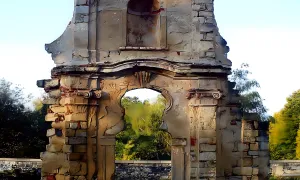
In the vicinity of St. Martin's church is worth visiting the Chapel of the Holy Cross, located south of the church. This ruin is an interesting historical monument and offers an additional view of the rich history of the region. For families with children, it is also advisable to visit the hill on the border of Markvartic and Veselý, where children can explore nature and observe the surrounding landscape.
For families with children, a visit to St. Martin's Church is a great opportunity to learn about history and architecture. Children can see the interior of the church and see what the Baroque sacral structure looked like. It is also possible to play and explore nature on the top, which will definitely impress children. It is recommended to bring with you some small toys or laptops so that children have something to do during the visit.
Frequently asked questions
Can the monument be visited?
Religious buildings are usually open mainly during services; at other times a visit is normally arranged with the parish or the operator. We have not verified specific times.
Where is the monument?
Location: Markvartice, Ústecký kraj. The map on this page shows the exact spot.
Why is the monument protected?
It is listed in the Central List of Cultural Monuments of the Czech Republic as a cultural monument (register no. 33530/5-3836).
For kids
Imagine going back to a time when the walls of the village of Marquartice stood as protection from dangerous robbers and wild animals. It was a time when people lived in small houses of clay and leather, and their life was full of work and struggle for survival.
How did it look here? Who lived here? What happened here?
Businesses nearby
Do you run a restaurant, accommodation, shop, museum, rental, wellness or other visitor service near this monument? Show yourself directly to the people heading to it — this is how they will see you in the app and on the web:
Events nearby
Zdroj akcí: otevřená data měst a obcí ČR (Národní katalog otevřených dat) a kalendář akcí Národního památkového ústavu.
Accommodation nearby
Trips and activities nearby
Guided tours, tickets and activities nearby from GetYourGuide
Affiliate link: if you buy from the partner, we may receive a commission. The price for you does not change.
Search tours and activities →Themed route
1. Top on the border of Markarrtic and Veselý Type: Natural view Why to visit: This elevation offers a beautiful view of the surrounding landscape. It's the perfect place to start a trip.
Kostel svatého Martina (Markvartice) Type: Sacral monument Why to visit: The main destination of the trip located on the high rise. It's an important historical object in the village.
3. Chapel of the Holy Cross Type: Ruins Why to visit: Located south of the church in the form of a preserved torza. This ruin represents an interesting clue to the past.
Seasonal recommendations
Spring - In the spring months, St. Martin's church in Markvice awakens to life after winter peace, surrounded by blooming nature. The warm sunlight penetrates the glass stained glass windows and creates a color game on the stone walls, while the surrounding meadows and trees dress up in a green dress. The atmosphere is quiet, almost meditative, especially in the morning, when the church appears to be a hidden treasure between the awakened village. It is a good time to start early in the morning or in the afternoon, avoiding larger groups of tourists who are starting to come home. Comfortable shoes are recommended, because after rainy days the roads to the monument can be muddy. Temperature is between 10- 15 ° C, so a light jacket or sweater is enough.
Summer - In the summer months, the church of St. Martin will turn into a living space full of light and shadows, where the sun shines directly into the interior and paints geometric patterns on the walls. The surrounding area is green and full of life - shrubs and trees in full bloom create a pleasant shadow, while there is a summer quiet surrounding the village with the occasional sound of birds. The best time to visit is early morning, when the church is still cold and calm, or late afternoon, when crowds of tourists disperse. It is recommended light but sun protective clothing and hat, because in the morning it can be very hot in open places.
Autumn - Autumn brings the church of St. Martin's to the Markvice with golden and red shades that are reflected in the windows and create a warm, almost mysterious atmosphere on the stones. Forests and fields around the village dress up in a colorful dress, while cooler air gives the interior of the church special peace. It is a good time in the afternoon when the sun shines oblique and creates long shadows that highlight architectural details. Warmer clothing is recommended - although temperatures can be pleasant, evenings are cold, and first freezers can occur in November. In advent time (since December) the church appears as a pre-Christmas hiding place, but without disturbing crowds that come with Christmas markets.
Winter - Winter Markvice with St. Martin's Church offers a unique atmosphere where the snow cover softens the shapes of the village and the church appears to be carved into white canvas. Sunlight, which penetrates glass windows, creates in the interior a game of light and shadows, while outside there is calm, interrupted only by snowing. The best time to visit is in the afternoon when the church is lit by seaside light and opening times are longer than in winter months. It is recommended to warm but comfortable clothing - layering is proven because temperatures range around 0 ° C and wind days can be unpleasant. In December, after St. Catherine's Day, the church appears to be a hidden shelter from winter cold, ideal for a peaceful tour without rush.
Visualizations and artistic views


The visualisations are generated by artificial intelligence and serve as inspiration.
Atmosphere of the place
This atmospheric visualisation of the place and period was generated by artificial intelligence. It is not real footage of the location.
Tips from visitors
No tips yet. Be the first!
Log in and add your tip.
Sources and literature
Photos: Beach.boy.22 / CC BY-SA 4.0 — Wikimedia Commons. The author and licence also appear when you hover over the image.
Faktickým podkladem tohoto textu byl článek na Wikipedii, jehož autory jsou přispěvatelé Wikipedie. Článek je dostupný pod licencí CC BY-SA 4.0.
Location on the map
Příběhy a pověsti
Legendy, pověsti a příběhy spjaté s touto památkou
Za ověřenou návštěvu v aplikaci získáte víc bodů — poznáme podle GPS, že jste na místě.
Reviews and comments