



Kostel svatého Mikuláše ve Vacově Church
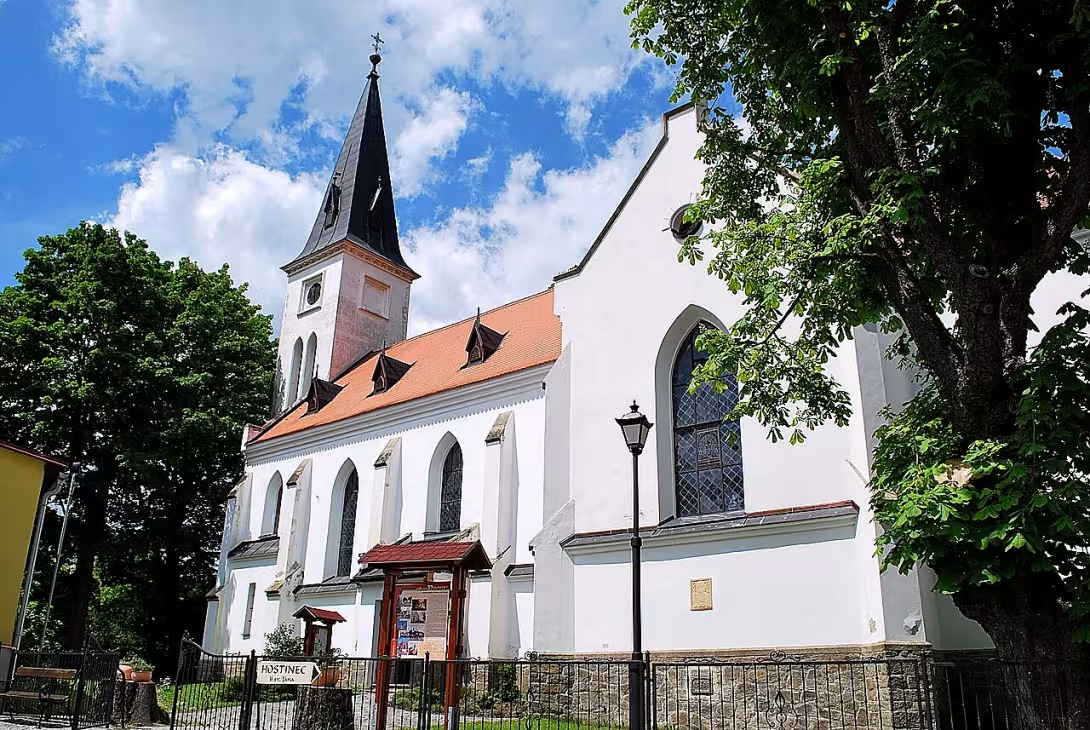
The Pseudogothic Church of St. Nicholas is the parish temple of the Vacation parish and one of the dominant villages in Prachatick. Built in 1888-1890 on the site of an older church, which in 1885 decided to tear down the village because it no longer met its needs.
The history of this place is long. Already in 1193, the hermit chapel was mentioned in writing. The wooden church was allegedly established in its place in 1230. During the Hussite wars, in 1421 it was burned and demolished. After the year 1588, when the Vacov was acquired by Koces from Dobrše, there was already a stone church of St. Lawrence. It burned down in 1757 and its repairs lasted 30 years. The patronage of the original church has been held alternately by various noble knights for centuries. In 1706, she received the construction of a new organ from the Highlands organist Václav Turnovsky; These were exchanged by an unknown organist in 1861 for 510 gold pieces.
The new church was designed by architects Jan Sedláček, J. Tille and J. Štěrbák. The foundation stone was laid on June 19, 1888. The building was supported by a prince from Schwarzenberg whose coat of arms decorate the church's circle. The church was consecrated on 10th August 1890 by Czech-Budějovice biskup Martin Josef Říha.
The church has a cross plan with a tripod in a longitudinal boat, a transverse boat and a presbytery with a triangular conclusion. The presbytery separates a significant victory arch from the ship. The tower extends to the west; the church is surrounded by a former cemetery.
The original medieval temple preserved two bells from Briktek of Cimperk from 1568 and 1588, which are still used today. Several tombstones from 1583, 1785, 1825 and 1856 were built into walls during the construction.
The interior is equipped with pseudogotic style. The main altar of St. Nicholas is decorated with an image of this saint from the middle of the nineteenth century. The altars are dedicated to St. John of Nepomuk and Virgin Mary. Believers have made the statues of St. Martin and St. Lawrence from the original temple appear on the main altar. The new church received an organ from organist Henry Schiffner of Prackov with eight registers and mechanical traction. In 1929, the organist Čeněk Skopek from Tábor completed them for 2800 crowns Czechoslovak. The altar painting of St. John Nepomuk by the painter Antonín Lhota dates back to 1899. In the twentieth century the interior was dealt with by the painter Alois Martan - he painted the presbytery as a thesis and after the Velvet Revolution added the Mosaic of Christ Pantocrator. In the years 2018- 2020, the church was replaced with windows and installed stained glass with the display of Czech earth patrons.
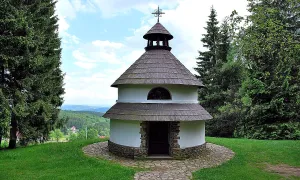
East of the church stands the Baroque tightrope chapel of St. John Nepomuk from the eighteenth century. The area is surrounded by fenced walls from the north, metal fences from the remaining sides. The bell Joseph was in 1889 by Petr Hilzer. Other bells were recited gradually during world wars. Traditionally, around the holiday of St. Lawrence (10 August), the so-called Vavřinec pilgrimage is held, which is considered "a small pilgrimage" and which they attach more importance to than the "great" pilgrimage to St. Nicholas.
Then and now
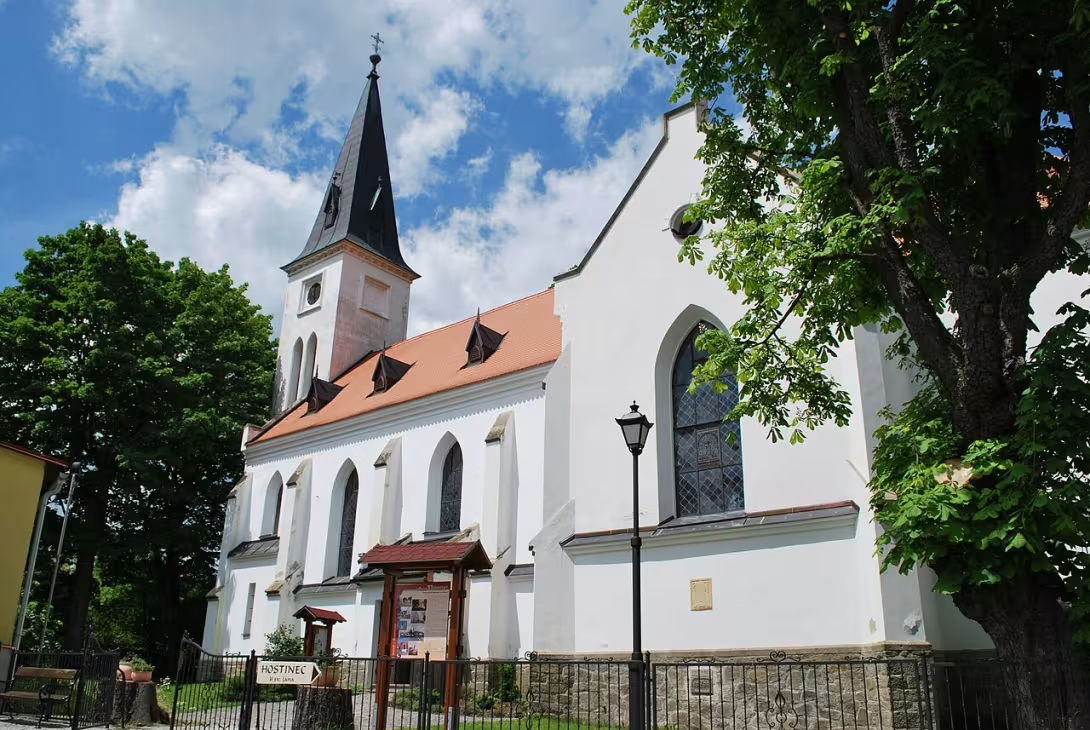
Drag the slider to compare how the landmark may have looked when it was built with the view today.
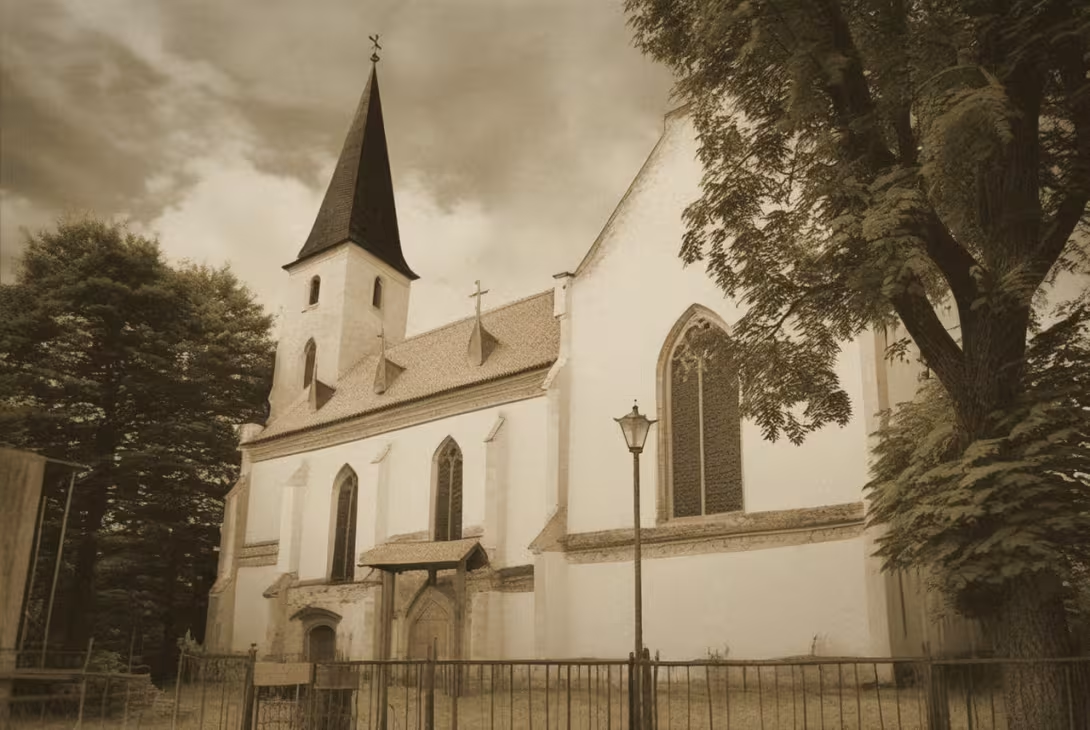
The historical appearance on the left is an AI-generated visualisation and serves as inspiration only.
Historical milestones
- 1193
- The first written mention of the hermit chapel at the site of the present church.
- 1230
- The position of the wooden church (allegedly on the site of the chapel).
- 1421
- The destruction of the church during the Hussite Wars.
- 1588
- The position of the stone church of St. Lawrence after obtaining the village of Kocova from Dobrše.
- 1757
- The great fire of St. Lawrence's Church, the subsequent repair took 30 years.
- 1888
- Opening of the building of the present church of St. Nicholas; laying of the base stone on June 19.
- 1890
- The ordination of the church on August 10th (St. Vincent's Day).
Architectural development
A Romanesque building with a semi-circular apsid and a tower on the west corner stood at the site of the present church since the 12th century. After the demolition of the original stone church in 1885, a pseudo-gothic church was built with a cross plan, a triple boat and a polygonal presbytery. Two bells (1568, 1588) and tombstones were preserved from the original Romanesque building. The interior was supplemented by organami by Henry Schiffner (1890) and later by paintings by Alois Martan (20th century).
Historical events
- 1193
- The first written mention of the hermit chapel at the site of the present church.
- 1421
- Hussite wars - wooden church burned and destroyed.
- 1885
- The demolition of the original stone church of St. Lawrence for a bad condition.
- 1890
- The consecration of the new church of St. Nicholas by the Czech-Budějovice Bishop Martin Joseph Říhou.
Owners
The sequence of owners with years if available, otherwise zero.
Points of interest
- The church of St. Nicholas was built in 1888-1890 in the place of the elder temple which the village decided to destroy in 1885.
- In the place of the present church there was a hermit chapel in 1193, later a wooden church from 1230.
- The original medieval church preserved two bells from 1568 and 1588, which are still used today.
- The interior was built into tombstones from 1583, 1785, 1825 and 1856.
- East of the church stands the Baroque chapel of St. John Nepomuk from the eighteenth century.
Guide
This guide is narrated by a synthetic voice generated by artificial intelligence.
Show guide text
This text was created by artificial intelligence and has not been editorially reviewed. It may contain inaccuracies.
The Church of Saint Nicholas is the parish church of the Vacov parish. It stands north of the town centre and forms its landmark. Today's pseudo-gothic building was erected between 1888 and 1890, though the site itself has a much longer history.
A written record from 1193 mentions a hermit's chapel there. A wooden church was allegedly built on its site in 1230, which was burned and destroyed during the Hussite Wars in 1421. After 1588, when Vacov was acquired by the Kocs family from Dobrše, a stone church of Saint Lawrence is documented. It had a semicircular apse, a tower at the western corner, and an extensive gallery. In 1757 it burned down and its repair took thirty years. In 1885 it was demolished as unsuitable. According to Alžběta Birnbaumová, this was a mistake that deprived the town of a historical monument.
The foundation stone of the new church bears the date of 19 June 1888. The building was designed by architect Jan Sedláček together with architects Till and Štěrbák. The patron of the construction was the Prince from Schwarzenberg and the Schwarzenberg coat of arms still adorns the gallery today. The church was consecrated on 10 August 1890, on the feast of Saint Lawrence, by the Bishop of České Budějovice Martin Josef Říha.
The church has a cruciform floor plan. It consists of a three-aisled nave with a transept and a presbytery with a tripartite closure, which is separated from the nave by a striking triumphal arch. On the western side stands the tower and around the church extends the former cemetery. Two bells by Brikcius from Cimperek from 1568 and 1588 were preserved from the old church. Several tombstones were also retained and built into the walls during construction.
The church furnishings are pseudo-gothic. On the main altar of Saint Nicholas is a painting of the saint from the mid-19th century. The side altars are, at the behest of the nobility, dedicated to Saint John of Nepomuk and the Virgin Mary. However, the locals managed to have the main altar supplemented with statues of Saint Martin and Saint Lawrence. These were meant to replace the side altars with this dedication that stood in the old church. The organ was built by Jindřich Schiffner from Cvikov.
In the 20th century the interior was decorated by the painter Alois Martan. As his diploma work, he painted the presbytery and after the Velvet Revolution completed the church with a mosaic of Christ Pantocrator. Between 2018 and 2020 the windows were given new stained glass with Czech territorial patrons.
The original patron did not disappear from Vacov customs. The small, so-called Saint Lawrence pilgrimage around 10 August has greater significance in the town than the large pilgrimage to Saint Nicholas.
Tips for visitors
The best time to visit St. Nicholas' church in Vacov is during the morning hours when the sun is sideways and illuminates the facade of the church, or in late afternoon hours when light creates pleasant shadows and emphasizes the detailed decoration of the interior. During the summer months it is advisable to avoid noon hours when the interior can be hot and uncomfortable tours.
It is recommended to use public transport where possible. Check the current connection and stop information in the traffic search engine. The public transport stop is located near the church, direct connection to Vacova is not always regular, so it is better to inform yourself in advance.
When visiting, wear comfortable clothes and shoes as the church and its surroundings offer a tour of the outdoor area. It is often cold in the interior, so bring a light sweater or coat. For a more comfortable tour you can also take a map or tourist guide to help you navigate around.
Photography is allowed in the church, but it is appropriate to ensure that other visitors are respected and do not touch the decoration. The best places for photography are the entrance part of the church with its pseudo-gothic facade and interior with paintings and altar. For quality images is ideal light from window holes in the morning.
In the vicinity of the church is worth a visit to the Baroque niche chapel of St. John Nepomucký, which is located east of the church directly on the premises. Another interesting thing is the Renaissance-Baroque chateau Vacov, located about a kilometre northeast of the church. Both of these objects are easily accessible on foot and offer other historical and cultural experiences.
For families with children, a visit to St. Nicholas' church is interesting thanks to its historical architecture and the opportunity to explore the surrounding nature. In the church area there is also a niche chapel, which can impress children with its small range and specific appearance.
Frequently asked questions
Can the monument be visited?
Religious buildings are usually open mainly during services; at other times a visit is normally arranged with the parish or the operator. We have not verified specific times.
Where is the monument?
Location: Vacov, Jihočeský kraj. The map on this page shows the exact spot.
Why is the monument protected?
It is listed in the Central List of Cultural Monuments of the Czech Republic as a cultural monument (register no. 42265/3-3797).
For kids
Imagine going back to when Vacov became the center of the trade route between Bohemia and Austria. It was an era of adventure, rebellion and beautiful buildings. And it was at this time that St. Nicholas' church stood.
There was a period of the greatest development of the city and the church. The church of St. Nicholas was one of the most important buildings in Vacov. His tower stood high in the sky and was visible from all sides of the city. In its interior were held important services, but also secret meetings and meetings.
Businesses nearby
Do you run a restaurant, accommodation, shop, museum, rental, wellness or other visitor service near this monument? Show yourself directly to the people heading to it — this is how they will see you in the app and on the web:
Events nearby
Zdroj akcí: otevřená data měst a obcí ČR (Národní katalog otevřených dat) a kalendář akcí Národního památkového ústavu.
Accommodation nearby
Themed route
Thematic cruise route: Baroque and natural beauty Vacova
1.Kostel svatého Mikuláše ve Vacově * Type: * Sacral monument, Baroque church from the 18th century. * Why visit? * Unique architecture with rich painting and historical significance for the region. The interior keeps valuable works of art, including altar paintings.
2. Baroque niche chapel of St. John Nepomuk * Type: * Small sacral structure in the church area. * Why visit? * A typical example of Baroque sacral architecture, located right by the church. Ideal for short meditation or photography.
3. Chateau Vacov * Type: * Renaissance-Baroque chateau from the 16th-18th century. * Why visit? * Impressive layout with park and historical interiors. In the past, the seat of noble families now serves cultural purposes.
4. Natural Reserve Black Mountain * Type: * Protected area with beech forests and rock formations. * Why visit? * It provides a peaceful natural background with rich fauna and flora. Suitable for hiking or nature observation.
* The route is designed to link sacral monuments to the region's natural wealth. *
Seasonal recommendations
Spring: In the spring period, St. Nicholas' church in Vacov is gaining immense beauty due to flourishing surrounding gardens and fields that celebrate the arrival of heat. The sunny days revive the colour of flowers and trees, which creates an ideal background for photos of the monument. Visit it in the morning or in the evening, when there is a temperate temperature and fewer visitors to enjoy a quiet atmosphere. It is recommended to wear clothes suitable for mild weather, as morning and evening may be colder.
Summer: In the summer period, St. Nicholas' church is a view of dense green meadows and classical architecture that is perfectly suited for a relaxing moment. In the main summer season the attendance may be higher, so we recommend arriving early in the morning or later in the evening. Secure your sunflower and tie to protect yourself from the strong sun, and always carry a drink for warm days.
Autumn: In the autumn period, the surrounding area of the church grows intense shades of golden and red flowers that create a unique atmosphere. Less visitors allow you to enjoy a peaceful walk around the monument and its surroundings. The temperature is gradually decreasing, so it is advisable to wear warmer clothes and perhaps even a hat or scarf to protect against the wind.
Winter: During winter, the church of St. Nicholas in the Vacov receives a romantic atmosphere, especially if surrounded by a snow blanket. The lighting in the monument can add magic to all visiting experiences. Hot clothing, including fur coat or coat, is essential for a comfortable visit.
Visualizations and artistic views


The visualisations are generated by artificial intelligence and serve as inspiration.
Photos from the area
Real photos taken near the monument


Zdroj a licence jsou uvedeny u každého snímku.
Atmosphere of the place
This atmospheric visualisation of the place and period was generated by artificial intelligence. It is not real footage of the location.
Tips from visitors
No tips yet. Be the first!
Log in and add your tip.
Sources and literature
Photos: Chmee2 / CC BY 3.0 — Wikimedia Commons. The author and licence also appear when you hover over the image.
Faktickým podkladem tohoto textu byl článek na Wikipedii, jehož autory jsou přispěvatelé Wikipedie. Článek je dostupný pod licencí CC BY-SA 4.0.
Location on the map



Příběhy a pověsti
Legendy, pověsti a příběhy spjaté s touto památkou
Fotografie návštěvníků
Zatím žádné fotografie. Buďte první, kdo přidá fotografii z návštěvy!
Log in a přidejte svou fotografii nebo hodnoťte.
Za ověřenou návštěvu v aplikaci získáte víc bodů — poznáme podle GPS, že jste na místě.
Reviews and comments